
20 min 36 sec
My Life as a Quant: Reflections on Physics and Finance
Explore the fascinating intersection of high-level physics and Wall Street finance through the eyes of a pioneer who helped shape the world of quantitative modeling while discovering the limits of scientific logic in human markets.
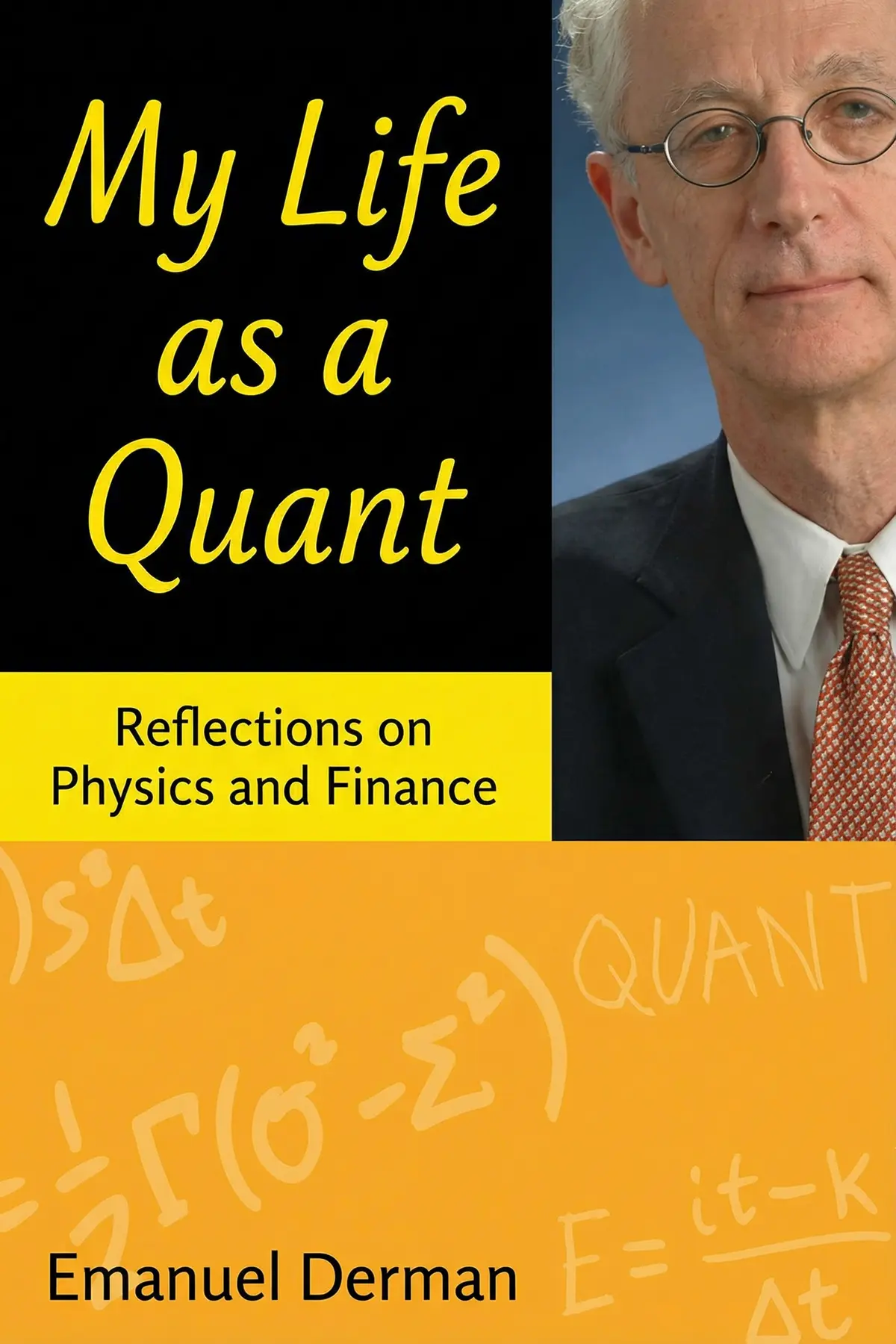
Table of Content
1. Introduction
1 min 33 sec
At first glance, the subatomic world of particle physics and the fast-paced, high-pressure environment of Wall Street seem to have nothing in common. One deals with the fundamental building blocks of the universe, while the other deals with the exchange of capital and the management of risk. However, over the last few decades, these two worlds have collided in a way that has permanently altered the financial landscape. This intersection is the home of the “quant”—the mathematical experts who use the tools of science to navigate the uncertainties of the market.
But this journey is about much more than just the mechanics of finance or the code behind a trading algorithm. It is a deeply personal and philosophical exploration of what it means to try to understand a complex world using tools that are, by their very nature, imperfect. Through the eyes of Emanuel Derman, we get a rare, behind-the-scenes look at the evolution of quantitative finance. We see the ambition that drives scientific discovery and the sobering reality of trying to apply that same rigor to the unpredictable actions of human beings.
As we move through this narrative, we will follow a throughline that connects the pursuit of “truth” in physics to the pursuit of “value” in finance. It’s a story of transformation—not just of a career, but of a perspective. It challenges us to think about the models we use to make sense of our lives and reminds us that while math can be elegant, the world is often much messier than an equation can describe. Let’s begin by stepping into the gritty, intense atmosphere of 1960s New York, where this journey first took flight.
2. The Academic Dream and the Reality of Physics
2 min 34 sec
A young immigrant arrives in New York with dreams of becoming the next Einstein, only to find that the path to scientific glory is paved with loneliness and doubt.
3. The Postdoctoral Purgatory and the Search for Meaning
2 min 32 sec
Life after a PhD reveals a landscape of high pressure and low security, leading to a profound questioning of what it means to truly know the world.
4. A New Language: From Physics to Programming
2 min 33 sec
As the door to academia begins to close, a new passion for computer code provides a bridge to an unexpected future in the corporate world.
5. The Birth of a Model: Bringing Order to the Bond Market
2 min 25 sec
In the chaotic world of finance, a physicist finds a way to apply scientific structure, leading to a groundbreaking new way to value the future.
6. The Culture of Risk and the Salomon Detour
2 min 11 sec
A move to a rival firm reveals the dark side of Wall Street culture and the limitations of modeling when human nature takes over.
7. The Mystery of the Smile and the Limits of Logic
2 min 39 sec
As markets grow more complex, even the most sophisticated quants must confront the reality that some financial mysteries cannot be fully solved by math alone.
8. Coming Full Circle: The Wisdom of Imperfection
2 min 27 sec
After a career spanning the heights of science and finance, a pioneer returns to the classroom with a new understanding of the boundary between truth and theory.
9. Conclusion
1 min 42 sec
Emanuel Derman’s life story serves as a powerful bridge between two seemingly irreconcilable worlds. From the quiet libraries of Columbia to the roaring floors of the world’s biggest investment banks, his journey illustrates the incredible power of the human mind to organize and interpret reality. We have seen how the tools of physics—logic, lattices, and rigorous modeling—can be brought to bear on the chaos of the markets to create structure and manage risk. But we have also seen the vital importance of the “human element.”
The throughline of this summary is the recognition that while math is a universal language, it cannot solve every human problem. The models Derman helped create, like the BDT model, are landmarks in the history of finance, but their true value lies in how they help us think, not just how they help us trade. They are maps of a territory that is constantly shifting under our feet.
As you move forward, the takeaway is one of balanced perspective. Whether you are navigating financial markets, a career, or personal challenges, remember that models and plans are essential tools, but they are not the territory itself. True wisdom comes from the ability to use logic and data as a guide while remaining open to the intuition and the unpredictable changes that make life—and markets—so complex. Derman’s legacy is a reminder that we are at our best when we combine the precision of the scientist with the humility of the philosopher, always seeking to understand more while knowing that some mysteries will always remain just beyond our reach.
About this book
What is this book about?
This summary follows the intellectual and professional journey of Emanuel Derman, a theoretical physicist who traded the pursuit of universal laws for the high-stakes world of quantitative finance. It traces his path from the rigorous academic halls of Columbia and Oxford to the trading floors of Goldman Sachs and Salomon Brothers, where he became a key figure in the rise of the quants. Listeners will gain a deep understanding of how financial models are constructed and, more importantly, why they often fail to capture the messy reality of human behavior. The narrative explores the development of groundbreaking tools like the Black-Derman-Toy model and the Samurai system, while offering a sobering reflection on the difference between the immutable laws of nature and the shifting sands of global markets. It is ultimately a story about the search for clarity in a complex world and the wisdom that comes from recognizing the boundaries of our own mathematical creations.
Book Information
About the Author
Emanuel Derman
Emanuel Derman is a former physicist turned financial engineer, best known for his pioneering work on quantitative models at Goldman Sachs. He helped develop the Black-Derman-Toy model and played a key role in translating complex financial theories into practical tools for Wall Street. As a professor at Columbia University, Derman explores the intersection of science, finance, and philosophy.
Ratings & Reviews
Ratings at a glance
What people think
Listeners find this work to be an intriguing narrative that offers deep perspectives on physics and finance, especially noting its worth as a superb supplement to finance courses. Furthermore, the autobiography is skillfully composed and recounts stories poignantly, infused with plenty of humor. They value the high-quality information, with one listener pointing to the detailed discussions of quantitative analysis mechanics, while another observes how brainpower can be lucrative on Wall Street.
Top reviews
Sirinat
Rarely do you find a Wall Street memoir that quotes Schopenhauer and Blake with such sincerity. Derman’s journey from a frustrated theoretical physicist to a Goldman Sachs heavyweight is both poignant and intellectually stimulating. Truth is, the sections on his meandering postdoc years resonated more than the financial modeling, capturing that specific brand of academic heartbreak. He writes with a dry humor that balances out the inherent arrogance of the physics world he left behind. While the deep dives into the Black-Scholes model might alienate some, they provide essential context for how the 'quant' revolution actually functioned. It's an excellent companion to any finance course, offering more soul than a textbook.
Show morePlernpiriya
Derman is a master storyteller who manages to make interest rate modeling sound like a high-stakes adventure. The book isn't just about stocks; it’s about the evolution of a man who realized that pure science wasn't the only way to find intellectual fulfillment. I found the stories about his time under Fischer Black to be the highlights of the book. Not gonna lie, I actually learned more about the application of math in the real world here than in most of my undergrad courses. His humility—viewing himself as a 'fish out of water' despite his PhD—makes him a very relatable protagonist. A truly amazing book with great work-life learnings.
Show moreRania
Finally, a memoir that captures the 'quant' revolution without all the usual Wall Street bravado. Derman’s journey is one of constant learning, as he transitions from the lofty heights of theoretical physics to the gritty reality of the trading desk. The information quality is superb, particularly the detailed discussions on volatility and bond options. I found his description of the cultural shift—where a PhD is only as good as their latest model—to be very eye-opening. Personally, I think this is a must-read for anyone considering a career change. It’s poignantly written, deeply informative, and filled with a quiet, dry humor that stays with you.
Show moreDream
As a physics student myself, Derman’s description of the 'postdoc trap' felt incredibly authentic. He captures that bleak reality where you’re either the next Feynman or you’re essentially nothing in the eyes of the elite. The transition to Wall Street is handled with a wry modesty that I didn't expect from someone in his position. Personally, I loved the 'smile' anecdote regarding his potential advisor; it perfectly encapsulates the awkwardness of graduate school life. My only gripe is that the second half feels a bit like a catalog of achievements rather than a cohesive narrative. Still, it’s a fascinating look at how brainpower migrated from labs to the Street.
Show moreSiriporn
Picked this up after reading some Michael Lewis, and it’s a completely different beast. Derman isn't looking to expose scandals; he’s recounting a life spent trying to find meaningful work that also pays the bills. The detail about Bell Labs and the development of Unix was a nice touch, showing the intersection of technology and finance. To be fair, he does get a bit technical when discussing his tenure at Goldman Sachs, but his writing is literate enough to carry you through. It’s a poignant reflection on how the 'smart young things' ended up on the trading floor. Definitely worth a read for anyone interested in the history of financial engineering.
Show moreMoon
Wall Street isn't all about greed, and this book proves it. Derman shows how the flight of brains to the Street was often born of necessity and the stifling atmosphere of corporate labs like Bell. I loved the technical 'mechanics' of his work, which gave me a much deeper appreciation for the models that run our modern markets. The truth is, his writing style is surprisingly sophisticated for a quant; he weaves in literary references without sounding like a total snob. There were moments where the pacing slowed down during the interest rate sections, but the humor kept me going. It’s an excellent read for anyone who appreciates the marriage of physics and finance.
Show moreBoss
It’s a bit of a mixed bag for the casual reader. In my experience, the first third of the book—the struggle of being a physics 'peregrinator'—was far more compelling than the actual quant work at Goldman. Derman is a fluid writer, but he often gets lost in the weeds of interest rate modeling and exotic options. Look, if you aren't interested in the mechanics of quantitative analysis, you might find yourself skimming the middle chapters. I appreciated his honesty about the creative stifling at Bell Labs, yet the final philosophical reflections felt a bit forced. It’s a solid 3-star read that could have used a more aggressive editor to trim the technical tangents.
Show moreJiraporn
The first half is brilliant, but the ending left me wanting more. Derman’s 'peregrinations' through the academic world are described with such vivid, painful detail that you can't help but root for him. However, once he gets to Goldman, the narrative shifts into a series of professional milestones that lack the same emotional punch. To be fair, the technical insights are top-notch for anyone in the industry, but they feel detached from the human element established earlier. He tries to make some big philosophical statements in the final chapter, but they fall a little flat. It’s a decent memoir, just a bit uneven in its pacing.
Show moreAir
Not exactly what I expected, but interesting nonetheless. I was looking for a secret-to-success book, but this is much more of a somber reflection on a life lived between two worlds. The chapter about his search for a PhD advisor at Columbia was hilarious and awkward, reminding me of my own time in academia. Gotta say, though, the second half feels a bit like a diary of a desk job. It’s well-written, but if you don't have a baseline interest in financial engineering, the 'hype' around Black-Scholes might feel a bit boring. It’s a solid, thoughtful memoir that just happens to be about finance.
Show moreOoi
Maybe I just didn't get the hype. Frankly, the author comes across as incredibly elitist, expressing a weird scorn for experimentalists and solid-state physicists. While the story of his career shift is unique, the book feels like a long-winded way to justify why he 'sold out' to Wall Street. The technical discussions on price options theory are dense—it's like being in a lecture you didn't sign up for. I was hoping for more 'Liar's Poker' style drama and less philosophical hand-wringing about the Tangible World. If you aren't already obsessed with the Black-Scholes model in 'steroid mode,' this is probably a pass.
Show moreReaders also enjoyed
A Splendid Exchange: How Trade Shaped the World
William J. Bernstein

Agent Sonya: The Spy Next Door
Ben Macintyre

A Different Kind of Power: A Memoir
Jacinda Ardern
Alexander Hamilton
Ron Chernow
A Higher Loyalty: Truth, Lies and Leadership
James Comey
AUDIO SUMMARY AVAILABLE
Listen to My Life as a Quant in 15 minutes
Get the key ideas from My Life as a Quant by Emanuel Derman, plus 5,000+ more titles in English and Thai.
- 5,000+ titles
- Listen as much as you want
- 7-day free trial
- Cancel anytime







