
24 min 13 sec
On Being and Becoming: An Existentialist Approach to Life
On Being and Becoming reimagines existentialism as a vibrant practice for modern living. It explores how human freedom, authentic creativity, and a deeper connection to nature can help us build a more meaningful existence.
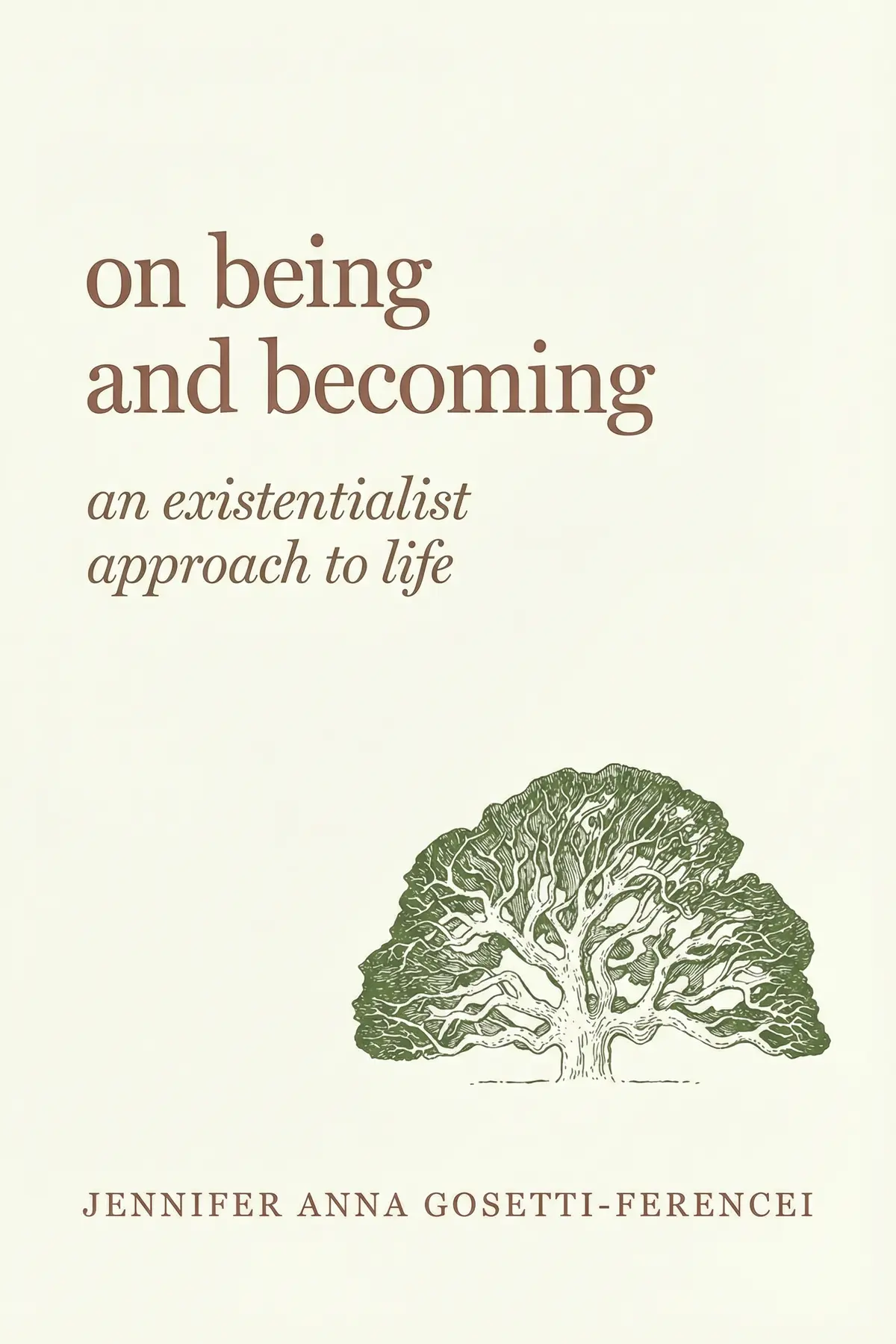
Table of Content
1. Introduction
1 min 54 sec
Have you ever paused in the middle of a busy afternoon and felt a sudden, sharp pang of uncertainty about the path you’ve chosen? It’s that quiet, nagging question: Am I living the life I actually want, or am I just following a script written by someone else? This sensation—this mixture of awe and anxiety—is at the very heart of the human experience. We are the only creatures we know of who can step back from our lives and evaluate them, feeling the heavy weight of every choice we make. We realize that our time is limited, and that every ‘yes’ we give to one path is a ‘no’ to a thousand others. This awareness can be paralyzing, yet it is also the source of our greatest power.
In these pages, we are diving deep into On Being and Becoming. This isn’t just a dry academic overview of old theories; it is a guidebook for the art of living. We often think of existentialism as a gloomy philosophy discussed by intellectuals in dark cafes, but that’s only a small piece of the story. At its core, this movement is about the thrill of freedom and the courage it takes to be truly yourself in a world that often wants you to be someone else.
Our journey will explore why the most painful emotions we feel—like dread or confusion—might actually be our best teachers. We’ll look at how we can stop being ‘products’ of our culture and start being the architects of our own souls. We’ll also see how our personal freedom isn’t an island; it’s something that depends on how we treat the people around us and even the planet beneath our feet. By the end of this summary, the goal is to shift your perspective from seeing yourself as a static ‘thing’ and instead seeing yourself as a continuous, beautiful process of creation. Let’s explore what it means to stop just ‘being’ and start truly ‘becoming.’
2. The True Scope of Existentialist Thought
2 min 59 sec
Discover why existentialism is far more than just a trend from mid-century Paris, reaching back centuries to address the most personal questions of human identity.
3. From Fixed States to Fluid Processes
2 min 51 sec
Learn why the ancient debate between permanent ‘being’ and changing ‘becoming’ is the secret key to unlocking your personal freedom.
4. The Transformative Power of Suffering
2 min 49 sec
Explore why avoiding pain might be holding you back and how embracing difficult emotions can lead to a more authentic life.
5. Escaping the Trap of the Crowd
2 min 47 sec
Understand the subtle ways modern society encourages us to live ‘inauthentically’ and how to reclaim your own unique voice.
6. Freedom as a Shared Responsibility
2 min 51 sec
Discover why your personal freedom is inextricably linked to how you view and treat the people around you.
7. The Self and the World as One
2 min 58 sec
Challenge the idea that your mind is separate from the physical world and explore how your emotions actually shape the reality around you.
8. Existentialism and the Call of the Earth
2 min 48 sec
Explore how the principles of freedom and authenticity can help us address the modern environmental crisis by changing our view of nature.
9. Conclusion
2 min 16 sec
As we reach the end of this exploration of On Being and Becoming, let’s bring it all back to that initial feeling of ‘becoming.’ The core message of this philosophy is both a challenge and a liberation: You are not a finished product. You are an open-ended question. To live authentically is to accept the responsibility of answering that question every single day through your actions, your relationships, and your engagement with the world.
We’ve seen that being truly human means navigating three fundamental relationships. First, your relationship with yourself: don’t let yourself be flattened by the labels of the crowd or the weight of your past. Stay fluid, embrace your freedom, and even find value in the moments of dread that remind you you’re alive. Second, your relationship with others: recognize that your freedom is tied to theirs. Move away from treating people like objects and toward seeing them as the rich, complex subjects they truly are. And third, your relationship with the world: remember that you are ‘in-the-world,’ not separate from it. Treat the environment not as a resource to be used, but as a home to be cherished and respected.
A great way to put this into practice is a thought experiment proposed by Nietzsche called ‘The Eternal Return.’ Imagine that a demon appeared to you tonight and told you that you would have to live this exact life—with every pain, every joy, and every tiny detail—over and over again for all eternity. There would be nothing new, just the same cycle forever. Ask yourself: how would that change your choices tomorrow? Would you continue with your current habits, or would you start making decisions that you would be proud to repeat forever? This isn’t about literal reincarnation; it’s a tool to help you identify what truly matters to you right now.
Existentialism doesn’t promise us a life without suffering or a world without problems. What it does promise is a life of depth, dignity, and agency. It reminds us that even in a chaotic and often confusing universe, we have the power to create meaning. You are the author of your own story. So, as you move forward, ask yourself: Who are you becoming today?
About this book
What is this book about?
On Being and Becoming is a profound philosophical journey that rescues existentialism from the dusty shelves of academic history and places it back into the heart of daily life. The book argues that we are not fixed entities but constant processes of change, urging us to embrace the fluid nature of our identities. It moves through the history of the movement—from its 19th-century roots to its mid-century heights—highlighting how thinkers like Nietzsche, Heidegger, and Beauvoir provide tools for modern survival. The core promise of the work is a path toward radical authenticity. It examines the tension between the individual and the 'mass,' the way we perceive the world as an extension of ourselves, and the ethical necessity of recognizing the freedom of others. Ultimately, it expands the existentialist lens to include our relationship with the environment, suggesting that a more poetic, less exploitative view of the natural world is essential for our collective and personal flourishing.
Book Information
About the Author
Jennifer Anna Gosetti-Ferencei
Jennifer Anna Gosetti-Ferencei is a distinguished professor of philosophy at Johns Hopkins University. Her scholarly expertise spans a wide range of topics, reflected in her previous works such as The Life of Imagination, Exotic Spaces in German Modernism, and The Ecstatic Quotidian. In addition to her academic contributions, she is an accomplished poet; her collection After the Palace Burns was the recipient of the prestigious Paris Review Prize.
Ratings & Reviews
Ratings at a glance
What people think
Listeners find that while perspectives differ on whether this work is a pragmatic handbook or a historical critique, most agree it provides an engaging and accessible overview of existentialist philosophy. They appreciate how the author contrasts various thinkers like Nietzsche, Sartre, and Beauvoir to examine concepts of freedom and authenticity. Furthermore, listeners value the way philosophical ideas are applied to contemporary life; one listener specifically notes that the analysis of identity in the "I selfie, therefore I am" chapter is very relevant. Additionally, they mention that the text effectively grounds abstract theories in daily challenges, such as navigating mass culture and making difficult personal decisions.
Top reviews
Tan
Finally got around to reading a philosophy book that actually makes me feel something about my own life choices. The highlight for me was the exploration of Nietzsche’s 'eternal return' as a practical thought experiment for testing authenticity. It’s a haunting question: would you live this exact life over and over again forever? That kind of framing makes the abstract concept of freedom feel heavy and real. I loved how the author included literary figures like Dostoevsky alongside the heavy hitters like Sartre. It makes the movement feel like a living conversation rather than a dead academic subject. Look, it’s not always an easy read, but the payoff for sticking with the denser chapters on the self and the other is immense. Truly inspiring stuff for anyone in a growth mindset.
Show moreRung
Wow, Gosetti-Ferencei has managed to synthesize a massive range of thinkers without losing the core human message of what it means to live well. This isn't just a history of a movement; it’s a call to action to stop treating the world as a resource and start seeing it as a space of possibility. The way she links the eternal return to our modern obsession with identity is masterfully done. I felt truly free to explore my own beliefs while reading, as the text never dictates one 'right' way to be. Instead, it offers a map of the landscape and lets you choose your own path. It’s a beautiful, challenging, and ultimately rewarding book that I’ll be coming back to for years. A must-read for any modern seeker.
Show moreRotjanee
This book manages a tricky balancing act by bridging the gap between rigorous historical analysis and practical application. Gosetti-Ferencei doesn't just list what Nietzsche or Sartre said; she asks what their ideas mean for us when we're staring at our phones or feeling lost in a crowd. The chapter 'I selfie, therefore I am' was a particular standout for me because it applies the concept of the 'look' to our modern digital performances. Personally, I found the writing to be accessible, though there were moments where the academic terminology felt a bit thick. If you want to understand how existentialism can actually shape your daily choices rather than just staying as an abstract theory, this is a great place to start. It reorients the big questions toward the subjective experience of living here and now.
Show moreWatcharin
As someone who usually finds existentialism a bit too bleak, I was surprised by how much wonder is packed into these pages. The author’s focus on relating authentically to the natural world—not just as a resource to be exploited, but as a source of mystery—really resonated with my own environmental concerns. Frankly, the book is at its best when it moves away from the Parisian cafés and into the realm of how we treat the people right in front of us. The warning against 'objectifying' others, like the post office clerk example, serves as a sharp reminder to see the freedom in everyone we meet. It’s a solid 4-star read that encourages you to take responsibility for the person you are becoming every single day.
Show morePia
The chapter on identity in the digital age—'I selfie, therefore I am'—is worth the price of admission alone. In a world where we are constantly performing for an audience, Gosetti-Ferencei uses Sartre’s theories to show how we often turn ourselves into objects for others to consume. It’s a wake-up call. I appreciated how the book emphasizes that freedom isn’t just about making choices, but about recognizing the freedom of those around us to avoid the trap of shaming. The prose is elegant and the structure is logical, moving from the individual to the collective and then to the world at large. Some sections on the history of the movement felt a bit repetitive if you’ve read Sarah Bakewell, but the modern connections here are much stronger.
Show morePracha
Ever wonder why the crowd on a morning commute feels so draining to your soul? This book dives deep into that feeling of anonymity and mass culture through the lens of thinkers like Simmel and Kierkegaard. It’s fascinating to see how the fear of becoming a 'non-playable character' in your own life has such deep philosophical roots. I found the discussion on 'authenticity' to be a refreshing change from the way that word is usually thrown around on Instagram. Here, it’s about a radical commitment to your own freedom and the mystery of the world. Gotta say, it changed the way I look at my daily routine. It’s a bit long in some places, but the insights into how we objectify one another are genuinely eye-opening.
Show moreCharles
Is this a self-help manual or a dense history of philosophy? To be fair, it feels like it’s trying to be both and sometimes gets caught in the middle. While the author does a great job outlining the differences between thinkers like Kierkegaard and Beauvoir, the language occasionally slips into abstruse territory that might alienate a casual reader. I found the sections on 'being in the crowd' incredibly relatable, especially the discussion on maintaining individuality within mass culture. However, the book sometimes spends too much time on historical nuances instead of pushing forward into modern solutions. It’s an interesting read for those with a little philosophy background, but it might be a bit frustrating if you're looking for a quick guide to living authentically. Not a bad book, just a bit uneven.
Show moreSuphan
Truth is, the book oscillates between flashes of brilliance and periods of unnecessary density. I was particularly moved by the chapter on seeking advice, which retells the story of Sartre’s student during the war. It perfectly illustrates the terrifying reality that our choices create our values, not the other way around. However, I often found myself skimming through the more Heideggerian sections because the language became so abstruse it lost its connection to real life. It’s a worthwhile read for the patient, but be prepared to do some mental heavy lifting. The author clearly knows her stuff, and her passion for the subject is obvious. I just wish the editing had leaned a bit more toward the popular side of philosophy to keep the momentum going.
Show morePenelope
Picked this up looking for a light introduction to existentialism, but it definitely requires some prior knowledge to fully appreciate. While it isn't as dry as a textbook, it doesn't quite qualify as 'Existentialism for Dummies' either. The author does a solid job comparing different philosophers, highlighting where Sartre and Beauvoir disagreed, which helped me see the movement as a spectrum rather than a single rulebook. I particularly enjoyed the mentions of Kafka and Dostoevsky; seeing how these ideas manifest in literature made the abstract theories much easier to digest. Personally, I would have liked more actionable advice, as the book spends a lot of time in the 19th and 20th centuries. Still, it's a thought-provoking synthesis for anyone interested in the big questions.
Show morePreeda
Not what I expected based on the subtitle 'An Existentialist Approach to Life.' I was hoping for a more direct application of these ideas to modern struggles, but instead, it felt like a deep dive into Heidegger and other difficult thinkers. The truth is, the academic jargon made it hard for me to stay engaged for long periods. I kept waiting for the 'how-to' part, but it often got buried under pages of historical context and technical distinctions between 'being' and 'becoming.' While the chapter on social media was a bright spot, the rest felt like it was written for graduate students rather than someone looking for life guidance. If you aren't already familiar with Husserl or Kierkegaard, you might find yourself lost in the weeds pretty quickly.
Show moreReaders also enjoyed
A Guide to the Good Life: The Ancient Art of Stoic Joy
William B. Irvine
A Little History of Philosophy
Nigel Warburton
A Theory of Justice
John Rawls
Becoming Beauvoir: A Life
Kate Kirkpatrick
Being and Nothingness: A Phenomenological Essay on Ontology
Jean-Paul Sartre
Being and Time
Martin Heidegger
AUDIO SUMMARY AVAILABLE
Listen to On Being and Becoming in 15 minutes
Get the key ideas from On Being and Becoming by Jennifer Anna Gosetti-Ferencei, plus 5,000+ more titles in English and Thai.
- 5,000+ titles
- Listen as much as you want
- 7-day free trial
- Cancel anytime







