
16 min 45 sec
Speed Reading: Learn to Read a 200+ Page Book in 1 Hour
By Kam Knight
Speed Reading provides a practical framework for significantly increasing reading velocity. Author Kam Knight explores cognitive and physical techniques to enhance focus, reduce mental barriers, and boost overall comprehension and information retention.
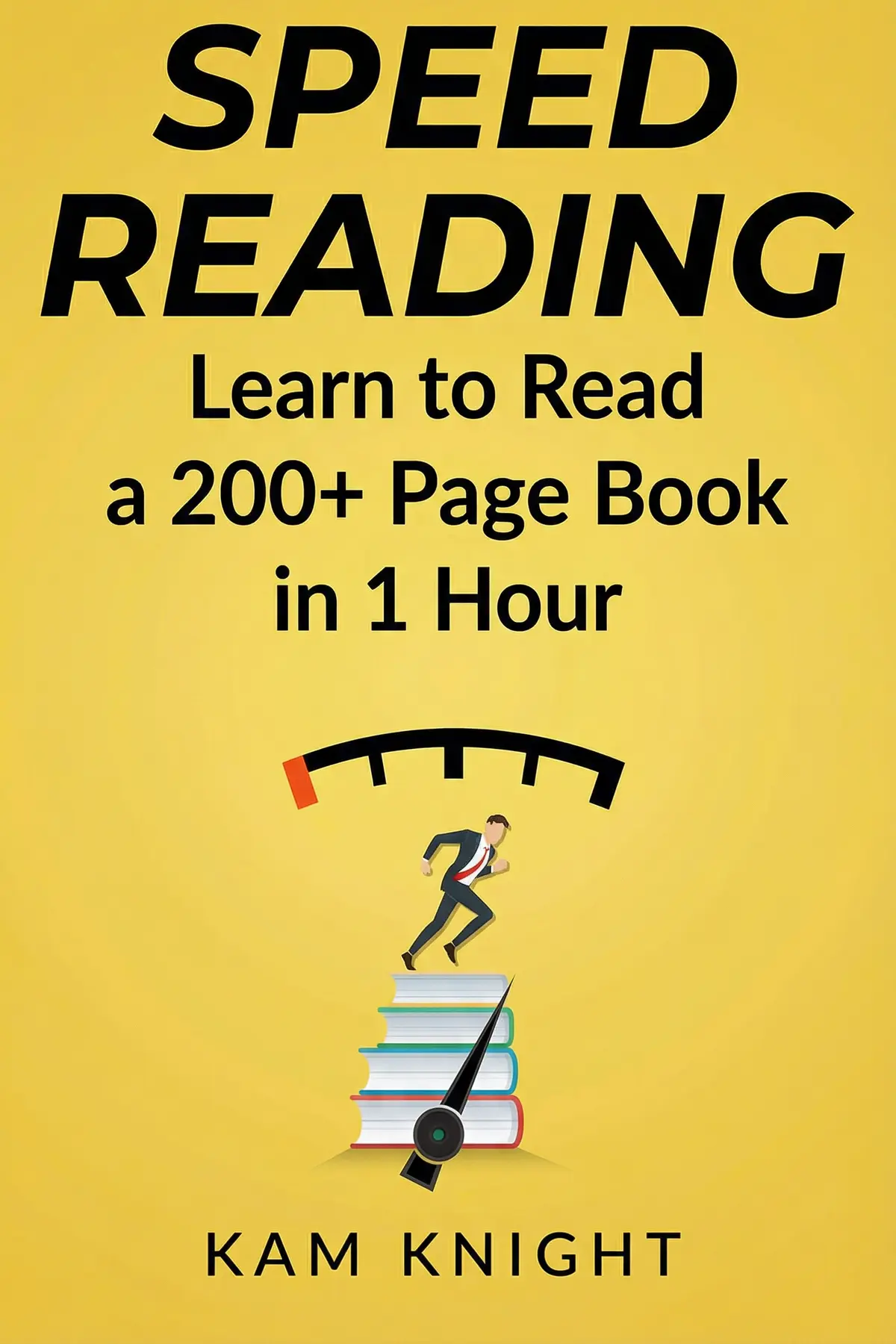
Table of Content
1. Introduction
1 min 45 sec
Consider for a moment the sheer power of your visual system. In a single, passing glance at a landscape or a crowded street, your brain processes millions of data points—colors, shapes, distances, and movements—all without you having to exert any conscious effort. You don’t look at a tree and laboriously identify the trunk, then the branches, then the leaves; you simply see ‘the tree’ instantly. Yet, when we sit down to read, this natural, high-speed processing often grinds to a halt. We find ourselves trudging through sentences word by word, as if we were back in second grade, sounding out every syllable.
This gap between our brain’s massive potential and our actual reading performance is what Kam Knight addresses. The central premise here is that reading is a skill often hindered by outdated habits and a lack of training. If over 80 percent of the information we take in comes through our eyes, why is reading so often the bottleneck of our productivity? The journey ahead isn’t just about moving your eyes faster; it’s about a total shift in how you engage with the written word.
In this summary, we will explore a roadmap to unlocking that dormant potential. We’ll look at how to prime your mind before you even open a cover, the specific visual hacks that can double or triple your speed, and the mental exercises that ensure your comprehension keeps pace with your velocity. By the end, the idea of finishing a 200-page book in a single hour won’t seem like a superpower—it will seem like a logical result of using your brain the way it was designed to be used.
2. Mental Priming and Purpose
2 min 00 sec
Discover why knowing ‘why’ you are reading is just as important as the act itself to sharpen your focus.
3. Harnessing the White Space
1 min 49 sec
Learn a counterintuitive visual technique that uses the gaps between words to accelerate your processing speed.
4. Thinking in Chunks
1 min 54 sec
Explore how to stop reading individual letters and start absorbing complete ideas as single visual units.
5. Silencing the Inner Narrator
2 min 00 sec
Break the habit of mentally ‘speaking’ every word to bypass the physical limits of speech-based reading.
6. Eliminating Visual Drag
1 min 55 sec
Address the physical eye movements that act as speed bumps and learn how to maintain forward momentum.
7. Active Comprehension and Memory
2 min 00 sec
Shift from passive scanning to active engagement to ensure you remember what you read long after the book is closed.
8. Maintaining Physical Stamina
1 min 53 sec
Learn simple eye exercises and habits to prevent fatigue and keep your reading performance at its peak.
9. Conclusion
1 min 29 sec
Mastering the art of speed reading is not about cutting corners or skimming for the highlights; it’s about upgrading the way your brain and eyes collaborate. We’ve seen that by setting a clear purpose and previewing your material, you can turn your mind into a high-precision search engine. Through techniques like space reading and chunking, you can bypass the slow, word-by-word processing of the past. By silencing your inner voice and eliminating the habit of looking back, you remove the friction that keeps most readers at a crawl.
What matters most is the realization that your potential for learning is far greater than your current habits allow. The strategies we’ve discussed—from visual hacks to active recall—are tools that, with practice, become second nature. Imagine what your life would look like if you could double your knowledge in half the time. Whether it’s staying ahead in your career, mastering a new hobby, or simply enjoying more literature, speed reading is the key to unlocking that growth.
As you move forward, start small. Apply one technique at a time, perhaps starting with a pacer or focusing on the white space in a news article. Be patient with yourself as you break old patterns. Your brain is an extraordinary machine, and you now have the manual to run it at its full capacity. The next time you pick up a book, don’t just read it—engage with it with the speed and clarity you were always meant to have.
About this book
What is this book about?
Have you ever felt overwhelmed by the mountain of text you need to consume for work, school, or personal growth? Speed Reading is a guide designed to solve that modern dilemma. It moves beyond the idea that reading quickly means skimming or losing detail. Instead, it posits that the human brain and eyes are naturally capable of processing information much faster than we were taught in elementary school. By retraining your visual habits and cognitive processing, the book promises to help you navigate through a standard-sized book in a fraction of the time it currently takes you. The book covers the psychological foundations of reading, such as goal-setting and previewing, before moving into mechanical hacks. You will explore techniques like space reading and chunking, which leverage your peripheral vision. It also addresses common 'speed killers' like subvocalization and regression. Finally, it offers strategies for deepening your understanding and ensuring that the information stays in your long-term memory. The ultimate goal is to transform reading from a slow, linear chore into a dynamic, high-speed interaction with ideas.
Book Information
About the Author
Kam Knight
Kam Knight is an author, coach, and writer who specializes in the optimization of mental performance. His professional work is dedicated to helping individuals improve their cognitive abilities in areas such as concentration, memory, and productivity. In addition to his insights on speed reading, Knight has authored several other works aimed at mental mastery, including Mind Maps, Everyday, and Concentration.
Ratings & Reviews
Ratings at a glance
What people think
Listeners find this book efficient for increasing reading pace and grasp, featuring hands-on methods that deliver nearly instant results. The material is uncomplicated and accessible, providing distinct explanations throughout each chapter, and listeners value its focus on enhancing understanding. They describe the work as refreshing, with one listener remarking on how it completely alters their reading habits.
Top reviews
Thitiwan
Finally got around to testing these methods, and I was genuinely surprised by how quickly the "space reading" technique clicked. Knight doesn't just tell you to read faster; he actually breaks down the mechanics of how the eye moves across a page and how to stop that annoying inner monologue. It’s a very straightforward guide that cuts through the fluff to deliver actionable habits that you can start using on your very next page. While some sections felt a little like common sense, the specific drills for expanding peripheral vision were worth the price alone. My comprehension hasn't suffered at all, which was my biggest fear going in. It’s rare to find a productivity book that actually changes your behavior by the end of the first chapter.
Show moreHenry
Ever wonder why some people can breeze through a 200-page book while you’re still stuck on chapter three? Knight’s breakdown of the relationship between the brain and the eyes really opened my eyes to my own bad habits. I never realized how much my eye fixation was slowing me down until I started practicing the Schultz tables mentioned in the book. The emphasis on comprehension over raw speed is what really sets this apart from other "get smart quick" manuals. It’s a practical, easy-to-digest guide that prioritizes the quality of information retention over just flipping pages. I’ve already noticed a shift in how I approach my daily work reports.
Show moreAmara
Picked this up because I wanted to reclaim my childhood "superpower" of devouring books in a single sitting. In our world of 15-second videos, my concentration had completely tanked, and I was falling into a massive reading slump. This guide acts as a great "reset" button for the brain. It’s not just about speed; it’s about retraining your mind to be an active participant in the reading process rather than a passive observer. The tips on "previewing" material to create a mental framework have been especially helpful for my non-fiction habit. I’ve started using these techniques alongside the Headway app to maximize my learning, and the results are undeniable.
Show morePlernpiriya
Wow, I didn't expect a book under 200 pages to fundamentally change the way I look at a printed page. Knight makes the compelling argument that reading is as much about eye health and visual range as it is about vocabulary. The "Shultz table" exercises seemed a bit silly at first, but after a week of practice, I can actually feel my peripheral vision expanding. The biggest takeaway for me was the concept of "regression"—I didn't realize how often I was re-reading the same sentence just because my mind wandered. By setting a clear "purpose" for each reading session as suggested, I’ve managed to stay engaged and finish books I would have normally abandoned.
Show moreSomrutai
Gotta say, Kam Knight has a way of making complex cognitive tasks feel incredibly simple and doable. Most of these techniques, like the "chunking" method, produce results almost immediately if you actually bother to do the exercises. I used to be the slowest reader in my friend group, always the last one to finish the latest bestseller, but now I’m keeping pace without feeling like it's a chore. The book is laid out perfectly, with clear explanations that reshape your reading behavior from the ground up. It’s a refreshing, practical guide that delivers exactly what it promises on the cover without any unnecessary complexity.
Show morePalm
As someone who struggles with massive non-fiction piles, this was a refreshing take on an old topic. The focus isn’t on some superhuman scanning ability but on reducing subvocalization and the "regression" habit of re-reading sentences. To be fair, some of the prose feels a bit padded to make it book-length, and you could probably find the core concepts in a long-form article if you looked hard enough. However, having all the exercises and the science of "chunking" in one place made it much easier for me to actually practice. I’m currently using the previewing method for my uni textbooks, and it has drastically cut down my study time. It's a solid resource for anyone feeling overwhelmed by their TBR list.
Show moreTom
The chapter on space reading was a total game-changer for my daily commute reading. It sounds counterintuitive to look at the gaps between words instead of the words themselves, but it actually forces your brain to take in groups of text at once. I did find that the exercises are much easier to do on a physical Kindle or a real book than on a small smartphone screen. My only minor gripe is that the author repeats certain points about "purpose" a few too many times. Still, the techniques for identifying topic sentences and skipping the filler in paragraphs have helped me stay focused. I’m definitely reading faster than I was a month ago without losing the plot of my novels.
Show morePaisley
After hearing so much hype about speed reading, I was skeptical that it was anything more than skimming. However, Knight clarifies early on that speed without comprehension is useless, which I really appreciated. The book provides a very structured path from breaking old habits to forming new, more efficient ones. My favorite part was the practical advice on adjusting your speed based on the genre; I don’t want to rush through a beautiful novel, but I definitely want to blast through a technical manual. It's a very accessible book that avoids overly technical jargon while still feeling grounded in science. A great tool for anyone looking to optimize their time.
Show moreAmy
To be fair, I expected something a bit more advanced, but this serves as a decent introductory primer. Many of the strategies, like chunking and avoiding vocalizing every word in your head, are standard speed reading 101. If you've never looked into the subject before, this will feel like a revelation. For those who have already dabbled in these techniques, you might find a lot of the book to be remedial filler. Look, the writing is clear and the chapters are short, which makes it an easy read in itself. It’s an okay resource, but I wish there were more "impossible" exercises to really push the boundaries of my vision.
Show moreArjun
This book felt like a collection of blog posts stitched together to capitalize on the "passive income" eBook trend. Frankly, most of the advice is either painfully obvious—like "read it ahead of time to know what you're reading"—or feels like pseudo-psychology filler meant to drive up the word count. I was looking for deep, neurological insights but instead got told to "state my purpose" before picking up a book. It’s not that the tips don't work at all, but rather that the "innovative" methods like space reading are just basic speed reading tropes you can find for free on YouTube. If you’re a complete novice, you might find a nugget of value, but for me, it was mostly a waste of an hour.
Show moreReaders also enjoyed
AUDIO SUMMARY AVAILABLE
Listen to Speed Reading in 15 minutes
Get the key ideas from Speed Reading by Kam Knight, plus 5,000+ more titles in English and Thai.
- 5,000+ titles
- Listen as much as you want
- 7-day free trial
- Cancel anytime







