

15 min 38 sec
Accounting Made Simple: Accounting Explained in 100 Pages or Less
By Mike Piper
Accounting Made Simple provides a foundational guide to financial literacy. It breaks down complex concepts like balance sheets, income statements, and double-entry bookkeeping into easy-to-understand principles for beginners and professionals alike.
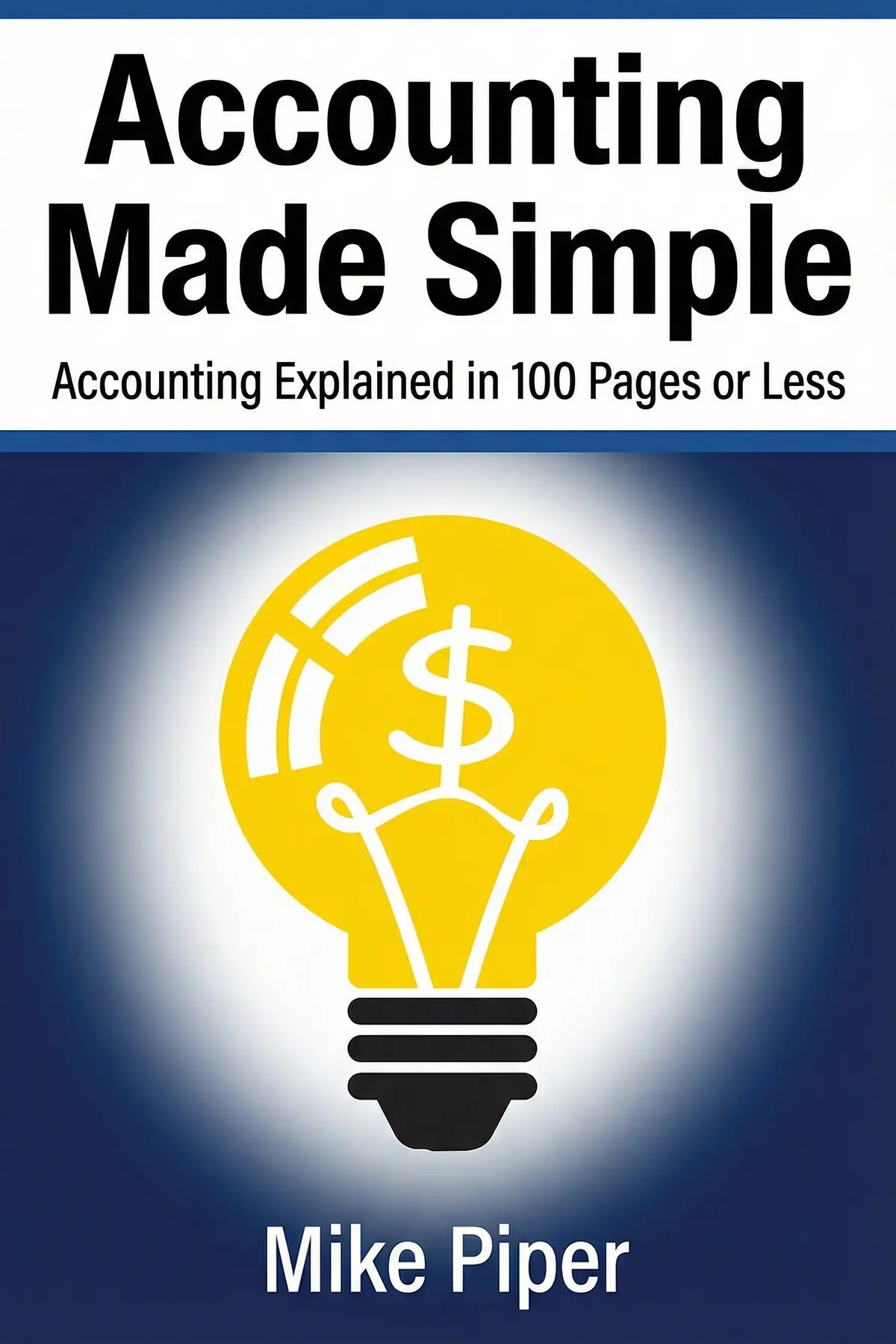
Table of Content
1. Introduction
1 min 30 sec
Have you ever sat down to review a financial report—perhaps a cash flow statement or a balance sheet—only to feel like you were staring at an ancient, undecipherable code? For many people, the world of accounting feels like a locked room, accessible only to those with specialized degrees and a penchant for complex jargon. There is a common feeling that if only we had a simple dictionary to translate these numbers into plain English, we might actually understand what is happening with our businesses or our personal investments.
If you have ever felt this way, you are certainly not alone. The reality, however, is that accounting is far from a dark art. It is the essential language of business, acting as the primary system for recording, analyzing, planning, and controlling financial transactions. When you learn to decipher the basics, you stop seeing just numbers and start seeing the real story of a company’s health. You begin to see exactly where money is being generated, where it is being lost, and where strategic changes could lead to growth.
In this summary, we are going to strip away the complexity. We will look at the foundational concepts that govern everything from a child’s lemonade stand to a global tech giant. We will explore how to calculate the equity in your own home, how to compare your profits against the biggest companies in the world, and how to ensure you never run out of cash. By the end, the throughline of accounting will be clear: it is a logical, structured way to tell the truth about a business’s financial position.
2. The Core Accounting Equation
2 min 26 sec
Every financial transaction rests on one elegant mathematical truth that balances assets against what is owed and what is truly owned.
3. The Purpose of the Balance Sheet
2 min 11 sec
A balance sheet acts as a financial snapshot, capturing exactly what a business is worth at one specific moment in time.
4. Measuring Performance via the Income Statement
2 min 09 sec
While the balance sheet is a photo, the income statement is a movie that tracks a company’s profitability over a set duration.
5. The Vital Role of the Cash Flow Statement
1 min 58 sec
Profit on paper doesn’t always equal money in the bank. This statement tracks the actual movement of currency to ensure a business stays solvent.
6. Using Ratios to Gauge Financial Health
2 min 01 sec
Numbers alone can be misleading; by using ratios, you can compare different companies and assess their true efficiency and stability.
7. The Mechanics of Double-Entry Bookkeeping
2 min 04 sec
Discover the disciplined system of debits and credits that ensures every financial move is accurately captured and perfectly balanced.
8. Conclusion
1 min 19 sec
The world of accounting is often treated as a daunting hurdle, but as we have seen, it is actually built on a foundation of simple, logical principles. By understanding the core equation—that assets are always balanced by liabilities and equity—you gain a fundamental key to understanding how any business is structured. Whether you are looking at a snapshot of a company’s worth on a balance sheet, its performance over time on an income statement, or its actual survival capacity on a cash flow statement, you are simply seeing different angles of the same financial reality.
The real power of this knowledge lies in its application. By using ratios to analyze health and employing the discipline of double-entry bookkeeping to ensure accuracy, you move from being a passive observer of numbers to an active participant in business strategy. You can now see the ‘why’ behind the numbers.
As you move forward, remember that accounting is not just for accountants; it is a vital tool for anyone who wants to make informed decisions. Start by looking at your own financial position through the lens of the accounting equation. Calculate your own equity, monitor your personal cash flow, and treat your finances with the same clarity and structure that the world’s most successful businesses use. When you speak the language of accounting, the mystery disappears, and the path to financial growth becomes clear.
About this book
What is this book about?
Accounting Made Simple offers a clear and straightforward path through the often-confusing world of business finance. Instead of treating accounting like a secret language, it breaks down the core documents and principles that every business owner, manager, or investor needs to understand. The book moves systematically from the basic accounting equation to the construction of balance sheets, income statements, and cash flow reports. The promise of the book is total clarity. It aims to take someone who feels intimidated by financial jargon and give them the tools to see the real story behind the numbers. By explaining how transactions are recorded and how to analyze a company's health through specific ratios, it empowers readers to make better financial decisions. Whether you are running a simple lemonade stand or analyzing the performance of a major corporation, these fundamentals remain the same, providing a universal lens through which to view business success.
Book Information
About the Author
Mike Piper
Mike Piper is a Certified Public Accountant and the prolific author behind eight different finance-related books. Beyond his published volumes, he manages the well-known personal finance blog, Oblivious Investor. His professional insights and articles have been featured in major national publications, including The Wall Street Journal, Money magazine, and Forbes. Piper's work focuses on making complex financial concepts accessible to a broad audience, leveraging his expertise as a CPA to demystify the world of money management and accounting.
Ratings & Reviews
Ratings at a glance
What people think
Listeners find that this guide clarifies fundamental accounting principles effectively and acts as a superb resource for grasping small business finances. Furthermore, the material is straightforward to follow and digest, with one listener mentioning it can be read in one sitting. They also value the brevity of the writing style and view it as a top-tier primer for the topic.
Top reviews
Luckana
Wow, I actually finished an entire book on accounting in a single afternoon without feeling like a total failure at life. The author really delivers on the 'made simple' promise by focusing on the 'ALOE' equation and building everything out from there. It’s refreshing to read a technical book where the author isn't trying to show off how smart they are. Instead, Piper seems genuinely interested in making sure you understand the difference between a debit and a credit. This is the perfect resource for a quick refresher or for someone who is absolutely terrified of math. It’s light, direct, and honestly one of the most useful business books I’ve purchased this year. I’ll definitely be keeping this as a handy reference.
Show moreSuthinee
As someone who recently launched a small startup, I needed a way to understand my books without going back to college for a four-year degree. This guide was a total lifesaver for me. It breaks down complex ideas like amortization and depreciation into plain English that anyone can grasp. The lack of filler is what makes this book shine; there are no boring anecdotes, just pure, useful information. It’s basically a crash course in financial literacy that empowers you to have better conversations with your bookkeeper while also providing a framework for understanding money flow. If you are an entrepreneur or a sole proprietor, you need this on your shelf. It’s the best return on investment for your time.
Show moreNarong
The chapter on the difference between cash and accrual accounting was a massive lightbulb moment for me. I’ve been struggling with my business finances for months, but seeing it laid out so simply changed my entire perspective. Mike Piper knows exactly how to explain the double-entry system so it feels intuitive rather than intimidating. The book is tiny, but every page is packed with high-value insights that stick with you. I especially appreciated the section on financial ratios, which helped me analyze my own business performance for the first time. It might be short, but it’s powerful. This is exactly what an introductory text should look like. No fluff, no confusion, just the essential building blocks of accounting.
Show morePracha
Picked this up on a whim after realizing my small business finances were a complete mess and I didn't even know what a general ledger was. Mike Piper managed to explain the accounting equation—Assets = Liabilities + Owner’s Equity—in a way that finally clicked for me. The absence of jargon and filler makes it a very efficient read for busy entrepreneurs who just need the basics. I especially liked how he differentiated between cash and accrual accounting, which is usually where I get lost. My only minor quibble is that the ratio analysis section was a bit thin for my taste. Still, for a quick-reference guide that you can finish in one sitting, it’s hard to beat this for the price and time investment.
Show moreLaor
After hearing so many people rave about this book on finance forums, I decided to see if it could actually make accounting interesting for an outsider. It turns out that Piper is a master of clarity, focusing on the core fundamentals without trying to dazzle the reader with his own expertise. The book is remarkably short, which is perfect for someone like me who has a notoriously short attention span for numbers. It lays out the four basic financial statements in a logical order that makes the relationship between them obvious. While it might be too basic for an accounting major, it’s a fantastic starting point for anyone else. I wish I had read this before I started my first business because it would have saved me significant confusion.
Show moreSuwit
Mike Piper has a real talent for stripping away the academic fluff that usually makes my eyes glaze over when looking at a balance sheet. The book is incredibly concise, which is both its greatest strength and its primary weakness. You get a solid grasp of GAAP and how FASB governs everything, but the examples provided are quite limited. I would have loved to see a few more practical cases to help solidify the concepts of debits and credits. That said, the way he uses the statement of retained earnings as a bridge between other documents is brilliant. It’s an excellent introduction to the subject for anyone who needs to understand the language of business without becoming a full-time accountant.
Show moreSarocha
Ever wonder why the balance sheet is called a 'snapshot' while the income statement is a 'recording'? This book explains those distinctions with zero pretension and maximum efficiency. It’s less than 100 pages, which means you can easily digest the entire thing during a long lunch break. The explanation of the matching principle was particularly helpful for my understanding of how expenses are tracked in a professional setting. I do think the author could have spent more time on inventory and COGS, as those are huge hurdles for retailers. However, as a foundational text, it’s quite solid. It provides just enough information to keep you from feeling lost when talking to a professional accountant. It’s a great tool for building a financial vocabulary.
Show moreDarius
To be fair, Mike Piper delivers exactly what the title promises, though I’m not convinced that 'simple' should always mean 'minimalist.' The structure is quite clever, as he introduces accounting principles only when they are needed for practical application, which helps keep the reader from getting bogged down in abstract theories. However, the brevity is a double-edged sword. I found the discussion on closing the books to be far too brief to be truly educative for a complete beginner. A few more diagrams or flow charts between the financial statements would have made the transitions much easier to follow. It’s a nice introduction, but it doesn't strike the right balance between being concise and providing actual depth for someone starting a business.
Show moreJoseph
Frankly, I have mixed feelings about how much content was left on the cutting room floor in the pursuit of staying under 100 pages. The author is a CPA, so he clearly knows his stuff, and his lack of fluff is refreshing compared to those massive textbooks. But the section on double-entry bookkeeping felt like it needed more examples to really sink in. I appreciated the breakdown of the balance sheet and income statement, yet the leap to more complex topics like depreciation felt rushed. It serves as a decent high-level overview for a layperson, but don't expect to be an expert by the final page. It’s more of a map than a guide, showing you where things are without explaining how to navigate the terrain.
Show moreErn
If you're looking for a comprehensive textbook that covers the nitty-gritty of tax law or complex corporate structures, you should definitely keep walking. This book is essentially a long-form article that’s been stretched out slightly to reach its ninety-seven-page limit. While the author does a decent job explaining the ALOE equation, the rest feels way too light for anyone who actually needs to perform daily bookkeeping duties. I finished it in about forty-five minutes and felt like I only scratched the surface of what I actually needed to know for my university class. It lacks the depth required to handle real-world irregularities or the loopholes that a professional analyst would encounter. Truth is, it’s a bit too simple to be truly useful for anything beyond a very basic vocabulary lesson.
Show moreReaders also enjoyed

7 Powers: The Foundations of Business Strategy
Hamilton Helmer

Alibaba: The House That Jack Ma Built
Duncan Clark

Bad Blood: Secrets and Lies in a Silicon Valley Startup
John Carreyrou

Be A Free Range Human: Escape the 9 to 5, Create a Life You Love,
Marianne Cantwell

Be Obsessed or Be Average
Grant Cardone
Being Boss: Take Control of Your Work and Live Life on Your
Kathleen Shannon
AUDIO SUMMARY AVAILABLE
Listen to Accounting Made Simple in 15 minutes
Get the key ideas from Accounting Made Simple by Mike Piper, plus 5,000+ more titles in English and Thai.
- 5,000+ titles
- Listen as much as you want
- 7-day free trial
- Cancel anytime







