
19 min 33 sec
Talent is Overrated: What Really Separates World-Class Performers from Everybody Else
By Geoff Colvin
Talent is Overrated dismantles the myth of innate genius, revealing that world-class performance is actually the result of deliberate practice, specific preparation, and a relentless commitment to identifying and fixing personal weaknesses.
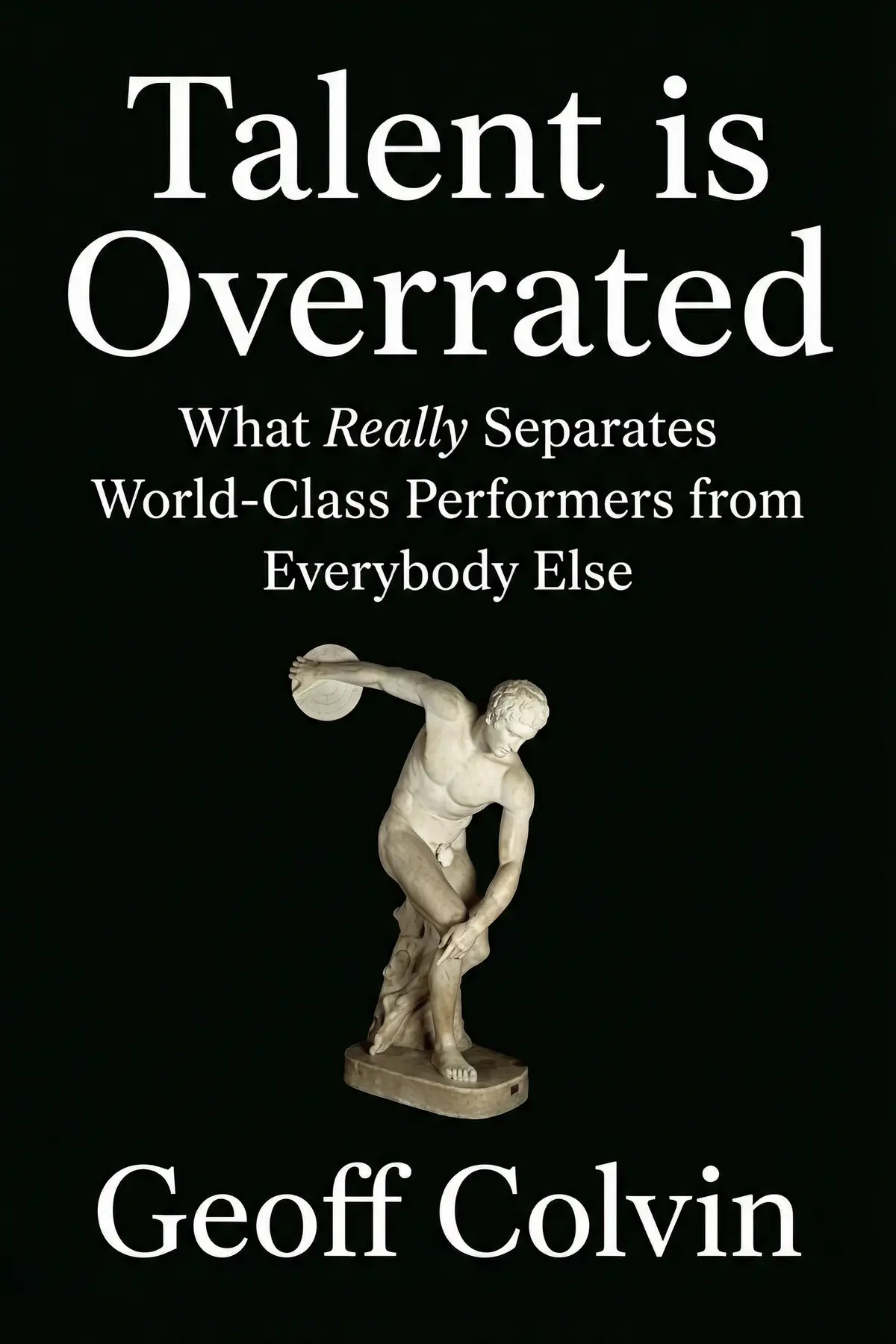
Table of Content
1. Introduction
1 min 38 sec
We live in a culture that is obsessed with the idea of the ‘natural.’ We see a virtuoso violinist or a legendary CEO and assume they were simply born with a special spark that the rest of us lack. We tell ourselves that greatness is a gift, a roll of the genetic dice that determines our ceiling before we even begin. But what if that entire narrative is wrong? What if the difference between being ‘just okay’ at your job and being one of the best in the world has almost nothing to do with your innate abilities?
In these pages, we are going to deconstruct the myths of talent and intelligence to find the real source of high performance. We’ll look at why decades of experience often lead to stagnation rather than mastery, and why some of the most ‘intelligent’ people on paper fail to achieve much of anything in practice. This isn’t a book about working harder in the traditional sense; it’s about working smarter by embracing a concept called ‘deliberate practice.’
The throughline of our exploration is simple: greatness is not a lottery win; it is an achievement. By the end of this journey, you’ll see that the path to world-class performance is open to anyone willing to trade the comfort of ‘good enough’ for the rigorous, focused, and often difficult work of true improvement. Whether it’s understanding how a grandmaster sees a chessboard or how a writer like Benjamin Franklin engineered his own genius, the lessons here are universal. We are going to look at the mechanics of mastery and provide you with a new lens through which to view your own potential. The hard truth is that there are no shortcuts, but the liberating truth is that the ceiling you think you have might not actually exist.
2. The Stagnation of Experience
2 min 13 sec
Think years of work automatically make you an expert? Discover why experience often fails to improve performance and why veteran professionals sometimes perform worse than their younger counterparts.
3. The IQ Fallacy
2 min 07 sec
Does a high IQ guarantee success? Explore the surprising evidence that suggests general intelligence is a poor predictor of greatness in fields ranging from sales to professional horse racing.
4. The Ten-Year Rule of Innovation
2 min 03 sec
Creativity is rarely a bolt from the blue. Learn why even the most famous ‘aha’ moments are actually the culmination of a decade of intense, immersive preparation.
5. The Mechanics of Deliberate Practice
2 min 06 sec
Mastery isn’t just about hard work; it’s about a specific kind of work. Discover the elements of deliberate practice and how it differs from traditional training.
6. Biological and Mental Transformation
1 min 54 sec
World-class performers aren’t born different—they become different. Explore how intense training physically reshapes the human body and rewires the brain.
7. The Strategic Edge of an Early Start
2 min 01 sec
Why do the greats often start as children? Learn about the advantages of beginning mastery early, from neuroplasticity to the hidden benefits of family support.
8. The Multiplier Effect and Internal Drive
1 min 52 sec
How does a tiny spark of interest turn into a lifelong obsession? Discover the ‘multiplier effect’ and the shifting nature of motivation on the path to greatness.
9. Engineering Mastery in Adulthood
2 min 02 sec
It’s never too late to apply the principles of greatness. Learn the practical steps for adults to identify weaknesses and design their own deliberate practice routines.
10. Conclusion
1 min 37 sec
The journey through the science of high performance brings us to a singular, unavoidable conclusion: the legend of the ‘natural’ is largely a myth. Whether we are looking at the intricate finger work of a violinist, the strategic brilliance of a grandmaster, or the persuasive power of a top-tier salesperson, the story is the same. Excellence is the result of thousands of hours of deliberate practice—a specific, focused, and often uncomfortable process of self-refinement.
We have seen that experience by itself is a trap, and that general intelligence is merely a starting point. To truly transcend mediocrity, you must embrace the ‘ten-year rule’ of preparation and understand that your brain and body are ready to adapt, provided you give them a reason to. The difference between those who stagnate and those who soar is the willingness to seek out feedback, to obsess over details, and to push through the grueling boredom of repetitive, focused training.
Your actionable takeaway is this: identify one core skill in your professional or personal life that you have been doing on ‘autopilot.’ For the next week, stop just ‘doing’ it. Instead, design a way to practice it. Break it down into its smallest components, record yourself, find a critic, and work only on the part you are worst at. Remember the words of Ted Williams, who practiced until his hands bled. You don’t need to suffer physically, but you do need to challenge yourself mentally. The ceiling on your potential is far higher than you think, but to reach it, you must stop waiting for talent to save you and start building your own greatness.
About this book
What is this book about?
Have you ever wondered why some people reach the pinnacle of their fields while others, who work just as hard, remain stuck in mediocrity? Talent is Overrated argues that the answer isn't found in our DNA or a high IQ score. Instead, the secret lies in a very specific type of activity called deliberate practice. This isn't just about putting in hours; it’s about a highly structured approach to improvement that involves constant feedback and pushing past your comfort zone. In this summary, we explore the evidence that debunks the 'natural talent' narrative. You will learn why experience alone doesn't make you better at your job, how world-class innovators spend years preparing for their 'sudden' breakthroughs, and why even the physical structure of your brain and body can be reshaped through specific training. Whether you are a business leader, an athlete, or a musician, this book provides a roadmap for transforming average results into extraordinary achievement by changing how you view and execute your daily work.
Book Information
About the Author
Geoff Colvin
Geoff Colvin is an editor and columnist for Fortune, and a highly regarded commentator and lecturer on subjects like business trends and leadership. He also contributes daily with business commentary on the CBS Radio Network.
Ratings & Reviews
Ratings at a glance
What people think
Listeners find the book to be an accessible read filled with fascinating data, particularly enjoying how it explains the research behind deliberate practice as the key to success. Furthermore, the work provides numerous real-world examples and is highly beneficial for mentors and instructors, who note that the content motivates them in their professional lives. Additionally, listeners appreciate the book's take on talent, recognizing that skill is measurable and that consistent, hard work leads to elite results.
Top reviews
Jonathan
Ever wonder why some people seem born for greatness while the rest of us just struggle along? Colvin destroys the myth of the 'natural' by dissecting the early lives of legends like Mozart and Tiger Woods to show the grueling work behind the curtain. It turns out that genius isn't a gift from the gods but a result of obsessive, specifically designed practice that most people would find unbearable. As a coach, I found the chapters on feedback and 'the 10-year rule' absolutely transformative for how I approach my students' development. Look, this isn't just another feel-good self-help book; it’s a rigorous blueprint for achieving elite performance in any discipline. I’ve already started applying these principles to my own training sessions with noticeable results. Highly recommended for anyone who leads others.
Show moreRotjanee
The chapter on organizational innovation was worth the price of the book alone. Colvin successfully bridges the gap between individual excellence and corporate culture, showing how leaders can foster an environment of continuous, deliberate improvement. It’s refreshing to see a writer acknowledge that 'talent' is often just a lazy label we use to describe someone who worked harder and smarter than everyone else. The anecdotes, like the one about the CEO making employees sing 'Happy Birthday' better, provide tangible examples of how feedback should work. This book is an essential tool for any manager who wants to build a high-performing team rather than just waiting for 'talented' hires to walk through the door. Truly an eye-opening perspective on human potential that encourages you to stop making excuses for your own performance.
Show moreJiraporn
Finally got around to reading this, and it lives up to the reputation of being a seminal work on human achievement. Colvin manages to take complex psychological research and turn it into a narrative that is both readable and deeply challenging. The way he dismantles the idea of 'innate gifts' is surgical, replacing it with a more democratic—if more demanding—path to excellence. I loved the focus on 'mental conditioning' and the idea that our minds can be trained just as rigorously as our muscles. While some critics say he ignores genetics, I think his point is that we haven't even come close to testing our actual genetic limits anyway. This is a must-read for anyone who is serious about self-improvement or leadership. It’s a five-star masterclass in performance science that I'll be returning to frequently.
Show morePensuda
As someone who has spent years in a corporate environment, I was fascinated by the argument that experience alone doesn't actually lead to mastery. Colvin points out that many professionals, from auditors to doctors, can actually get worse over time if they aren't engaging in deliberate practice. This idea is both terrifying and incredibly motivating because it suggests that we have far more control over our skill levels than we think. The prose is accessible, and the scientific citations provide a layer of credibility that many business books lack. My only gripe is that the author occasionally glosses over the role of luck or physical limitations in certain fields like professional sports. Still, it’s a vital read for anyone looking to break out of a plateau. Skill is measurable, and this book shows you how to measure it.
Show moreMay
Picked this up after a colleague mentioned the 'multiplier effect,' and I’m glad I took the time to finish it. The book does a fantastic job of explaining how tiny initial advantages can snowball into massive performance gaps through a cycle of praise and increased effort. I particularly appreciated the section on 'mental models' and how experts perceive patterns that beginners simply cannot see. The writing style is engaging, though I did find some of the business-specific examples a bit dry compared to the sports and music anecdotes. To be fair, the message that 'hard work' isn't enough—that it must be specific, feedback-driven work—is a distinction that needs to be made more often. It’s a challenging read that forces you to re-evaluate your daily habits and how you spend your working hours.
Show moreManop
After hearing so much hype about the 10,000-hour rule, it was great to see a book that actually clarifies what those hours need to look like. Colvin emphasizes that it’s not just about the volume of work, but the intensity and the willingness to tackle the things you’re bad at. As a teacher, I’ve seen firsthand how students plateau because they only practice the parts they already know well. This book provides the vocabulary and the evidence needed to push them into more productive, albeit more difficult, territory. The sentence structure is varied enough to keep the reading pace quick, and the layout of the 'attributes of deliberate practice' is very helpful. It’s a grounded, evidence-based look at what it really takes to be the best, even if the 'why' of motivation remains a bit mysterious.
Show moreNarumon
If you think your abilities are fixed at birth, this book will either liberate you or make you feel very guilty about your lack of progress. Colvin presents a compelling case that talent is a myth we use to justify our own mediocrity, which is a tough pill to swallow but ultimately empowering. I found the discussion on 'domain-specific knowledge' particularly relevant to my career in engineering, as it explained why general intelligence only takes you so far. The book is well-structured, moving logically from individual skill to team dynamics, although it does repeat itself quite a bit in the middle chapters. Personally, I found the section on '10 years of silence' for artists to be the most moving part of the whole narrative. Hard work is non-negotiable, and this book proves it.
Show moreMai
This book feels like a deep dive into territory already explored by Gladwell, yet it manages to carve out its own space by focusing on the 'how' rather than just the 'who.' While the writing is competent and clear, I found the middle sections slightly repetitive as Colvin hammers home the definition of deliberate practice. Truth be told, if you’ve read Outliers or Drive, some of this will feel like a retread of familiar anecdotes. However, the distinction between simple experience and focused, painful improvement is a crucial takeaway for anyone feeling stuck in their career. It’s a solid 3.5 rounded down because the pacing drags in the latter half. The research is definitely there, but the delivery could have been a bit more punchy to keep me fully engaged throughout. It is useful, but perhaps not as revolutionary as the title suggests.
Show moreArjun
To be fair, I appreciate the research, but the author’s tone often feels a bit cold and lacking in empathy for the average person. Colvin seems to suggest that if you aren't spending your life in the 'ugly zone' of painful practice, you're somehow failing to reach your potential. While the science behind neuroplasticity is fascinating, the book ignores the fact that most people actually want a balanced life rather than world-class mastery. I liked the breakdown of Mozart’s 'forged' letters, which helped humanize a figure usually shrouded in myth. However, the book leaves many questions unanswered regarding the intrinsic motivation needed to sustain such a miserable training regimen for decades. It’s an interesting theoretical framework, but the practical application feels limited to the hyper-ambitious few who are willing to sacrifice everything for a trophy.
Show moreTum
Not what I expected, and frankly, I found the core message to be somewhat reductive and overblown. Colvin spends hundreds of pages arguing that 'deliberate practice' is the secret sauce, but he essentially just rebrands the concept of 'Flow' without adding much new psychological insight. He also makes the absurd claim that anyone can be trained to do anything, which completely ignores the biological realities of human variance. While it was interesting to read about the '10 years of silence' required for great composers, the book eventually becomes a slog of repetitive case studies. I would much rather recommend Mihaly Csikszentmihalyi’s work if you want to understand the actual mechanics of high-level performance. It felt more like an elongated magazine article than a fully realized book. Save your time and read the original research instead.
Show moreReaders also enjoyed
60 Seconds & You’re Hired!
Robin Ryan
A Liberated Mind: How to Pivot Toward What Matters
Steven C. Hayes
Acting with Power: Why We Are More Powerful Than We Believe
Deborah Gruenfeld
AUDIO SUMMARY AVAILABLE
Listen to Talent is Overrated in 15 minutes
Get the key ideas from Talent is Overrated by Geoff Colvin, plus 5,000+ more titles in English and Thai.
- 5,000+ titles
- Listen as much as you want
- 7-day free trial
- Cancel anytime







