

A Year with Peter Drucker: 52 Weeks of Coaching for Leadership Effectiveness
Joseph A. Maciariello
Explore how the four-day workweek can revolutionize business by boosting productivity, enhancing employee well-being, and contributing to environmental sustainability without sacrificing profitability or personal career security in the modern digital age.
2 min 18 sec
In the current era, we find ourselves navigating the complexities of the Fourth Industrial Revolution. It’s a time defined by rapid technological shifts and the rise of a digital landscape that has fundamentally altered the way we trade our time for money. On the surface, the internet and digital connectivity promised us a world of unprecedented flexibility. We saw the birth of the gig economy, a realm of temporary roles and freelance opportunities that seemed to offer workers the freedom to choose when and where they worked. However, beneath that surface lies a more troubling reality. For many, this flexibility has turned into a state of being constantly plugged in, where the boundaries between home life and professional obligations have completely vanished. We are witnessing a workforce that is perpetually online, always on call, and increasingly stressed by the lack of traditional security.
This shift has created an environment that many find unsustainable. Workers are frequently jumping between roles, struggling with financial instability, and feeling the physical and mental weight of a system that demands their attention around the clock. But what if there was a way to capture the benefits of modern technology while restoring the balance and security of a traditional career? This is where the concept of the four-day week enters the conversation. It represents more than just a longer weekend; it’s a potential solution to the deepest problems of the modern workplace. By rethinking the standard workweek, we can actually increase profitability and productivity while significantly improving the quality of life for everyone involved. Over the course of this summary, we will explore how this model functions, why it’s a necessary evolution, and how it can even play a role in addressing global issues like climate change and social inequality. We’ll look at the data that suggests we are only truly productive for a fraction of our days and see how reclaiming our time can lead to a more sustainable and prosperous future for businesses and individuals alike.
2 min 56 sec
Revisiting the era of heavy industry reveals a stark contrast to today’s precarious job market, where digital connectivity has blurred the lines between rest and labor.
2 min 47 sec
Our appetite for instant gratification and cheap services comes at a high human cost, fueling an unsustainable culture that exploits the most vulnerable workers.
2 min 43 sec
The struggle for fair working conditions is an ongoing battle, as modern digital corporations find new ways to bypass traditional labor protections and oversight.
2 min 30 sec
A startling realization about how little time office workers are actually productive led to a revolutionary formula for the modern workplace.
2 min 20 sec
Transitioning to a shorter week requires more than just a schedule change; it demands a collaborative effort and a deep understanding of organizational goals.
2 min 32 sec
True flexibility means giving employees autonomy over where and when they work, leading to better recruitment, lower costs, and higher job satisfaction.
2 min 25 sec
A four-day week is not a social charity but a business strategy that uses time as a currency to drive performance and maintain economic stability.
2 min 10 sec
The current wealth gap mirrors the unsustainable conditions of the past, making the four-day week an essential tool for stabilizing a fractured society.
2 min 11 sec
A shorter workweek offers a direct and immediate way to reduce carbon emissions while fostering a culture of community service and sustainability.
1 min 59 sec
As we have seen throughout this exploration, the traditional five-day workweek is an aging model that no longer fits the reality of our digital, high-pressure world. The shift toward a four-day week is not just a trend or a luxury; it is a necessary evolution for a society that is increasingly stressed, unequal, and facing an environmental crossroads. By focusing on productivity rather than just hours spent at a desk, the 100-80-100 model offers a way for businesses to thrive while giving their employees back the one thing they need most: time. This extra time allows for better health, stronger family bonds, and a deeper connection to the community, all of which feed back into a more loyal and effective workforce.
The transition requires courage and clear communication from leadership, but the rewards are clear. We can reduce our collective carbon footprint, address the widening gap of inequality, and create a workplace culture that values human dignity. The throughline of this entire journey is the recognition that our current path is unsustainable and that a practical, profit-compatible solution is within our reach. As you reflect on these ideas, consider how the gift of time could transform your own organization or career. The future of work isn’t about doing more with less; it’s about doing better with what we have, and the four-day week is the most promising roadmap we have for getting there. It is time to embrace a model that supports a healthy planet, a stable economy, and a fulfilling life for every worker.
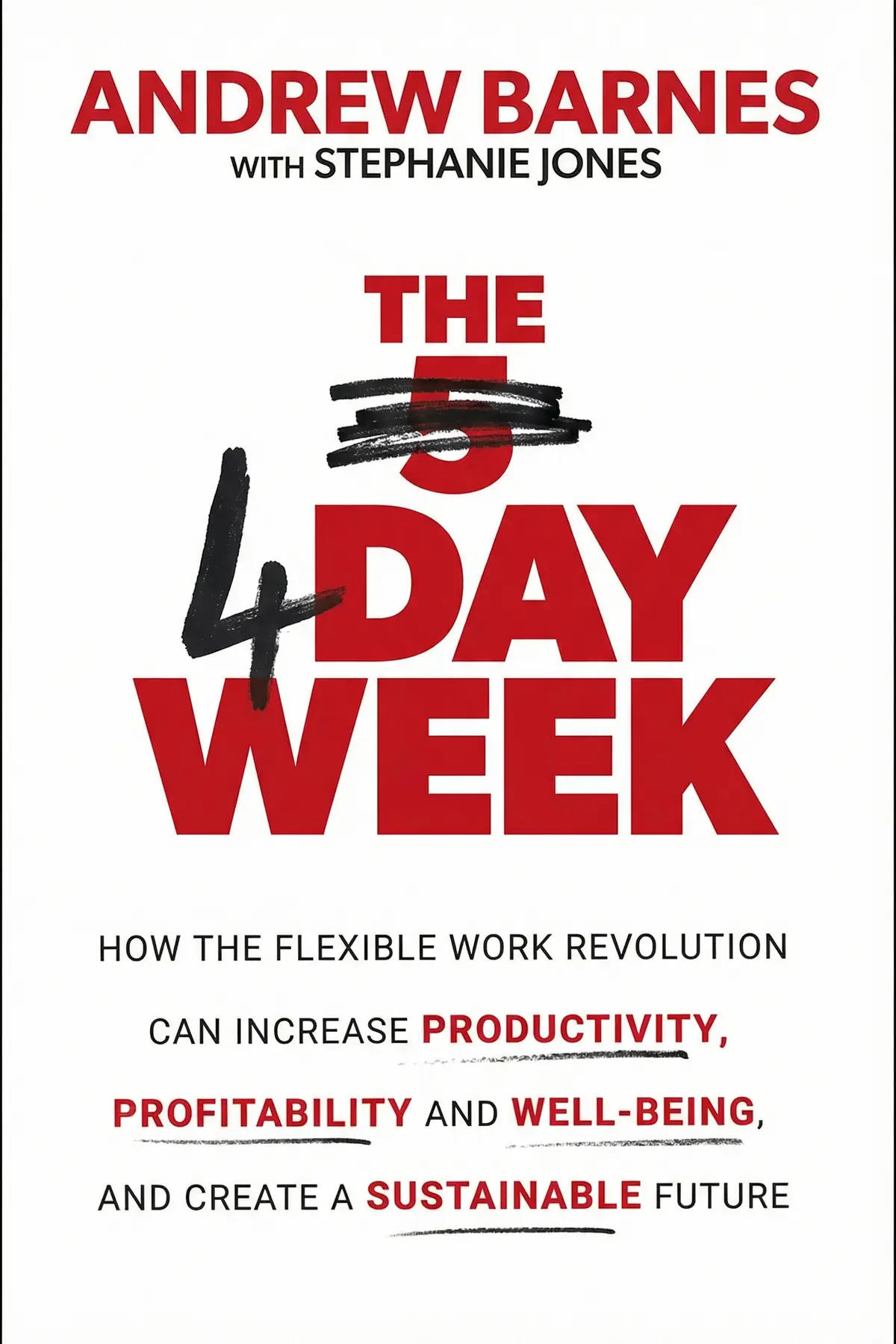
The 4 Day Week presents a compelling argument for a radical shift in how we structure professional life. It challenges the traditional five-day model, arguing that our current methods are relics of an industrial past that no longer suit the digital era. The book details a framework where employees work eighty percent of the time but maintain one hundred percent of their productivity and pay. This is not just a plea for more leisure time; it is a strategic business model designed to combat the burnout and instability of the modern gig economy. By examining the successful implementation of this model at Perpetual Guardian, the book provides a roadmap for leaders to transition their organizations toward greater efficiency and employee satisfaction. It addresses the economic, social, and environmental benefits of a shorter week, suggesting that this change is necessary to address rising inequality and the climate crisis. The promise is a future where work is more focused, lives are more balanced, and the corporate world becomes a more sustainable force for good.
Andrew Barnes is a dedicated entrepreneur and philanthropist who established Perpetual Guardian, the largest corporate trustee company in New Zealand. He gained international recognition for pioneering the four-day workweek within his own firm, effectively shifting the global dialogue on workplace flexibility. Outside of his professional endeavors, Barnes resides in New Zealand, where he spends his time cultivating his Waiheke Island vineyards and meticulously restoring his classic yacht, Ariki.
Listeners find this book to be an intriguing examination of how work will change, though reactions are divided on whether it focuses too much on social commentary and gig economy politics over actionable steps. People appreciate the inclusion of the "100-80-100" rule, which suggests keeping total pay and output consistent while decreasing hours on the job. Furthermore, they emphasize the research-backed perspective, with one listener highlighting the fascinating data from the real-world trial at Perpetual Guardian. They also note that the framework provides a viable method for enhancing staff wellness and potentially lowering environmental emissions.
Finally, a business book that recognizes we are humans rather than just replaceable gears in a corporate machine. The authors eloquently argue that our current way of working is fundamentally unsustainable for our mental health and the planet. By reducing the work week, we aren't just helping employees; we are cutting down on commuting emissions and massive office energy consumption. I found the section on the Fourth Industrial Revolution particularly insightful because it explains why our old 40-hour models are obsolete. The 100-80-100 rule is the logical conclusion of an automated world where quality should matter more than quantity. It is a bold, visionary, and deeply humane look at how we can reclaim our lives. Every HR professional needs a copy of this on their desk immediately.
Show moreBold, data-driven, and absolutely necessary for the modern era. Barnes doesn't just theorize; he provides a blueprint based on a real-world financial company trial that actually worked. I loved the contrast between his philosophy and the 'work until you drop' mentality we see in Silicon Valley. This book proves that when you treat employees with respect and give them back their time, they reward the company with higher focus and loyalty. The 100-80-100 rule is the most sensible thing I’ve read in a business book in years. It’s not about doing less work; it’s about doing the same work smarter. If you care about change leadership and innovation, you have to read this. It is a masterclass in rethinking the social contract between employer and employee.
Show moreAndrew Barnes presents a compelling case for the future of employment through his famous experiment at Perpetual Guardian. The 100-80-100 rule—100% pay for 80% time, provided 100% productivity is maintained—is a game-changer for anyone interested in organizational efficiency. I appreciated the data-driven approach used to silence critics who believe that longer hours always equal better results. It is refreshing to see a CEO challenge the toxic grind culture perpetuated by figures like Elon Musk. However, I do agree with some other readers that the book occasionally veers too far into labor politics. While the context is important, the focus on the gig economy felt slightly repetitive toward the end. Still, it is a vital read for leaders who want to improve employee well-being without sacrificing the bottom line.
Show moreAs a project manager accustomed to Agile methodologies, I found the discussion on productivity versus time spent very relevant. The book successfully debunks the myth that sitting in a chair for forty hours leads to maximum output. By focusing on the Perpetual Guardian experiment, Barnes shows that focused, intense work periods are far more valuable than the traditional slog. I liked the emphasis on empowering staff to find their own efficiencies rather than having management dictate every move. Some of the criticisms regarding Agile in the book felt a bit misplaced, perhaps based on poor implementations of the framework. Nevertheless, the overarching message about the 100-80-100 rule is powerful. It challenges us to rethink what a 'full' work week actually looks like in a digital age.
Show moreAfter spending the last year teaching and facilitating remotely, I’ve realized just how much 'filler' exists in our standard work days. This book perfectly articulates that feeling. The authors make a strong case that our current employment models are outdated and damaging to our collective well-being. I was particularly struck by the idea that a 4-day week offers the flexibility people crave from the gig economy but with the safety of a full-time salary. It's about security and flexibility combined. While some of the sections on global labor regulations felt a bit heavy, the core message about productivity is spot on. We need to stop measuring success by how many hours we can sit in a cubicle. This is a great starting point for that conversation.
Show moreThe concept of a four-day work week is undeniably attractive, yet I’m not entirely convinced by the feasibility described here. Barnes writes with a very specific European or ANZ-centric worldview that might not translate well to high-pressure 'face time' cultures in Asia or Latin America. He makes some great points about how technology has essentially chained us to our desks, but the solutions feel a bit idealistic for smaller businesses. To be fair, the Perpetual Guardian case study is fascinating and provides some much-needed empirical evidence. My main gripe is that the writing can be a bit polarizing, often painting every aspect of the gig economy as an absolute evil. It’s a thought-provoking piece for your shelf, but don't expect it to solve all your management hurdles overnight.
Show moreEver wonder if we can truly dismantle the 9-to-5 grind without the whole system collapsing? This book attempts to answer that, though the results are mixed. The evidence from the New Zealand trials is definitely the highlight, offering a glimmer of hope for a more balanced future. I found the segments on environmental benefits and reduced worker burnout to be the most persuasive parts of the narrative. On the flip side, the writing style can be a bit dry and overly academic in parts. It spends a lot of time on the history of labor movements, which might bore someone looking for quick business tips. It’s a decent introductory text for the movement, but it lacks the 'punch' of a truly transformative management book.
Show moreNot what I expected based on the title, but still worth a look for the curious. I thought this would be a productivity guide, but it’s really more of a macro-economic look at labor. The author is very critical of the gig economy, which he views as a precarious and stressful trap for most workers. While I agree with some of his points, the book lacks a bit of balance regarding the benefits of freelancing. The four-day week is presented as the ultimate antidote to these modern ills. It’s an interesting premise, even if the implementation details are a bit thin on the ground. I’m still skeptical if this would work in a fast-paced retail or service environment. It feels like a solution designed specifically for white-collar office work.
Show morePicked this up hoping for a manual on restructuring my team’s workflow, but I was met with a dense political manifesto instead. While the core idea of a four-day week is brilliant, Barnes spends roughly eighty percent of the pages complaining about the gig economy and praising European social safety nets. It felt less like a business strategy book and more like a long-form op-ed on why modern capitalism is failing. I wanted more about the 100-80-100 rule and significantly less social commentary on global pension schemes. Frankly, the one chapter dedicated to actual implementation was useful, but it wasn't enough to justify the slog through the rest of the rants. If you are looking for a practical 'how-to' guide, you might find yourself as frustrated as I was by the lack of actionable steps.
Show moreTo be fair, the author clearly has a passion for labor reform, but the book’s title is somewhat misleading. I expected a deep dive into the mechanics of a shorter work week, yet I received a lecture on why the gig economy is a disaster. It is a very 'European' book in its political leanings, often ignoring the nuances of why certain labor markets function the way they do. The tone felt a bit aggressive and one-sided, leaving little room for a balanced discussion on flexible work. There is a great idea buried in here, but the social rants make it difficult to find the practical gems. I wanted a roadmap, not a critique of global social security programs. It’s a missed opportunity to truly convert the skeptics of the four-day movement.
Show moreJoseph A. Maciariello

Deborah Gruenfeld
Mike Michalowicz
Hamilton Helmer
AUDIO SUMMARY AVAILABLE
Get the key ideas from The 4 Day Week by Andrew Barnes, plus 5,000+ more titles in English and Thai.







