


7 Powers: The Foundations of Business Strategy
Hamilton Helmer
Transition from a top performer to a successful leader. This guide provides essential frameworks for mastering delegation, building trust, and motivating a diverse team to achieve organizational goals.
1 min 46 sec
Stepping into a management role for the first time is one of the most exhilarating yet daunting milestones in a professional career. You have likely spent years honing your craft, becoming the person everyone relies on for technical expertise or consistent results. Because of that excellence, you have been handed the keys to the department. But as you settle into your new office, a sobering reality often sets in: the very skills that got you here are not necessarily the ones that will keep you here. You are no longer responsible for just your own output; you are now responsible for the output, morale, and growth of an entire group of people.
This shift is often complicated by social and psychological pressures. Perhaps you are now managing former peers who feel they were passed over for the same role. Maybe you are replacing a beloved leader and feel the weight of their legacy. Or, conversely, you might be stepping into a dysfunctional situation where you are expected to perform an immediate turnaround. Many companies, unfortunately, provide plenty of technical training but very little in the way of people-management education. This leaves new leaders to figure things out through trial and error, which can be a stressful way to start.
The goal of this guide is to bridge that gap. We are going to walk through the essential best practices that turn an unsure new supervisor into a confident, respected manager. We will look at how to build a foundation of trust from day one, how to adapt your style to the unique needs of different team members, and how to master the difficult but necessary conversations around performance and hiring. By the end of this journey, you will have a clear framework for not just surviving your first year in management, but setting the stage for long-term leadership success. Let’s explore how you can hit your stride and lead your team to new heights.
2 min 40 sec
Moving into a leadership role requires a delicate touch during the initial transition period. Learn why listening and observing are more powerful than making immediate, sweeping changes.
2 min 20 sec
Effective leadership is not a one-size-fits-all approach. Discover how to balance control and encouragement by tailoring your style to each individual’s unique needs and situation.
2 min 16 sec
Delegation is more than just offloading tasks; it is a vital tool for employee development. Explore how to let go of control to empower your team.
2 min 13 sec
Meetings can either be a drain on resources or a catalyst for progress. Learn the secrets to keeping your team focused, engaged, and productive.
2 min 18 sec
Technical qualifications are important, but a candidate’s mindset is the true predictor of long-term success. Discover how to identify the right attitude during the interview process.
2 min 15 sec
Handling underperformance is the ultimate test of a manager. Learn how to use a structured, supportive approach to either turn an employee around or move them on.
2 min 10 sec
Traditional rewards don’t always inspire peak performance. Learn the art of ‘dovetailing’ to connect your employees’ personal goals with the company’s success.
2 min 29 sec
Your ability to lead others is limited by your ability to lead yourself. Explore how emotional intelligence and self-image define your managerial impact.
1 min 48 sec
Becoming a manager is a profound transformation that requires you to move from the world of ‘doing’ to the world of ‘enabling.’ As we have explored, the most successful first-time managers are those who recognize that their primary value no longer lies in their individual technical output, but in their ability to foster a high-performing, motivated, and trusted team. You have seen how important it is to start slowly, prioritizing the building of trust and open communication over the urge to exert immediate control. You’ve learned that there is no single ‘right’ way to manage every person; instead, the best leaders are those who can adapt their style to meet the unique needs and skill levels of each individual.
We’ve also discussed the practical tools of the trade—the art of delegation that empowers others, the discipline of running efficient meetings that respect everyone’s time, and the strategic importance of hiring for attitude. You now have a framework for handling the toughest parts of the job, including the formalized process of managing underperformance with clarity and dignity. And perhaps most importantly, you’ve seen that the foundation of all great leadership is the work you do on yourself. By developing your emotional intelligence and maintaining a positive, honest self-image, you become the kind of leader people genuinely want to follow.
As you move forward in your new role, remember that you are a facilitator of success. Your job is to remove the obstacles in your team’s path and to align their personal dreams with the goals of the organization. There will be days of frustration and doubt, but if you keep these best practices at the center of your approach, you will not only achieve the results your company expects but also find deep fulfillment in watching your team grow and thrive. The path from a first-time manager to an expert leader is a marathon, not a sprint—so take a deep breath, trust your training, and lead with confidence.
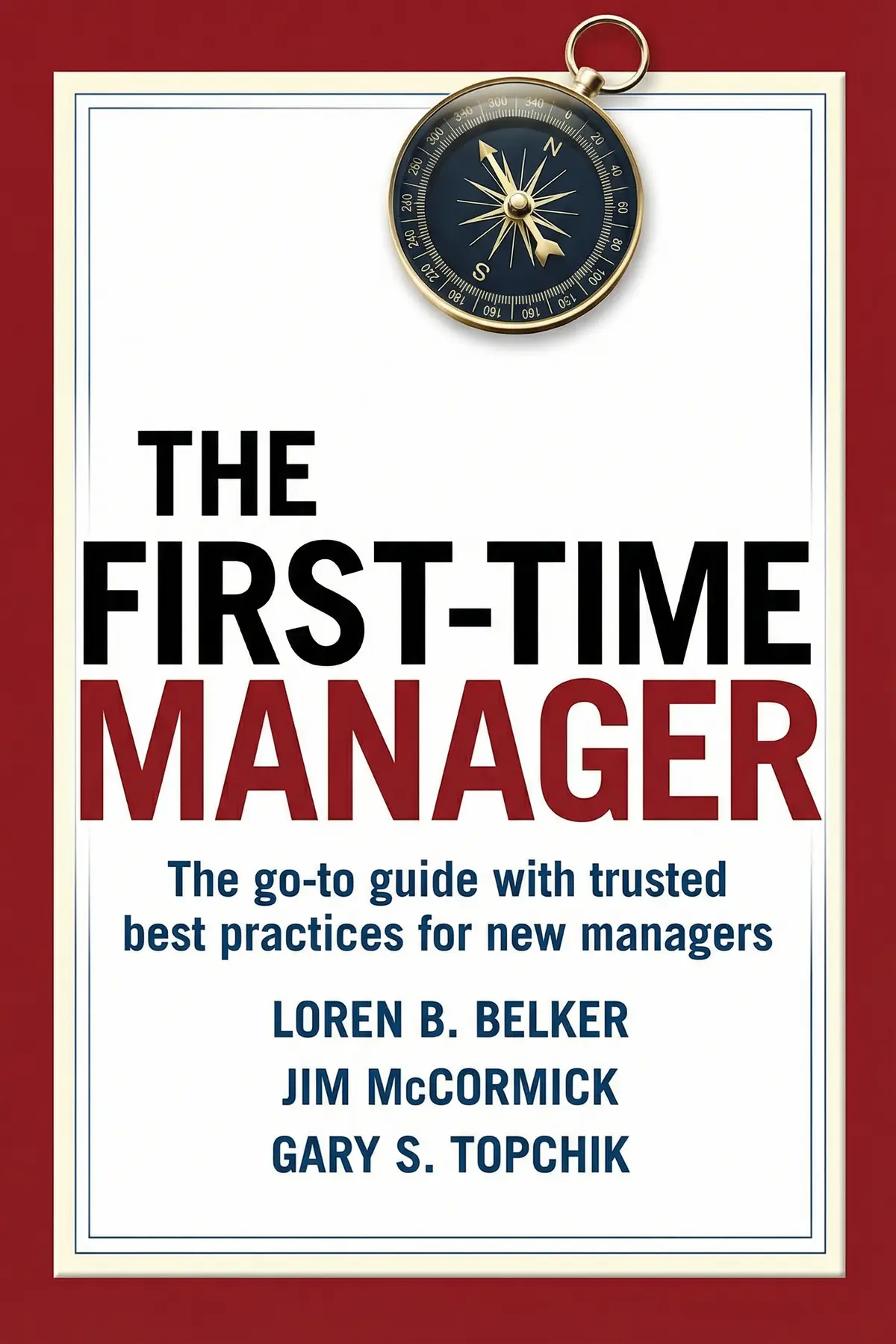
The First-Time Manager offers a roadmap for the challenging transition from being an individual contributor to leading a team. For many, a promotion into management is a reward for technical excellence, yet the skills required to oversee people are entirely different from those needed to execute tasks. This book fills that gap by providing a comprehensive set of best practices for navigating the early days of leadership. Listeners will explore the foundational elements of management, including how to establish authority without being overbearing, the art of effective delegation, and the nuances of hiring and firing. Beyond the tactical, the guide delves into the psychology of leadership, emphasizing the importance of emotional intelligence and the alignment of individual employee aspirations with company objectives. It promises to turn the anxiety of a new role into a confident, results-driven management career.
Jim McCormick is an organizational consultant, executive coach, and the president of the Research Institute for Risk Intelligence. He formerly served as the COO of a major American architectural firm. Loren B. Belker spent nearly thirty years as an executive in the insurance industry. Gary S. Topchik was the managing partner of SilverStar Enterprises Inc. and specialized in management development and executive coaching. He also authored The Accidental Manager and Equity Checking.
Listeners find this management guide to be an essential read for first-time supervisors, offering a thorough breakdown of core principles in a very accessible style. The text is skillfully composed and packed with references, while one listener specifically highlighted its emphasis on daily practical usage. Listeners find the material to be a great value and a high-quality resource, with one listener noting it acts as a helpful prompt for learning to delegate tasks more effectively.
As someone who just stepped into a lead role at a mid-sized firm, I found this book to be an indispensable mentor in print form. It highlights the importance of aligning an employee's personal interests with organizational goals to foster genuine motivation. Many new supervisors struggle with the 'sink or swim' reality, but this guide provides a life jacket through its clear explanations of diplomatic versus autocratic management. I've already started implementing the tips on how to host more effective meetings, and the results have been immediate and positive. Not gonna lie, I took pages of notes on the delegation strategies alone. This is easily the most comprehensive overview of essential concepts I’ve found so far. If you want to move from directing people to helping them become self-directed, start here. It is well worth the investment of both time and money.
Show moreI was genuinely surprised by how helpful this was, and I wish I had read it six months ago when I first got promoted. It really takes the mystery out of the 'sink or swim' approach that most companies take with their new leads. The insights into how to handle underperforming staff by aligning their goals with the company's needs were particularly eye-opening for me. In my experience, most management books are either too theoretical or too aggressive, but this one strikes a nice balance. It’s written in a very positive tone that encourages you to motivate your team rather than just controlling them. The flow of the chapters is logical, and the focus on practical application makes it easy to use as a daily reference. Even though it's been updated over the years, the core principles of human interaction remain relevant. This is definitely my top recommendation for anyone looking to improve their leadership skills.
Show moreFinally got around to reading this staple after seeing it on every 'new manager' reading list for the last decade. It’s a solid resource that covers the basic mechanics of leading a team without getting bogged down in dense academic jargon. I particularly valued the focus on daily practical applications, like how to transition from being a peer to being the boss. While the tone is conversational and encouraging, some of the sections on recruitment felt a bit thin for today’s competitive market. The advice on delegation is a great reminder that your job is no longer to do the work, but to ensure the work gets done by others. It’s an easy read that serves as a high-level primer for those who feel thrown into the deep end. Just keep in mind that its roots are older, so some scenarios feel slightly dated in a modern tech environment.
Show moreThis book provides a very pragmatic look at what it actually means to be responsible for the output of others. I appreciated the specific 'talks' or scripts provided for different managerial situations, even if they were a bit simplistic. It’s a field-agnostic guide, meaning the advice works whether you are in healthcare, manufacturing, or retail. One of the best reminders was the section on not correcting employees in front of their peers to protect department morale. While some of the recruitment advice feels a bit 'old school,' the core message about building trust is timeless. To be fair, you have to read it with a grain of salt regarding some of its social views. Overall, it functions as a great reference tool for daily challenges. It helped me realize that my primary role is to provide my staff with whatever they need to excel.
Show moreEver wonder why some bosses are so much easier to work for than others? This book dives into that dynamic by focusing on the move from being a 'doer' to a 'leader.' I liked how the authors emphasized the psychological aspect of management, specifically the idea of helping your team become self-directed. The writing style is easy to digest, which is a relief compared to the dry textbooks I usually have to slog through. One minor criticism is that it can be a bit repetitive in its delivery of the main points. However, that repetition might actually help the concepts stick for a stressed-out new supervisor. It’s a value-for-money purchase because it covers everything from hiring to firing in under 300 pages. It serves as an excellent reminder to step back and let your team grow through delegation.
Show morePicked this up specifically to help with my interviewing skills, even though I am not a manager myself. I wanted to understand the mechanics of the role to better support my own supervisor and carry my load on various projects. The book is well-written and offers numerous references that I plan to explore later in my career. It gives a great overview of the difference between autocratic and diplomatic leadership styles, which helped me identify my own workplace tendencies. My only real complaint is that some of the 'sample speeches' felt a bit stiff and unnatural to deliver in person. Still, the underlying logic of the 'Improvement Seed' talk is a solid way to approach performance issues for any professional. It’s a comprehensive resource that definitely provides more 'pros' than 'cons' for most readers.
Show morePersonally, I found this book to be exactly what I needed to calm my nerves before my first week as a supervisor. It's an easy and conversational guide that avoids the typical high-brow fluff found in business literature. I especially liked the section on how to handle the transition when you are suddenly managing your former friends and peers. That’s a delicate situation, and the advice to be professional but not cold was spot on. I’ll admit that some of the views on work-life balance are definitely dated and should probably be ignored. But if you can look past those moments, the book is packed with indispensable sage advice to avoid common pitfalls. It’s a great value and serves as a practical roadmap for the long journey of management. I feel much more prepared to provide my staff with what they need to succeed.
Show moreThe chapter on recruitment really missed the mark for me, especially the 'attitude' questions which seemed superficial at best. That being said, the book functions as a decent, high-level map for anyone navigating their first ninety days in a leadership role. I appreciate that the authors avoid 'management speak' in favor of a more direct, common-sense style. However, the truth is that a lot of the advice feels like it was written for a corporate world that doesn't quite exist anymore. The suggestions regarding employee personal lives and childcare feel particularly tone-deaf in a post-pandemic landscape. It's a generalist guide that provides a few 'nuggets' of wisdom, but you’ll likely need to supplement it with more contemporary literature. To be fair, reading the ramblings of these authors can be a bit depressing when they try to justify basic emotional intelligence. It’s a mixed bag, offering sage advice alongside some truly archaic perspectives.
Show moreAfter hearing several colleagues recommend this, I expected something a bit more profound than what I actually received. It’s a light read, and the lack of management jargon is definitely a plus, but it often borders on being too simplistic. I found the sections on managing change to be particularly lacking in depth for anyone dealing with complex organizational shifts. Look, the book has some great management truths that have stood the test of time, but the implementation strategies are hit-or-miss. I found myself disagreeing with their 'wrong' answers in the sample interviews, as they seemed like caricatures rather than real-world responses. It’s a useful primer for someone who has zero experience, but seasoned professionals will find it repetitive. It’s essentially a collection of common-sense tips bundled together. It’s okay for a quick flight read, but don’t expect it to change your life.
Show moreNot what I expected from a book that is supposedly a 'must-read' for modern professionals. Frankly, the advice given is so archaic that it actually became frustrating to finish the later chapters. On page 99, they suggest that parents should have backup plans for sick children to avoid missing work, which is incredibly out of touch with modern family dynamics. It’s clear that this was originally written by men from a different generation who didn’t have to worry about the realities of modern caregiving. The conversational tone can't mask the fact that much of the content is redundant and contradicts the very emotional intelligence it tries to promote. If you work in a progressive field like tech or startups, you will likely find this depressing rather than helpful. There are far better resources out there that don't require you to sift through such outdated social attitudes and repetitive 'talks.'
Show moreHamilton Helmer

Margaret Heffernan


Joseph A. Maciariello


AUDIO SUMMARY AVAILABLE
Get the key ideas from The First-Time Manager by Loren B. Belker, plus 5,000+ more titles in English and Thai.







