
A Promised Land
Barack Obama
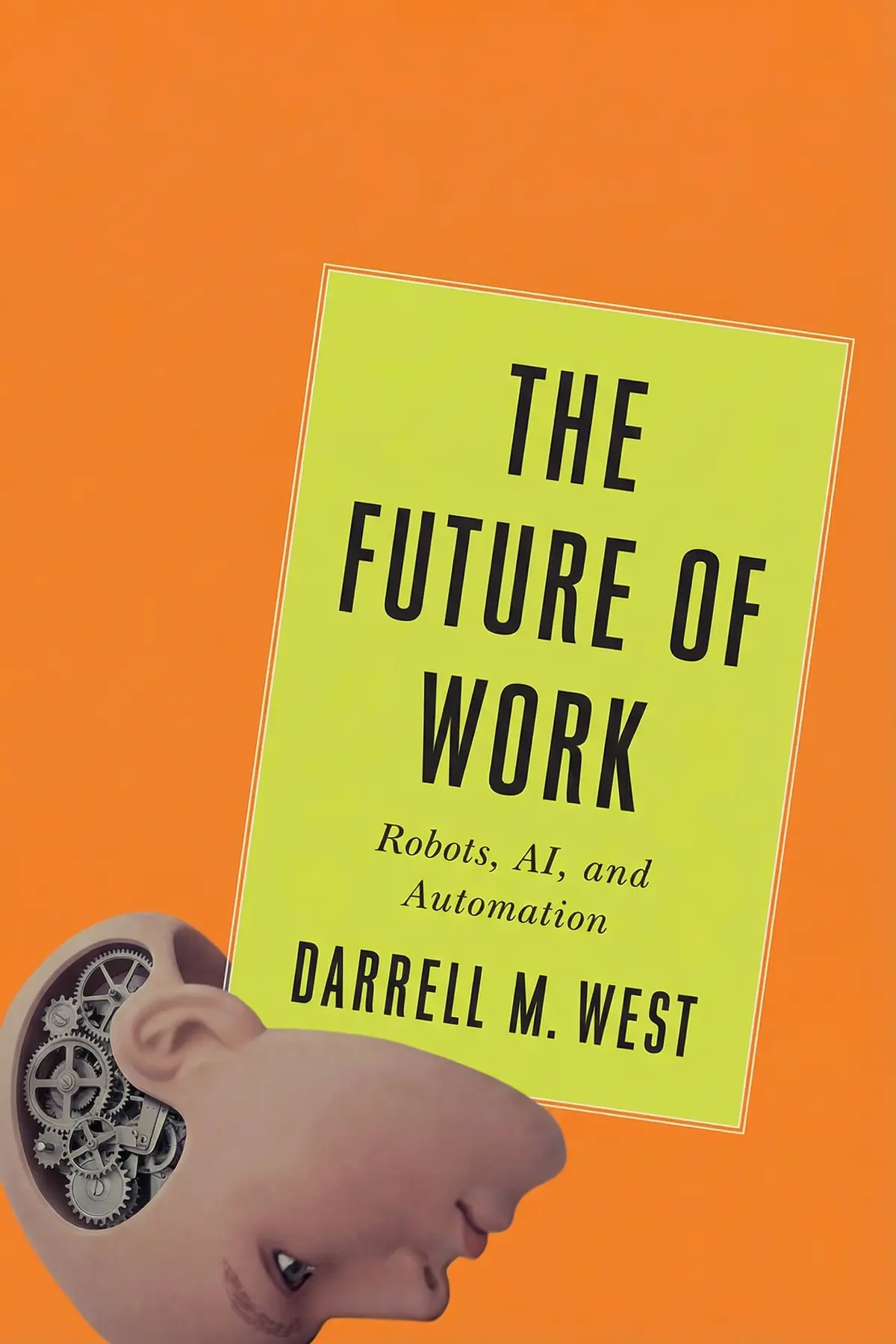
Darrell M. West examines the seismic shift toward an automated economy, exploring how AI and robotics necessitate a radical rethink of our social contracts, education systems, and the very meaning of work.
2 min 06 sec
Think for a moment about your daily routine. Perhaps you’ve seen a drone delivering a package, or maybe you’ve used a digital kiosk to order your lunch instead of speaking to a cashier. You might have noticed your car’s software helping you stay in your lane, or an algorithm suggesting exactly the right product for you to buy next. These aren’t just minor conveniences; they are the early ripples of a massive economic tidal wave. We are standing at the edge of a fundamental shift in how human beings exist within the economy.
In this exploration of the digital landscape, we are looking at the insights of Darrell M. West and his work, The Future of Work. West argues that we are currently undergoing a ‘megachange’—a transition every bit as profound as the shift from the farm to the factory over a century ago. But this time, the engine of change isn’t steam or electricity; it’s artificial intelligence, robotics, and hyper-connectivity.
The central throughline of this journey is the recognition that while technology brings incredible efficiency and potential prosperity, it also threatens to tear the existing social fabric if we don’t act. Our current systems—our schools, our healthcare, our taxes, and even our sense of identity—are all built for a world that is rapidly disappearing. To survive and thrive in this new digital economy, we have to do more than just update our software; we have to update our social contract.
Over the next few segments, we’ll explore how automation is moving from the factory floor to the office cubicle, why the very definition of a ‘job’ needs to change, and what political and social reforms are required to prevent a future of deep inequality and social unrest. This isn’t just a story about robots; it’s a story about us, and how we choose to build a society where technology serves humanity, rather than replaces it. Let’s look at how the foundations of our working world are being rebuilt from the ground up.
2 min 46 sec
Witness the transition from an industrial society to a digital one, where robots are no longer just tools but a more cost-effective and reliable alternative to human labor.
2 min 55 sec
Discover how artificial intelligence is moving beyond simple tasks to make complex decisions in finance and defense, raising urgent questions about bias and human safety.
2 min 31 sec
Explore how the fusion of 5G and ubiquitous sensors is turning our cities and bodies into data-driven systems, optimizing everything from traffic to healthcare.
2 min 37 sec
Question the traditional link between labor and identity as we move toward a future where human contribution might be found in art, parenting, and community service.
2 min 31 sec
Learn about ‘citizen accounts’ and the need for lifelong education to support a workforce that can no longer rely on traditional employer-provided benefits.
2 min 18 sec
Analyze why political polarization and a focus on old economic battles are preventing leaders from addressing the looming challenges of automation.
2 min 14 sec
Examine the need for political and electoral changes to ensure that the wealth of the digital age is shared and that the government remains responsive to the people.
2 min 12 sec
As we look back at the ground we’ve covered, the central message is clear: the digital revolution is not a distant possibility; it is an unfolding reality. The shift from an industrial economy to one driven by robots, artificial intelligence, and constant connectivity is the defining ‘megachange’ of our century. It promises levels of efficiency, precision, and medical advancement that were once the stuff of dreams. Yet, it also threatens the very foundations of how we live, work, and relate to one another.
We have seen how automation is fundamentally changing the business world, making human labor less central to production. We’ve explored how AI is beginning to take over complex decision-making, and how the Internet of Things is turning our physical world into a massive data-set. Perhaps most importantly, we’ve discussed the urgent need to redefine ‘work’ itself—moving away from a narrow focus on the forty-hour week and toward a broader appreciation for art, caregiving, and community service.
To navigate this, we cannot rely on the systems of the past. We need portable citizen accounts that provide security regardless of employment status. We need a commitment to lifelong learning that allows every person to adapt as technology evolves. And we need political systems that are transparent and truly democratic, ensuring that the immense wealth created by these new technologies isn’t hoarded by a tiny elite but is used to support the social fabric.
The future is not yet written. The technology itself is neutral; what matters is how we choose to use it. If we act now to update our social contract and our political institutions, we can create a world where automation leads to more freedom and more human connection. But if we wait, we risk a future of deep division and instability. The choice is ours to make, and the time to start building that ‘runway’ to the future is today. Let’s move forward with the understanding that while the machines are coming, our humanity is what must remain at the center of the economy.
The Future of Work is a deep dive into the technological revolution currently reshaping our global economy. Darrell M. West explores how the rapid rise of artificial intelligence, robotics, and the Internet of Things is moving us away from the industrial age and into a digital era. This transition, while promising efficiency and precision, poses significant threats to traditional employment structures and social stability. The book promises a roadmap for navigating this disruption. It argues that simply waiting for the market to correct itself is not an option. Instead, we must proactively redesign our social safety nets, modernize our political institutions, and broaden our cultural definition of what constitutes a valuable contribution to society. From the implementation of portable 'citizen accounts' to the importance of lifelong learning, West provides a comprehensive look at the reforms needed to ensure that the technological gains of tomorrow benefit the many rather than just the few.
Darrell M. West is a prominent political scientist and the vice president of Governance Studies at the Brookings Institution. With a career focused on the intersection of technology, policy, and society, he has authored several influential works. His previous titles include Billionaires: Reflections on the Upper Crust, published in 2014, and Megachange: Economic Disruption, Political Upheaval, and Social Strife in the 21st Century, which arrived in 2016. His work at Brookings highlights his commitment to understanding how modern governance can adapt to the challenges of the digital age.
Listeners find that although perspectives differ on whether the text provides fresh ideas beyond today's news, many value its broad analysis of how AI, automation, and the Internet of Things are altering conventional jobs. Additionally, they appreciate the inclusion of varied data and practical examples showing the likelihood of workforce displacement in areas such as finance and manufacturing. Furthermore, listeners highlight the author's progressive recommendations for social policy changes, like lifelong education and portable benefits, while one listener points out the book's perceptive look at how the healthcare industry might gain from such transitions.
After hearing about the inevitable robot uprising for years, I wanted a book that actually looked at the social infrastructure needed to survive it. West delivers exactly that with his focus on portable benefits and lifelong education. The way he explains the shift from traditional employment to a more fluid, digital economy is both brilliant and terrifying. It’s not just about robots taking jobs; it’s about how we value human contribution outside of a paycheck. He makes you realize that the safety net of the 20th century is completely inadequate for the 21st. The real-world examples from companies like Ford and McDonald’s provide a grounded perspective that balances out the more theoretical policy discussions.
Show moreThe chapter on healthcare alone is worth the price of admission for this book. West shows how AI and automation can actually lead to better patient outcomes by freeing up humans for the caring aspects of the job. It’s a refreshing take. In a genre that is usually filled with nothing but doom and gloom, this stands out. He backs up his claims with a wealth of diverse statistics that show the complexity of the current job market. The idea of portable benefits—social safety nets that follow the worker rather than being tied to an employer—is a policy shift that we desperately need to discuss. This isn’t just a tech book; it’s a blueprint for a more humane future.
Show moreAs someone who spends way too much time worrying about job security, this was an eye-opening read. West manages to weave together the impact of AI and the Internet of Things into a coherent narrative that feels urgent without being purely alarmist. I especially appreciated the deep dive into how healthcare might actually see improvements even as manufacturing jobs vanish. To be fair, some of the policy suggestions regarding portable benefits feel like a pipe dream given our current political climate. However, the data points regarding the decline in the worker share of income are impossible to ignore. It’s a solid, statistics-heavy look at why our old ways of thinking about 9-to-5 employment are essentially dead.
Show moreFinally got around to this one, and I was impressed by how West uses historical anecdotes to paint a picture of our shifting economy. The story about Walter Reuther at the Ford factory asking how robots would buy cars is a classic for a reason, and it fits perfectly here. While many authors just talk about tech, West specifically looks at how the digital economy disrupts everything from finance to the service industry. I found his argument for lifetime education to be the most compelling part of the entire book. We can't expect a four-year degree to last forty years anymore. My only real gripe is that he glosses over the 'now what' for people who might not have the aptitude for high-level STEM roles.
Show moreTo be fair, the statistics West pulls together from sources like the Bureau of Labor Statistics and the IMF are incredibly useful for anyone thinking about this topic. He avoids the trap of being too academic, keeping the prose lean and moving the reader through the various dominos of displacement. I was particularly struck by the quotes from tech CEOs like Andrew Puzder, who basically argued that machines are better employees because they never take vacations or sue for discrimination. It's a wake-up call. The book makes a strong case that we are at a turning point similar to the Industrial Revolution. While it’s heavy on US-centric politics towards the end, the global implications are made very clear.
Show moreLooking at the current economic landscape, it is clear that we are in the middle of a massive shift, and West captures that transition perfectly. He doesn't just focus on the machines; he focuses on the people and the systems that govern us. I appreciated the specific examples, like the McDonald's kiosks and the mentions of Harmony the sex doll, which make the theoretical threat of automation feel very real. The truth is, we are not prepared for the level of disruption coming our way. While I found the author’s tone a bit dry at times, the substance of his policy recommendations provides a necessary starting point for debate. It’s a comprehensive overview that manages to be both informative and unsettling.
Show moreDarrell West provides a decent enough overview of the automation crisis, but it frequently feels a bit repetitive. He hits all the major notes: AI displacement, political polarization, and the need for universal basic income or similar reforms. Look, the statistics are well-researched. However, the book lacks a certain spark that makes the reader feel like they’re discovering something truly groundbreaking. I found the section on the Internet of Things (IoT) interesting, especially regarding its application in smart cities. But the author’s optimism about political reform seems misplaced considering how gridlocked everything is right now. It’s a good primer. If you are new to the subject, buy it, but seasoned readers might find it a bit thin.
Show moreEver wonder why our political leaders seem so out of touch with the digital revolution? West explores this gap quite well, showing how political inaction is the biggest hurdle to a smooth transition into the automated future. This is serious. The book does a fine job explaining the Internet of Things and how it facilitates real-time monitoring of everything from health to infrastructure, which is a massive change from how things used to work just a decade ago. Personally, I would have liked more focus on the ethical dilemmas of AI-driven surveillance. The solutions offered—like rethinking work to include volunteering—are intriguing. They lack a roadmap. It’s a thought-provoking read, though it leaves you with more questions than answers.
Show moreThis book reads like a collection of news headlines that were hastily glued together. I was looking for a deep investigation into which specific jobs would be lost, but instead, I got a surface-level summary of things most people already know. Truth is, if you’ve been following tech news for the last five years, you won't find many new insights here. West spends too much time on the "what" and not nearly enough on the "how" or the "when." The writing feels dry and heavily padded with statistics that don’t always support his conclusions. Frankly, I expected more intellectual rigor from a Brookings scholar rather than a repetitive call for government-funded retraining.
Show moreA truly frustrating experience that left me feeling like I’d just read a long-winded government brochure. West clearly believes the state is the only answer to every problem, ignoring the fact that government inefficiency is often what holds us back in the first place. His proposals for reimagining work are just thinly veiled excuses for massive tax hikes and more bureaucracy. The book fails to define the actual technical limits of AI. It treats it instead as a magical force that will simply replace everyone overnight. Not gonna lie, I felt like I was being lectured by someone who hasn't stepped foot in a private-sector office in decades. It’s a waste of time for anyone looking for practical, market-based insights.
Show moreBarack Obama

Masaji Ishikawa
John Rawls
Yuval Noah Harari

Miles Taylor
AUDIO SUMMARY AVAILABLE
Get the key ideas from The Future of Work by Darrell M. West, plus 5,000+ more titles in English and Thai.







