
21 min 45 sec
The Innovation Stack: Building an Unbeatable Business One Crazy Idea at a Time
By Jim McKelvey
Discover how Jim McKelvey, cofounder of Square, built a world-changing company by solving a chain of impossible problems, ultimately creating a unique business model known as an Innovation Stack.
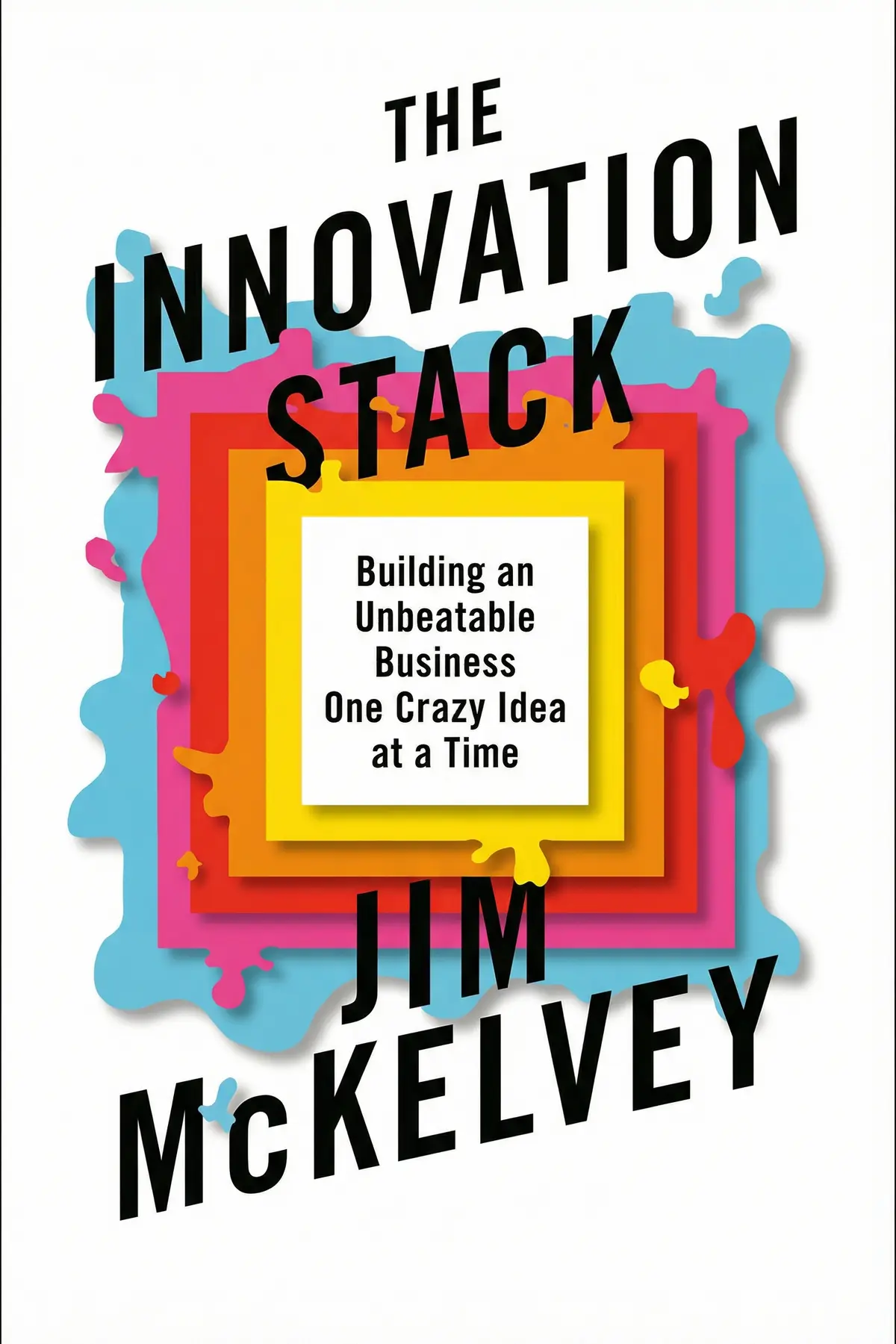
Table of Content
1. Introduction
1 min 45 sec
Imagine you are a glass artist, working in your studio, finally on the verge of selling a piece of work that has been collecting dust on your shelf for years. You’re excited to make the sale, but there is one problem: your customer wants to pay with a credit card you don’t accept. In that moment of frustration, you don’t just lose a sale; you find a calling. This is precisely how Jim McKelvey began the journey that would lead to the creation of Square, a company that revolutionized how the world handles money.
In this exploration of Jim McKelvey’s insights, we are going to look deep into what it actually means to be an entrepreneur. It is a word that gets thrown around a lot these days, applied to anyone who starts a side hustle or opens a franchise. But McKelvey argues that true entrepreneurship is something far more rare and much more demanding. It is the act of stepping outside the circle of what is known and comfortable to solve a problem that the rest of the world has ignored.
We will follow the evolution of what he calls an “innovation stack.” This isn’t a single invention or a clever marketing trick. It’s a series of interlocking solutions that arise because you are forced to solve one problem after another just to stay alive as a business. We’ll see how this stack allowed a small startup to take on the most formidable competitor on the planet—Amazon—and win. We’ll also look at historical examples of people who built these stacks long before the term existed, from the Wright brothers to the founders of the world’s largest banks.
By the end of this journey, you’ll understand why not knowing what you’re doing can actually be your greatest advantage, and why the most powerful businesses aren’t built on a master plan, but on a series of crazy ideas born out of absolute necessity. Let’s dive in and see how the world looks when you decide to stop copying and start creating.
2. Defining the True Entrepreneur
2 min 26 sec
Discover why most successful businesses are actually just clever copies of existing ideas, and learn how true entrepreneurs find success by venturing into the unknown wilderness beyond established industry boundaries.
3. The Power of the Perfect Problem
2 min 21 sec
Learn how a missed sale in a glass studio revealed a deep systemic flaw in the global financial system, proving that the best business ideas often start with simple, personal frustrations.
4. Innovation in the Pitching Process
1 min 58 sec
See how radical honesty and a willingness to highlight potential failure turned a standard investment meeting into a legendary success, winning over the toughest venture capitalists in Silicon Valley.
5. The Birth of the Innovation Stack
2 min 40 sec
Explore the concept of an innovation stack, where solving one problem leads to another, creating a chain of interlocking solutions that eventually become a company’s greatest competitive advantage.
6. Innovation as a Survival Mechanism
2 min 03 sec
Using the Wright brothers as a historical lens, see why true innovation is rarely about a single ‘aha’ moment and more about a desperate struggle to keep a vision from crashing.
7. Standing Firm Against the Giant
2 min 09 sec
Witness the David vs. Goliath battle between Square and Amazon, and discover why staying true to your unique ‘stack’ is more effective than trying to beat a competitor at their own game.
8. Learning from History: The Bank of Italy
2 min 14 sec
Discover how a produce vendor in 1901 used an innovation stack to create what is now Bank of America, proving that the principles of entrepreneurship are timeless.
9. The Advantage of Not Being an Expert
2 min 07 sec
Uncover the surprising truth that a lack of industry experience can be a founder’s greatest asset, allowing for radical solutions that ‘experts’ would be too afraid to try.
10. Conclusion
2 min 02 sec
As we wrap up our look at Jim McKelvey’s journey and the concept of the innovation stack, the most important takeaway is a shift in how we perceive the act of building. We often think of success as the result of a perfectly executed plan, but in the world of true entrepreneurship, success is the result of a perfectly handled series of crises. An innovation stack is not a design; it is a footprint. It is the record of a company that refused to die and, in the process of surviving, invented a new way of existing.
You have seen how Square didn’t just win by having a cool gadget; they won by creating an interlocking system of transparent pricing, simple hardware, and ease of use that was born from the struggle to serve those whom the world had forgotten. You’ve seen how giants like Amazon can be defeated not by matching their power, but by having a stack so unique and integrated that it cannot be stripped apart and copied.
So, what can you do with this? The most actionable advice is to lean into your fear. When you are doing something truly new, you will feel a constant sense of discomfort. You will feel like an impostor because you don’t have the ‘expertise’ that others seem to have. But remember: if you are truly exploring, no one is an expert. That discomfort is actually a sign that you are moving in the right direction—that you have left the safety of the city walls and are entering the wilderness where real change happens.
Find your ‘perfect problem’—the thing that bothers you so much you can’t ignore it. Don’t worry if you don’t have the answers yet. Start solving the first part of it. When that solution creates a new problem, solve that one too. Keep building your stack, brick by brick, born of necessity and survival. If you stay with it long enough, you won’t just have a business; you’ll have a fortress. The world doesn’t need more copyists; it needs more people willing to step into the unknown and build the next innovation stack. Now, it’s your turn to find a problem worth solving and start swiping.
About this book
What is this book about?
The Innovation Stack explores the fundamental difference between standard business operators and true entrepreneurs. While many successful businesses thrive by copying existing models, a true entrepreneur enters uncharted territory to solve problems that have no established solution. Using the founding story of Square as a primary example, the book illustrates how the necessity of survival leads to a series of interlocking inventions that eventually form an unbeatable competitive advantage. Readers will learn about the "problem-solution-problem" chain, where solving one hurdle inevitably creates a new one, requiring even more creativity. The book examines historical figures like A.P. Giannini and the Wright brothers to show that innovation stacks are not planned but evolved through grit and necessity. Ultimately, the book provides a roadmap for anyone looking to build something entirely new, emphasizing that a lack of industry expertise can actually be a secret weapon when facing a perfect problem.
Book Information
About the Author
Jim McKelvey
Jim McKelvey is a serial entrepreneur and inventor. In 2009, he cofounded Square, the acclaimed financial-payments company that’s now worth upward of $100 billion. In 2016, he founded Invisibly, which powers micropayments for online content. Before his entrepreneurial escapades, McKelvey made his living as a glass artist.
Ratings & Reviews
Ratings at a glance
What people think
Listeners find the content very accessible and amusing, with one listener observing that it breaks away from the usual business book structure. Beyond that, the writing is skillfully executed, and listeners enjoy the infusion of humor. The text provides useful perspectives, as one listener stresses its utility for founders, and listeners prize the way it broadens their understanding of entrepreneurial methods. Additionally, the narrative is quite absorbing, with one listener even comparing the story to a mystery novel.
Top reviews
Por
This book reads like a fast-paced narrative rather than a dry business manual. McKelvey manages to turn the story of a small card reader company defeating the Amazon behemoth into something that feels like a thriller. The 'Innovation Stack' concept is a brilliant way to explain why some companies are simply uncopyable even when a giant tries to clone them. I particularly enjoyed the self-deprecating humor and the realization that solving one tiny problem often forces you to solve twenty more. It’s an eye-opening perspective for anyone tired of the usual jargon that fills most startup guides. If you want a book that teaches you how to think through impossible hurdles, this is it. It’s easily the most entertaining business book I have picked up all year.
Show morePhichai
Picked this up on a whim and ended up finishing it in two sittings because the storytelling is just that infectious. It’s refreshing to read a business book where the author admits they had no idea what they were doing half the time. McKelvey’s journey from glassblowing to co-founding Square is told with a level of wit that makes complex economic theories actually digestible. The way he describes the 'perfect problem' changed how I look at market gaps entirely. Truthfully, it feels more like a mystery novel where you’re trying to figure out the secret sauce alongside the protagonist. While some might find his definition of entrepreneurship a bit narrow, the insights into building a resilient organization are gold. Highly recommended for founders who feel like they're drowning in regulations.
Show moreTakeshi
Wow, I wasn't expecting a book about credit card processing to be this entertaining. McKelvey has a gift for taking mundane business decisions and showing how they are actually radical acts of survival. The 'Innovation Stack' isn't a single invention, but rather a chain reaction of fixes that eventually creates a whole new category. I found the section on 'perfect problems'—those underserved markets that the big guys ignore—to be particularly inspiring. The writing is punchy, funny, and surprisingly humble despite the massive success of Square. It challenges the 'move fast and break things' mantra with a more thoughtful approach to systemic problem-solving. Every aspiring founder needs to grasp these concepts before they start pitching their next big idea.
Show moreTeng
Finally got around to reading this and I’m kicking myself for waiting so long. It’s rare to find a business book that doesn't follow the standard template of 'anecdote, lesson, checklist.' Instead, you get a wandering, honest exploration of what it means to build something truly new. The humor is spot-on, and the way McKelvey breaks down the 'virtuous cycle' of IKEA is masterclass-level strategy. It really opened my mind to the idea that the best businesses are often built out of desperate necessity rather than grand vision. The prose is well-crafted and keeps you moving through the technical bits without ever feeling like a chore. This is the kind of book you want to give to every friend who has a 'great idea' but is afraid to start.
Show moreSuphan
Look, the history lessons provided here are worth the price of admission alone. It’s fascinating to see the parallels between A.P. Giannini’s early banking days and a modern tech startup. McKelvey proves that 'Innovation Stacks' are a timeless phenomenon, not just a Silicon Valley buzzword. The writing is incredibly readable, and the author’s voice is genuinely likable, which is a rarity in this genre. I loved the concept that solving a problem for an unserved customer naturally leads to a series of innovations that become impossible for a competitor to copy. It’s a very optimistic take on the power of entrepreneurship to actually improve society. Highly informative and entertaining from cover to cover.
Show moreGame
Ever wonder why some startups thrive while massive incumbents fail to replicate their success? Jim McKelvey provides a compelling answer through his theory of interlocking solutions that form a defensive perimeter. The writing is snappy and avoids the usual 'ten steps to success' fluff that plagues the genre. I found the distinction he makes between a 'businessman' and a 'true entrepreneur' to be quite profound and somewhat controversial. However, some of the analogies felt a bit stretched, and the constant focus on the Square vs. Amazon narrative bordered on self-congratulatory at times. Still, the historical deep dives into Southwest and IKEA make the core thesis feel much more robust and universal. It’s definitely worth a read for the mental models alone.
Show moreIvan
As someone who has slogged through countless strategy books, I found this to be a breath of fresh air. Instead of preaching from a pedestal, the author uses a conversational tone to explore why some companies develop a 'stack' of unique innovations. The case study on Bank of America’s early days was a highlight for me, showing that these patterns aren't just limited to tech. To be fair, the book does wander into some strange tangents that don't always pay off, but the central message remains strong. I loved the idea that being first isn't as important as building a series of dependent solutions that competitors can't untangle. It’s a messy, honest look at what it actually takes to survive in a cut-throat industry.
Show moreMaya
Not what I expected at all, but in a good way. The book is less about 'how to build an app' and more about the philosophy of expanding markets through radical accessibility. McKelvey’s explanation of the 'unguarded economic border' is a great mental model for finding new opportunities. I gotta say, the story of how they essentially forced the credit card companies to change their rules was pretty badass. It’s a nice reminder that regulations are often just roadblocks waiting for someone with enough audacity to push through. My only gripe is that the author’s definitions can be a bit rigid, making it seem like his way is the only 'true' way to innovate. Still, the entertainment value alone makes it worth it.
Show moreTaw
Frankly, the core idea here is interesting but probably could have been summarized in a lengthy blog post. While the writing is undeniably witty and engaging, I felt like I was being sold the Square origin story for the hundredth time. The 'Innovation Stack' feels like a clever rebranding of established concepts like value chains or competitive moats, just with more 'startup-y' language. There are some great nuggets of wisdom, especially regarding the regulatory hurdles they faced, but they are buried under a lot of fluff. I also struggled with the author’s tendency to frame luck as purely a result of his specific philosophy. It's a decent read for inspiration, but don't expect a step-by-step roadmap for your own business.
Show moreUbolrat
To be honest, the chapter on 'perfect problems' had some merit, but the rest of the book felt like a rambling justification for success. McKelvey constantly plays up the 'scrappy underdog' trope, conveniently downplaying the massive advantages of having Jack Dorsey as a co-founder. I found the tone to be a bit cringey at times, especially with phrases like 'squaring up' appearing more often than necessary. Most of the 'innovations' he lists are just standard business decisions viewed through the rosy lens of hindsight. If you've read your fair share of Drucker or Christensen, you won't find much that's truly revolutionary here. It feels like a high-production-value sales pitch for his own ego rather than a helpful guide. I’d skip this one.
Show moreReaders also enjoyed
7 Powers: The Foundations of Business Strategy
Hamilton Helmer

Alibaba: The House That Jack Ma Built
Duncan Clark
Being Boss: Take Control of Your Work and Live Life on Your
Kathleen Shannon
Better and Faster: The Proven Path to Unstoppable Ideas
Jeremy Gutsche
AUDIO SUMMARY AVAILABLE
Listen to The Innovation Stack in 15 minutes
Get the key ideas from The Innovation Stack by Jim McKelvey, plus 5,000+ more titles in English and Thai.
- 5,000+ titles
- Listen as much as you want
- 7-day free trial
- Cancel anytime







