
59 Seconds: Change Your Life in Under a Minute
Richard Wiseman
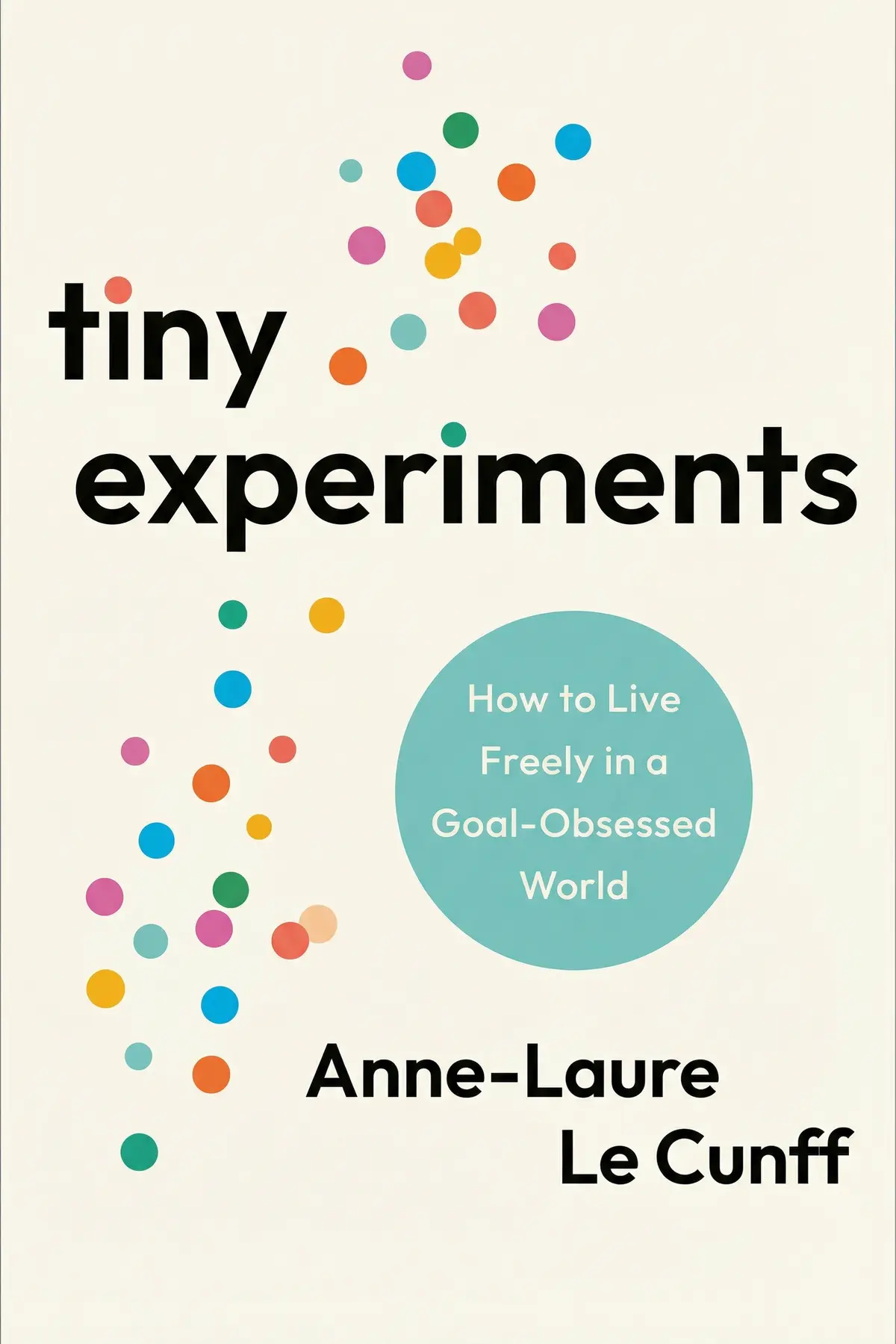
Tiny Experiments reveals how to navigate uncertainty and achieve sustainable growth by swapping rigid goals for small, curiosity-driven trials that prioritize learning, energy management, and immediate impact over long-term perfection.
1 min 33 sec
In our modern world, we are often told that the only way to succeed is to have a crystal-clear vision of where we want to be in five or ten years. We are taught to set massive goals, create rigid roadmaps, and march toward them with unwavering focus. But what happens when the road suddenly disappears? For many, life doesn’t follow a predictable, straight line. You might be a high-achiever who reaches the top of the mountain only to find the view feels empty. You might be someone facing a sudden change in health, a career pivot, or simply a nagging sense that your current path is someone else’s dream.
These moments of uncertainty are usually treated as crises to be resolved as quickly as possible. We feel an intense pressure to find the “right” answer immediately. However, there is a different way to look at these in-between spaces. Instead of seeing uncertainty as a void to be filled, you can see it as a laboratory to be explored. This is the heart of the throughline we will explore: the shift from a goal-obsessed mindset to an experimental one.
In this summary, we will walk through a practical system for navigating life’s transitions. You will learn how to replace the heavy weight of permanent decisions with the light, flexible structure of tiny experiments. We’ll look at how to manage your energy rather than just your time, how to embrace being intentionally mediocre in some areas to excel in others, and how to turn every mistake into a data point for your next move. By the end, you’ll see that growth isn’t about reaching a final destination; it’s about the continuous, joyful process of discovery that happens when you treat your life as a series of small, meaningful trials.
2 min 03 sec
Discover why traditional goals often lead to paralysis and how small, duration-based commitments can help you build momentum without the fear of long-term failure.
2 min 12 sec
Learn to move beyond the rigid tick of the clock and align your work with your body’s natural rhythms and qualitative moments of deep focus.
1 min 56 sec
Explore why trying to be perfect in every area of life is a recipe for burnout and how choosing to be mediocre can lead to excellence.
2 min 03 sec
Discover how to turn every action into a learning opportunity by implementing simple reflection tools that bridge the gap between doing and growing.
2 min 00 sec
Learn how to decide whether to keep going, take a break, or change direction once an experiment concludes, avoiding the trap of mindless consistency.
1 min 43 sec
Find out how sharing your experiments and focusing on immediate contributions can attract unexpected opportunities and foster a more fulfilling life.
1 min 55 sec
Understand how the cumulative power of tiny experiments leads to a life of freedom and authenticity that isn’t dependent on external achievements.
1 min 37 sec
As we wrap up our journey through the world of Tiny Experiments, the core message remains clear: the most effective way to navigate a complex, changing world is not to plan more rigidly, but to experiment more freely. We’ve seen how replacing overwhelming goals with simple, time-bound pacts can break the cycle of paralysis. We’ve explored the importance of honoring our natural energy rhythms and the qualitative power of Kairos over the quantitative tick of the clock.
We’ve learned that perfection is often the enemy of progress, and that strategic mediocrity can give us the space we need to truly excel where it matters. Through reflection loops like the Plus Minus Next framework, we’ve seen how to transform every experience into a step forward. And finally, we’ve discussed how to increase our surface area of luck by focusing on generativity and sharing our work with the world.
Now, the laboratory is yours. You don’t need a massive life overhaul to start. You don’t need to quit your job or move to a new city. All you need is one small curiosity and a commitment to try something for a few days. Ask yourself: what is one tiny experiment I could start today? What is one pact I can make with myself for the next ten days?
Remember, the goal isn’t to find the final answer to your life; it’s to stay in the game of discovery. By treating your life as a series of experiments, you replace the fear of the unknown with the excitement of what’s next. You move from a life of “what if” to a life of “let’s see.” And in that shift, you find the freedom to grow, to adapt, and to live with purpose in a goal-obsessed world.
In a world obsessed with five-year plans and fixed destinations, Tiny Experiments offers a refreshing alternative: the experimental mindset. This book explores how to transform the anxiety of uncertainty into a systematic process of self-discovery through what the author calls "pacts"—small, manageable commitments to action. By focusing on qualitative time, strategic imperfection, and continuous reflection loops, readers learn how to build momentum without the crushing weight of perfectionism. The book provides a framework for managing cognitive and emotional resources while moving toward a life of generativity, where making a positive contribution today is more important than building a distant legacy. It is a guide for anyone feeling stuck, burnt out, or ready to explore new possibilities through low-risk, high-reward trials.
Anne-Laure Le Cunff is a neuroscientist, entrepreneur, and writer known for her work on mindful productivity and personal development. She’s the founder of Ness Labs, a platform dedicated to neuroscience-based learning and creativity.
Listeners find this work to be both motivating and perceptive, featuring evidence-based material that provides tangible steps for self-improvement. They value the focus on trial and error, as one listener points out how it helps transform uncertainties into experiments. The text is accessible, pleasing, and efficient; one review emphasizes that it delivers the necessary equipment to master flow. Listeners prize the practical nature of the advice, with one noting that every chapter offers actionable takeaways that stick.
This book arrived at exactly the right time when I was feeling paralyzed by the pressure of massive life goals. Anne-Laure Le Cunff takes her neuroscience background and turns it into a very practical manual for anyone scared of failing. Instead of the usual corporate fluff, she treats life like a laboratory where every setback is just data. To be fair, some sections felt a bit like a textbook, but the PACT framework is genuinely useful for breaking out of a creative slump. I loved the idea of turning my paralyzing doubts into small, manageable experiments. It’s less about perfection and more about flow. I’ve already implemented three of her suggestions and feel more productive than I have in months.
Show moreAs someone who has struggled with burnout for years, Le Cunff’s perspective on iterative progress felt like a breath of fresh air. She doesn't promise massive overnight changes. The truth is, most of us just need a way to make small improvements without feeling overwhelmed by the 'productivity' cult. The writing is clear and the tone is incredibly empowering. I've already started my first 'tiny experiment' with my morning routine, and the results are promising. It’s rare to find a self-improvement book that feels both rigorous and compassionate. If you’re feeling stuck on the career ladder and want to reclaim your curiosity, buy this book.
Show moreThe chapter on reframing failure as data changed my entire approach to my side project. For years I’ve been terrified of starting because I didn't want to mess up, but this book gave me the tools to view every setback as a learning opportunity. It’s a very practical guide that focuses on empowering the reader through experimentation. While it’s in a crowded field alongside James Clear, I think the 'experiment' mindset is more forgiving than the 'habit' mindset. Not gonna lie, the French-accented narration in the audiobook was a bit slow for me, so I switched to the physical copy. It's a much better experience in print where you can highlight the actionable steps. Truly transformative for my daily productivity.
Show morePicked this up on a whim and was pleasantly surprised by the depth of the research. Anne-Laure Le Cunff avoids the usual clichés of the genre by rooting her advice in neuroscience. This isn't just a pep talk; it’s a manual for personal growth that respects the complexity of the human brain. I particularly enjoyed the sections on overcoming the fear of disruption and building social connections. It provides a structured way to handle uncertainty, which is something we all need in 2025. Every chapter offers actionable takeaways that stick with you long after you close the cover. It’s a 5-star read for anyone looking to reclaim their agency in a chaotic world.
Show moreFinally got around to reading 'Tiny Experiments' and I appreciate the shift from rigid habits to curious testing. The author doesn't just tell you to 'follow your dreams' blindly. Instead, she provides a research-backed method to test those dreams before you blow up your life. In my experience, the iterative approach is much more sustainable than trying to change everything overnight. Every chapter has actionable takeaways that stick with you. It's an easy, enjoyable read that actually yields results if you’re willing to do the work. The only downside was that the pacing felt a bit uneven in the middle chapters, but the conclusion ties everything together beautifully.
Show moreNot what I expected, but in a good way. I thought this was going to be another book on how to be a more efficient worker bee. Instead, it’s a deep dive into how to build a meaningful life through trial and error. Some might find it a bit basic if they’ve read a lot of self-help, but for me, the simplicity was the point. It strips away the jargon and gives you a framework to actually do things. It's insightful, empowering, and highly recommended for anyone feeling demotivated. The author manages to turn complex neuroscience into something you can actually use while drinking your morning coffee.
Show moreTo be fair, the self-help market is incredibly crowded, so finding a new angle is tough. This book manages it by focusing on the 'experiment' as the unit of change rather than the 'habit.' It’s a subtle but powerful difference that makes the advice feel much more attainable. While I agree with some other reviewers that the organization can feel repetitive in spots, the practical guidance is top-notch. It helped me step off the corporate hamster wheel and start thinking about my career in a much more creative way. It’s an easy, enjoyable, and ultimately productive read. Not exactly a reinvention of the wheel, but a very polished and scientific version of it.
Show moreAfter hearing all the buzz about Ness Labs, I had high hopes for this one, but it ended up being a bit of a mixed bag for me. While the core philosophy is sound, the book feels a bit cluttered with excessive examples that don't always land. Frankly, I missed some of the more practical tools she usually mentions online, like the Eisenhower Matrix or interstitial journaling. It’s a decent read if you’re trapped in the corporate hamster wheel and need permission to try something new, but it didn't feel revolutionary. Look, it’s better than most generic productivity books, but it lacks the punch of something like Atomic Habits. It’s a good introductory text, but seasoned self-help readers might find it a bit repetitive.
Show moreEver wonder why some productivity books feel like they’re written for people with no actual responsibilities? This one almost falls into that trap by occasionally ignoring the role of luck and privilege in success, but it redeems itself through its scientific grounding. Anne-Laure’s PhD in neuroscience adds a layer of credibility that many 'gurus' lack. I found the PACT framework helpful, though the middle of the book gets a bit repetitive with its anecdotes. Personally, I think it’s a great companion to Four Thousand Weeks, but it isn't quite the life-changing manifesto it claims to be. It’s not a magic spell for success, but it is a solid toolkit for better decision-making.
Show moreFrankly, I found the structure a bit cluttered with too many underdeveloped examples that felt like they were there just to fill space. The core idea—that we should test our lives in small increments—is excellent, but it could have been a long essay rather than a full book. I was hoping for more on the Wayfinder mindset, which was barely touched upon compared to her workshops. However, the author’s enthusiasm is contagious and her academic background shines through. To be fair, if you are new to the world of productivity and want something less 'hustle culture' and more 'curiosity culture,' this is a solid entry point. Just don't expect a revolution.
Show moreRichard Wiseman
William B. Irvine
Andrew D. Thompson
Deepak Chopra
AUDIO SUMMARY AVAILABLE
Get the key ideas from Tiny Experiments by Anne-Laure Le Cunff, plus 5,000+ more titles in English and Thai.







