
A Year with Peter Drucker: 52 Weeks of Coaching for Leadership Effectiveness
Joseph A. Maciariello
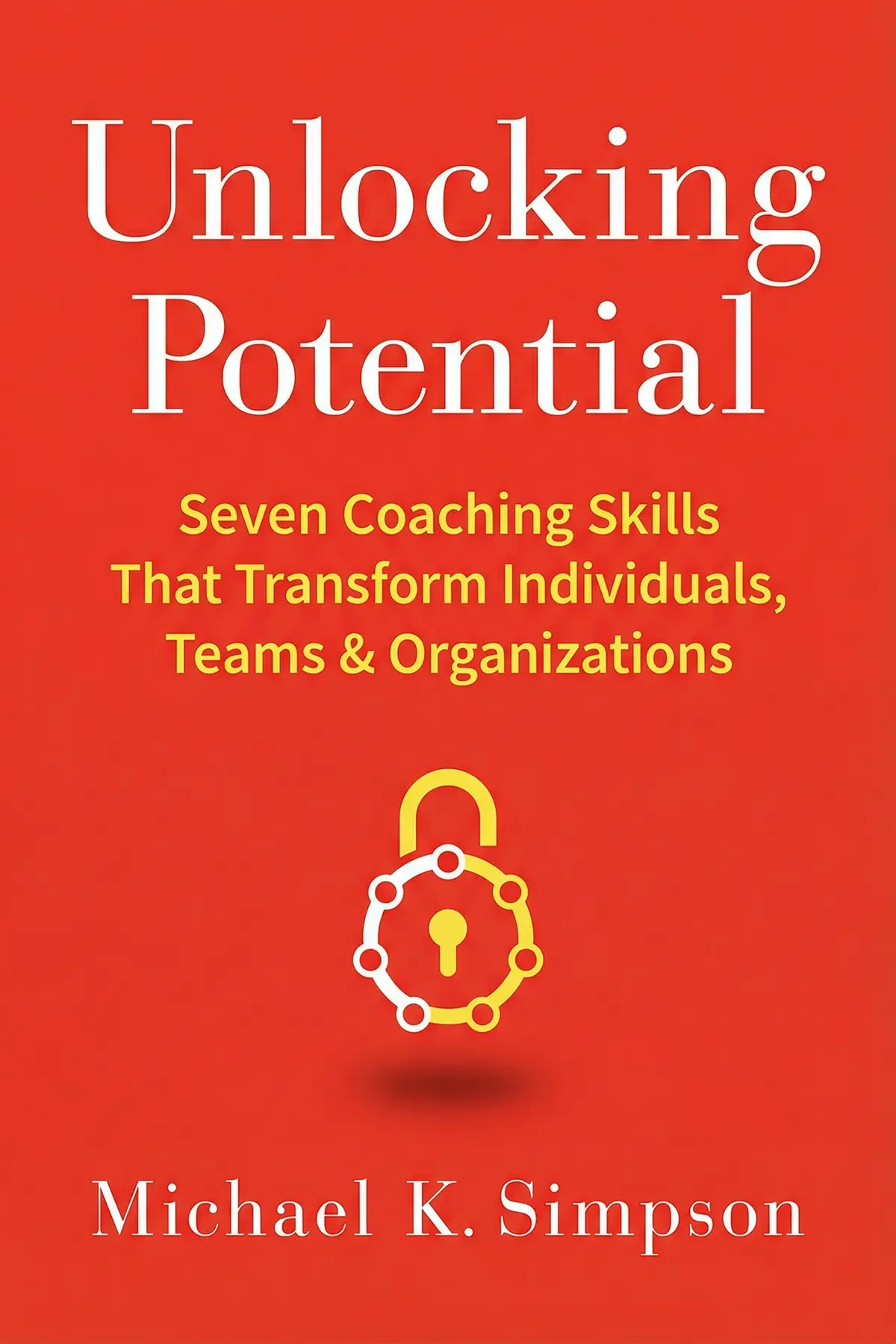
Unlocking Potential explores how leaders can transform their teams by adopting a coaching mindset. Michael K. Simpson details seven essential skills focused on trust, core values, and effective communication to drive organizational growth.
1 min 35 sec
In the modern professional landscape, the only constant is change. Organizations that survive and thrive are those that can adapt, and that adaptation starts with the people on the front lines. As a leader, you are likely feeling the pressure to keep your team’s skills sharp and their motivation high. However, there is a significant gap between wanting your team to grow and actually facilitating that development. Many leaders fall into the trap of simply giving orders or providing expert advice, but these traditional methods often fail to spark true innovation or long-term engagement.
This is where the transformative power of coaching comes into play. The core message of Unlocking Potential is that leadership is not about having all the answers; it is about asking the right questions. When you shift your perspective from being a supervisor to being a coach, you begin to see your employees not as resources to be managed, but as individuals with untapped capabilities waiting to be released. This shift can turn an average department into an exceptional powerhouse in a remarkably short window of time.
In the following sections, we will explore the foundational principles that allow a coach to build deep trust and facilitate genuine commitment. You will learn why the most impactful feedback is often the kind that employees give themselves and why aligning personal values with professional tasks is the secret to sustained productivity. By the end of this journey, you will have a clear framework for navigating the daily whirlwind of business while keeping your eyes on the long-term potential of every person you lead. Let’s begin by looking at the bedrock of this entire approach: trust and the belief in human growth.
1 min 57 sec
Building a successful coaching relationship requires more than just technical knowledge; it demands a deep-seated belief in human capability and a secure foundation of mutual honesty.
1 min 43 sec
Trust isn’t just about being a nice person; it requires a delicate balance of personal integrity and professional skill to truly inspire a team.
1 min 42 sec
Our internal views of reality often dictate our external performance. Learn how a coach can help identify and reshape these limiting perspectives.
1 min 25 sec
Lasting change cannot be forced from the outside. Discover why asking powerful questions is the key to creating self-sustaining motivation.
1 min 31 sec
Execution is about more than just hard work; it is about finding the mental space where productivity feels natural and effortless.
1 min 31 sec
Success in the workplace is often unsustainable if it comes at the cost of personal fulfillment. Learn to harmonize these two essential spheres.
1 min 23 sec
It’s easy to get lost in urgent, day-to-day demands. Here’s how coaches help their teams stay committed to long-term strategic goals.
1 min 27 sec
Feedback is a vital tool for growth, but its impact depends heavily on how it is delivered. Discover the technique that ensures it is actually heard.
1 min 28 sec
The biggest opportunity for organizational growth lies not with the top stars or the low performers, but with the massive group in between.
1 min 23 sec
As we have seen, the path to unlocking potential is not paved with more management, but with better coaching. It begins with the fundamental realization that every person on your team possesses talents and capabilities that may not yet be visible on the surface. By building a culture rooted in deep trust and credibility, you create the safety necessary for people to take risks and challenge the paradigms that hold them back.
Remember that your most powerful tools are your questions. By asking instead of telling, you foster a sense of internal commitment and ownership that no external incentive can match. You help your team find their flow, navigate the whirlwind of daily demands, and align their professional output with their personal missions. This holistic approach ensures that growth is not just a temporary spike in productivity, but a sustainable evolution toward excellence.
The most important takeaway is to start where the impact is greatest. Don’t just focus on the outliers; look to the broad middle of your organization and offer them the coaching they need to blossom. Stop micromanaging and start empowering. When you step back and allow your team to lead themselves toward the goals you have co-created, you don’t just improve your business outcomes—you transform the very lives of the people who make those outcomes possible. Now, take a moment to consider: who on your team is waiting for their potential to be unlocked, and what is the first question you will ask them?
Have you ever wondered why some teams consistently exceed expectations while others remain stuck in mediocrity? Unlocking Potential argues that the difference lies in leadership style. Instead of merely managing or consulting, effective leaders must become coaches who identify and nurture the latent talents of their employees. This book provides a roadmap for this transformation, focusing on values-based leadership and the creation of a high-trust environment. The promise of this guide is a total shift in how you interact with your colleagues. By mastering seven specific coaching skills, you can move away from the exhausting cycle of micromanagement and toward a culture of self-motivated execution. It is about aligning personal missions with professional goals, ensuring that every individual feels empowered to contribute their best work toward a shared vision of success.
Michael K. Simpson is a highly respected executive coach with over 25 years of experience partnering with some of the most prominent businesses across the globe. He is a published author whose other notable works include Ready, Aim, Excel and Your Seeds of Greatness.
Listeners find this work to be a useful introductory manual for nurturing leadership abilities, although some listeners believe the material rehashes ideas from other popular business books. There is praise for the organized models, such as the four coaching principles, which offer a functional strategy for establishing trust and driving results. Furthermore, the provided sample questions and case studies assist listeners in implementing these techniques within their professional groups. The idea of "moving the middle" is frequently cited as a standout feature; specifically, one listener remarked that it offers an "eye-opening" viewpoint on prioritizing average employees to achieve lasting success.
After hearing a lot about the '80/20 rule' in management, Simpson’s take on 'Moving the Middle' felt like a genuine revelation for my leadership style. Instead of obsessing over the superstars who might leave anyway, he argues for lifting the bulk of the team to drive long-term success. It is a truly compelling shift in perspective. The book is divided clearly into four principles—Trust, Potential, Commitment, and Execution—which provide a structured roadmap that I actually found useful during our quarterly reviews. While some might say the advice on building trust is basic, the way he ties it to 'challenging paradigms' creates a cohesive system. I really appreciated the specific coaching questions he provides; they are much more tactical than the vague platitudes you find in most business books. Truth is, if you are looking for a practical guide to stop micromanaging and start developing talent, this is a top-tier resource. It’s concise, well-organized, and emphasizes the human element of execution.
Show moreThe chapter on strategic clarity alone justified the purchase price for me. As a small business coach for nearly ten years, I can attest that the lessons Simpson shares are foundational for anyone trying to build a high-performing culture. He breaks down the Seven Coaching Skills in a way that is both professional and accessible. Tapping into talent and moving the middle are concepts that my clients struggle with every single day. The truth is that most leaders focus on the 'problem children' or the 'rockstars' while the heart of the company gets ignored. Simpson provides a brilliant framework to fix that imbalance. I didn't find the writing to be poor at all; instead, it felt direct and focused on results rather than flowery language. This is essentially gospel for coaches who want to see their teams execute flawlessly without the need for constant micromanagement.
Show moreWow, what a refreshing take on talent development that doesn't just circle back to standard micromanagement tactics. I've been looking for frameworks like these to help my department transition into a more collaborative environment. We are all coaches now, whether we know it or not, and this book shows you how to embrace that role effectively. The section on challenging paradigms was particularly useful for our creative team. It pushed us to look at our existing workflows through a different lens. Simpson makes it clear that the responsibility for change ultimately lies with the employees, but the coach provides the tools and the clarity needed to succeed. Not gonna lie, I was skeptical about another business book, but the focus on integrity and potential really won me over. It’s a brilliant guide for any level of leadership.
Show morePicked this up during a transition into a leadership role, and it served as a solid compass for my first few months. The four principles of coaching—Trust, Potential, Commitment, and Execution—are easy to remember and even easier to explain to my own team. I especially liked the section on 'strategic clarity' because it helped me realize I wasn't being nearly specific enough with my expectations. Personally, I found the real-world examples and the focus on 'Execution' to be the strongest parts of the book. It avoids the dreaded 'corporatespeak' that usually makes these management guides feel like a chore to finish. While some of the Seven Skills felt a bit like common sense, having them laid out in this specific order makes for a great reference guide. I would have liked a companion website for the forms mentioned, but the core message is strong enough to stand alone.
Show moreAs someone who grew up playing competitive sports, the analogy Simpson uses between the sideline coach and the business lead clicked instantly. In sports, the coach can’t actually run the plays; they have to rely on the players to execute the vision. This book treats the office the same way, emphasizing that workers today don't want to be micromanaged. They want a project, a deadline, and the trust to get it done. The Seven Skills provide a great roadmap for building that kind of environment. I particularly appreciated the focus on honesty and integrity as the foundation of 'Trust.' While the book does lean on some familiar concepts from other authors, the structure makes it much more actionable for a busy supervisor. It's a quick read that functions as a great reminder of the power of asking the right questions.
Show moreFinally got around to reading this, and I was pleasantly surprised by the list of specific coaching questions included in the later chapters. Many leadership books stay in the clouds, but this one actually gets down into the dirt of daily interactions. The framework of 'Trust, Potential, Commitment, and Execution' is a helpful way to diagnose where a team is currently struggling. If your team isn't performing, you can usually trace it back to a breakdown in one of those four areas. I also found the 'Move the Middle' strategy to be an eye-opening perspective on long-term growth. Investing in the average performers ensures that your organization doesn't collapse if a few top-tier talents decide to leave for other opportunities. It’s a pragmatic, real-world approach that avoids the nonsense buzzwords found in most modern business literature.
Show moreThis book offers a highly structured approach to what can often feel like a very abstract 'soft skill.' By breaking coaching down into the 4 principles and 7 skills, Simpson gives you a checklist to ensure you aren't missing any critical steps in talent development. It is a good reminder of the power of questions and how nothing trumps honesty in a professional relationship. While the prose isn't exactly 'delightful,' it is functional and easy to digest. I think the comparison to Jim Collins is fair, but Simpson adds enough of his own coaching flavor to make it worth the read. The advice on giving effective feedback was particularly helpful for our mid-level managers who often struggle with being too vague. It’s a solid, four-star guide that delivers exactly what the subtitle promises without overcomplicating the message with useless corporate jargon.
Show moreEver wonder if there's actually a significant difference between being a traditional manager and being a coach? Simpson tries to bridge that gap here, though the result feels more like a standard management handbook than a revolutionary coaching manual. The advice isn't much different from what you would find in any entry-level leadership course. The 'Move the Middle' concept is the only truly fresh perspective in the entire text. It’s a good reminder that our average performers often represent our greatest untapped potential if we just give them the right attention. However, the rest of the book relies heavily on established frameworks that feel a bit dated in the modern workspace. It is a decent, middle-of-the-road read that works well as a refresher for veteran leaders but likely won't blow anyone’s mind with original theories or groundbreaking prose.
Show moreTo be fair, I expected a bit more depth from a seasoned expert like Simpson, but this felt like a virgin text that never saw an editor. The prose is clunky, and at times, it feels like an amazing percentage of the book is just unnecessary filler used to stretch ideas. Most of the content is a clear repackaging of ideas already mastered by Stephen Covey or Jim Collins. If you've read 'The 7 Habits' or 'Good to Great,' you won’t find many new insights here. He gives you a list of coaching questions, but frankly, you could find more nuanced prompts with a five-minute Google search. I was hoping for deep strategies on 'moving the middle,' but the book remains disappointingly shallow on the actual implementation. It’s not a total waste of time for an absolute beginner, but for anyone who has been in management for more than a year, it’s mostly redundant.
Show moreNot what I expected at all, especially given the hype around these specific coaching frameworks. My imagination failed me while trying to find value in what essentially felt like a collection of recycled blog posts. The book covers lots of fundamental facts about talent development to an amazingly shallow level of detail. It is not enough to convince skeptics and offers zero new insights to those already familiar with leadership basics. Plus, the writing style is incredibly distracting and feels like it skipped the final proofreading stage entirely. You can explain business concepts and still delight your reader with decent prose, but Simpson fails to do either here. Save your money and just search for 'coaching questions' online. You'll get the same list of bullets without having to slog through pages of repetitive filler that adds nothing to the conversation.
Show moreJoseph A. Maciariello


Deborah Gruenfeld
Mike Michalowicz
Hamilton Helmer

Margaret Heffernan
AUDIO SUMMARY AVAILABLE
Get the key ideas from Unlocking Potential by Michael K. Simpson, plus 5,000+ more titles in English and Thai.







