

23 min 37 sec
Valley of Genius: The Uncensored History of Silicon Valley (As Told by the Hackers, Founders, and Freaks Who Made It Boom)
By Adam Fisher
Explore the vibrant, unfiltered history of Silicon Valley through the personal accounts of the eccentrics and visionaries who built the digital world, from the first video games to the social media giants.
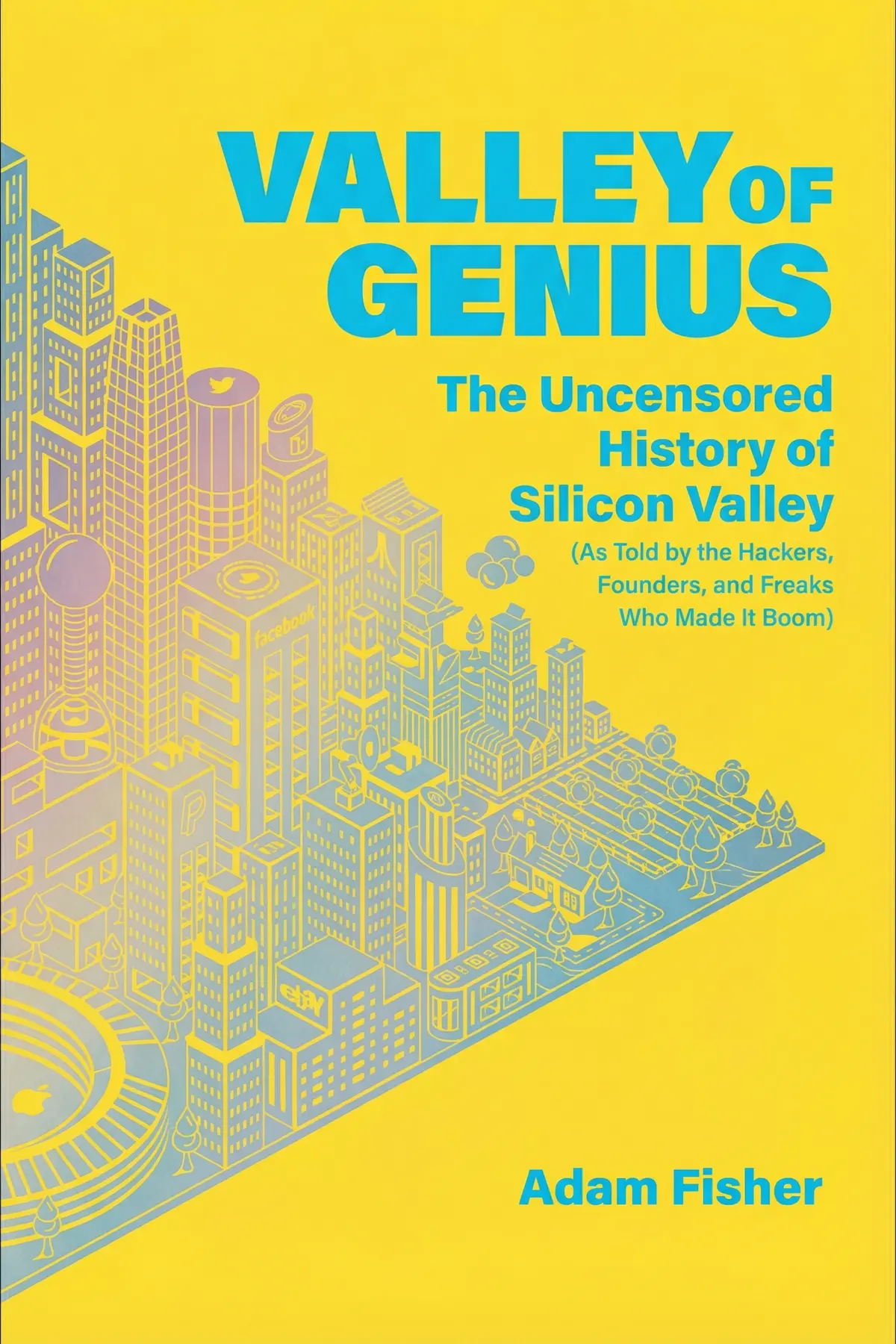
Table of Content
1. Introduction
1 min 43 sec
When we think of Silicon Valley today, we often imagine sleek glass buildings, billions of dollars in venture capital, and polished executives in hoodies. It feels like a well-oiled machine of progress. But if you peel back the layers of history, you find a story that is far more chaotic, human, and strange than any corporate brochure would suggest. The real history of this region isn’t just about semiconductors or software; it’s about a specific breed of person—the hackers, the misfits, and the dreamers who didn’t just want to build businesses, but wanted to build things that had never existed before.
Located in the San Francisco Bay Area, Silicon Valley transformed from a quiet collection of suburbs into the global heart of high-tech innovation in just a few decades. Since the late 1960s, this relatively small geography has been the birthplace of almost every digital tool we consider essential today: the personal computer, the internet as we know it, mobile devices, online marketplaces, and the social networks that connect billions.
What makes this story unique is the culture that facilitated these leaps. It was a world where twenty-somethings found themselves at the helm of empires, where working through the night was a badge of honor, and where the boundaries between professional life and countercultural experimentation were almost nonexistent. In this summary, we are going to walk through that history, following the throughline from the first arcade machines to the algorithms that now rule our attention. We will see how a research lab at a copier company invented the future and then gave it away, how a spiritual journey to India helped shape the world’s most valuable company, and why some of the most successful businesses began as projects the founders didn’t even want to turn into companies. This is an uncensored look at the genius and the madness that built our modern world.
2. The Wild Foundations of the Tech Boom
2 min 34 sec
Discover how a simple game about digital tennis and a culture of radical hedonism established the very first blueprint for the Silicon Valley success story.
3. The Laboratory That Invented the Modern PC
2 min 36 sec
While most people credit Apple or IBM for the personal computer, the real architectural breakthroughs happened in a research center owned by a copier company.
4. The Partnership of the Two Steves
2 min 18 sec
Explore the strange beginnings of Apple, where illegal phone gadgets and a spiritual trek to India set the stage for a technological revolution.
5. Borrowing Brilliance to Build the Mac
2 min 02 sec
See how a pivotal visit to a competitor’s lab and a cinematic television commercial turned the Macintosh into a cultural icon.
6. The Greatest Failed Company in History
2 min 09 sec
What happens when you have the perfect idea a decade too soon? The story of General Magic reveals the blueprint for the modern smartphone.
7. eBay and the Architecture of Online Trust
2 min 10 sec
Learn how a weekend coding experiment based on a radical belief in human honesty turned into a global marketplace and invented the feedback loop.
8. The Accidental Empire of Google
2 min 06 sec
The world’s most powerful search engine started as a college research project that its founders were desperate to sell so they could finish their degrees.
9. The Second Act of Apple and the Mobile Shift
2 min 04 sec
Follow the high-stakes development of the iPhone and learn why Steve Jobs had to be convinced to let outside developers into his walled garden.
10. Facebook and the Architecture of Social Attention
2 min 13 sec
Trace the rise of a dorm-room project that prioritized speed over everything else and changed the way we perceive privacy and connection.
11. Conclusion
1 min 42 sec
The journey of Silicon Valley, from the early days of Pong to the global reach of Facebook, is a testament to the power of a specific kind of environment. It is a place that combined a massive influx of capital with a radical tolerance for failure and an almost fanatical devotion to new ideas. As we have seen through the stories of Atari, Xerox, Apple, and Google, the most significant breakthroughs often came from the edges—from people who were more interested in the ‘coolness’ of a project than its immediate profitability.
The throughline of this history is the tension between the visionary and the corporate. Xerox had the future in its lab but couldn’t see it through a corporate lens. Apple took those same ideas and, through the sheer will of Steve Jobs, forced them into the mainstream. Google and eBay showed that the internet could scale human intelligence and trust in ways that were previously unimaginable. And finally, Facebook showed how these technologies could eventually become the primary way we experience the world.
Ultimately, Silicon Valley is more than just a place on a map. It is a mindset that values speed, disruption, and the belief that a few people with enough talent and caffeine can change the world. While we often focus on the gadgets and the stock prices, the real lesson of this story is that the modern world was built by individuals who weren’t afraid to be unconventional. As you look at the smartphone in your pocket or the social feed on your screen, remember that these tools are the results of decades of high-stakes gambles, late-night breakthroughs, and a stubborn refusal to accept things as they are. The ‘genius’ of the valley wasn’t just in the engineering; it was in the courage to imagine a future that no one else saw coming.
About this book
What is this book about?
Valley of Genius offers a deep dive into the evolution of Northern California’s tech hub, moving beyond the polished corporate narratives to reveal the messy, human truth. It traces the trajectory of innovation from the early days of microchips and arcade games like Pong to the world-altering emergence of platforms like Google and Facebook. The narrative highlights the unconventional cultures that fostered these breakthroughs—environments where late-night coding sessions, countercultural ideals, and radical experimentation were the norm. Listeners will discover the forgotten pioneers like Xerox PARC and General Magic, whose ideas predated modern tech by decades. The story explains how the partnership of Steve Jobs and Steve Wozniak birthed a new era of computing and how simple side projects like eBay transformed global commerce. By focusing on the individuals—the hackers, the dreamers, and the occasional outcasts—this account explains how a small pocket of California became the epicenter of global innovation and how its unique, often chaotic ethos shaped the devices and networks we use today.
Book Information
About the Author
Adam Fisher
Adam Fisher is a thinker and writer who specializes in the origins and future of technology. In addition to his extensive research and writing for Valley of Genius, his work has appeared in prominent publications such as Wired, the MIT Tech Review, and the New York Times Sunday magazine.
Ratings & Reviews
Ratings at a glance
What people think
Listeners consider the book a captivating work that offers remarkable insights into Silicon Valley’s history. They value the narrative style, with one listener highlighting how the interviews are woven together into a conversation, and the writing's quality, with one noting it is written using transcribed interviews. The arrangement of the book draws varied responses, as some applaud the ingenious structure while others find the format a bit unusual.
Top reviews
Kanchana
The narrative structure here is something else entirely, trading traditional prose for a curated collage of voices that feels like a front-row seat to history. Fisher doesn't just tell you what happened at Xerox PARC or the Homebrew Computer Club; he lets the icons and the outcasts argue it out right on the page. By weaving thousands of hours of interviews into a singular timeline, the book manages to capture the frantic, drug-fueled, and often ego-driven energy of the early computing days. I particularly enjoyed the segments on General Magic and Netscape, which often get overlooked in favor of the usual Apple and Google mythology. It is a massive undertaking that pays off by creating a multi-dimensional portrait of innovation. This is less of a business manual and more of a visceral piece of art that documents how a few rebels actually changed the world.
Show moreFord
Wow, what a wild ride through the ego-driven, visionary, and often chaotic birth of the digital world. This book captures the erratic pulse of Silicon Valley by letting the participants speak for themselves, creating a sense of immediacy that standard histories can't match. From the garage days of Jobs and Wozniak to the utopian dreams of Burning Man, Fisher connects the dots between counterculture and corporate dominance in a way that feels organic. The chapter on Napster was particularly illuminating, offering a cradle-to-grave look at a company that usually only gets a footnote. It’s a thick read, but the short, punchy quotes keep the momentum moving at a breakneck pace. This is the definitive record of the personalities who decided what the future was going to look like before the rest of us even knew it was coming.
Show morePing
As someone who lived through the dot-com boom and bust, reading this was like a visceral trip down memory lane that hit all the right notes. The way Fisher splices these interviews together makes it feel like you're sitting at a dinner party with the brightest and most arrogant minds of the last fifty years. It’s messy and loud and brilliant, exactly like the industry it describes. I especially appreciated the inclusion of figures like Mike Slade and the detailed look at General Magic—stories that usually get buried under the weight of the Apple/Google dominance. The book doesn't just give you the facts; it gives you the flavor of the era, the smell of the soldering iron, and the frantic energy of a startup. This is the 'Please Kill Me' of Silicon Valley, and I couldn't put it down.
Show moreTippawan
This book captures the frantic, erratic pulse of the Valley better than any other tech history I have ever encountered. Fisher's curation is masterful, allowing the narrative to emerge from the cacophony of voices without the need for a heavy-handed narrator. The stories are legendary, the personalities are larger than life, and the sheer audacity of these 'geniuses' is on full display throughout every chapter. It’s a brilliant piece of journalism that manages to be both a celebration and a cautionary tale about the power of technology. Whether it's the section on the first conferencing software or the detailed account of Steve Jobs' return to Apple, the book feels alive. It’s a massive, beautiful, and occasionally frustrating document of the people who shaped our modern reality. If you have any interest in tech culture, this is an absolute must-read.
Show moreAir
Fisher has managed to curate a vivid, messy tapestry of the tech world that feels more authentic than any polished biography. Truth is, the oral history format is a double-edged sword that provides incredible intimacy while occasionally giving the reader a bit of chronological whiplash. You get the raw, unfiltered perspectives of the legends—and the people who hated them—which adds a layer of grit often missing from these stories. My only real gripe is the glaring absence of the 'PayPal Mafia' and companies like Sun Microsystems, which felt like a strange hole in an otherwise comprehensive timeline. Still, the sections on the 'Mother of All Demos' and the early Atari days are worth the price of admission alone. It’s a fascinating, albeit slightly exhausting, look at the personalities that built the digital age we now inhabit.
Show moreZanya
Ever wonder what it was actually like in the trenches during the rise of the personal computer? This book skips the dry analysis and goes straight for the jugular with first-hand accounts of the feuds, the failures, and the occasional strokes of brilliance. I loved how it didn't just focus on the suits, giving plenty of room to the engineers and the dreamers who were dropping acid and building the future simultaneously. While the lack of a traditional narrator might be jarring for some, I found the spliced-together conversations to be a refreshing way to digest such a massive amount of information. It reads like a high-speed documentary where everyone is trying to get the last word. If you’re a fan of 'Please Kill Me,' you will definitely appreciate the vibe Fisher is going for here.
Show moreSangduan
Finally got around to this one and the oral history format is a stroke of genius for a subject as fragmented as Northern California's tech scene. Fisher doesn't try to smooth over the contradictions; he lets the conflicting accounts stand side-by-side, which feels like a much more honest way to document history. The transition from the idealistic, acid-dropping hippies of the 60s to the ruthless capitalists of the 90s is captured with startling clarity through these snippets. Personally, I found the deep dive into Xerox PARC and the development of the GUI to be the most rewarding part of the whole book. It’s a bit of a commitment due to its length and the sheer number of names to keep track of, but it’s an essential read for anyone who wants to understand the culture behind the code.
Show moreUdom
Picked this up on a whim and was surprised by how much the 'spliced interview' style actually works once you get into the rhythm of it. It’s less a textbook and more of a grand, sprawling conversation that spans decades of innovation and ego. While it’s definitely more focused on software and internet culture than the 'silicon' hardware of the early days, the insights into the minds of the founders are gold. You see the connections between the Whole Earth Catalog and the eventual rise of social media in a way that feels inevitable. My only criticism is that it can feel a bit repetitive when multiple people are describing the same party or feud. However, as a primary source for the legends of the Valley, it’s an incredibly valuable and entertaining resource.
Show moreOrathai
To be fair, I went into this expecting a deep dive into the engineering breakthroughs of the Valley, but it felt much more like a collection of gossip and personality clashes. The format is undeniably unique, but the constant jumping between speakers made it difficult for me to stay grounded in the actual technological evolution. It often feels like a hagiography that leans too heavily on the 'rebel genius' trope while ignoring the systemic issues or the people displaced by these tech giants. I found the section on Wired magazine a bit self-indulgent and unnecessary compared to the meatier chapters on Apple and NeXT. It’s a decent enough index for tech history, but I think I would have preferred a more cohesive narrative that offered some critical distance. Interesting as a social document, but less so as a historical analysis.
Show moreJonathan
Look, I wanted to love this, but it felt like a total hagiography that spent way too much time celebrating a hyper-masculine culture of 'disruption.' It’s a revolving door of men talking about how they fought, took drugs, and got rich, with almost zero attention paid to the people their innovations actually affected. The oral history style is an interesting gimmick, but without a narrator to provide context or push back on some of the more outrageous claims, it just feels like an echo chamber. I found myself bored by the endless feuds and the obsession with who gets the credit for what. If you want a story about coke-fueled egos and tech-bros patting each other on the back, this is for you. Otherwise, stick to Isaacson or someone who actually analyzes the impact of these companies.
Show moreReaders also enjoyed

AI 2041: Ten Visions for Our Future
Kai-Fu Lee



7 Powers: The Foundations of Business Strategy
Hamilton Helmer


AUDIO SUMMARY AVAILABLE
Listen to Valley of Genius in 15 minutes
Get the key ideas from Valley of Genius by Adam Fisher, plus 5,000+ more titles in English and Thai.
- 5,000+ titles
- Listen as much as you want
- 7-day free trial
- Cancel anytime







