
16 min 56 sec
Weekend Language: Presenting with More Stories and Less PowerPoint
Weekend Language explores how to ditch corporate jargon and dull slides in favor of the engaging, natural storytelling we use in our personal lives to influence and captivate professional audiences.
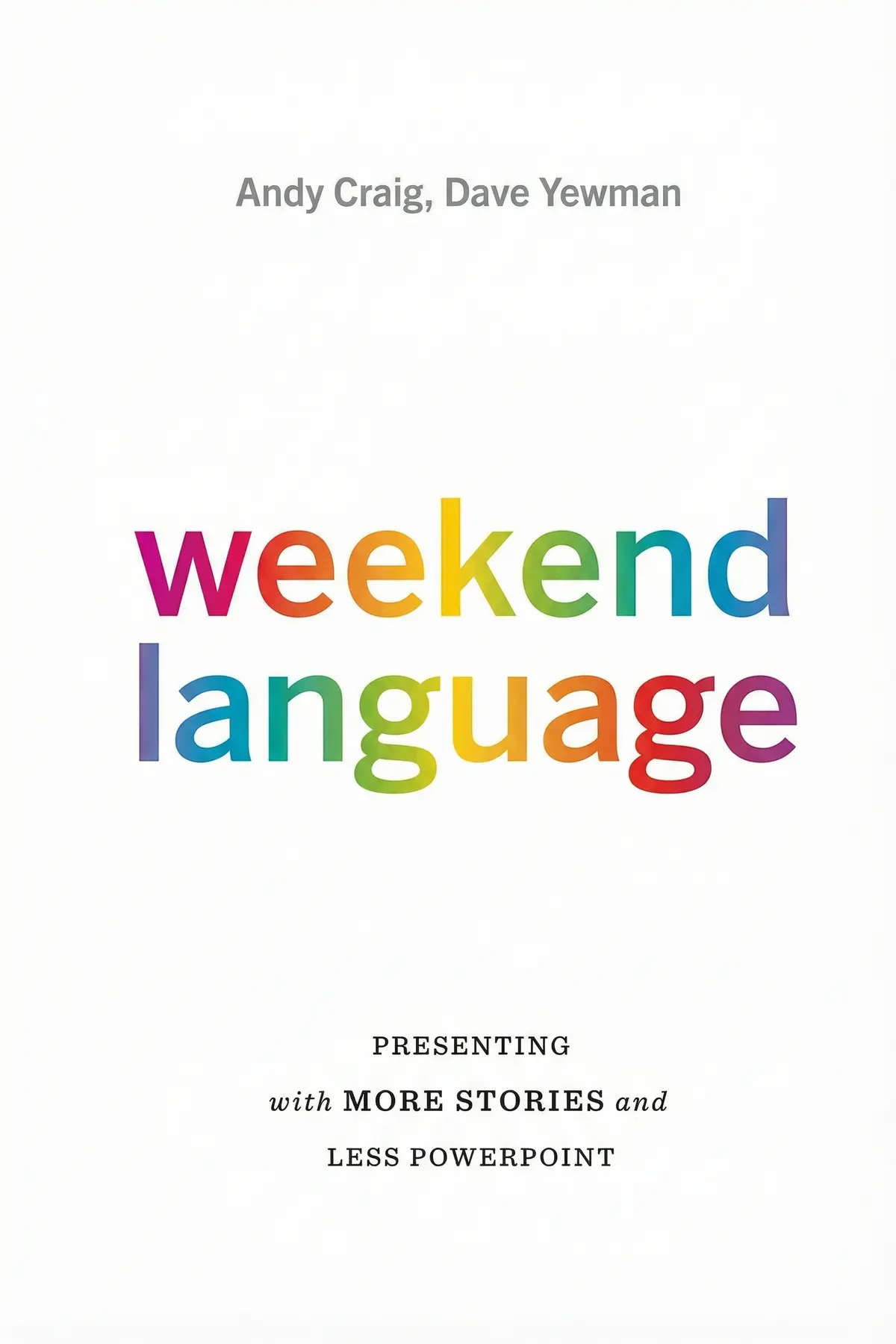
Table of Content
1. Introduction
1 min 57 sec
Think about the last time you were at a casual gathering—perhaps a Saturday afternoon barbecue or a Sunday dinner with friends. Chances are, you were relaxed, expressive, and probably told a story that had everyone leaning in. You didn’t need a projector to explain why your weekend trip was a disaster or why a new restaurant was incredible; your voice, your gestures, and your natural narrative flow did all the work. This is what communication experts call weekend language. It is human, relatable, and instantly engaging.
Now, contrast that with your typical Monday morning. The moment we walk into the office, a strange transformation often occurs. We stop being people and start being ‘professionals.’ We trade our vibrant stories for bullet points and swap our natural enthusiasm for a linguistic soup of corporate jargon. We talk about ‘leveraging synergies’ and ‘optimizing end-to-end deliverables’ while our colleagues’ eyes slowly glaze over. This shift isn’t just boring; it’s a massive barrier to effective leadership and persuasion. When we stop speaking like humans, our audience stops listening like humans.
In this exploration of the concepts found in the work of Andy Craig and Dave Yewman, we are going to look at how to bridge that gap. We’ll examine how to reclaim the authenticity of your weekend voice and apply it to your most important business moments. We will explore why our reliance on technology often weakens our message and how a return to the basics of storytelling can make you the most memorable person in the room. By focusing on clarity, simplicity, and the power of narrative, you can transform your presentations from a chore into a tool for real connection. It’s time to stop hiding behind your slides and start speaking a language that actually moves people. Here is the throughline we will follow: the most powerful tool in business isn’t a piece of software, but your ability to tell a story that makes people care.
2. Breaking the PowerPoint Dependency
2 min 39 sec
What happens when you take away the most common tool in business? Discover why a temporary ban on slides can actually sharpen your focus and improve your message.
3. The Strategic Power of Narrative
2 min 36 sec
Business communication often drowns in jargon. Learn how to use stories, analogies, and the power of ‘imagine’ to make your message resonate.
4. Structuring for Maximum Impact
2 min 54 sec
Your audience’s attention is a limited resource. See how to use the inverted pyramid and clear signposting to keep them engaged from start to finish.
5. Mastering Physical and Vocal Delivery
2 min 48 sec
Communication is about more than just the words you choose. Explore how pauses, movement, and eye contact can amplify your message.
6. The Illusion of Spontaneity Through Practice
2 min 40 sec
The most natural-sounding presentations are often the ones most heavily rehearsed. Learn why preparation is the key to true authenticity.
7. Conclusion
1 min 22 sec
As we wrap up this look into the strategies of Weekend Language, the core message is clear: the most effective way to communicate in business is to stop acting like a ‘business person’ and start acting like a human being. The divide between who we are on Saturday and who we are on Monday is an artificial one, and it’s one that actively hinders our ability to lead and persuade.
By breaking our dependency on slides, we force ourselves to find the true heart of our message. By embracing storytelling and analogies, we move our audience from a place of passive confusion to active engagement. And by paying attention to our physical presence—the way we move, the way we pause, and the way we look our colleagues in the eye—we build the trust that is essential for any real professional success.
Remember that spontaneity is not something that happens by accident; it is a gift you give yourself through rigorous preparation. When you put in the work to master your narrative, you earn the right to be your authentic self on stage. The next time you have a high-stakes meeting or a presentation, challenge yourself to ditch the jargon. Answer the ‘So what?’ question immediately. Tell a story that would hold someone’s interest at a dinner party. If you can speak to your colleagues with the same clarity and warmth you use with your friends, you won’t just be delivering a presentation—you’ll be making a lasting impact. It’s time to bring your weekend language into the workweek and see just how much more powerful your voice can become.
About this book
What is this book about?
Have you ever noticed how your personality seems to vanish the moment you step into a conference room? During the weekend, you’re likely a vibrant storyteller, keeping friends and family engaged with colorful anecdotes. But on Monday morning, many of us retreat behind a wall of dense PowerPoint slides and soul-crushing corporate terminology. Weekend Language provides a roadmap for bringing that natural, conversational energy back into the workplace. This guide promises to revolutionize the way you communicate by showing you how to prioritize narrative over data dumps. It explores why we become dependent on visual crutches like PowerPoint and offers a radical thirty-day challenge to break that addiction. You will learn the mechanics of high-impact storytelling, from using the inverted pyramid structure of journalism to mastering the subtle art of body language and vocal pacing. By the end, you'll understand how to pass the 'So what?' test with every audience and ensure your message isn't just heard, but actually remembered and repeated long after the meeting concludes.
Book Information
About the Author
Andy Craig
Andy Craig is a distinguished communication consultant and the co-founder of Elevator Speech. With a professional background rooted in advertising and political communications, he has dedicated his career to coaching executives and refining messaging strategies for major global corporations. Dave Yewman is also a co-founder of Elevator Speech and a seasoned communication consultant. A former journalist and corporate executive, Yewman draws on his media expertise to help leaders deliver messages that are both clear and compelling. Together, Craig and Yewman have established themselves as premier authorities in business communication, working extensively with Fortune 500 companies.
Ratings & Reviews
Ratings at a glance
What people think
Listeners find the book beneficial and straightforward, offering realistic advice and strong examples that allow for a speedy read. They value the stimulating insights, as one listener pointed out how it maintains a link between the message and the crowd, while another praised the integration of narratives into presentations. The material is lauded for enhancing communication abilities, with one listener noting visible progress in their speaking style since completing the book.
Top reviews
Cooper
Weekend Language completely transformed how I approach my Monday morning meetings. We spend our Saturdays telling vivid, hilarious stories at a barbecue, but the second we step into the boardroom, we turn into PowerPoint-obsessed robots spitting out jargon like 'synergistic deliverables.' This book is a wake-up call to bring that authentic, relaxed personality back into professional settings. I love the concept of the PowerPoint detox; removing the crutch of slides forced me to actually connect with my team. It’s practical, punchy, and the first business book I’ve actually enjoyed finishing in a single sitting. My colleagues have already noticed that I'm more animated and clear when I speak. Truly a game-changer for anyone who hates corporate-speak.
Show moreSaowalak
Wow. This is the first time I’ve actually felt excited to rework a slide deck. The mosquito example from Bill Gates really stuck with me as a way to make a point visual rather than just stating a fact. We often forget that we are the presentation, and the slides are just the backup singers. This book is short, punchy, and doesn't waste any of your time with unnecessary filler. It’s a total game-changer for anyone who struggles with boring, corporate-speak presentations. I highly recommend it for any team that is stuck in a cycle of endless, forgettable meetings. It really encourages you to find your own authentic voice again.
Show moreDaranee
After hearing several leaders at my company recommend this, I was curious if it would live up to the hype. It does. The advice to ditch jargon and speak like a human being is simple, but so few people actually do it in the workplace. I particularly liked the Feynman-style approach to explaining complex ideas—if you can’t explain it simply, you don’t know it. Using concrete examples instead of abstract data points has helped me keep my audience’s attention much longer than before. This book is a must-read for anyone who wants their ideas to actually stick. It helps you pass the 'Who cares?' test with flying colors every time you open your mouth.
Show moreAisha
Think of your next presentation as a conversation at a barbecue rather than a lecture from a podium. That’s the core shift this book encourages, and it works wonders for engagement. By incorporating backstories and personal anecdotes, you bridge the gap between you and your listeners. It takes intelligence to make things simple, and this book gives you the tools to do exactly that. The focus on preparation and 'recording yourself' is humbling but necessary if you want to be a top-tier communicator. Don't waste money on a fancy seminar; just read this and start practicing. It’s thought-provoking and keeps your messages connected to the audience’s real-world needs. Five stars for the practical, no-nonsense blueprint.
Show moreGioia
Finally, a business book that doesn't feel like a chore to get through. The 'So what? Who cares?' test is something I now apply to every single email and presentation I draft because it cuts through the fluff immediately. Craig and Yewman emphasize that stories are what people remember, not bullet points on a screen. My only minor gripe is that some of the examples felt a bit repetitive, but the logic remains sound. Following the journalism-style inverted pyramid helps keep my audience engaged from the first two minutes. This is a solid, helpful resource for anyone looking to simplify their message and make abstract concepts tangible. It makes the scary task of public speaking feel much more manageable.
Show moreChan
The 30-day PowerPoint detox sounds absolutely terrifying, but the logic behind it is undeniable. By banning slides, the authors force you to focus on the narrative first—a complete reversal of how most of us work. I started using the 'three-second rule' for my visuals, ensuring that if someone looks at a slide, they get the gist instantly before returning their eyes to me. This shift makes the presenter the center of attention rather than a glowing screen. It requires more preparation than 'winging it,' but the impact on my sales calls has been noticeable. Definitely worth the two hours it takes to read. If you want people to retell your anecdotes instead of ignoring your charts, pick this up.
Show moreSuthinee
As someone who presents to executives weekly, I found the section on 'signposting' and ending early to be incredibly insightful. Most people try to cram as much information as possible into their allotted time, which just leads to mental fatigue for the audience. This book teaches you to respect people's time by leading with your strongest material and finishing a few minutes ahead of schedule. The authors have a great way of explaining how to make abstract technical concepts tangible through analogies. I’ve already started using more 'imagine' scenarios to hook my listeners. My delivery has improved, and I feel much more confident standing away from the podium. It's a quick read that offers immediate ROI.
Show moreMaya
Truth is, I never realized how much my nervous 'ums' were killing my credibility until I read the chapter on vocal fillers. The authors provide a very grounded approach to mastering your delivery, from strategic pausing to intentional movement across the stage. It’s not just about what you say, but the energy you project. I appreciate how they demystify the 'spontaneous' success of speakers like Steve Jobs by revealing the hours of grueling practice behind the scenes. It’s a quick read with practical points that you can implement the very next day. I'm definitely recommending this to my whole department to help us eliminate the 118-slide decks we've become addicted to. Great examples throughout.
Show moreWipada
Look, the fundamental philosophy here is great, but the book feels a bit light on substance for the price point. The S.T.O.R.Y. methodology is a nice mnemonic, yet I found myself wishing for more detailed workshops on crafting the actual stories. It’s a lot of 'what' and 'why' with a little less 'how' than I usually prefer in a professional development guide. That said, the reminder that 93% of communication is non-verbal was a much-needed kick in the pants. It’s a good primer for novices, but seasoned speakers might find it a bit repetitive after the first fifty pages. Use it as a quick refresher rather than a deep dive into communication theory.
Show moreDuangjai
Is it just me, or have we heard all of this before? Frankly, while the core message of using 'weekend language' is charming, most of this feels like common sense repackaged for a corporate audience. If you’ve ever taken a basic communications class, you already know about the inverted pyramid and keeping slides simple. The text often feels bloated with endless anecdotes that prove their point but don’t necessarily show you the mechanics of how to do it yourself. It’s a very quick read, which is nice, but I was hoping for more ground-breaking strategies instead of Journalism 101. For a seasoned professional, this might feel like a waste of twelve bucks for info you can easily find on the web.
Show moreReaders also enjoyed
AUDIO SUMMARY AVAILABLE
Listen to Weekend Language in 15 minutes
Get the key ideas from Weekend Language by Andy Craig, plus 5,000+ more titles in English and Thai.
- 5,000+ titles
- Listen as much as you want
- 7-day free trial
- Cancel anytime







