
15 min 06 sec
What’s Our Problem?: A Self-Help Book for Societies
By Tim Urban
Explore the roots of societal division and the psychological mechanisms that drive our polarized world. This summary reveals how to move from tribalism toward objective truth through a lens of intellectual humility.
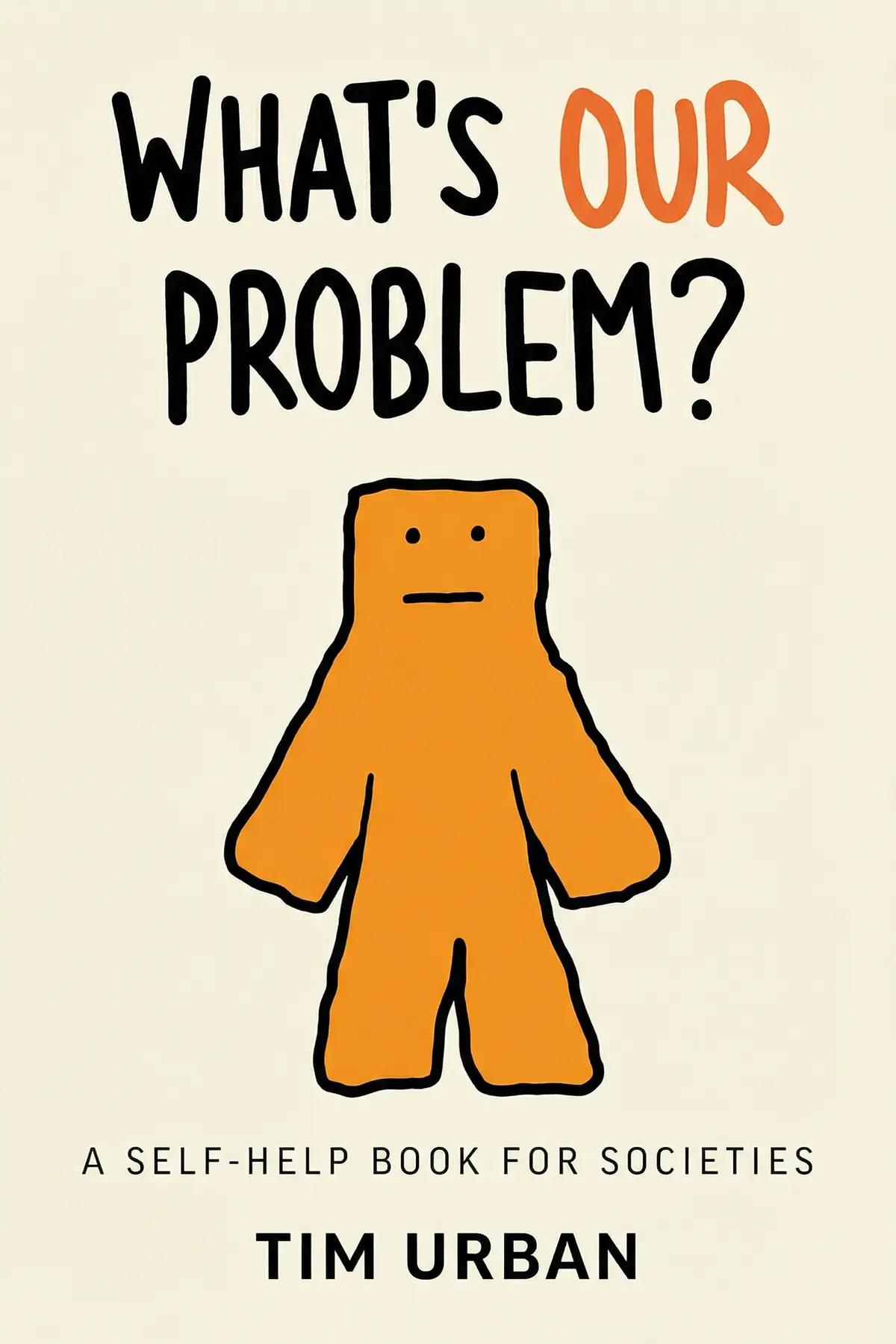
Table of Content
1. Introduction
1 min 57 sec
Imagine for a moment that the entire history of our species is written down in a massive, one-thousand-page book. Each page represents about two hundred and fifty years. If you were to flip through this volume, you would find that for the first nine hundred and fifty pages, almost nothing changes. Our ancestors lived as hunter-gatherers, survival being the only constant theme. It isn’t until page nine hundred and fifty that the agricultural revolution begins, and the dawn of what we call ancient history finally appears.
As you reach the very last page—page one thousand—the pace of the story accelerates to a dizzying degree. This final page covers everything from the birth of the United States to the invention of the internet. The ink on this page is barely dry, yet the shift from page nine hundred and ninety-nine to page one thousand is more dramatic than any transition in the previous nine hundred and ninety-eight pages combined. We are currently living at the very bottom of that last page, and the next chapter—page one thousand and one—is ours to write.
The stakes couldn’t be higher. We are standing at a crossroads where technology could lead us to a state of near-infinite abundance and progress, or it could lead to a catastrophic collapse. The concern, however, is that while our technology has advanced exponentially, our collective maturity as a society seems to be moving in the opposite direction. Instead of acting like the wise, experienced authors of our future, we are behaving like children. We see rising tribalism, the breakdown of our institutions, and a level of political venom that feels unsustainable.
This summary explores why this is happening. We will look at the psychological mechanics of the human mind, the way our modern environment triggers our most primitive instincts, and how we can begin to reclaim our rationality. By the end, you’ll have a new framework for understanding the chaos of the modern world and, more importantly, a sense of how you can contribute to a healthier, more mature society. The goal isn’t just to understand what’s wrong; it’s to find the tools to set it right.
2. The Internal Conflict of Two Brains
2 min 16 sec
Discover the biological tug-of-war happening inside your head between your ancient instincts and your modern reasoning, and why this clash defines our social behavior.
3. The Four Rungs of Thinking
2 min 29 sec
Learn to identify the different levels of intellectual honesty we use, from the objective scientist at the top to the blind zealot at the bottom.
4. The Shift Toward Internal Tribalism
2 min 08 sec
Explore why society has turned inward to find enemies, transforming political differences into high-stakes tribal warfare.
5. The Rise of Modern Fundamentalism
2 min 19 sec
Analyze how low-rung thinking has permeated both sides of the political spectrum, creating dogmatic movements that stifle open inquiry.
6. The Path to a Mature Society
2 min 29 sec
Learn the practical steps for reclaiming your rationality, from practicing intellectual humility to finding the courage to speak your truth.
7. Conclusion
1 min 28 sec
The journey through the history of our species shows us that we are at a unique and perilous moment. We have the tools of gods but the emotional maturity of toddlers. The divide in our society isn’t a permanent feature of humanity; it’s a symptom of our primitive minds being overwhelmed by a modern world they weren’t built for. But as we have seen, we are not helpless. We possess a higher mind that is capable of incredible things if we only give it the steering wheel.
What’s Our Problem? isn’t just a question—it’s a challenge. The problem is the low-rung thinking that keeps us trapped in cycles of anger and division. The solution is a commitment to the truth over tribalism and a dedication to the rungs of the scientist and the sports fan. This requires a constant, daily effort to check our biases, listen to those we disagree with, and find the bravery to speak authentically.
As you move forward, keep the ladder in mind. In every conversation, every news article you read, and every social media post you consider sharing, ask yourself: ‘What rung am I on right now?’ By making the conscious choice to climb higher, you are doing more than just improving your own life; you are helping to steer our entire society toward a brighter, more rational future. The next page of our story is being written right now. Let’s make sure it’s a page we can be proud of. Start with yourself, stay humble, and keep reaching for the higher mind.
About this book
What is this book about?
Have you ever looked at the world and wondered why everything feels so chaotic and divided? What’s Our Problem? offers a deep dive into the underlying causes of our modern social and political turmoil. It isn't just a commentary on the news; it is a structural analysis of how the human brain functions in a modern environment it wasn't designed for. The book introduces powerful metaphors to help us understand our own behavior and the behavior of the groups we belong to. By exploring the conflict between our primitive instincts and our higher reasoning, the summary provides a roadmap for rising above the fray. It promises to transform the way you view disagreements, political movements, and your own internal thought processes. Ultimately, it is a call to action for anyone who wants to see a more rational, compassionate, and functional society. You will learn why we are so prone to tribalism and how we can consciously choose to climb the ladder of high-level thinking to build a better future together.
Book Information
About the Author
Tim Urban
Tim Urban is a writer, blogger, and internet sensation. His well-loved blog Wait But Why is characterized by simple cartoons, wry humor, and insightful observations about technology, life, and the world. Known for his ability to explain complex topics with clarity and wit, he has become a leading voice in deep-dive internet commentary.
Ratings & Reviews
Ratings at a glance
What people think
Listeners describe the work as insightful, offering a thoroughly researched perspective and an intriguing lens through which to analyze social structures. Furthermore, they enjoy the intellectually stimulating material, witty tone, and quality illustrations, noting its ability to make intricate systems easier to understand. The book is also praised for its prose and how well it sparks conversation, with one listener pointing out its clear explanation of political dynamics. However, reactions to the timing are varied, as some feel the delivery is sharp while others suggest it becomes tedious.
Top reviews
Supachai
Tim Urban has a way of making 700 pages feel like a breeze, mostly because of those signature stick-figure illustrations. This book isn't just a political commentary; it's a massive, necessary toolkit for understanding the vertical axis of how we think. He introduces concepts like the 'Ladder' and 'Idea Labs' that help deconstruct why our public discourse has become so radioactive. While the book is undeniably a behemoth, the pacing kept me engaged through most of the chapters. Frankly, the distinction between our primitive minds and our higher, truth-seeking minds is the most useful framework I've encountered in years. It challenged me to look at my own tribal tendencies without feeling like I was being lectured. Even if you don't agree with every example, the core logic is hard to ignore.
Show moreAlice
This book should be mandatory reading for anyone who feels like they’re losing their mind watching the news. Urban has managed to create a universal language for the insanity of the 2020s. The 'Primitive Mind' versus 'Higher Mind' battle is something I now see playing out in every single one of my interactions. It’s a thick volume, but the humorous approach and the constant influx of drawings make it feel much lighter than your average sociopolitical text. Truth is, we are all living in echo chambers, and this book is a giant hammer trying to crack those walls open. It doesn't tell you what to think, which is the best part. Instead, it teaches you how to keep your thinking on the high rungs where truth actually lives.
Show moreMoon
Wait But Why fans will recognize the familiar blend of deep-thinking and stick-figure charm that Tim Urban excels at. This isn't just another partisan hack job; it’s a genuine attempt to diagnose why we’ve all become so miserable and divided. The 'Ladder' metaphor is something I've already started using to check my own reactions to controversial news stories. Personally, I think the most important takeaway is the 'Idea Lab' concept—we need places where we can be wrong without being destroyed. The book is huge, yes, but it’s packed with insights that are actually worth the time investment. It’s rare to find a book that is this analytical while remaining so emotionally resonant. It’s easily one of the most important books I’ve read this decade.
Show moreKofi
Finally, a book that explains the 'insanity' of the current political climate without forcing you to pick a team. Urban focuses on the process of thinking rather than the content of the thoughts, which is a refreshing change of pace. I spent an entire weekend devouring this because the writing style is so conversational and the illustrations are genuinely funny. The way he breaks down 'low-rung' tactics like cancel culture and forced silencing is both logical and fair. It makes you realize that the real conflict isn't left vs. right, but rather the authoritarian rungs vs. the liberal ones. This book is a massive achievement that actually offers a glimmer of hope for how we can fix our broken culture. Five stars for the clarity alone.
Show moreJob
Picked this up because I’ve been a long-time fan of the 'Wait But Why' blog, and the intellectual depth here is staggering. Urban spends a massive amount of time dismantling what he calls 'low-rung thinking' on both sides of the political spectrum. The visual aids are a total lifesaver, simplifying complex psychological rubrics into something you can actually visualize during a heated debate. I found the section on 'Genies and Golems' particularly insightful for understanding group dynamics. However, I do have to admit that the middle section felt a bit lopsided in its focus. It spends hundreds of pages on specific social justice movements while barely touching on the populist right in the same level of detail. Still, the overarching message about returning to high-rung, scientific-style thinking is incredibly timely.
Show moreCamila
Ever wonder why common sense seems to have vanished from our modern public discourse? This book provides a deeply researched and surprisingly humorous answer to that question. Urban’s framework of 'what' vs 'how' we think is a total game-changer for anyone feeling exhausted by the constant tribal warfare on social media. I loved the emphasis on humility and the idea that being a 'Scientist' on the ladder is better than being a 'Sports Fan' for your political tribe. My only real gripe is that it feels very US-centric, which might make it slightly less relatable for international readers. Nevertheless, the writing style is accessible and the logic is mostly airtight. It’s a thought-provoking deep dive that actually tries to bridge the gap between opposing sides.
Show moreMia
After hearing Tim’s TED talk on procrastination, I knew his book on society would be unique, and it didn't disappoint. The breadth of research is impressive, citing everything from FIRE data to historical psychological concepts. He manages to simplify complex sociological theories without making them feel watered down or condescending. The chapters on how groups transform into 'Golems' were particularly chilling and accurate. However, look, the book is undeniably a slog in certain places where the anecdotes become repetitive. I also felt like some of the neologisms were a bit unnecessary and started to clutter the narrative toward the end. Despite that, it’s a brilliant overview of our current cultural malaise. It definitely sparked some intense, high-rung discussions in my friend group, which I think was the goal.
Show moreNim
As someone who often finds political theory dry and inaccessible, the visual aids in this book were a total lifesaver. Urban has a gift for taking high-level concepts and making them feel like common sense. I found the 'Emergence' chapter particularly fascinating for understanding how individual people form larger, sometimes dangerous, collective entities. It’s a well-researched overview that doesn't shy away from uncomfortable truths about how our brains are wired for conflict. My only complaint is the length; it really didn't need to be 700 pages to get the point across. Some of the middle chapters felt like they were repeating the same core thesis using slightly different examples. Still, the discussion value here is incredible, and I’ve been recommending it to everyone regardless of their political leanings.
Show moreRung
Not what I expected after waiting years for the author to finally finish his magnum opus on society. The first 40% is classic Tim Urban—engaging, funny, and full of brilliant charts that make you feel smarter with every page. But then, the book takes a sharp turn into a very specific critique of 'wokeness' that goes on for far too long. To be fair, he makes some valid points about illiberalism, but it felt like he was beating a dead horse after the first hundred pages. Meanwhile, the actual solutions to these existential societal problems are crammed into the final ten pages of a nearly 700-page book. I wanted more actionable advice and less time spent on the same few examples. It’s an interesting read, but it definitely needed a more ruthless editor in the middle.
Show moreManop
To be fair, the first few hundred pages of this book are absolutely brilliant and offer a fresh perspective on human tribalism. I was totally on board with the 'Primitive Mind' and 'Higher Mind' breakdown. But the narrative gets bogged down when it starts focusing almost exclusively on one side of the political spectrum for the majority of the text. It felt less like a balanced framework and more like a long-form grievance about campus culture and diversity statements. As someone who works in academia, those sections felt a bit like an outsider's rant rather than a nuanced critique. There are some minor typos in the charts, and the lack of specific, diverse solutions was disappointing. It’s worth a read for the first half alone, but be prepared for some heavy bias.
Show moreReaders also enjoyed
A Warning
Miles Taylor

Abolish Rent: How Tenants Can End the Housing Crisis
Tracy Rosenthal
Abortion: Our Bodies, Their Lies, and the Truths We Use to
Jessica Valenti

Adults in The Room: My Battle With Europe’s Deep Establishment
Yanis Varoufakis
21 Lessons for the 21st Century
Yuval Noah Harari
A Different Kind of Power: A Memoir
Jacinda Ardern
AUDIO SUMMARY AVAILABLE
Listen to What’s Our Problem? in 15 minutes
Get the key ideas from What’s Our Problem? by Tim Urban, plus 5,000+ more titles in English and Thai.
- 5,000+ titles
- Listen as much as you want
- 7-day free trial
- Cancel anytime







