
19 min 11 sec
Work Clean: The life-changing power of mise-en-place to organize your life, work, and mind
By Dan Charnas
Work Clean explores how the professional culinary system of mise-en-place can be adapted to any career, offering a structured philosophy for organization, time management, and achieving a state of focused, high-performance work.
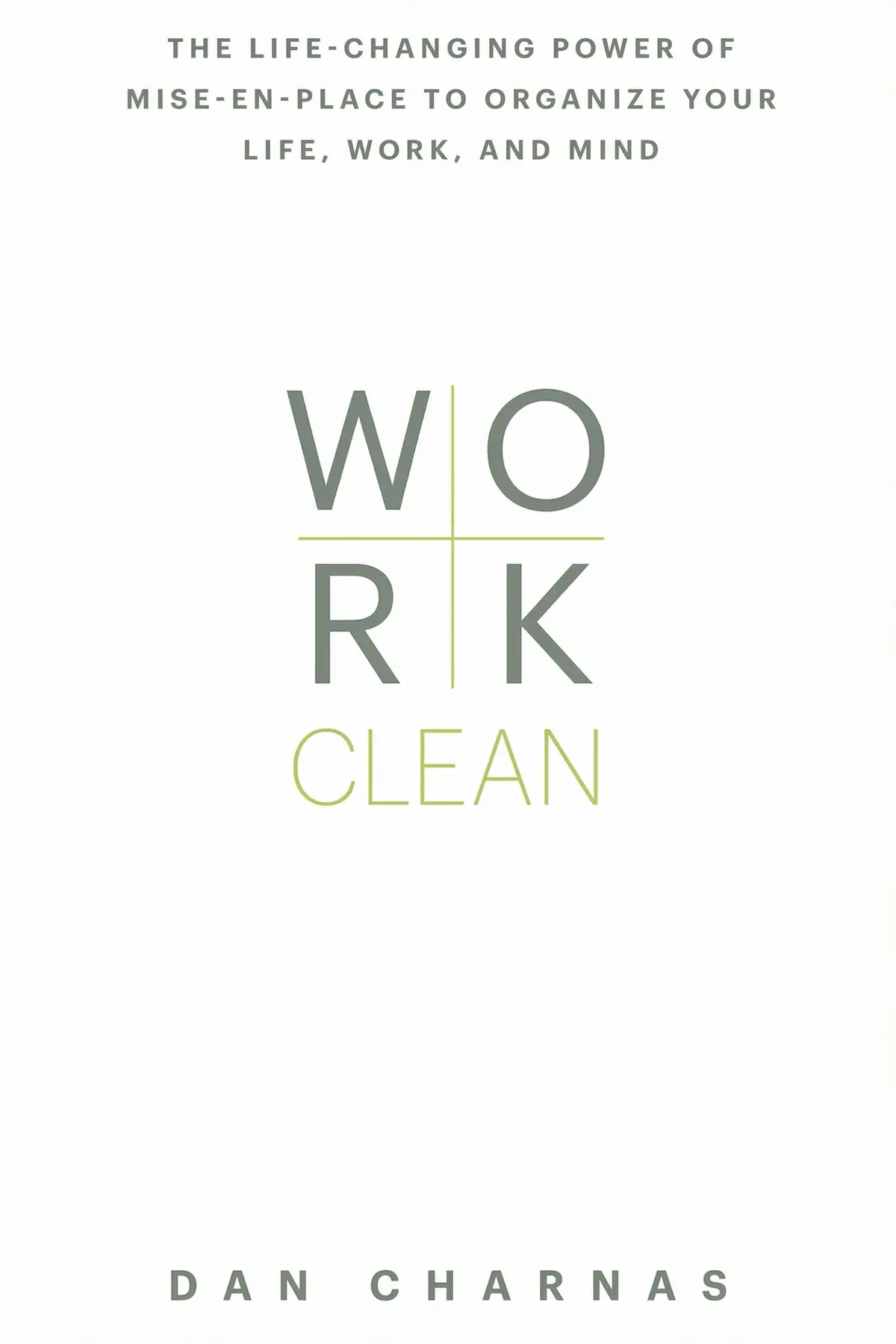
Table of Content
1. Introduction
2 min 14 sec
Imagine walking into a world-class kitchen just before the dinner rush. You won’t see chefs running around frantically looking for knives or searching for the salt. Instead, you’ll see a scene of eerie, focused calm. Every herb is chopped, every sauce is simmered, and every tool is positioned exactly where it needs to be. This state of readiness is known in the culinary world as mise-en-place. While we often translate this as simply putting things in place, it is actually an entire philosophy of excellence that allows chefs to perform miracles under extreme pressure.
In our modern lives, we often feel like we’re drowning in a sea of emails, notifications, and competing priorities. We approach our work with a sense of scattered urgency, jumping from one fire to the next. But what if we could bring that same kitchen-grade discipline to our desks, our laptops, and our daily schedules? This is the central premise of Dan Charnas’s exploration. He argues that the chaos of the modern workplace is a choice, and that by adopting the rigorous standards of the professional kitchen, we can find a sense of peace and high-performance flow that we never thought possible.
Over the course of this summary, we’re going to look at how to rebuild your workday from the ground up. We’ll explore the psychological shifts required to stop reacting and start orchestrating. We will look at how to treat your physical and digital environments as precision instruments rather than storage bins. By the end, you’ll understand why the most productive people don’t necessarily work harder—they just prepare better. They understand that excellence isn’t a fluke; it’s a result of the careful arrangement of time, space, and motion. Let’s step into the kitchen and see how these ancient culinary secrets can revolutionize the way you live and work today.
2. The Supremacy of Preparation
3 min 05 sec
Discover why the world’s most efficient professionals spend more time setting up than they do executing, and how this shift can eliminate your daily stress.
3. Arranging the Workspace for Motion
2 min 41 sec
Your physical environment is either a tool or an obstacle. Learn how to optimize your desk and digital files for maximum efficiency and minimum friction.
4. The Discipline of Cleaning as You Go
2 min 54 sec
Forget the end-of-day cleanup. Learn why maintaining order in real-time is the secret to sustained focus and avoiding the afternoon slump.
5. Choreographing Time and Sequence
2 min 56 sec
Moving beyond the simple to-do list, this idea explores how to weave multiple tasks together into a seamless, high-efficiency workflow.
6. The Power of the Closing Ritual
2 min 38 sec
How you end your day determines how you start the next. Learn the essential practice of the ‘close’ to ensure long-term career sustainability.
7. Conclusion
2 min 43 sec
As we wrap up our journey through the world of mise-en-place, it’s worth reflecting on the core philosophy that ties all these ideas together: the idea that how we do anything is how we do everything. Work Clean is not just a collection of productivity hacks or a guide to a neater desk. It is a call to take your work—and yourself—seriously. It is about moving from a state of ‘amateur’ chaos, where we are constantly surprised by our own lives, to a state of ‘professional’ mastery, where we act with intention and poise.
The three questions we started with—What do I need? How will I do it? Where will it happen?—should become your new daily mantra. Before you start a project, before you begin your day, and even before you head into a difficult conversation, take a moment to ‘mise’ the situation. Ensure you have the resources, the strategy, and the environment required for success. Remember that the ten minutes you spend preparing are not a waste of time; they are the most valuable ten minutes of your day.
By adopting the habits of front-loading your work, maintaining a frictionless workspace, cleaning as you go, and mastering the art of the closing ritual, you are doing more than just getting organized. You are creating a life where excellence is the default setting. You are giving yourself the gift of focus in a world that is trying to steal it from you. The calm, sparkling kitchen we imagined at the beginning isn’t just a place for chefs; it’s a metaphor for a mind that is prepared, a heart that is present, and a professional life that is truly ‘clean.’
So, as you step away from this summary and back into your daily routine, ask yourself: what is the one area of your life that feels most chaotic right now? Is it your inbox? Your physical desk? Your morning schedule? Start there. Apply the principles of mise-en-place to that one small corner of your world. Clean it, organize it, and prepare it for the work ahead. Once you experience the peace and power that comes from a well-ordered station, you’ll never want to work any other way. It’s time to stop reacting and start orchestrating. It’s time to work clean.
About this book
What is this book about?
Have you ever wondered how high-end restaurant kitchens manage to deliver hundreds of complex, perfect meals in a single night without descending into total anarchy? The secret isn't just talent; it's a rigorous system of preparation and discipline known as mise-en-place. In Work Clean, author Dan Charnas translates these professional culinary secrets into a practical framework for the modern office and personal life. The book promises a path out of the constant state of reactivity that defines today’s workplace. By adopting the habits of master chefs—such as front-loading work, arranging spaces for optimal movement, and maintaining a continuous state of order—you can eliminate the friction that slows you down. This isn't just about tidying your desk; it's about a fundamental shift in how you perceive time, space, and your own professional responsibility. Whether you are a writer, a programmer, or an executive, these principles offer a blueprint for working with more precision and less stress.
Book Information
About the Author
Dan Charnas
Dan Charnas is an award-winning culture and business journalist who has written extensively about the intersection of professional excellence and daily practice, drawing from his background in both the restaurant and music industries. As a former record company executive and music supervisor, he authored the definitive history of hip-hop business The Big Payback, and went on to teach at New York University's Clive Davis Institute of Recorded Music, where his research into professional kitchen organization led to the development of his work-life management system.
Ratings & Reviews
Ratings at a glance
What people think
Listeners find the book straightforward to get through and appreciate the subject matter, with one listener mentioning that it strikes a solid balance between real-world examples and rules. Additionally, the text aids in improving task efficiency, and one listener views it as an ideal roadmap for those who are currently overwhelmed. The overall writing style earns praise as well, and one listener remarks on how it simplifies complex thought processes into manageable parts.
Top reviews
Titiluck
Finally got around to reading this after a colleague wouldn't stop talking about it. The way Dan Charnas translates the high-pressure environment of professional kitchens into actionable advice for the average office worker is truly impressive. I’ve read my fair share of productivity guides, but the philosophy of mise-en-place offers a more rhythmic, intentional way to work than just ticking off a checklist. The chef anecdotes aren't just fluff; they provide a visceral context that makes the 'missions' and 'arrangements' stick in your brain. Truth is, I actually started cleaning my desk every night because of the 'clean as you go' chapter. While some might find the detailed breakdowns a bit much, I found the step-by-step guidance exactly what I needed to stop feeling so scattered. Highly recommended for anyone drowning in emails.
Show moreDylan
Wow, I didn't expect a book about kitchens to change how I manage my inbox. The transition from culinary school principles to the 'non-kitchen world' is seamless. I love how it emphasizes that preparation isn't just about work—it's about making your life more stress-free so you can enjoy your time at home. The interviews with different chefs were fascinating and provided a 'behind the scenes' look that kept me engaged through the more technical parts. It really breaks down your thought processes and shows you where your 'leaks' are. I've bought the Kindle version to keep as a reference and might get the audio version for my commute. It’s one of those rare books that actually changes how you move through space.
Show moreChatchai
Look, if you feel overwhelmed by your daily schedule, just buy the hard copy. This is hands-down my favorite productivity book. I’ve tried every app and system out there, but 'Work Clean' is the first one that felt like a philosophy rather than just a set of rules. The idea of treating your workspace as a sacred 'station' changed my entire attitude toward my boring office job. Charnas is a great storyteller, and he weaves the practical advice into the chef profiles so well that you don't even realize you're being taught. It’s about more than just time management; it’s about pride in your work and your environment. I find myself thinking 'clean as you go' multiple times a day now. It’s a total game-changer for anyone who feels like they’re constantly playing catch-up.
Show moreAnthony
Personally, I've found that most self-help books are just the same three ideas recycled. This one feels different. It’s a superb marriage of 'Getting Things Done' logic and the gritty reality of a line cook. The process flow is logical, and the emphasis on a 'proud way to practice' work is something missing from most corporate training. I've started applying the mise-en-place concept to everything from cooking my dinner to preparing for big presentations at work. It makes the day feel less like a series of fires to put out and more like a planned sequence. Not gonna lie, it takes some discipline to set up the system, but the payoff in reduced stress is 100% worth it. It’s an excellent way forward for anyone who feels like they’re drowning in their to-do list.
Show moreAudrey
As someone who's already a fan of David Allen’s GTD, I wasn't sure if Charnas would bring anything new to the table. I was pleasantly surprised. The book is structured in three clear parts, and frankly, you should start taking heavy notes by the second section. It moves from the history of mise-en-place to the specific exercises you can use to reorganize your mental and physical workspace. I especially liked the section on 'squaring' your day—it’s a simple concept but incredibly effective for preventing that mid-afternoon burnout. My only gripe is that it can feel a bit repetitive at times. The author clearly wanted this to be a comprehensive manual, but a tighter edit would have made it a five-star read for me. Still, it's a solid framework that I'm already using to manage my household chores and freelance projects.
Show morePornpimon
Picked this up while prepping for a promotion interview at my current company. I’ve always been a bit disorganized, and I wanted something that wasn't just another 'hustle culture' manifesto. This was exactly what I needed. The focus on 'working clean' isn't just about physical tidiness; it's about mental clarity and how you approach every single task. I learned a thing or two about how to sequence my day to avoid 'the weeds'—that kitchen term for when you're overwhelmed and falling behind. The anecdotes were a nice touch and made the advice feel more grounded in reality. It’s written well and moves quickly, though some of the planning steps feel a bit rigid for a creative job like mine. Definitely worth a read if you're looking to level up your professional habits.
Show moreYothaka
Ever wonder why professional kitchens run so smoothly while your desk looks like a disaster zone? Charnas answers that question by deconstructing the habits of the world's best chefs. I found the mix of anecdotes and guidelines very easy to read. To be fair, I skipped some of the more elaborate exercises, but the core principles are incredibly solid. It helps you become much more efficient by forcing you to confront how much time you waste on 'friction.' The chapter on the 'first move' was particularly eye-opening for me. Sometimes we get stuck just because we haven't identified the very first physical action needed to start a project. It’s a simple shift, but it works. Not everything in here will apply to every job, but the general ethos is something everyone can benefit from.
Show moreAnawin
After hearing several people rave about Charnas’s approach, I decided to see if the culinary metaphors actually held up. They do. The writing quality is top-notch, and the author does an excellent job of breaking down complex thought processes into something manageable. I'm currently a student, and even though I don't have an 'office job' yet, I’m using these techniques to organize my study sessions and social calendar. The book is structured logically, starting with the theory and ending with a practical run-through of a typical day. My only complaint is that it’s a bit long-winded in the middle sections. You could probably get the same info from a shorter version, but the stories are so entertaining that you don't mind the extra pages too much.
Show moreEnd
The concept of 'mise-en-place' for the corporate world is genius, but the execution is bloated. Like many business books, the author takes a brilliant 50-page idea and expands it into a 300-page commitment. I really enjoyed the stories about the discipline and cleanliness of top-tier chefs, but I found myself skimming the 'system' parts toward the end. Do we really need complex exercises to sort our to-dos into missions? Maybe some people do, but it felt a bit over-engineered for my taste. That said, I’ve incorporated the 'first move' logic into my mornings and it has genuinely helped me stop procrastinating on big projects. It’s a good book buried under a lot of extra weight. If you have the patience to dig through the filler, there are some real gems here.
Show moreArjun
This was a total slog. To be fair, I went in with high expectations because I love cooking shows, but the metaphors were stretched way too thin. It felt like a 20-page blog post that was aggressively padded out to become a 300-page book. Some of the 'mantras' were almost patronizing, like spending an entire chapter explaining that you should read your emails in the morning. Really? I don't need a case study about a Michelin-star chef to tell me to check my schedule. The 'missions' felt like busywork designed to make you feel productive without actually getting anything done. If you want to be more efficient, just wake up earlier and plan your day for ten minutes. You don’t need this much filler in your life. It took me months to finish because I kept falling asleep.
Show moreReaders also enjoyed
AUDIO SUMMARY AVAILABLE
Listen to Work Clean in 15 minutes
Get the key ideas from Work Clean by Dan Charnas, plus 5,000+ more titles in English and Thai.
- 5,000+ titles
- Listen as much as you want
- 7-day free trial
- Cancel anytime







