The Four Pillars of Investing: Lessons for Building a Winning Portfolio
William J. Bernstein
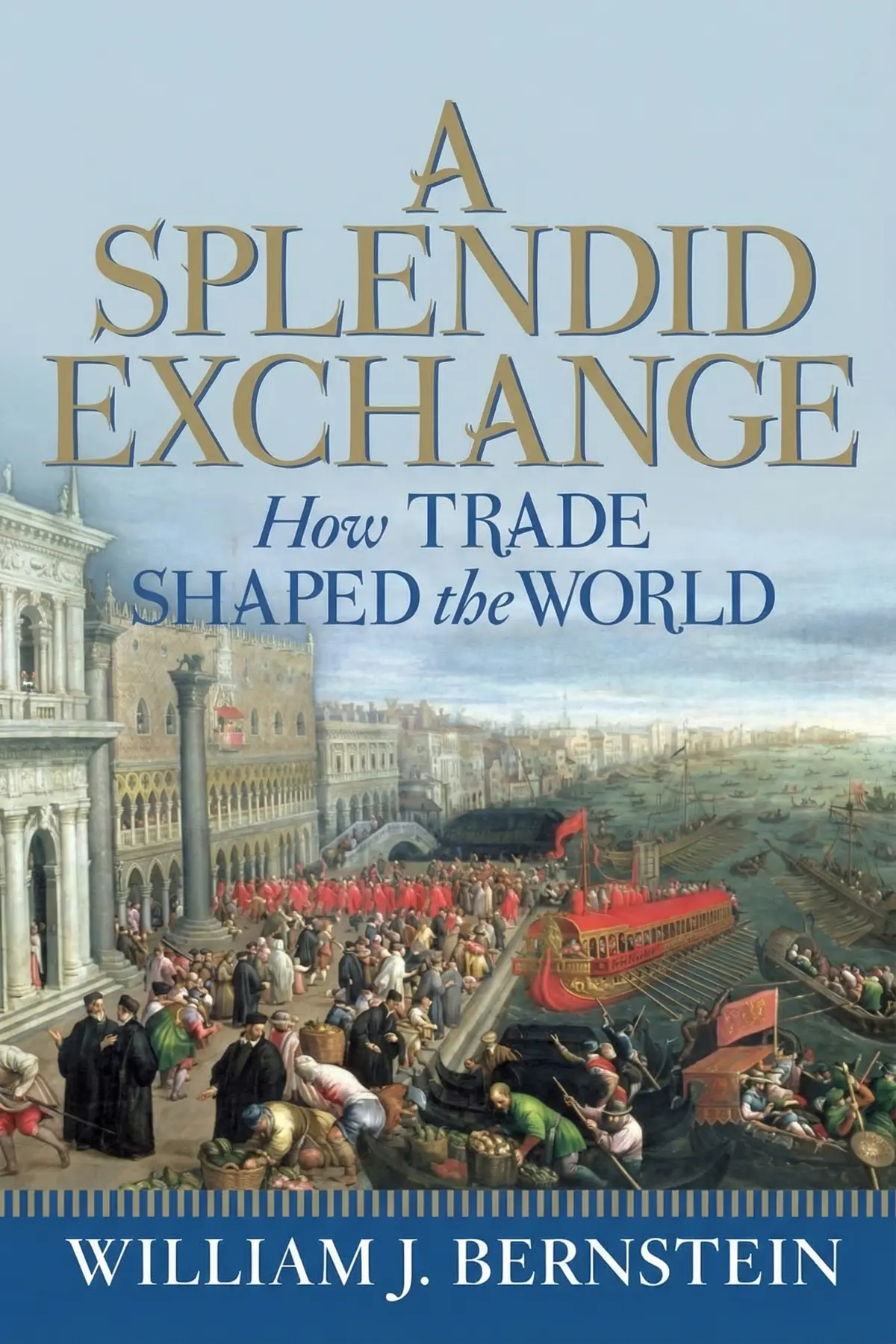
A Splendid Exchange explores the deep history of global trade, from ancient Mesopotamian obsidian routes to modern globalization, revealing how commerce has continuously reshaped human civilization, culture, and conflict.
2 min 01 sec
Have you ever paused to consider the incredible journey of the objects surrounding you? Your smartphone, your coffee, even the fabric of your clothes likely represent a complex web of international cooperation that spans several continents. In our modern era, we often view globalization as a contemporary phenomenon, perhaps something that began with the internet or the rise of massive shipping containers. But the truth is far more ancient and far more dramatic. The story of how we buy, sell, and move goods is, in many ways, the story of humanity itself.
In this exploration of our commercial past, we are going to look at the deep roots of global exchange. We will move beyond the idea of trade as a simple transaction and see it as a force of nature that has built empires, fueled scientific discovery, and occasionally brought civilizations to their knees through disease and conflict. The throughline of this narrative is that humanity has always been a trading species. From the moment our ancestors first settled into agricultural communities, they realized that no single region possessed everything it needed to thrive. This fundamental scarcity became the primary driver for exploration and connection.
Over the next several segments, we will trace this evolution. We will start in the ‘cradle of civilization’ and see how the basic need for tools sparked the first long-distance routes. We will witness how the domestication of specific animals changed the geography of power, and how the obsession with exotic tastes led to the accidental discovery of new worlds. We will also confront the darker side of this history—the way trade facilitated the movement of captive humans and deadly pathogens. Finally, we will look at the intellectual and technological shifts that brought us to our current globalized state, examining both the immense prosperity trade has created and the persistent inequalities it has left in its wake. This is a story of risk, innovation, and the eternal human desire to reach across the horizon for something new.
2 min 23 sec
Discover how the very first trade routes emerged from the basic survival needs of early agricultural societies in the fertile lands of the Persian Gulf.
2 min 34 sec
See how the unique evolution of the camel transformed the arid deserts of Asia into bustling highways for luxury goods and cultural exchange.
2 min 29 sec
Explore the immense profits of the medieval spice trade and the unintended, devastating consequences that followed in its wake.
2 min 17 sec
Follow the daring explorers of the fifteenth century as they used new technology to break the old trade monopolies and expand the global map.
2 min 18 sec
Witness the birth of the 17th-century global economy, where the first multinational corporations transformed capital and credit into world-spanning empires.
2 min 12 sec
See how the world moved from the restrictive hoarding of mercantilism to the revolutionary ideas of Adam Smith and David Ricardo.
2 min 04 sec
Observe how the 19th-century technological explosion of steamships and refrigeration created a truly interconnected global marketplace for the first time.
2 min 02 sec
Analyze how the shift back to isolationism and high tariffs in the 1920s and 30s helped trigger the economic collapse of the Great Depression.
2 min 11 sec
Examine the post-war explosion of globalization and the growing divide it has created between high-skilled winners and low-skilled workers.
1 min 35 sec
As we look back over the thousands of years of human exchange, a clear pattern emerges. Trade is far more than just the movement of goods for profit; it is the fundamental mechanism through which humanity has shared its greatest innovations, its cultures, and even its biological realities. From the obsidian blades of Mesopotamia to the digital devices of the 21st century, our desire to reach beyond our borders has been the primary driver of our development as a species.
We have seen that periods of openness and exchange generally lead to eras of great prosperity and discovery, while periods of isolation and protectionism often end in economic stagnation and conflict. However, we must also acknowledge that trade has never been a purely benign force. It has been a carrier for the plague, a driver of the slave trade, and a source of deep inequality. The lesson of history is that while trade is essential, it is also a powerful tool that requires careful management.
Today, we stand at a crossroads where the benefits of a globalized world are being weighed against the social costs of inequality. The challenge for the modern world is to maintain the incredible efficiencies and connections that global trade provides while addressing the needs of those who have been left behind by the shift. If we can find a way to make the fruits of this splendid exchange more accessible to everyone, we can ensure that the next era of human history is as productive and innovative as the ones that came before. The journey of trade is far from over; it is a continuous process of connection that will continue to shape our world for generations to come.
This summary provides a sweeping chronological look at how the movement of goods has defined the human experience. It starts in the ancient world, where the simple need for raw materials like timber and stone drove early civilizations to connect across the Persian Gulf. You will see how biological advantages, such as the domestication of camels, bridged vast deserts and linked the East and West long before the modern era. The narrative explores the high-stakes world of the spice trade, where the pursuit of flavor led to massive wealth, the expansion of slavery, and the devastating spread of the Black Death. The journey continues through the Age of Discovery, as European powers sought maritime shortcuts and accidentally stumbled upon the Americas, forever altering the global map. You will learn about the birth of the first global corporations and the intellectual shift from protectionist hoarding to the principles of free trade. Finally, the summary examines the technological revolutions of steam and refrigeration that made the world smaller, while addressing the modern challenges of economic inequality. It promises a comprehensive understanding of why trade is not just a commercial activity, but the primary engine of global history.
William J. Bernstein is a retired neurologist whose popular writing has focused on modern investment strategies and financial history. His books include The Birth of Plenty: How the Prosperity of the Modern World Was Created and The Four Pillars of Investing.
William J. Bernstein
Listeners find this volume to be deeply researched and expertly composed, with one listener pointing out the detailed endnotes provided for additional study. Furthermore, the work offers a robust account of international commerce, with one listener emphasizing its comprehensive coverage from beginning to now. Also, the storytelling is captivating, with one listener calling it an "immensely enjoyable walk through history," and the author's prose is lucid and easy to digest.
This book is essentially a biography of the world, told through the lens of commerce and human desire. Bernstein manages to bridge the gap between ancient Sumerian clay tablets and modern-day WTO protests with a fluid, engaging narrative style that never feels like a slog. I was particularly struck by how the author treats the spice trade not just as a business venture, but as a high-stakes drama filled with audacity and occasional barbarity. The research here is clearly exhaustive, yet the prose remains accessible to someone who isn't an economics major. It’s rare to find a historian who can explain the Stolper-Samuelson theorem and the cultural impact of silk with equal clarity. If you enjoy sprawling histories that connect the dots across centuries and continents, this is a must-read for your collection.
Show moreAs a history buff, I really appreciated how the author connects the dots between ancient trade hubs and the rise of Islamic civilization. Bernstein gives Ibn Battuta more coverage than Marco Polo, which was a refreshing change of pace from the typical Eurocentric narratives found in many textbooks. The book is an immensely enjoyable walk through history that reveals how our craving for things like tea, calico, and opium literally redrew the borders of empires. The narrative remains incredibly clear despite the massive scope of the subject matter. I finished the book feeling like I’d just taken a masterclass in world history. Every page is packed with interesting tidbits that keep you turning to the next chapter. It’s a brilliant melding of economic theory and human drama that I’ll likely revisit again.
Show moreI’ve been fascinated by global markets for years, yet I still found myself constantly highlighting new facts in these pages. This is a splendidly written history that manages to be both academic and incredibly readable at the same time. The way Bernstein explains the transition from the pre-modern world of luxury goods to our modern era of mass-market globalization is nothing short of masterly. He doesn't shy away from the blood-soaked reality of how trade was often forced upon people, yet he still highlights the undeniable benefits that exchange has brought to civilization. The storytelling is vivid, the pacing is generally excellent, and the insights into how protectionism has cycled through history are very timely. This belongs on the shelf of anyone interested in how the world actually works behind the scenes.
Show moreWow. I feel like I just took an epic journey through time. From the very first exchanges of obsidian in the Stone Age to the digital transactions of today, Bernstein captures the relentless human urge to truck and barter. The book is thoroughly researched, as evidenced by the extensive bibliography and notes. I especially liked the focus on the Indian Ocean trade, which is often overlooked in Western history books. The prose is elegant and the author’s ability to weave together disparate events into a cohesive story is impressive. It’s one of those rare books that actually changes how you look at the world around you. After reading this, you’ll never look at a piece of clothing or a spice rack the same way again. A truly magnificent achievement in historical writing.
Show moreEver wonder how a simple bag of peppercorns once held the power to launch entire navies? This book answers that and so much more by tracing the evolution of trade from the very beginning. The truth is, I expected something a bit drier, but Bernstein’s storytelling is surprisingly cinematic, especially during the sections on the Silk Road and the Portuguese exploration. He doesn't sugarcoat the cruelty of colonialism or the devastating spread of the bubonic plague along trade routes. My only real gripe is that the ending felt a little rushed compared to the meticulously detailed earlier chapters. Still, the maps and figures included are excellent visual aids that help clarify some of the more complex economic shifts. It definitely makes you rethink your morning coffee and where it actually comes from.
Show morePicked this up after seeing it recommended for fans of 'Guns, Germs, and Steel' and it did not disappoint. Bernstein has a knack for making even the most technical aspects of trade history feel relevant to a modern reader. I spent hours diving into the extensive endnotes, which are a goldmine for anyone looking to do further research on their own. The chapter on the 'disease of trade' was a particular highlight, showing how interconnected our world has always been, for better and for worse. Sentence lengths vary, keeping the pace brisk. Look, it’s a dense read that requires focus, but the payoff is a much deeper understanding of how global markets shaped the map of the world we see today. It is truly an informative survey of human ambition.
Show moreFinally finished this 400-page beast, and while it's a commitment, the sheer volume of research is staggering. Bernstein does a creditable job of remaining neutral for most of the narrative, examining both the courage of explorers and the cruelty of the companies they worked for. The section on the Dutch and English East India Companies was eye-opening, illustrating how corporate power functioned centuries ago. I loved the inclusion of detailed maps; they really helped me visualize the shifting trade routes over time. Frankly, some of the economic models discussed in the later chapters were a bit over my head, but the author explains them well enough for a layman to grasp the basic concepts. It’s an epic journey through time that rewards patient readers with a very sophisticated worldview.
Show moreWhile I don't always agree with Bernstein's unwavering defense of free trade, the historical sections are undeniably brilliant. He provides a comprehensive survey of how trade built civilization from the ground up. I was particularly fascinated by the discussion of how different countries viewed mercantilism and how those cultural differences influenced their economic success or failure. The book is well-written with a good dose of humor to leaven the more tragic episodes of history. Personally, I think the author downplays the benefits that protective barriers have provided to developing nations in the past, but his arguments are always intelligent and worth considering. It is a thought-provoking read that forces you to examine your own biases about how the global economy should function. Definitely worth the time for the history alone.
Show moreNot what I expected, particularly in the latter half of the volume. While the historical sections on the Indian Ocean and the incense trade were absolutely fascinating, I found the author’s stance on modern globalization to be a bit one-sided. He acknowledges the losers of free trade—those whose jobs vanish overnight—but then offers little more than a metaphorical shrug as a solution. It felt as if he spent 300 pages building a brilliant historical case only to end with a policy prescription that boils down to 'stay the course.' To be fair, the writing is top-notch and the research is clearly deep, but the transition from historian to advocate at the end didn't quite land for me. It’s a solid history book, but perhaps not the definitive word on where we should go from here.
Show moreGotta say, I have mixed feelings about this one. On one hand, the historical depth is incredible and the writing style is very accessible for such a heavy topic. On the other hand, I struggled to stay engaged during some of the more data-heavy sections. It took me months to get through because I kept putting it down for something more fast-paced. When it's good, it's great—like the parts about the silk trade and the origins of coffee. But when it gets into the weeds of 19th-century tariff debates, it becomes a bit of a slog. It’s clearly a well-researched project, and I respect the effort that went into it. However, if you aren't already very interested in economic history, you might find your attention span tested by the sheer density of the information.
Show more


Yanis Varoufakis

Ben Macintyre


AUDIO SUMMARY AVAILABLE
Get the key ideas from A Splendid Exchange by William J. Bernstein, plus 5,000+ more titles in English and Thai.