
A Promised Land
Barack Obama
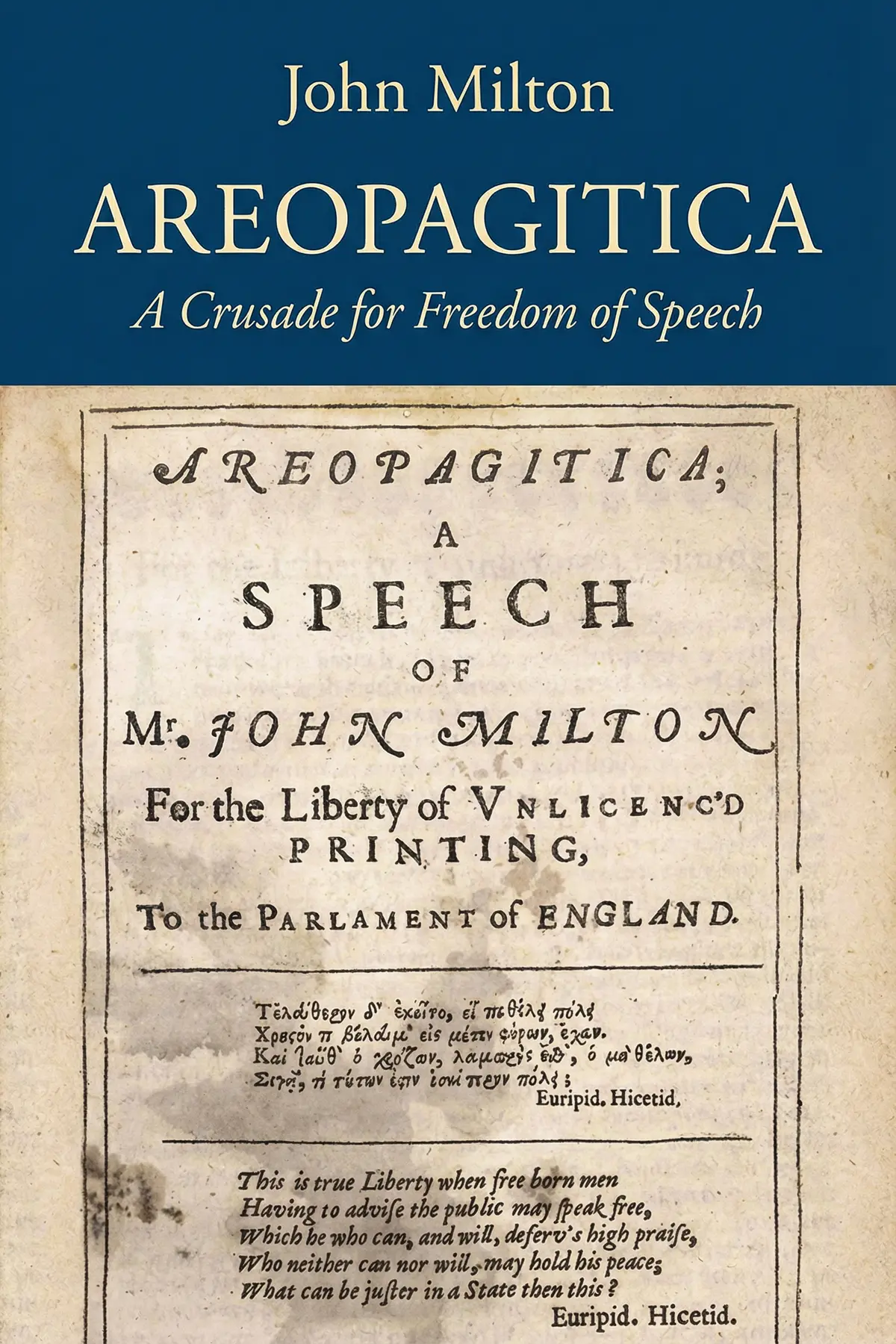
A historical defense of free speech, John Milton’s influential essay challenges government censorship. It argues that the pursuit of truth requires an open exchange of ideas and the rejection of intellectual gatekeeping.
39 sec
Imagine a world where every word you intended to publish required the official stamp of government approval. In 1644, this was the reality in England. While the nation was gripped by a civil war, a secondary battle was being fought over the nature of human thought itself. John Milton, the famous poet, stepped into this fray with a daring manifesto. His work, Areopagitica, remains a foundational defense of free expression. He didn’t just want the right to speak; he wanted to dismantle the gatekeepers of the human mind. This journey through his arguments reveals why silence is a tool of tyrants and why the collision of ideas is essential for human progress.
52 sec
Step back into the restrictive world of 17th-century publishing to see how a single law threatened to stall the intellectual and cultural progress of an entire nation.
49 sec
Explore why Milton believed that even controversial or “wrong” ideas are essential for uncovering the truth and fostering growth in a flourishing, healthy society.
53 sec
Learn how the suppression of the human voice was viewed not just as a legal issue, but as a direct assault on human dignity and fundamental values.
31 sec
Today, we live in an age of constant information, yet Milton’s questions remain relevant. Areopagitica reminds us that freedom of the press isn’t just about the speaker; it’s about the listener’s right to pursue truth without state interference. Milton’s crusade highlights that censorship is ultimately a sign of weakness in those who impose it. By championing the right to engage with every side of an argument, he laid the groundwork for the modern belief that in a free and open marketplace of ideas, the truth will eventually rise to the surface.
In 1644, John Milton faced a world where the English government sought total control over the printing press. Areopagitica is his response—a fiery, philosophical plea for the freedom of expression and the right to publish without state licensing. Milton argues that truth is not a fragile thing that needs protection from "bad" ideas; instead, it is a resilient force that only reveals itself through open debate and the collision of differing perspectives. The book explores the dangers of censorship, viewing it as an insult to human reason and a tool of despotic regimes. By restricting what can be written and read, a society halts its own intellectual and spiritual growth. Milton's work promises a vision of a society where the free flow of information is a natural right and a necessity for a functioning democracy. This summary highlights how his 17th-century arguments against pre-publication licensing laid the groundwork for modern concepts of free speech and why they remain vital in our current digital age.
John Milton was a legendary English poet and philosopher, best known for his monumental epic poem Paradise Lost. Beyond his contributions to literature, he was a staunch advocate for intellectual liberty and political reform. His writings covered a broad spectrum of topics, including freedom of speech and the ethics of governance, securing his legacy as a pivotal figure in both literary and philosophical history.
Listeners find Milton’s defense of free expression to be a fascinating and timelessly relevant work, with one listener noting his arguments for the "potency of life" within books remain essential to modern discourse. Furthermore, listeners appreciate the historical context and logical rigor he applies to the dangers of censorship. Although perspectives vary on the prose’s accessibility—which some listeners find dense or difficult to navigate—they also mention the text’s core premise is profoundly insightful. Additionally, many value the work as a fundamental historical survey that continues to challenge contemporary views on the suppression of ideas.
The idea that destroying a good book is akin to slaying reason itself is one of the most powerful arguments ever put to paper. Milton’s Areopagitica is a foundational text that remains vital in an age where heterodox opinions are increasingly rebranded as sedition. His logic is piercing: truth is irrepressible and invincible, so why do we fear the 'dust and heat' of open debate? I was moved by his description of books as vials containing the purest extraction of the living intellect. This isn't just a political tract; it’s a spiritual appeal for the freedom of the human mind. Even when the language gets thick, the clarity of his conviction shines through. It’s a masterpiece of logical rigor and moral courage that every citizen should grapple with at least once.
Show moreMilton’s defense of the printed word feels shockingly modern when you consider our current climate of digital deplatforming and corporate censorship. While the prose is undoubtedly dense, the central argument that a book contains a 'potency of life' is a staggering piece of rhetoric. He argues that to destroy a good book is to kill reason itself, an image of God in the eye, which is a hauntingly beautiful sentiment. I found his historical survey of censorship from antiquity to the Inquisition quite fascinating, even if it was clearly intended to flatter his Protestant audience. Frankly, the 1644 context of the English Parliament trying to regulate speech through licensing mirrors our own struggle with social media giants today. It is a rigorous, logical, and essential text for anyone worried about the future of free expression. You have to work for it, but the payoff is immense.
Show moreTo be fair, the language is dense, yet there is an undeniable 'potency of life' in these pages that transcends the centuries. Milton argues that to censor a work before it is even published is to do violence to the soul of the author. This hit home for me. I loved how he turned the idea of licensing back on the very government officials who claimed to be fighting for liberty. His points about how schisms can actually contain a deeper unity were also surprisingly relevant to our current political divisions. While some of the religious arguments felt a bit dated, the overarching theme of self-responsibility for one’s own spiritual development is timeless. It’s a challenging read, but it offers a lot of intellectual meat to chew on if you have the patience for it.
Show moreAfter hearing so much about this pamphlet in my university courses, I finally sat down to tackle the actual text. In my experience, it’s a bit of a mixed bag. On one hand, Milton makes brilliant points about how the trial of our virtues requires us to engage with what is contrary. He rejects a 'cloistered virtue' that never sees its adversary, which is a profound takeaway for modern discourse. On the other hand, the 1644 Parliament licensing context is so specific that it can be hard to follow without a heavy set of footnotes. The middle section, where he surveys the history of censorship, drags significantly. It’s a fascinating historical survey, but the prose is quite typical for its time—dense, demanding, and somewhat elitist. It’s worth reading for the big quotes, but expect to do some heavy lifting.
Show moreThis is one of those works where the SparkNotes summary might actually be more enjoyable than the original prose. Not gonna lie, I found Milton’s style to be incredibly difficult to navigate, even though I consider myself a regular reader of classics. The core premise is essential—free expression is the bedrock of a healthy society—but the delivery is so bogged down in 17th-century theological debates that the message gets lost. I did appreciate the historical context regarding the Catholic Inquisition and how Milton views censorship as a form of spiritual laziness. However, for a casual reader, the esoteric nature of the text might be a major turn-off. It’s a foundational work that feels like a duty to read rather than a pleasure, though its insights into the suppression of ideas are still very sharp.
Show moreLook, we are living through a precarious new age of surveillance and 'misinformation' purges, making Milton’s 1644 plea more vital than ever. The truth is that the establishment will always find a pretext to regain its stranglehold on popular discourse. Milton’s warning that the censor sins against the future is a brilliant observation that we see playing out on social media every day. However, I have to be honest: as a piece of literature, it’s pretty dry. The logical rigor is there, but the emotional resonance is buried under a mountain of archaic references and dense paragraphs. It’s an important work of political philosophy that happens to be wrapped in a very tough shell. If you can get past the 'thous' and 'thees,' there is a lot of wisdom here regarding the dangers of a managed consensus.
Show morePicked this up because I wanted to understand the origins of the First Amendment, and Milton’s survey of history is certainly an interesting place to start. He is clearly biased toward his Protestant worldview, particularly in his disdain for the Catholic Inquisition, but his logic regarding 'trial by contrary' holds up remarkably well. He argues that we aren't born innocent, but rather impure, and it is the process of distinguishing truth from vice that actually purifies us. This is a great argument against safe spaces and the sanitization of ideas. That said, the prose is incredibly ponderous. It’s a slim volume that took me twice as long to finish as a book three times its size. It's a foundational historical document, but definitely not a light read for a Sunday afternoon.
Show moreIs it possible for a book to be undeniably right in its message but absolutely agonizing to actually read? Personally, I struggled immensely with Milton’s unusual style and his penchant for long, winding sentences that seem to swallow the point he’s trying to make. The core premise—that we should allow all views to be heard—is something I agree with, yet the execution here feels wooden and ponderous. It reads more like an esoteric legal brief than a soaring defense of liberty. To be fair, I understood the basic premise about the dangers of licensing, but I found myself zoning out during the more historical and theological sections. It’s an important historical document, no doubt, but as a reading experience, it was quite a chore. I would recommend finding a summary unless you are a scholar of 17th-century prose.
Show moreMy copy included Milton’s writings on divorce, which I found even more impenetrable than the main argument against censorship in Areopagitica. Frankly, I just didn't have the background knowledge to appreciate the specifics of his legal and religious arguments. I understood his basic premise about the 'killing of reason,' but the rest of the text felt like a long, winding road to nowhere. The sentence structures are so complex that I often had to read a single paragraph three times just to find the verb. It’s a reflection on my own limitations, perhaps, but I found the experience more frustrating than enlightening. I respect the themes of intellectual freedom, but the actual writing style felt like it was designed to keep people out rather than invite them in.
Show moreI expected a soaring oratorical masterpiece, but instead, I found myself drowning in a sea of lifeless sentences that seem to go nowhere. Milton is like a Polonius who lacks any shred of self-awareness. He rambles on with an absurd assemblage of overwrought analogies that feel like 'Pseudo-Shakespeare' at its absolute worst. The truth is, the arguments here are incredibly simplistic once you strip away the layers of fluff and archaic posturing. Why use a thousand words when ten would suffice? It’s horridly stiff and lacks any real blood pumping through its veins. I respect the historical significance of the Areopagitica, but the actual experience of reading it was dull. If this is his 'famous defense' of free speech, I truly hope his poetry is more accessible than this dry, academic slog.
Show moreBarack Obama
Masaji Ishikawa
John Rawls
Miles Taylor
William B. Irvine
AUDIO SUMMARY AVAILABLE
Get the key ideas from Areopagitica by John Milton, plus 5,000+ more titles in English and Thai.







