
14 min
Buddhism – Plain and Simple: The Practice of Being Aware, Right Now, Every Day
By Steve Hagen
Buddhism – Plain and Simple offers a clear, accessible path to understanding the fundamental teachings of Zen Buddhism. It focuses on seeing reality clearly, embracing change, and finding peace through mindfulness and perception.
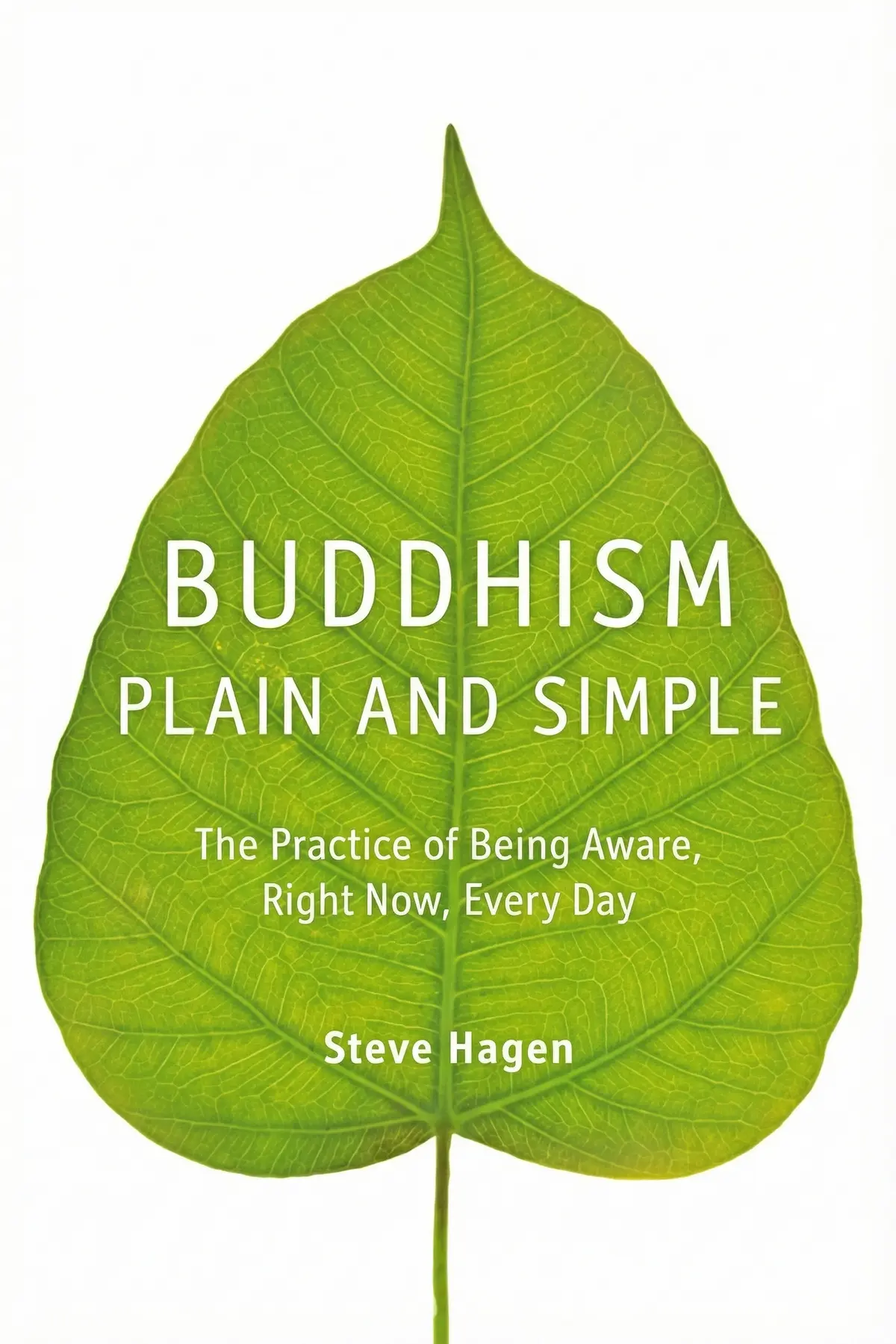
Table of Content
1. Introduction
1 min 54 sec
Have you ever spent a seemingly perfect afternoon doing everything you thought would make you happy—shopping for new gadgets, catching up with friends over a meal, or treating yourself to something special—only to return home feeling strangely hollow? It is a common experience in our modern world. We chase after moments of excitement, yet once they pass, we are left with a lingering sense of exhaustion or even emptiness. It’s as if we are constantly running toward a horizon that keeps moving further away.
This sense of dissatisfaction isn’t just about the big things; it often bleeds into our daily worries. We find ourselves constantly on edge, fretting over missing a train, being late for a bill payment, or deeper anxieties regarding our family’s safety and our own professional security. This pervasive discontent is why so many people, from everyday individuals to high-profile celebrities, have found themselves drawn to the wisdom of Buddhist thought. They aren’t necessarily looking for a new religion, but rather a new way of seeing the world.
In our exploration of Buddhism – Plain and Simple, we aren’t going to look at ancient rituals or complex dogmas. Instead, we are going to look at the world through the lens of direct experience. The central premise here is that everything we are looking for is actually right in front of us. We are often blind to it because we are shrouded in a veil of our own making—a veil woven from our desires, our fears, and our rigid opinions about how things ‘should’ be.
By the time we finish, you’ll see how to lift that veil. We’ll explore why the concept of a permanent ‘self’ is more of a hurdle than a help, how to apply your energy without the exhaustion of straining, and what a simple occurrence like a dripping faucet can teach you about the profound power of mindfulness. The goal is simple: to learn how to live in the moment and find a peace of mind that isn’t dependent on external circumstances.
2. The Root of Suffering in Resistance
2 min 22 sec
Discover how our internal expectations and the constant battle against change create a cycle of dissatisfaction that prevents us from experiencing life as it truly is.
3. The Raft of Practice
1 min 59 sec
Explore the first steps of the Eightfold Path, focusing on how shifting our views and intentions can lead us away from suffering and toward a clearer perception.
4. Effort without Strain and the Power of Mindfulness
2 min 15 sec
Learn why true progress doesn’t require forceful struggle and how focusing on your internal reactions can transform your relationship with the world around you.
5. The Illusion of the Permanent Self
1 min 55 sec
Challenge the common belief in a fixed identity and discover how viewing yourself as a continuous flow can provide a new sense of freedom.
6. Relative Truth versus Absolute Reality
2 min 00 sec
Explore how language and concepts divide the world into opposites and why true understanding comes from perceiving the inseparable whole.
7. Conclusion
1 min 35 sec
In the end, the journey through the core principles of Buddhism brings us back to a very simple starting point: the here and now. We’ve seen how our tendency to judge our experiences and resist the natural flow of change is the true engine of our dissatisfaction. By holding onto fixed ideas of who we are and how the world should behave, we create a barrier that keeps us from the peace we so desperately seek.
The shift toward a more content life doesn’t require a radical change in your external circumstances. It requires a radical change in your awareness. As you begin to practice the right intentions and cultivate mindfulness, you start to see through the illusions of the permanent self and the arbitrary divisions of language. You begin to experience the world not as a series of problems to be solved or desires to be fulfilled, but as a continuous, interconnected process.
If you want to start applying this today, there is a very simple way to begin: just breathe. The next time you feel a surge of anxiety, a pang of regret, or the heat of anger, don’t try to fight the feeling or distract yourself. Simply close your eyes and bring your full attention to the sensation of your breath entering and leaving your body. By doing this, you are stepping out of the cycle of reaction and into the present moment. This small act of awareness is the first step toward waking up to the reality of your life, just as it is, plain and simple.
About this book
What is this book about?
This summary explores the core tenets of Buddhism as presented by Steve Hagen, stripping away the religious trappings to focus on the direct experience of reality. It addresses the common human experience of discontent and the persistent feeling that something is missing, even when we have achieved material success or personal goals. Through an examination of the Eightfold Path, the book promises to guide listeners toward a state of awareness known as being 'awake.' It covers essential concepts like the impermanence of all things, the illusion of the individual self, and the difference between relative and absolute truth. By the end, listeners will understand how to shift their perspective from resisting life's changes to flow with them, ultimately finding a durable sense of peace and contentment in the present moment.
Book Information
About the Author
Steve Hagen
Steve Hagen is a Zen priest and a teacher of Buddhism. He is also the author of How the World Can be the Way It Is: An Inquiry for the New Millennium into Science, Philosophy, and Perception. His work is known for making complex Buddhist philosophy accessible to Western audiences without losing the depth of the original teachings.
Ratings & Reviews
Ratings at a glance
What people think
Listeners find this guide to Buddhism to be a compelling read that functions as a superb primer on its core tenets. The material is composed in straightforward English and is very accessible, with one listener remarking that it is a book to revisit repeatedly. They value its genuine perspective on Buddhism absent of religious components, and one review emphasizes how it delivers concepts without sounding preachy. The author’s style is full of passion, and listeners appreciate the brief clarifications and the stimulating ideas provided throughout.
Top reviews
Somboon
Finally got around to this Zen classic after years of hearing about it. What struck me immediately was how Hagen strips away the incense, the rituals, and the 'funny clothes' to get to the core of what it means to be awake. This isn't a book about becoming a Buddhist; it's a book about seeing. He uses plain English to explain why our minds are constantly 'leaning' toward the future or the past instead of just being in the here and now. I loved the section on the afterlife where he basically says it doesn't matter because we haven't even figured out how to live in the present. To be fair, some might find the lack of specific 'methods' frustrating, but I found the conceptual clarity refreshing. It’s a passionate, quick read that I know I’ll return to whenever my mind starts to get cluttered with nonsense again.
Show moreJonathan
Buddhism is often presented as this mystical, exotic thing, but this book brings it right back to the ground. There are no rules here, just observations about how we create our own suffering by refusing to see things as they are. I felt a real sense of peace reading Hagen’s take on the 'stream' of existence. He doesn't want you to kill the Buddha; he wants you to stop looking for a Buddha outside of your own awareness. This is easily the most straightforward spiritual book on my shelf. It’s concise and gets straight to the point without any 'sciencey' filler or neuro-babble that seems to be popular in modern mindfulness books. If you want to understand the basic tenets of Buddhism without the baggage, start here. It’s plain, simple, and deeply thought-provoking.
Show moreSofia
Ever wonder why most spiritual books feel like they’re trying to sell you a costume? Hagen does the opposite. He tells you to take the costume off. This is a brilliant, stripped-down look at what the Buddha actually taught before 2,500 years of tradition got layered on top. I appreciated his 'secular' approach; you don't have to believe in anything to get value from this. He just asks you to look at your own experience. The way he describes how we 'lean' into our expectations instead of just seeing what is right in front of us changed how I view my daily commute. It’s not about being a 'better' person; it’s about being an awake person. It is a quick read, but it holds a lot of weight. Highly recommended for skeptics.
Show moreOoi
The chapter on the afterlife is worth the price of the book alone. Hagen essentially argues that obsessing over what happens after we die is just another way of avoiding the reality of right now. It’s a bold, no-nonsense take that I found incredibly refreshing. He presents Buddhism as a philosophy of 'seeing' rather than a system of belief. I've found myself re-reading certain passages just to sit with the simplicity of his words. It’s not a 'how-to' guide with 10 steps to enlightenment, which might annoy some people, but that’s the whole point. You can't follow a map to somewhere you already are. This book is a passionate plea to wake up and stop living in a dream of your own making. It’s authentic, direct, and remarkably clear.
Show moreBee
What sets Hagen apart from other spiritual teachers is his refusal to lean on dogmatic crutches. In my experience, most introductory texts get bogged down in history or cultural traditions, but this stays focused on the philosophy. He presents the idea of 'no-self' in a way that is actually digestible for a Western audience. I particularly enjoyed the distinction he makes between religion and a way of life. It’s not about believing in something; it’s about observing reality as it is. My only minor gripe is that the prose can be a bit repetitive at times. He repeats phrases about 'the whole' and 'seeing' quite often, which might be a Zen teaching tool, but it felt a little circular in the middle chapters. Still, it’s an excellent, non-preachy entry point for anyone curious about mindfulness.
Show morePalm
Wow, this was exactly the mental reset I needed for the new year. Hagen manages to explain the Four Noble Truths without making them sound like ancient commandments. He frames them as practical observations about the human condition. I’ve read a few books on Zen before, but his explanation of 'no-self'—specifically the idea that we aren't a noun but a process—really clicked for me this time. Truth is, we spend so much time worrying about the future that we miss the only moment we actually have. The book is very thin, but it’s dense with ideas that make you stop and look at the wall for twenty minutes. My only complaint is the repetitive nature of the second half. It felt like he was trying to fill a page count, but the first 80 pages are gold.
Show moreAroha
As someone who prefers a secular approach to meditation, I appreciated how Hagen avoids the sciencey traps of modern NüBü writers. He doesn't try to prove Buddhism with an fMRI scan. Instead, he focuses on the raw philosophy of perception. The book is written in very plain English, making it accessible even if you've never heard of dharma before. To be fair, he does get a little repetitive with the 'mind leaning' metaphors toward the end, and some of the logic regarding the lack of a permanent self felt a bit dismissive of human memory and trauma. But as an introduction to the core concepts of Zen, it’s top-tier. It isn't preachy, and it doesn't ask for your devotion. It just asks for your attention. Definitely worth a spot on the bookshelf.
Show moreSukit
After hearing so much about Hagen’s approach, I found it a bit of a mixed bag. On one hand, his writing is accessible and he avoids the usual esoteric jargon that makes these books a chore. I liked the anecdote about the soft-top car and the raccoon—it made the concepts feel lived-in. However, by the halfway mark, it felt like he had run out of things to say. He kept repeating the same few phrases about 'awakening' and 'the truth waiting to be seen' over and over again. It started to feel less like a philosophy and more like a collection of mantras. Is Buddhism really this simple? I felt like I was being told what I was doing wrong without being given any actual tools to fix it. It’s a good primer, but I think I need something with more meat on its bones.
Show morePete
I really wanted to like this, but I couldn't get past the condescending tone. Hagen uses this analogy of a scared little boy at an X-ray machine to explain our fear of consciousness, and it felt incredibly patronizing. He tells the reader 'it won't hurt,' as if he’s some enlightened parent and we’re all just confused children. The logic felt full of holes, too. He argues there is no separate self and that we aren't the same person we were at age six because our atoms changed, but that’s just a leap in logic that ignores how experiences carry forward. To suggest there is zero connection between our past and present is just silly. Plus, the formatting was distracting—italics and capital letters seemed to be thrown in at random. For a book that claims to be simple, it felt unnecessarily smug.
Show moreElla
The writing style in this book drove me absolutely up the wall. Every other sentence has an italicized word for emphasis, which makes the whole thing feel like being yelled at by a very calm person. It felt incredibly repetitive; I think he said 'you must experience the here and now' at least fifty times. There’s almost no actual content here—it’s just a handful of abstract ideas stretched out over 150 pages. One minute he says distinct objects don't exist, and the next he's giving advice on how to live your life. How can I live a life if I don't exist? The contradictions and leaps in logic were too much for me to handle. I was looking for a clear guide, but instead, I got a mediocre collection of 'deep' thoughts that don't actually offer any solutions.
Show moreReaders also enjoyed
A New Earth: Awakening to Your Life’s Purpose
Eckhart Tolle
Aflame: Learning from Silence
Pico Iyer
A Force for Good: The Dalai Lama's Vision for Our World
Daniel Goleman
A Return to Love: Reflections on the Principles of a Course in Miracles
Marianne Williamson
Abundance: The Inner Path to Wealth
Deepak Chopra
Alcoholics Anonymous
Alcoholics Anonymous World Services
AUDIO SUMMARY AVAILABLE
Listen to Buddhism – Plain and Simple in 15 minutes
Get the key ideas from Buddhism – Plain and Simple by Steve Hagen, plus 5,000+ more titles in English and Thai.
- 5,000+ titles
- Listen as much as you want
- 7-day free trial
- Cancel anytime







