
16 min 51 sec
Available in:English
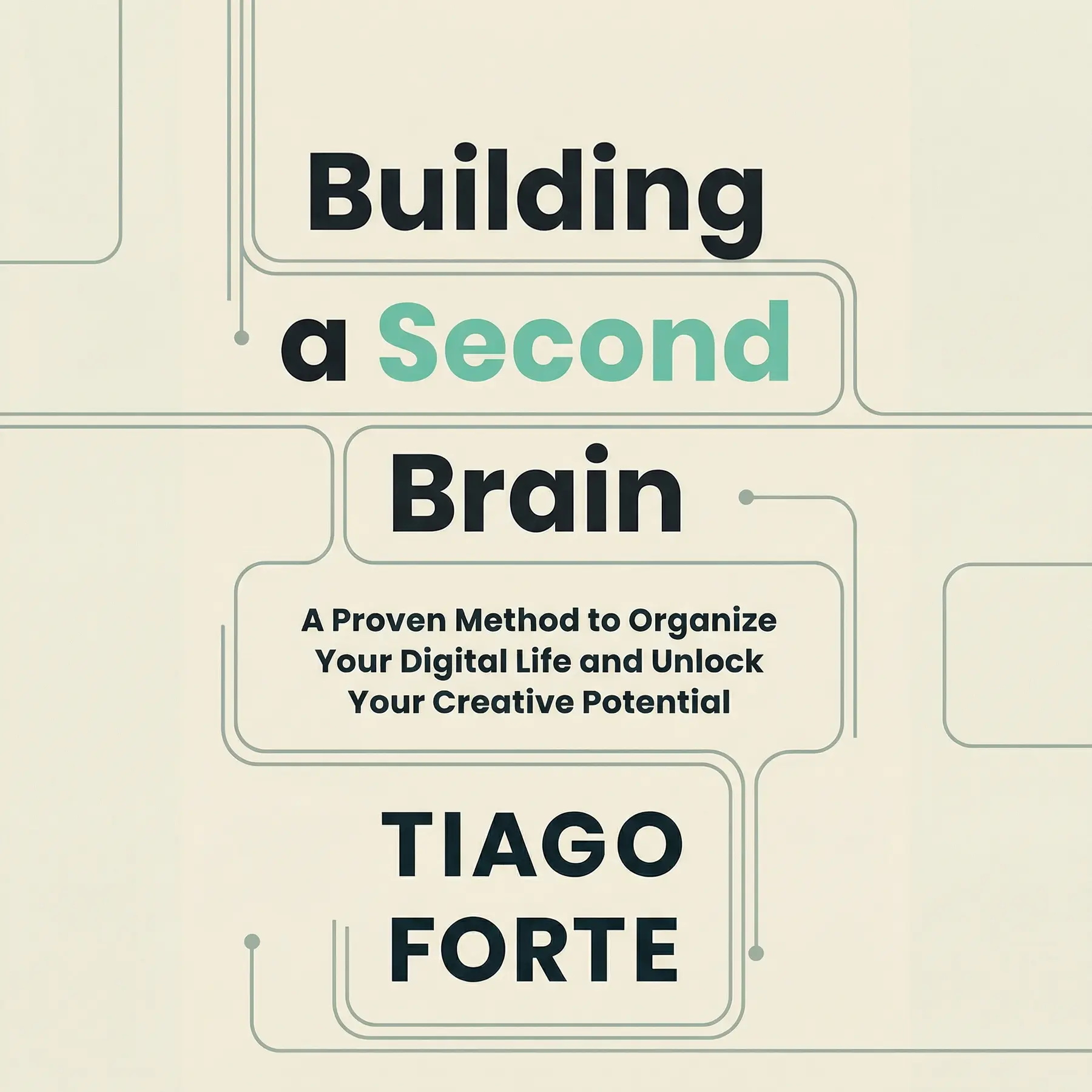
Building a Second Brain: A Proven Method to Organize Your Digital Life and Unlock Your Creative Potential
By Tiago Forte
Stop struggling with information overload and start creating. This summary explains how to build a digital system that preserves your best ideas, organizes your life, and boosts your creative output exponentially.
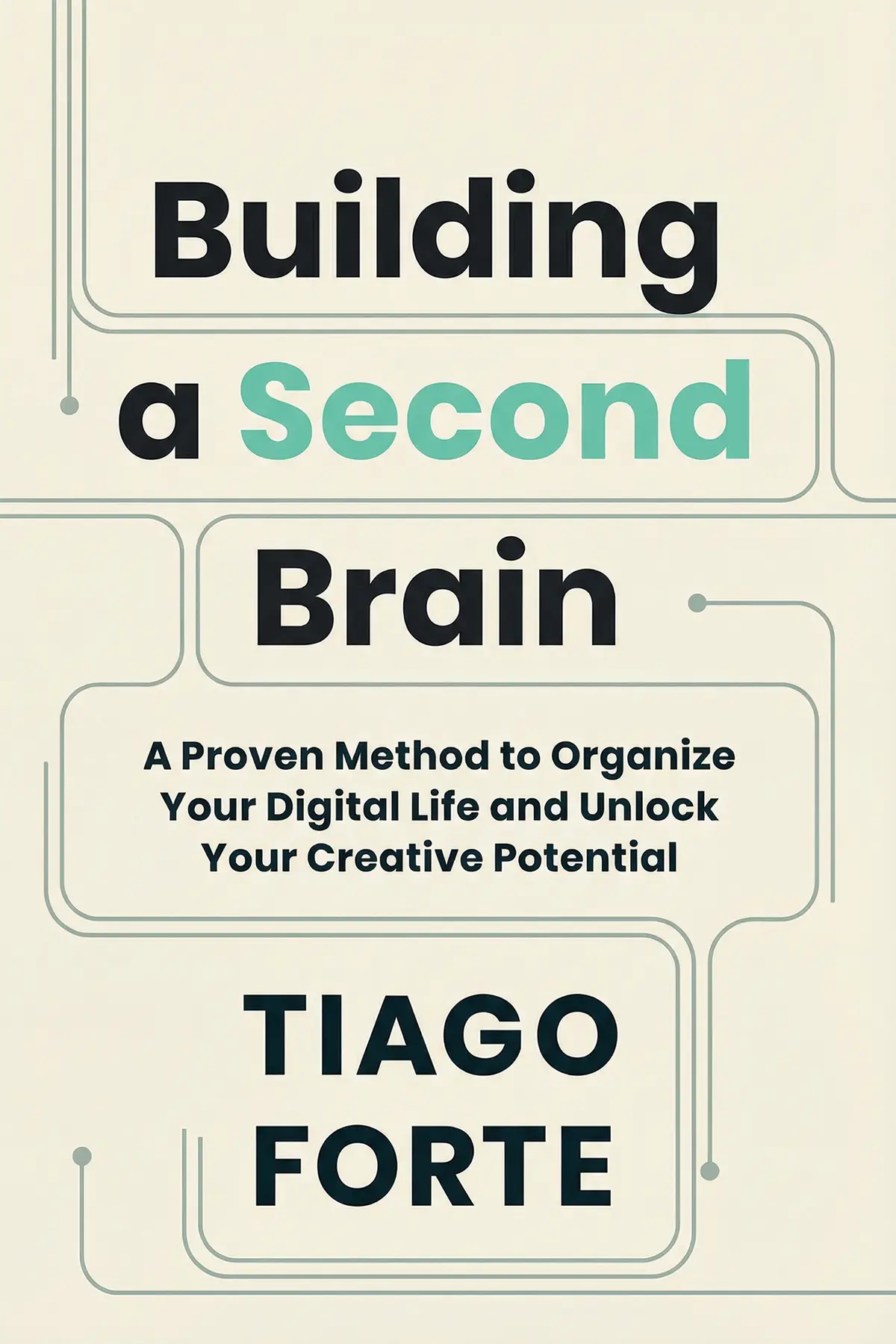
Table of Content
1. Introduction
2 min 19 sec
Have you ever experienced that frustrating moment where a brilliant realization strikes you in the middle of a commute, only for it to vanish into thin air by the time you reach your desk? Or perhaps you’ve been in a high-stakes meeting, knowing you recently read a study that would perfectly support your argument, yet you simply cannot recall the specific details or where you found them. These aren’t just minor lapses in memory; they are symptoms of the unique era we live in—an era of relentless information overload.
Research suggests that the average person today processes a staggering amount of data, roughly thirty-four gigabytes every single day. Our biological brains, though incredible, were never meant to serve as high-capacity storage vaults for every fragment of data we encounter. When we try to force our minds to do the heavy lifting of remembering every detail, we end up stressed, exhausted, and remarkably uncreative. We are so busy trying to hold onto the past that we have no mental space left to build the future.
But there is a better way. Technology, which is often the source of our overwhelm, also provides the solution. By building a digital system to act as a Second Brain, we can systematically record, sort, and refine the knowledge we encounter. This allows our actual brains to return to their primary function: deep thinking and innovative problem-solving.
In this walkthrough of the Second Brain methodology, we will explore a proven four-step framework designed to turn your digital life from a source of clutter into a wellspring of potential. We’re going to look at how to capture what matters, organize for action rather than just storage, distill your notes down to their most potent essence, and finally, express those ideas to make a real impact on the world. By the end, you won’t just have a collection of notes; you’ll have a personal knowledge engine that grows more valuable every day. Let’s dive into how you can reclaim your mental energy and never lose a great idea again.
2. Mastering the Art of Capture
3 min 10 sec
Discover why your current way of saving information is likely failing you and learn the secret to identifying truly valuable knowledge assets.
3. Organizing for Action with PARA
2 min 53 sec
Forget the traditional library-style organization. Learn how to arrange your digital life based on what you are actually doing right now.
4. The Power of Distillation
3 min 08 sec
Learn the art of subtraction to ensure your notes are actually useful when you need them months or years down the line.
5. Expression and the Use of Intermediate Packets
3 min 27 sec
Stop starting from scratch. Discover how to assemble your creative work from pre-built blocks and overcome the fear of the blank page.
6. Conclusion
1 min 54 sec
Building a Second Brain is about more than just finding a better app for your to-do lists; it is a fundamental shift in how you relate to the digital world. We no longer have to be victims of the endless stream of content that vie for our attention. Instead, we can become curators of our own intellectual growth. By following the CODE system—Capture, Organize, Distill, and Express—you create a virtuous cycle where every piece of information you encounter has the potential to become a building block for your future success.
Remember that this is a journey, not a one-time setup. Start small. You don’t need to organize your entire digital life in a single weekend. Begin by capturing just two high-quality assets a day. Clear out your old, messy folders by moving them into an Archive, giving yourself the ‘clean slate’ you need to start fresh with the PARA system. Spend a few minutes distilling a single article that really interests you, and look for opportunities to save small ‘packets’ of work that you can use again later.
The ultimate goal of this system is freedom. When you trust your Second Brain to remember the details, your biological brain is finally free to do what it was evolved for: to imagine, to connect, and to create. You aren’t just organizing files; you are unlocking your creative potential. As you move forward, keep the spirit of ‘verum ipsum factum’ in mind—we only truly know what we make. So, go forth and start making. Use the knowledge you’ve gathered to solve problems, share your unique perspective, and build the things that only you can build. Your Second Brain is ready to support you every step of the way.
About this book
What is this book about?
We live in an era where we are constantly bombarded by more information than our biological brains were ever designed to handle. From news feeds to work emails and personal insights, the sheer volume of data leads to mental exhaustion and forgotten ideas. This guide provides a systematic solution to this modern crisis by introducing the concept of a Second Brain—a digital repository that mirrors your thinking and stores your knowledge for future use. The promise is simple: by outsourcing the task of remembering to a reliable digital system, you can free your mind to focus on what it does best—thinking, imagining, and creating. You will learn the CODE framework, which stands for Capture, Organize, Distill, and Express. This method ensures that your digital notes are not just a graveyard of files, but a dynamic, actionable engine for your professional and personal projects. Whether you are a student, a creative professional, or a corporate leader, this system transforms information into a lasting asset.
Book Information
About the Author
Tiago Forte
Tiago Forte is the founder of ForteLabs and a leading expert on personal knowledge management and productivity. He has dedicated his career to helping people use technology to enhance their creativity and efficiency. Forte has served as a consultant for major global organizations, including Toyota, Nestlé, and the Inter-American Development Bank. His teachings have reached a global community of over 25,000 online learners, making him one of the most prominent voices in the modern productivity movement.
Ratings & Reviews
Ratings at a glance
What people think
Listeners find this title outstanding for knowledge management, as it delivers functional techniques for handling personal data and structuring digital routines. The delivery is lucid and easy to grasp, which clarifies the milestones for success, and listeners mention improved output and efficiency. They prize the work's life-altering influence, and one listener points out how it reframes their entire method of organization.
Top reviews
Cha
Wow. This book completely shifted how I view my digital life and mental clarity. For years, I struggled with 'information FOMO,' bookmarking hundreds of articles I never revisited, but Tiago Forte provides a concrete framework to actually use that knowledge. The PARA system—Organizing by Projects, Areas, Resources, and Archives—is a total game-changer because it prioritizes action over just hoarding data. It’s not just about taking better notes; it’s about building a reliable infrastructure for your creativity. I’ve noticed a massive spike in my productivity since I stopped trying to memorize everything and started trusting my digital system. If you feel constantly overwhelmed by your browser tabs and random voice memos, you need this. It’s a clear, accessible guide that turns digital chaos into a structured creative engine.
Show moreOat
Ever wonder why you feel so mentally drained even when you aren't technically working? It’s likely because you’re trying to use your brain as a storage device instead of a processing tool. Building a Second Brain provides the antidote to that cognitive load by teaching you how to externalize your thoughts. I particularly loved the 'Express' part of the CODE framework, which emphasizes that the point of knowledge management is to actually create something new. Since implementing these principles, I’ve closed over 200 open tabs and moved everything into a streamlined system in Notion. The weight off my shoulders is palpable. This isn't just about apps; it's a fundamental shift in how to navigate an information-dense world. Truly transformative work that I wish I’d read back in college.
Show moreVarinee
Finally, a framework that prioritizes the output rather than just the storage of information! I’ve been a serial note-taker for years, but I always felt like my notes were a 'black hole' where ideas went to die. Building a Second Brain changed that by forcing me to think about how my future self will actually use the data I'm capturing. The 'Express' phase is a brilliant reminder that we should be building blocks for future projects, not just collecting digital dust. My creative output has doubled since I started using PARA to organize my research. The writing is punchy, the logic is sound, and the impact on my daily workflow has been immediate. It’s easily one of the most practical books on productivity I’ve read in the last decade.
Show moreTern
As a freelance designer, my desktop used to be a graveyard of 'final_v2' files and random screenshots that I could never find when I actually needed them. After working through Forte’s methods, I finally feel like I have a handle on my professional assets. The chapter on 'Distilling' was particularly eye-opening for me, as it taught me how to take notes for my future self rather than just highlighting text mindlessly. The writing is accessible and the steps are easy to follow, even if you aren't a 'tech person.' I did find some of the examples a bit banal, and the tone occasionally leans into being condescending, but the practical value of the filing system outweighs the fluff. It’s a solid 4-star read for anyone drowning in digital clutter.
Show morePriya
After hearing about this on several productivity podcasts, I decided to see if the 'Second Brain' was worth the hype. Frankly, the methodology is excellent for anyone in a corporate environment where information hoarding is a real problem. The book explains how to make information retrievable, which is where most people fail. I’ve started applying the 'Project' vs 'Area' distinction at work, and it’s made my weekly reviews so much faster. I do agree with other reviewers that there is a bit too much repetition, and some chapters felt like they were reaching to meet a word count. Still, the core principles of the CODE framework are practical and easy to implement immediately. It’s a great resource for improving efficiency, even if you have to wade through some flowery language to get to the meat.
Show moreOn
The chapter on distilling information was the highlight for me, specifically the idea of 'Progressive Summarization.' Most of us just clip articles and let them rot in Evernote, but Forte shows you how to layer your notes so they are useful months later. It’s a very pragmatic approach to Personal Knowledge Management (PKM) that doesn't get bogged down in which specific software you should use. I appreciated that he stays 'tool-agnostic,' focusing on the habits rather than the tech. My only gripe is that the book feels a bit too much like a marketing vehicle for his expensive online course. Regardless, the value is there if you’re looking to organize your digital life. It’s a quick read that offers a lot of 'aha' moments for the chronically disorganized.
Show moreNiramai
Personally, I found the PARA system to be the most valuable part of the whole experience, even if the rest of the book felt a bit stretched. I’ve always struggled with where to put 'middle-ground' information that isn't quite a project but isn't trash either. The 'Resources' and 'Areas' categories solved that problem for me instantly. While I think the 'Second Brain' branding is a bit hyperbolic, the underlying principles of digital organization are solid. It’s a great guide for students or early-career professionals who are overwhelmed by the sheer volume of media we consume daily. You might find some of it repetitive if you’ve followed Tiago on YouTube, but having it all in one cohesive volume is definitely worth it for the sense of order it brings.
Show moreNatchaya
To be fair, Tiago Forte has a very clear and accessible writing style that makes complex ideas feel manageable. However, I couldn't shake the feeling that I was reading a polished manual for things I was already doing instinctively. The PARA method is just basic organization, and while 'Capture' is a good reminder to write things down, is it really worth an entire book? I was hoping for more deep-dive neuroscience or perhaps some historical context regarding commonplace books—which the author strangely ignores in favor of modern celebrity examples. It’s a decent primer for someone just starting their career or someone who is naturally very disorganized. If you’re already an avid note-taker, you’ll likely find yourself skimming through eighty percent of the pages to find the few nuggets of actual wisdom.
Show moreBo
Look, I wanted to love this because the hype in the productivity community is massive, but it felt like an over-extended blog post. The core concepts, CODE and PARA, are actually quite useful, yet they could have been explained in twenty pages rather than three hundred. There is so much filler here, including anecdotes about Taylor Swift and Richard Feynman that felt more like padding than essential evidence. To be fair, if you’ve never used a folder in your life, this might feel revolutionary, but for most people, it’s just common sense wrapped in fancy acronyms. I’m honestly surprised at the price tag for what essentially amounts to 'put your files in folders and summarize them.' It’s not a bad system, but the book itself is incredibly wordy and repetitive.
Show moreNathan
This book is essentially an overpriced manual for basic computer literacy disguised as a productivity revolution. Forte acts like he discovered the concept of note-taking, completely ignoring centuries of intellectual history like the Dutch commonplace books described by Erasmus. Instead of rigorous methodology, we get shallow stories about pop stars and the same repetitive advice to 'use an app.' If you know how to create a folder and you understand that you should probably save things you want to remember, you have already mastered this book. It is 300 pages of fluff that could have been a single Twitter thread. I bought this on a recommendation from Ali Abdaal, but it was a total letdown. Save your money and just look up the acronyms on Google; you’ll save hours of your life.
Show moreReaders also enjoyed
AUDIO SUMMARY AVAILABLE
Listen to Building a Second Brain in 15 minutes
Get the key ideas from Building a Second Brain by Tiago Forte, plus 5,000+ more titles in English and Thai.
- 5,000+ titles
- Listen as much as you want
- 7-day free trial
- Cancel anytime







