

Split the Pie: A Radical New Way to Negotiate
Barry J. Nalebuff
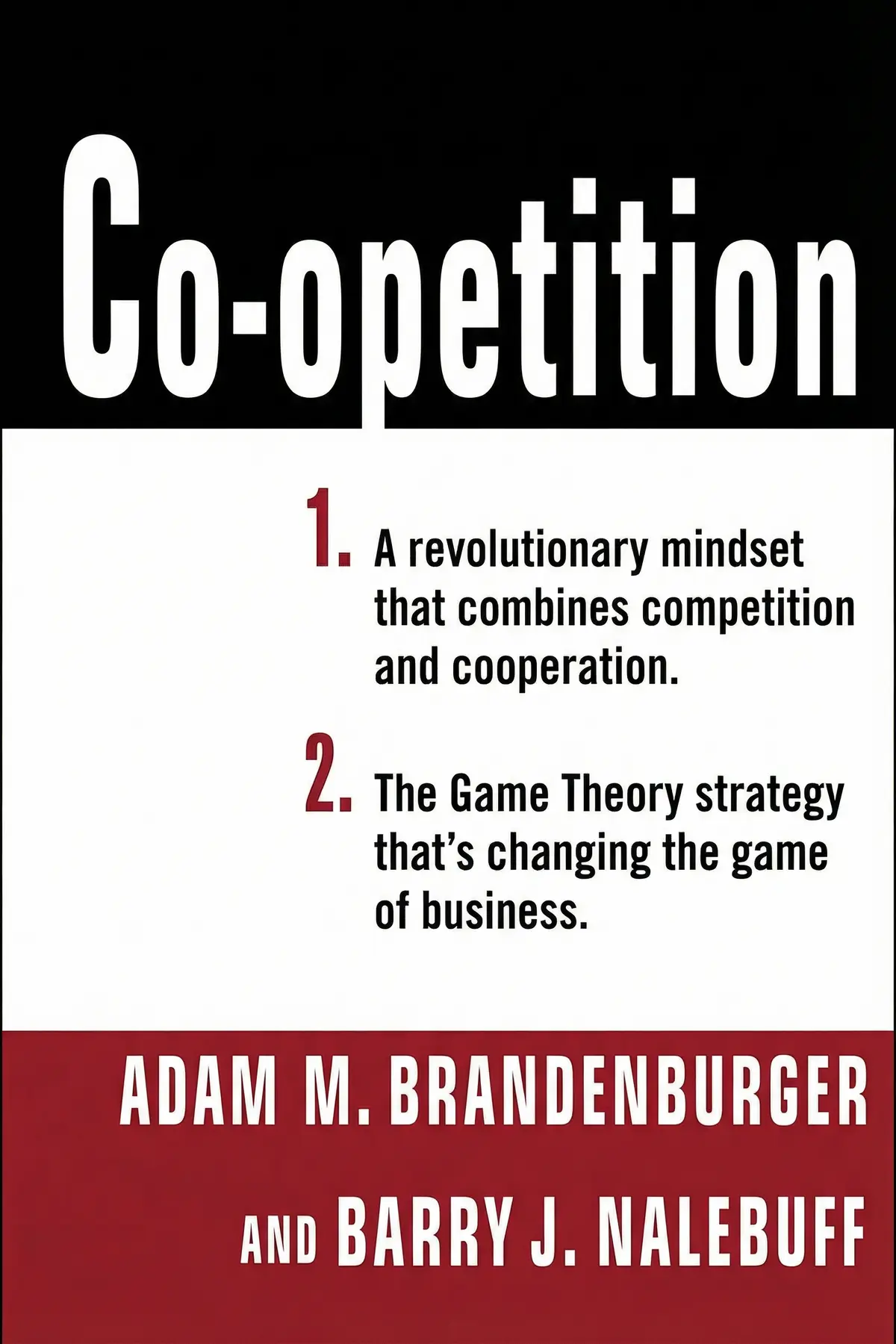
Co-opetition explores a groundbreaking business strategy that blends competition and cooperation. Using game theory, it reveals how companies can create more value together while still competing to capture their fair share of the market.
1 min 25 sec
In the high-stakes world of business, we’re often taught that it’s a dog-eat-dog race. The prevailing wisdom suggests that for you to win, someone else has to lose. We imagine business as a battlefield where the only goal is to crush the opposition and seize their market share. But what if that perspective is actually holding you back? What if the secret to modern success isn’t just outrunning your rivals, but occasionally holding their hand while you run?
This is the core premise of Co-opetition. The term itself is a hybrid, merging cooperation and competition into a single, revolutionary mindset. It suggests that the marketplace isn’t a simple zero-sum game. Instead, it’s a complex environment where you can—and often should—collaborate with the very people you are trying to beat. By shifting your focus from purely competitive tactics to a strategy that includes cooperative elements, you can actually expand the entire pie instead of just fighting over the crumbs.
In this summary, we’re going to look at how game theory provides a roadmap for this new way of thinking. We will explore how to identify the different roles everyone plays in your industry and, more importantly, how you can change the rules of the game to work in your favor. Whether you are a seasoned executive or a budding entrepreneur, understanding how to balance these two seemingly opposite forces is essential for navigating today’s interdependent economy. Let’s dive into how you can stop just playing the game and start rewriting it.
2 min 01 sec
Discover why your fiercest rival might also be your most valuable partner and how to identify the ‘complementors’ who make your products more desirable.
2 min 24 sec
Learn a structured approach to business strategy using five essential levers that can be adjusted to shift the market in your favor.
1 min 52 sec
Understand why your mere presence changes the game for everyone else and why you should sometimes demand payment just for showing up.
2 min 03 sec
See how creating scarcity and focusing on unique trade-offs can give you the upper hand in even the most competitive industries.
1 min 55 sec
Explore how specific contract clauses can protect your margins and prevent price wars without violating market fairness.
1 min 47 sec
Learn how the way you present information—and what you choose to hide—can dictate how your competitors react to your moves.
2 min 00 sec
Find out how to avoid direct competition by redefining your market boundaries and leveraging the connections between different industries.
1 min 21 sec
As we wrap up our look at Co-opetition, the most important takeaway is that the traditional, purely competitive model of business is no longer sufficient. In an interconnected world, your success is tied to the success of your customers, your suppliers, and even your rivals. By embracing the mindset of co-opetition, you open up a world of strategic possibilities that go far beyond simple price-cutting or aggressive marketing.
You now have the tools to analyze any business situation through the lens of the Value Net and the PARTS framework. You can identify who your complementors are and work with them to grow the market. You can look at Added Value, Rules, Tactics, and Scope as levers that you have the power to pull. You don’t have to be a victim of the market; you can be an architect of it.
To put this into practice immediately, start by looking at your current professional relationships with fresh eyes. Is there a competitor you could collaborate with on a specific project to lower costs for both of you? Could you offer a ‘Most Favored Customer’ clause to a key client to build long-term stability? Perhaps you can project more confidence by taking on a performance-based contract, signaling that you truly believe in the value you provide. The game of business is constantly changing, but with the strategies of co-opetition, you are no longer just a player—you are a strategist capable of shaping the game to ensure that everyone, especially you, comes out ahead.
The traditional view of business is a zero-sum game where one person's gain is another's loss. Co-opetition challenges this narrow mindset by introducing a more nuanced reality: companies often succeed by working with their rivals. By combining the concepts of cooperation and competition, authors Barry J. Nalebuff and Adam M. Brandenburger provide a strategic framework for navigating complex market relationships. The book introduces the Value Net, a model that identifies the four key players in any business environment: customers, suppliers, competitors, and complementors. It then outlines the PARTS framework—Players, Added value, Rules, Tactics, and Scope—as a method for analyzing and changing the game of business to your advantage. The promise of this approach is not just to play the game better, but to fundamentally reshape the game itself to ensure long-term profitability and innovation.
Barry J. Nalebuff is a Milton Steinbach Professor at the Yale School of Management. Adam M. Brandenburger is a professor at the Stern School of Business at New York University and formerly taught at Harvard Business School. Both authors are leading experts who have conducted extensive research on game theory and its practical applications in the corporate world.
Barry J. Nalebuff
Listeners find the work insightful, noting the compelling examples and strong application of game theory principles. Additionally, the content is accessible and clear, with one listener observing that it makes strategic planning less daunting. They also appreciate the prose, with one listener mentioning that the book is written in a very simplified manner.
The way the authors deconstruct the Value Net is nothing short of revolutionary for a business text. Instead of the typical zero-sum mentality where your gain must be someone else's loss, this book introduces the concept of complementors, which completely changes the industry analysis landscape. It feels much more holistic than Michael Porter’s Five Forces because it acknowledges that your success can actually depend on the success of others. Personally, I found the PARTS model—Players, Added Value, Rules, Tactics, and Scope—to be an incredibly pragmatic way to rethink my current project strategy. Even though the case studies feature companies like Intel and NutraSweet from decades ago, the underlying logic is timeless. It forces you to think strategically and stay proactive rather than just reacting to the market. I’ve already dog-eared dozens of pages to reference during my next board meeting.
Show moreWow, this completely flipped my perspective on dealing with competitors. Picked this up because I wanted to understand how to grow my company in a crowded niche, and the idea of 'Co-opetition' provided exactly the mental shift I needed. The authors show that you can compete on the price of the pie while cooperating to make the pie bigger for everyone. This isn't just fluffy theory; it’s backed by rigorous game theory that makes strategic planning feel way less daunting. I particularly loved the section on 'Tactics' and how perceptions can be managed to change the outcome of a negotiation. The writing is punchy and direct, avoiding the usual corporate jargon that plagues these kinds of books. I’m keeping this on my desk as a constant reminder that business doesn't always have to be war. Truly a must-read for any modern entrepreneur.
Show moreThe chapter on game-theoretic tactics transformed how I negotiate with suppliers. I’ve read a lot of business books, but few provide a framework as clear as the PARTS model. Most strategy guides are either too vague or too complex, but this hits the sweet spot. It provides a language for things I’ve felt instinctively but couldn't quite articulate. For instance, the way they describe the relationship between customers and complementors is brilliant. It makes you realize that you aren't just fighting for a slice of the pie; you're part of an ecosystem. Even though it's an older title, the logic is sound and the writing is surprisingly engaging. It’s the kind of book you keep around as a guidebook as you continue to grow your career. If you want to understand the 'why' behind successful business moves, start here.
Show moreWhile the examples certainly feel like a time capsule of the early 90s, the core logic remains incredibly sharp. Look, you have to look past the dated references to floppy disks and old airline wars to see the brilliance of the game theory application. The card game anecdote at the beginning, where Barry negotiates with his students over red and black cards, is a masterclass in understanding 'Added Value.' It illustrates why having the power to walk away or change the game is more important than just having the best product. To be fair, some sections drag a bit, and the font choice in my paperback copy was oddly distracting. However, the simplified writing style makes complex economic theories feel accessible to anyone, not just PhDs. It’s a solid guidebook for any founder who feels stuck in a 'winner-takes-all' mindset.
Show moreAs someone who lived through the Michael Porter era of business school, this was a breath of fresh air. For years, we were taught that the only way to win was to crush the competition and squeeze suppliers. Nalebuff and Brandenburger offer a more nuanced view where 'complementors' play a central role in your success. My only gripe is that the book is quite old now; published in 1996, it misses the entire digital revolution and the platform dynamics of the 21st century. I’d be very curious to see how the authors would apply the PARTS model to companies like Uber or Airbnb today. Still, the fundamental concepts are robust. The simplified manner in which they explain game theory is impressive, making it easy to digest even if you aren't a math whiz. It’s a great addition to any strategy library, despite its age.
Show moreFinally got around to reading this classic, and I'm glad I did. The authors have a way of making high-level strategy feel like common sense. I was particularly struck by the concept of 'Added Value'—it’s not just about what you bring to the table, but what the table loses if you leave. That single realization has already changed how I approach my vendor contracts. Not gonna lie, some of the mid-book chapters on 'Rules' and 'Tactics' are a bit dense and require a few re-reads to fully grasp. However, the payoff is worth it. The book is written in a very accessible way, making it easy for a non-expert to understand the mathematical underpinnings of business moves. It’s a great book for anyone looking to think more strategically and less reactively in their daily work life.
Show moreStrategic planning always felt like a black box until I encountered Nalebuff’s simplified approach. This book takes the intimidating world of game theory and turns it into a set of tools you can actually use on Monday morning. I love how it emphasizes that you can change the game rather than just playing the hand you're dealt. The distinction between 'Players' and 'Added Value' is particularly helpful for identifying where your leverage actually lies. To be fair, I did find the font and layout of the book a bit dated, which made it slightly harder to stay focused during the longer case studies. But the content is top-tier. It forces you to look at your competitors as potential partners in certain contexts, which is a vital skill in today’s interconnected economy. Definitely worth the read.
Show moreEver wonder if a business book can be too simplified? Co-opetition starts with a bang by introducing the Value Net, but I found my interest waning significantly by the halfway point. Frankly, the first hundred pages or so cover everything you actually need to know about the PARTS framework. After that, the case studies start to feel repetitive and a bit anecdotal rather than rigorous. It is a bit of a slog to get through the later chapters when the initial concepts were already so clear. I also think the book underestimates how difficult it is to actually coordinate with competitors in the real world without running into legal headaches. It’s a decent read for the historical context of strategic theory, but you could honestly get the gist of it from a well-written summary or a Wikipedia page. Useful, but not life-changing.
Show moreNot what I expected given the hype, but still decent. The core theory is fantastic, especially the transition from the Five Forces to the Value Net. But let’s be real: the examples are from a different world. We are talking about businesses that existed before the internet was a household staple. It makes it hard to see the immediate application sometimes. Truth is, the first 100 pages are a 5-star experience, but the latter half of the book feels like it's just filling space. I liked the pragmatic approach to rules like 'Most Favored Customer' clauses, but I wish there were more modern updates. It’s a useful historical text for anyone interested in the evolution of business strategy, but it definitely shows its age. A solid three stars for the foundational ideas.
Show moreTo be fair, the first chapter about the card game is the only part worth your time. The rest of the book feels like a repetitive expansion of a single good idea that could have been an article. While the concept of cooperating with rivals is interesting, the execution here is dated and the case studies are ancient. I found the writing style a bit condescending at times, as if the authors were trying too hard to make 'game theory' sound like a magic trick. The 'Value Net' is just a renamed version of existing industry models with a few tweaks. If you want to learn about strategy, there are much more modern books that don't rely on examples from the 1980s. In my experience, you’re better off reading a summary online and saving yourself the ten hours it takes to get through this.
Show more
Joseph A. Maciariello



Andrew Ross Sorkin

Deborah Gruenfeld

Mike Michalowicz

Ha-Joon Chang

Niall Kishtainy

AUDIO SUMMARY AVAILABLE
Get the key ideas from Co-opetition by Barry J. Nalebuff, plus 5,000+ more titles in English and Thai.







