
35 min 36 sec
Distinction: A Social Critique of the Judgement of Taste
Explore how your personal tastes in art, food, and fashion are actually powerful tools used to maintain social hierarchies and signal class status in this foundational study of modern sociology.
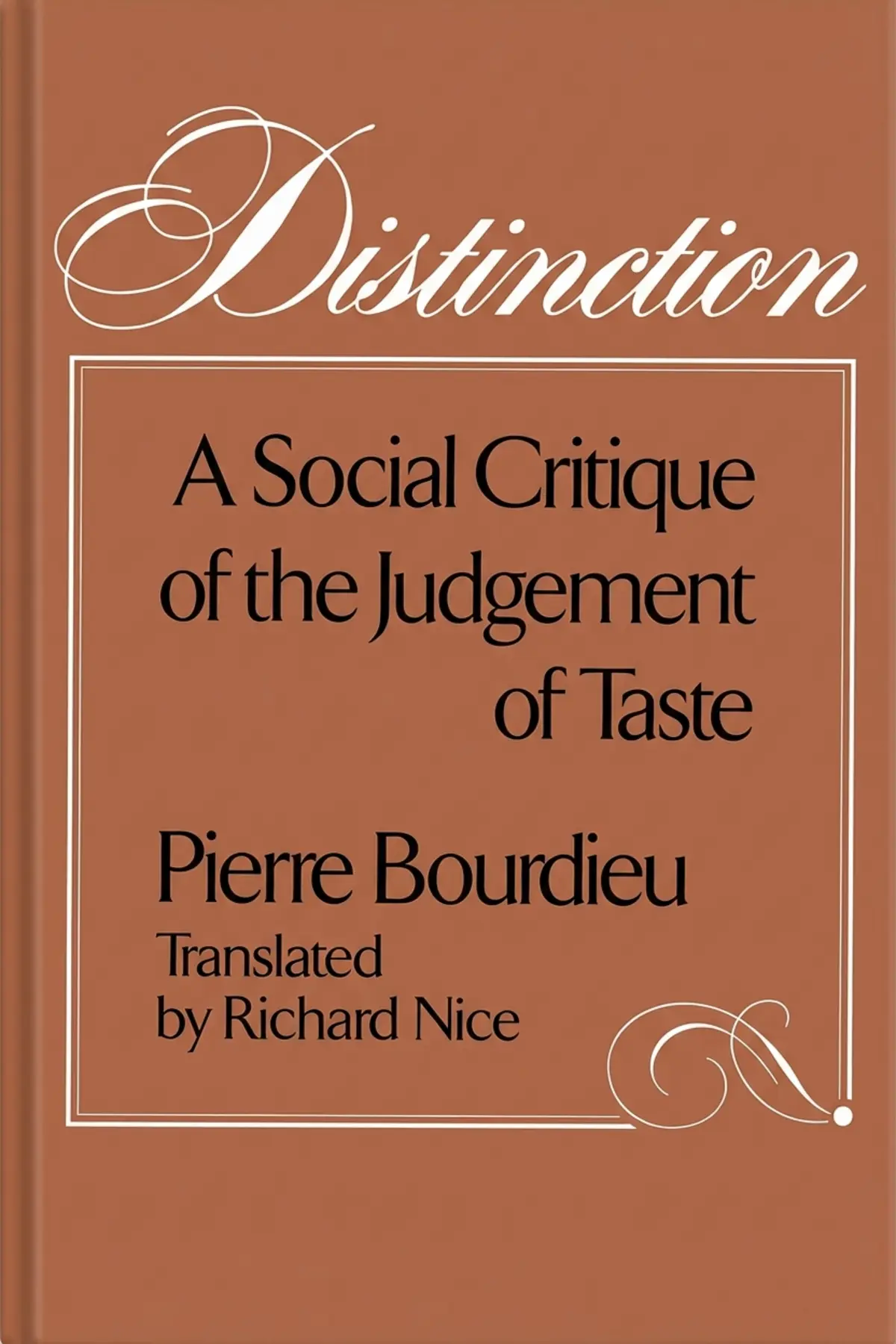
Table of Content
1. Introduction
1 min 55 sec
Why do we gravitate toward certain things while recoiling from others? Most of us move through the world assuming that our likes and dislikes are deeply personal, perhaps even innate. When you select a specific brand of coffee, choose a movie for a Friday night, or decide which painting deserves a spot on your wall, you likely feel you are simply expressing your unique personality. However, the social reality is far more complex and structured than we might imagine. Our preferences are not formed in a vacuum; they are the result of a lifelong immersion in a specific social environment.
In this exploration of Pierre Bourdieu’s landmark work, we are going to look at the hidden architecture of the social world. We will move beyond the idea that ‘good taste’ is a self-evident quality and instead examine how it is used as a weapon of social exclusion. The central throughline here is that taste is a matter of distinction—a way for individuals to mark their place in a hierarchy and distance themselves from those they perceive as beneath them. We will see how our upbringing, our education, and our financial resources combine to create a ‘habitus,’ an internal compass that steers every choice we make.
By the end of this journey, you will see your own life through a sociological lens. You will understand why the cultural elite prizes abstract art while the working class often prefers the concrete and the useful. We will break down the different types of ‘capital’—not just the money in your bank account, but the knowledge and credentials in your mind—and see how these assets dictate your social trajectory. This is not just a study of 1960s France; it is a blueprint for understanding how social classes define themselves and each other in any modern society. Prepare to have your assumptions about ‘natural’ talent and individual preference challenged as we uncover the social critique of the judgment of taste.
2. The Social Hierarchy of Aesthetics
2 min 15 sec
Personal preferences are rarely as unique as they feel, often aligning with a structured scale of social standing that dictates what is seen as refined or common.
3. Taste as an Internalized Social Map
2 min 09 sec
Our perceptions of what is ‘proper’ or ‘beneath us’ act as a guiding force, making our social status a deeply felt, subjective reality.
4. The Self-Fulfilling Cycle of Class Identity
2 min 09 sec
How our collective beliefs about what is ‘elite’ or ‘common’ actually create the social reality of those categories through our daily actions.
5. A Multi-Dimensional View of Social Status
2 min 15 sec
Moving beyond the simple ‘social ladder,’ we discover a complex space defined by different types of assets and personal histories.
6. The Power of Cultural and Educational Capital
1 min 58 sec
Knowledge and degrees can be just as valuable as money, acting as a hidden form of currency that opens doors and grants status.
7. The Hidden Meaning of Capital Composition
2 min 10 sec
How the specific mix of money and culture in your life determines whether you are seen as an intellectual, a tycoon, or a commoner.
8. The Social Arc: Why Our Background Matters
1 min 54 sec
Your current status is only half the story; where you came from and where you are headed defines your taste and social identity.
9. Strategies for Social Survival and Advancement
2 min 11 sec
When the world changes, we often trade one type of asset for another to keep our place in the social order.
10. The Science of Mapping the Social Space
2 min 09 sec
By combining data on assets and preferences, we can create a literal map that shows how our lives are clustered by class.
11. Practical Knowledge and the Concept of Misrecognition
2 min 13 sec
We often mistake our socially learned tastes for ‘natural’ talent or personal preference, failing to see the class origins of our choices.
12. Habitus: The Internal Compass of Lifestyle
1 min 54 sec
Underlying all our preferences is a deep-seated set of dispositions that coordinates our choices and makes our lifestyle feel like a coherent whole.
13. The Choice of Necessity: Working-Class Pragmatism
1 min 57 sec
For those with limited resources, taste is often a matter of utility, where the practical value of an object is prized over its appearance.
14. The Luxury of Form: Elite Aestheticism
2 min 07 sec
The affluent can afford to ignore the practical use of things, focusing instead on the ‘art for art’s sake’ approach to life.
15. Cultural Competence as a Social Gatekeeper
2 min 02 sec
To enjoy ‘high culture,’ you often need a secret key—a background of education and exposure that acts as a barrier to those outside the elite.
16. The Social Power of Classification
2 min 00 sec
In the end, class is something we build together through the constant act of judging and labeling ourselves and others.
17. Conclusion
2 min 18 sec
As we conclude our journey through the social logic of taste, the picture that emerges is one of a world far more structured and competitive than we might have initially believed. We have seen that our personal preferences—those seemingly unique and intimate choices we make every day—are actually the footprints of our social history. They are shaped by the ‘habitus’ we formed in childhood, fueled by the specific mix of economic and cultural capital we have accumulated, and directed by the social trajectory of our lives. Taste is not a neutral pursuit of beauty; it is a powerful tool for social distinction, a way for us to signal our status and navigate the hidden hierarchies of our society.
This realization brings with it a certain social responsibility. When we recognize that ‘good taste’ is often just a reflection of social privilege, we can begin to see through the ‘natural’ justifications for inequality. We can see that the cultural elite’s ‘refinement’ and the working class’s ‘pragmatism’ are both logical responses to the material conditions of their lives, rather than signs of inherent superiority or inferiority. Understanding the mechanics of capital and classification allows us to be more critical of the ways in which our institutions, like the education system, can perpetuate these gaps under the guise of meritocracy.
The actionable takeaway here is to become a more conscious observer of your own social world. Notice the ‘distinctions’ you make throughout the day. When you judge someone’s style, their speech, or their interests, ask yourself: ‘What social category am I placing this person into? And what type of capital am I valuing in this moment?’ By unmasking the social origins of our own tastes, we gain a degree of freedom from the invisible structures that guide us. We can begin to appreciate the diversity of cultural expressions without automatically ranking them on a vertical scale. In the end, Pierre Bourdieu’s work is not just a critique of taste, but an invitation to a more empathetic and intellectually honest understanding of how we live together in a world of class. It is a call to look past the surface of ‘legitimate’ culture and see the vibrant, complex, and socially constructed reality that lies beneath.
About this book
What is this book about?
Have you ever wondered why certain hobbies or artistic preferences are seen as sophisticated while others are dismissed as common? This deep dive explores the profound connection between our aesthetic choices and our social standing. It challenges the idea that taste is a purely individual or natural trait, revealing instead how it is shaped by our upbringing and the different types of capital we possess. The book promises to pull back the curtain on the hidden mechanics of social class. You will discover how our everyday decisions—from the furniture we buy to the way we speak—serve as markers that distinguish us from others. By understanding the concepts of economic and cultural capital, as well as the 'habitus' that guides our lifestyle, you will gain a new perspective on how inequality is perpetuated through the seemingly innocent act of having a preference. It is an invitation to see the social world as a complex map where every choice we make defines our position in a hidden hierarchy.
Book Information
About the Author
Pierre Bourdieu
Pierre Bourdieu was a titan of twentieth-century sociology. As a professor at both the School for Advanced Studies in the Social Sciences and the prestigious Collège de France in Paris, his influence spanned numerous academic disciplines. His expansive body of work examined everything from the sociology of education to the deep structures of aesthetics. Bourdieu’s academic excellence was recognized globally through honors such as the Goffman Prize from the University of California, Berkeley, the Huxley Medal from the Royal Anthropological Institute, and the Médaille d'Or from the Centre National de la Recherche Scientifique.
Ratings & Reviews
Ratings at a glance
What people think
Listeners find this work a required text for students of the Canon, with one listener noting it as a classic for communication scholars and sociologists. The material also receives high praise, as one listener describes it as the most important piece of social theory written. Additionally, listeners appreciate the depth of analysis, with one listener mentioning plenty of examples. However, views on the translation are split, though some listeners claim it is done very well.
Top reviews
Aisha
Finally tackled this monster after years of intimidation, and I have to say it lives up to the hype as a must-read for anyone interested in the social canon. Bourdieu brilliantly argues that our 'disinterested' appreciation of art is actually a deeply interested move in the game of class distinction. The first chapter is an absolute masterpiece of theory, even if the subsequent 500 pages of graphs and charts feel like overkill. I especially loved the sections on how even our literal taste in food—like the preference for hearty meals versus light, elegant portions—marks our place in the hierarchy. It is a giant elaboration on how we use culture as a weapon to keep the 'riff-raff' out. Truly one of the most important pieces of social theory ever penned.
Show morePetch
The way Bourdieu dismantles Kant’s idea of 'disinterested' beauty is nothing short of revolutionary for the field of aesthetics. Instead of beauty being a universal human faculty, he shows it to be a localized tool for social exclusion and class stratification. I was struck by the idea of 'disgust' being the ultimate barrier to companionship; if you cannot share a meal because of class-coded food preferences, you will never truly connect. The book is stuffed to the brim with empirical data that, while old, illustrates his points with incredible granularity. Not gonna lie, it is a marathon of a read that requires multiple sittings. However, as a classic for sociologists, its value remains unmatched in the 21st century.
Show moreAkosua
Arguably the most significant social theory of the last century, this work provides a totalizing view of how society reproduces its hierarchies. Bourdieu’s mapping of the social space, using cultural and economic capital as the X and Y axes, is a stroke of genius that clarifies so much about political alignment. The book is a must-read for anyone serious about the 'Canon' because it forces you to look at the very act of reading such a book as a move for distinction. I found the analysis of the 'petite bourgeoisie' and their 'life on credit' to be particularly haunting and accurate even in our modern gig economy. It is a giant, complex, and beautiful machine of a book.
Show moreWillow
Masterpiece in conception and a whirlwind of intellectual power. This is not just a book; it is an encyclopedia of the social breath, armor-plated with every possible analytical tool. I was deeply impressed by the visual diagrams and how they illustrate the distance between social groups, even if the math behind them is a bit opaque. The discussion on how the elite can afford to be 'natural' while the middle class is forever 'striving' is the most accurate thing I’ve read all year. To be fair, you have to be in the right headspace for the 600-page commitment, but the perspective shift is permanent. It is a foundational text that every social scientist needs on their shelf.
Show moreWei
This cornerstone of sociology demands a lot of patience, but the payoff regarding how we perform our social status is immense. Frankly, Bourdieu’s concept of 'habitus' changed how I view my own shopping habits and art preferences. While the prose is often described as dense molasses, the sheer volume of examples from 1960s France provides a robust framework. It is fascinating to see how the 'aristocracy of culture' maintains its grip through subtle cues rather than just overt wealth. You might find yourself re-reading sentences five times just to find the verb, but it is worth the effort for any serious student of communication. The translation is surprisingly fluid given the complexity of the original French thought.
Show morePooja
Ever wonder why you feel like a snob for liking certain indie films while hating blockbusters? This book provides the most detailed analysis of that exact internal tension. Bourdieu explores how 'good taste' is essentially a performance of cultural capital that we use to distinguish ourselves from those we perceive as 'unrefined.' I found the breakdown of the 'gentleman' versus the 'scholar' particularly insightful; it explains that effortless vibe the elite have that the rest of us can never quite fake. The writing style is definitely a hurdle, as Bourdieu seems allergic to simple sentences and quick points. Still, the way he connects fashion, music, and even interior design to class trajectory is eye-opening.
Show moreFatou
After hearing about this in my communication theory class, I expected a dry textbook, but I found a stinging critique of modern life. The specific detail about bananas being the fruit of the working class while the elite prefer peaches stayed with me for days. It makes you realize that nothing you do—from the sports you play to the way you decorate your living room—is actually 'natural.' We are all just following a script written by our economic and cultural backgrounds. The translation is handled very well, though no translator could fully smooth out Bourdieu's winding dialectical style. It is a dense, challenging journey that will leave you questioning every 'choice' you have ever made.
Show moreKenji
As someone who grew up in a working-class household and struggled through grad school, this book felt like a personal attack in the best way possible. Bourdieu captures that 'insidious trembling' you feel when you are trying to appreciate art you were not raised to understand. He explains how we internalize these class judgments until they feel like our own personal failings rather than social impositions. The volume of examples—from photography to classical music—makes the abstract theory feel grounded. My only gripe is that he treats the working class as a bit of a 'dull mass' without much agency. Nevertheless, it is a life-changing read that forces a brutal kind of self-honesty.
Show moreThawee
Look, the data is incredibly dated and the methodology is frankly a mess of percentages without standard deviations or error estimates. Bourdieu might be a genius of theory, but his statistical analysis feels like he is just trying to prove what he already believed about the French bourgeoisie. He treats the lower classes as a monolithic mass, ignoring the nuances of immigrant experiences or internal shifts within the working class. While his critique of Kantian aesthetics is sharp, the 'ivory tower' vibe is hard to shake throughout the middle sections. To be fair, some of the insights into 'making a virtue of necessity' are still chillingly relevant today. It is an important historical text, but do not expect a modern scientific study.
Show moreRay
Does this man own a period, or did he trade them all for more commas and semicolons? I spent half my time reading 'Distinction' just trying to find the beginning of the thought, which makes the 'dense' reputation feel like an understatement. While the theory of habitus is brilliant in conception, the execution is buried under a mountain of charts that are nearly impossible for a layman to navigate. He spends hundreds of pages proving that rich people like different stuff than poor people, which feels like a 'no duh' observation at times. I appreciate the intellectual apparatus he has built here, but it is salon-leftism at its most inaccessible. If you are not an academic, you are better off reading a summary.
Show moreReaders also enjoyed
All About Love: New Visions
bell hooks

A Biography of Loneliness: The History of an Emotion
Fay Bound Alberti

A Force for Good: The Dalai Lama's Vision for Our World
Daniel Goleman


A Room of One’s Own
Virginia Woolf

Abolish Rent: How Tenants Can End the Housing Crisis
Tracy Rosenthal
Abortion: Our Bodies, Their Lies, and the Truths We Use to
Jessica Valenti

AUDIO SUMMARY AVAILABLE
Listen to Distinction in 15 minutes
Get the key ideas from Distinction by Pierre Bourdieu, plus 5,000+ more titles in English and Thai.
- 5,000+ titles
- Listen as much as you want
- 7-day free trial
- Cancel anytime







