
15 min 06 sec
Exactly What to Say
By Phil M Jones
Master the art of influence with specific, high-impact phrases designed to guide conversations toward favorable outcomes. Learn how subtle shifts in wording can bypass resistance and lead others to say yes.
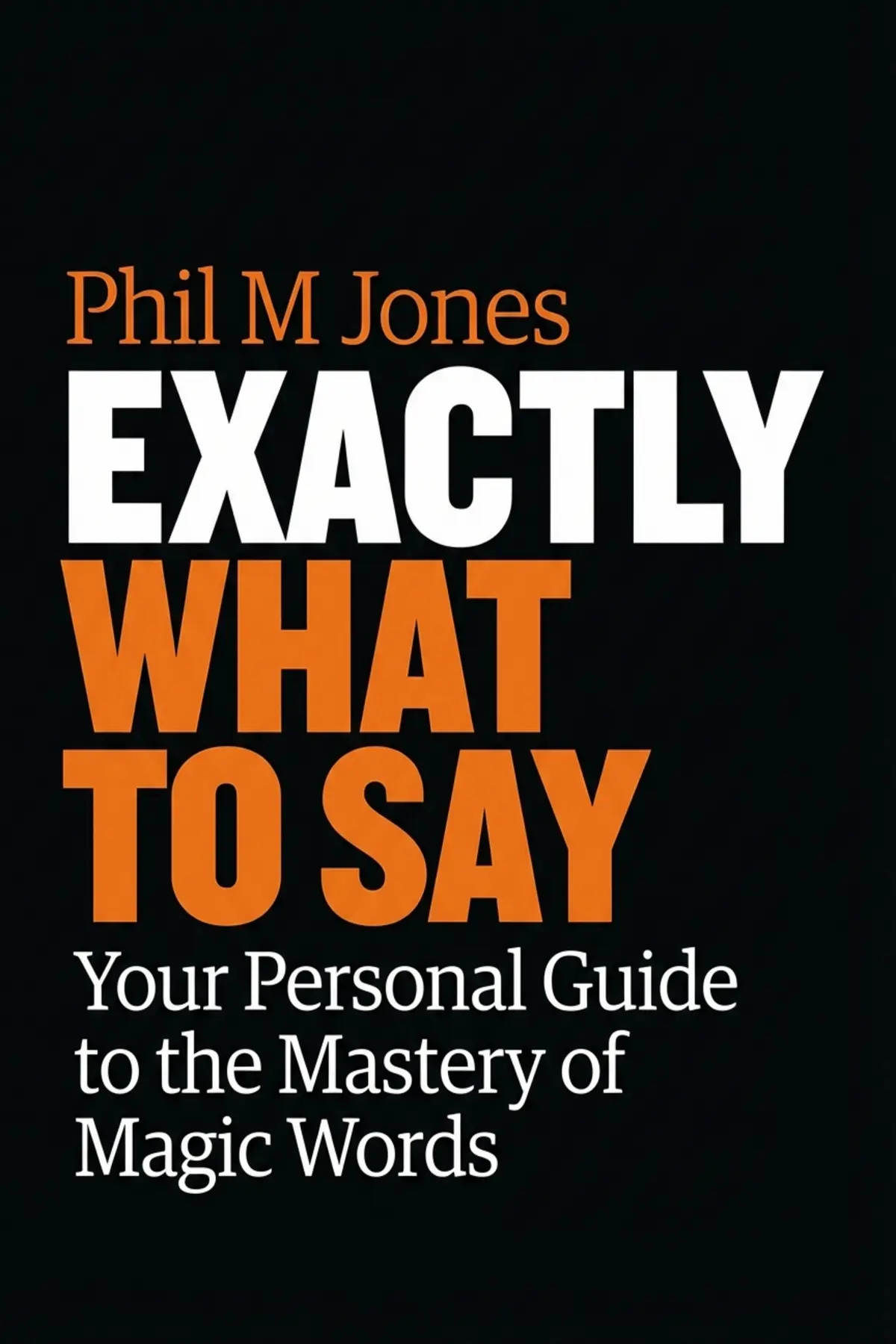
Table of Content
1. Introduction
1 min 34 sec
Have you ever walked away from a conversation feeling like you missed a major opportunity? Perhaps you were trying to close a deal, convince a colleague of a new strategy, or simply ask a friend for a favor, and the answer you got wasn’t the one you were hoping for. Often, we attribute these moments to bad timing or a difficult audience, but what if the barrier wasn’t the situation at all? What if the barrier was simply the specific words you chose to use?
In the world of professional communication, there is a fine line between persuasion and pressure. Most people default to language that unintentionally triggers a “no” response or makes the other person feel defensive. We are going to explore the concept of “magic words”—specific sequences of language that speak directly to the subconscious mind. These are phrases that are hardwired into our psychology, allowing you to guide others toward a decision while making them feel like they are the ones in total control.
Throughout this guide, we will look at how tiny adjustments in your phrasing can lead to massive shifts in results. We’ll see how to open closed doors, how to manage difficult questions, and how to lead a person through a decision-making process without them ever feeling pushed. The goal is to move from a place where you are simply having conversations to a place where you are having conversations that truly matter. By the time we finish, you will have a toolkit of verbal triggers that can be applied to almost any interpersonal scenario, transforming you into a more influential and effective communicator. Let’s dive into the mechanics of why some words work and others fail, starting with how to bypass the initial barriers of the human mind.
2. Bypassing Resistance with Subconscious Hooks
1 min 41 sec
Discover how a simple, low-pressure opening can pique curiosity and drop defensive walls before you even begin your pitch.
3. The Psychological Power of Open-Mindedness
1 min 23 sec
Learn how to frame your ideas so that rejecting them feels like a rejection of the listener’s own self-image.
4. Redirecting Conflict and Testing Knowledge
1 min 15 sec
Instead of arguing with someone who thinks they know everything, use a specific question to uncover the gaps in their understanding.
5. Assuming Success in Scheduling and Logistics
1 min 29 sec
Stop asking for permission and start assuming the best outcome by changing how you handle phone numbers and meeting times.
6. The Choice Architecture of Three Options
1 min 24 sec
Guide your prospects toward your preferred outcome by narrowing their world down to three simple paths.
7. Using Social Proof and the Power of 'Most People'
1 min 34 sec
Tapping into the human desire for safety in numbers can make your suggestions feel like the obvious standard.
8. Leading the Way with Narrative Transitions
1 min 26 sec
Don’t leave the next steps to chance. Use specific phrases to take charge of the transition from discussion to action.
9. Softening Tough Questions with Curiosity
1 min 32 sec
Turn potentially intrusive or aggressive questions into harmless inquiries that uncover the truth behind objections.
10. Conclusion
1 min 48 sec
The mastery of communication isn’t about having a silver tongue or being a born extrovert. As we have seen, it is about understanding the subtle psychological triggers that drive human behavior and choosing your words with intention. The “magic words” we’ve discussed are not tricks or deceptions; they are tools that allow you to communicate more clearly and help others overcome the internal barriers that keep them from making a decision.
From the moment you start a conversation with a low-pressure hook like “I’m not sure if this is for you,” to the moment you lead them toward action by saying “What happens next is,” you are providing leadership. You are helping people move from a state of uncertainty to a state of clarity. You have learned how to use open-mindedness to gain a hearing, how to use social proof to provide safety, and how to use curiosity to uncover the real reasons behind hesitation.
But remember, knowing these words is only the first step. The real magic happens when you put them into practice. Like any skill, this takes repetition. You might not get it perfect the first time, and that’s perfectly fine. The key is to start incorporating these phrases into your daily life—not just in big business meetings, but in your interactions with family, friends, and strangers.
As you begin to use these techniques, you will notice a shift in how people respond to you. Conversations will feel smoother, resistance will melt away, and you will find yourself reaching agreements more often than not. Don’t worry about memorizing everything at once. Pick one or two phrases that resonate with you and try them out today. Over time, these magic words will become a natural part of your vocabulary. You have the power to influence the world around you, one word at a time. Now, go out and have the conversations that count.
About this book
What is this book about?
This summary explores the psychological triggers behind effective communication, focusing on the specific "magic words" that can change the trajectory of any interaction. Whether you are navigating a complex business negotiation or simply trying to reach an agreement with a friend, the way you frame your requests dictates the response you receive. Phil M Jones provides a tactical toolkit for everyday conversations, demonstrating how to assume control without appearing aggressive. You will learn how to present choices that lead naturally to a decision, how to handle objections before they even arise, and how to use social proof to make your suggestions more appealing. The promise of this work is simple: by changing your words, you can change your world, turning stalled discussions into successful partnerships and confusion into clarity.
Book Information
About the Author
Phil M Jones
Phil M. Jones is a professional speaker and sales expert whose career began with a humble car-washing business at the age of 14. By 15, he was managing a team of his peers, showcasing an early talent for leadership and persuasion. After years of high-level success in the corporate sales world, he launched his own consultancy in 2008 to share his strategies with a global audience. He is the author of several best-selling titles, including Straight Forward, Exactly Where to Start, and Exactly How to Sell.
Ratings & Reviews
Ratings at a glance
What people think
Listeners find this book to be an efficient and accessible read that provides actionable guidance for daily life. Further, its direct and concise nature makes the advice simple to apply right away, and listeners enjoy the specific wording and useful demonstrations included. They also appreciate the short length and its effectiveness in sharpening communication, highlighting how it can improve social exchanges and shift one’s inner monologue.
Top reviews
Fatima
Wow. I didn't realize how much I was over-explaining until I read this. Jones provides a toolkit of verbal shortcuts that actually work. I started using "how open-minded would you be" in my client meetings this week and the shift in energy was immediate. It’s a tiny book, more of a pamphlet really, but the density of value is incredible. You can finish it in a single sitting, yet you'll find yourself flipping back to it before every major call. If you’re looking for deep theory, go elsewhere, but for practical, "do this now" advice, it’s a goldmine. It completely changed my internal dialogue about how to approach difficult prospects.
Show moreLogan
As someone who works in the nonprofit sector, I’ve always been wary of sales tactics that feel slimy or pushy. However, the phrases in this guide are less about tricking people and more about removing the friction in communication. "Just imagine" is a phrase I’ve started using during donor meetings to help them visualize the impact of their gift, and it makes the conversation feel collaborative rather than confrontational. The book is incredibly thin—I'm talking 20 minutes to read—but it focuses on the subconscious triggers that stop people from saying yes. It’s become a mandatory read for my team because it helps us stay focused on the other person's needs during high-stress fundraising rounds.
Show moreBig
Picked this up after seeing it on a "must-read" list for entrepreneurs. Let's be real: this is a collection of scripts, not a deep dive into human psychology. That being said, the scripts are brilliant. I love the "I’m not sure if it’s for you, but..." opening because it takes the pressure off both parties immediately. My only gripe is the price for such a short read; you’re basically paying for a series of bullet points in a very small format. Still, if even one of these phrases helps you close a deal, the ROI is massive. It’s a tactical manual for anyone who needs to influence others without sounding like a robot.
Show moreNattapong
Ever wonder why some people just seem to get their way without any effort? This book explains those "magic words" that bypass the brain's rejection response. Personally, I found the section on "the good news" to be a total game-changer for handling negative clients. It helps pivot the conversation without sounding dismissive or rude. The layout is very clean with big fonts, which makes it a quick reference guide rather than a dense textbook. It’s definitely "salesy," so if you’re sensitive to that tone, you might find some of it a bit manipulative. But for business? It is undeniably essential for improving your social acumen.
Show morePita
After hearing the audiobook was a massive hit, I decided to grab the physical copy for my desk. It's essentially a list of 23 psychological triggers packaged into short, punchy phrases. Truth is, many of us use these naturally, but seeing them codified helps you use them intentionally rather than by accident. "When would be a good time to..." is a much better approach than "Are you free?" because it assumes a positive outcome. I’ve started using these scripts in my emails and noticed a higher response rate already. It’s a bit repetitive in parts, but the clarity is what makes it useful for everyday scenarios.
Show moreMuk
To be fair, this is less of a "book" and more of a pocket guide. If you’re expecting 300 pages of research and case studies, you’ll be disappointed. Phil Jones cuts straight to the chase with actionable scripts that target the subconscious mind. I particularly liked the advice on using "what's the best number to contact you at" instead of asking for permission to call. It sounds small, but these shifts in language change the power dynamic of a conversation instantly. It’s practical, punchy, and easy to implement the same day you read it. Just don’t expect a literary masterpiece; it's a tool, not a story.
Show moreMilk
The chapter on "what most people would do" really rubbed me the wrong way. While I understand the power of social proof, using it to nudge someone into a decision feels a bit too much like manipulation for my comfort level. I read this to better understand the tactics manipulative people use on me, and in that regard, it was very eye-opening. There are some gems here, like "before you make your mind up," which encourages looking at more facts. However, the tone is very aggressive in its pursuit of "winning" the conversation. It’s useful as a defensive arsenal, but use it with a conscience because it can feel like you're attacking the person you're talking to.
Show moreTum
Look, I appreciate the simplicity of this book, but the price for something I can read in 15 minutes is a tough pill to swallow. The font is huge and there’s a lot of white space. Jones clearly knows his stuff, and the "If I can... then will you..." formula is a classic for a reason. But I didn't find anything here that I hadn't already heard in basic sales training or on a few YouTube videos. It’s a nice refresher if you’re in a slump and need a quick confidence boost, but if you’ve been in the game for a while, you probably know most of these "secrets" already. It's more of a booklet than a book.
Show moreMan
Not what I expected at all. I was hoping for more mindset training and psychological depth, but this is strictly about the mechanics of a sales pitch. It’s very focused on steering people toward a specific outcome that favors you. Some of it feels quite dated and potentially annoying to a savvy customer who knows they are being handled. For instance, the "silence" trick is so well-known now that it can come across as awkward or even passive-aggressive if not handled perfectly. I’ll give it three stars because the "just imagine" section was actually quite inspiring for my creative work, but the rest felt a bit too transactional for me.
Show moreMatteo
Finally got around to reading this and I feel a bit cheated. It’s a booklet at best with fewer than 6,000 words. The author claims these are magic words, but they're mostly just ways to corner people into saying yes by exploiting their desire to be polite. I tried the "what makes you say that?" response to an objection and it just made the client defensive and annoyed. It lacks the nuance needed for complex human interactions and feels like a collection of scripts for a call center. If you work in high-pressure telemarketing, this might be your bible. But for building long-term, honest relationships? This approach feels a bit too slimy.
Show moreReaders also enjoyed
AUDIO SUMMARY AVAILABLE
Listen to Exactly What to Say in 15 minutes
Get the key ideas from Exactly What to Say by Phil M Jones, plus 5,000+ more titles in English and Thai.
- 5,000+ titles
- Listen as much as you want
- 7-day free trial
- Cancel anytime







