
24 min 47 sec
Finding Meaning in an Imperfect World
By Iddo Landau
Finding Meaning in an Imperfect World argues that fulfillment is found by embracing life’s flaws. It challenges perfectionism and offers practical philosophical tools to recognize the profound value in everyday existence.
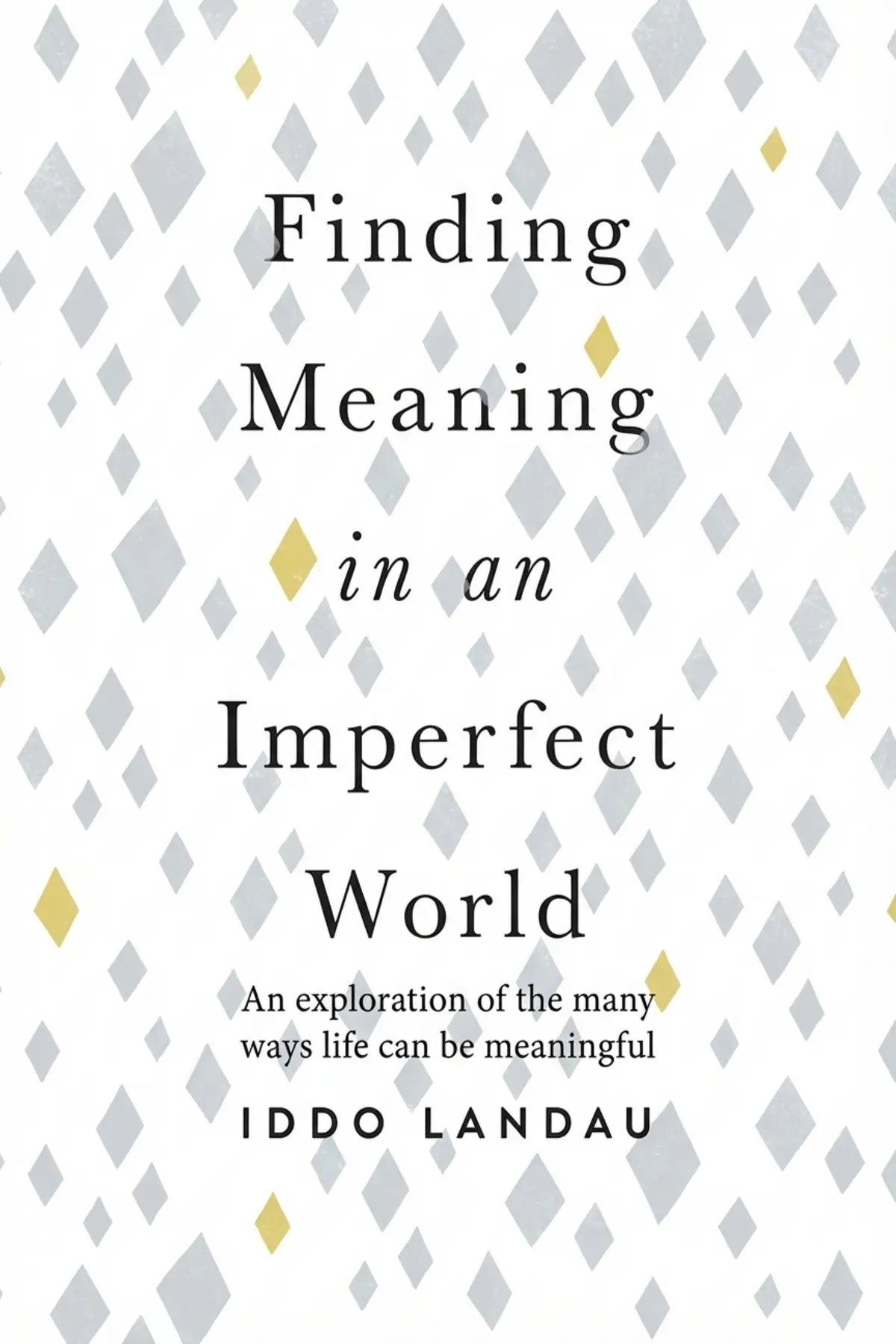
Table of Content
1. Introduction
2 min 02 sec
We have all been there. Perhaps it is late at night, and the house is quiet, or maybe it is a Tuesday afternoon in the middle of a tedious commute, and suddenly, the question hits you: What is the point of all this? Is my life actually meaningful? These are the kind of questions that can feel heavy, even overwhelming. They seem like the sort of mysteries that only a sage on a mountaintop or a brilliant philosopher could ever hope to answer. Most of us go through our days assuming that meaning is something reserved for the history books—something for people like Mother Teresa or Albert Camus—while the rest of us are just checking off items on a to-do list.
But here is the exciting shift we are going to explore today. In Iddo Landau’s perspective, these big, scary questions don’t require a mystical revelation to solve. In fact, when we break them down with a bit of logic and a fresh set of eyes, we find that the meaning of life isn’t nearly as esoteric as we’ve been led to believe. It is something much more normal, much more everyday, and much more accessible than we might think. You do not need to be a genius or a saint to have a life that is profoundly valuable.
Over the course of this summary, we are going to dive into why our obsession with being the “best” or the “greatest” actually prevents us from seeing the beauty that is already right in front of us. We will talk about why death doesn’t take away from the value of our experiences and how even a simple chore like cleaning a kitchen floor can hold a philosophical lesson. We will also tackle some of the darker parts of the human experience, like suffering and pain, and see how they fit into the larger puzzle of a meaningful existence.
By the end, you will have a new set of philosophical tools to help you think about your own life with more clarity. This isn’t about finding a single, magic answer that applies to everyone; it’s about learning how to identify the unique value that already exists in your world and how to cultivate more of it. Let’s begin by looking at what we actually mean when we use that big, heavy word: meaning.
2. Defining Meaning Through the Lens of Value
2 min 55 sec
What do we really mean when we say life is empty? This section explores the deep connection between meaning and value, using the story of Leo Tolstoy to illustrate the point.
3. Escaping the Perfectionist Trap
2 min 50 sec
Many of us feel like failures because we aren’t changing the world. Here, we discuss why the ‘all-or-nothing’ mindset is the enemy of a fulfilling life.
4. Why Mortality Does Not Diminish Worth
2 min 45 sec
If everything ends in death, does anything matter? We explore why the temporary nature of life actually enhances its value rather than erasing it.
5. Meaning Beyond the Illusion of Choice
2 min 47 sec
If our lives are determined by biology and circumstance, can they still be meaningful? We look at why value exists even without absolute free will.
6. The Power of Intrinsic Value
2 min 33 sec
Does every action need a higher purpose? We explore the difference between doing things as a means to an end and doing them because they are valuable in themselves.
7. Navigating the Paradox of the End
2 min 24 sec
What happens after you achieve your biggest goal and still feel empty? We look at how to sustain meaning through lifelong projects and shifting mindsets.
8. Finding Meaning in the Midst of Suffering
2 min 33 sec
How can life be meaningful when there is so much pain? We examine the views of Schopenhauer and Viktor Frankl to find a path through the dark times.
9. Practical Steps to Cultivate Purpose
2 min 33 sec
Meaning isn’t just something you have; it’s something you can build. This final section provides actionable strategies for identifying and increasing the value in your life.
10. Conclusion
1 min 25 sec
In the end, the search for meaning doesn’t have to be a desperate hunt for a hidden treasure. As we have seen, the arguments that suggest life is fundamentally meaningless—whether they are based on our mortality, our lack of free will, or the presence of suffering—don’t actually hold up under scrutiny. They rely on an all-or-nothing perfectionism that doesn’t fit the reality of the human experience.
What Iddo Landau reminds us is that meaning is about value, and value is all around us. It is in the temporary beauty of a garden, the ongoing project of being a good person, and the intrinsic joy of a shared meal. We don’t need to be legends to be significant. We just need to be present and willing to recognize the worth in our imperfect lives.
If you take one thing away from this exploration, let it be this: Your life is already more meaningful than you think. By letting go of the need for perfection and focusing on the tangible, everyday things that make life worth living, you can cultivate a deep sense of purpose that doesn’t depend on being the best, the smartest, or the most successful. The world is flawed, and our lives are short, but within those boundaries, there is an incredible amount of room for beauty, connection, and profound value. Go out and look for it—it’s already there, waiting to be noticed.
About this book
What is this book about?
Have you ever looked at your life and wondered if it truly matters? Many of us feel a sense of meaninglessness, believing that unless we achieve greatness or find some cosmic purpose, our lives are empty. Iddo Landau’s work addresses this existential anxiety head-on, dismantling the common philosophical arguments that lead us to despair. This book is a guide to shifting your perspective from the unattainable ideal of a perfect life to the tangible reality of a meaningful one. By exploring the nature of value, the trap of perfectionism, and the reality of suffering, Landau provides a roadmap for finding worth in the mundane and the magnificent alike. It promises to transform your understanding of what makes a life well-lived, moving away from lofty abstractions toward a practical, grounded sense of purpose.
Book Information
About the Author
Iddo Landau
Iddo Landau is a Professor of Philosophy at Haifa University in Israel. He is a leading scholar on the topic of the meaning of life and has published extensive academic and accessible work exploring how humans can find fulfillment in a flawed world.
Ratings & Reviews
Ratings at a glance
What people think
Listeners find the work both articulate and readable, with one listener noting its practical approach throughout. They value the philosophical themes, including one individual who highlights the enlightening insights regarding perfectionism. However, listeners have mixed reactions to the sections concerning meaning.
Top reviews
Chanon
After hearing Oliver Burkeman recommend this work in a recent interview, I knew I had to dive in. Landau offers an incredibly insightful look at how we define worth in a world that often feels chaotic or indifferent. The final third of the book is where it truly shines, providing practical suggestions for creating meaning rather than just theorizing about it. Truth is, his critique of the perfectionist mindset—the idea that life must be flawless to be meaningful—felt like a weight lifting off my shoulders. It is a thorough and readable treatment of a dense subject. While the middle sections can get a bit bogged down in academic rebuttals, the overall message is transformative. I found the arguments well-articulated and surprisingly easy to follow for a philosophy text. If you have ever felt like your life is 'not enough,' this book will likely change your perspective entirely.
Show moreJack
The chapter on perfectionism was an absolute game-changer for my perspective. Landau manages to dismantle the idea that meaning requires some sort of cosmic significance or flawless execution. Instead, he focuses on how we can find value in the mundane and the imperfect. Not gonna lie, I was worried this would be another dry academic text, but it’s actually quite illuminative. The author presents and criticizes arguments against finding meaning in a way that is easy to understand for a layperson. Life is valuable, and even if we struggle to find its purpose, that doesn't mean it isn't there. This book acts as a guide to help you navigate through those internal storms. I highly recommend it to anyone who feels like they are constantly falling short of some invisible standard. It’s a classic of philosophical work in the best possible sense.
Show moreMilk
Wow, I didn't realize how much I needed this framework until I started reading. Landau's take on how perfectionism poisons our search for meaning is absolutely brilliant. He identifies the core issue: we think meaning has to be 'big' or 'perfect' to count, when the reality is that it's found in the small, imperfect moments of every day. The work was insightful and showcased some truly novel ways of understanding our place in the world. I loved the balance between rigorous philosophical argument and practical, real-world application. In my experience, most books on this topic either go too far into the clouds or stay too close to shallow self-help, but this hits the sweet spot. It’s a thorough and practical guide that actually leaves you with something to use. Definitely a must-read for the modern skeptic who still wants to believe in something.
Show moreThanit
Ever wonder why it's so difficult to feel satisfied with your daily routine? Landau addresses this head-on by critiquing our tendency toward existential perfectionism. This book helped me form a coherent thought process for my own 'quarantine shower thoughts' and general overthinking about my career path. To be fair, some of the points he makes feel like common sense once you see them on the page. However, having them organized into such a logical framework is immensely helpful for navigating the storms of adulthood. The author identifies and defines how we can find value even in an imperfect world, which is a message we desperately need. I appreciated the breath of ideas touched upon here, even if some of the chapters felt a bit wordy. It’s a solid read for anyone in their 20s or 30s struggling with the 'is this it?' feeling.
Show moreMo
Picked this up during a particularly existential weekend and found it quite grounding. Landau identifies and defines the topic of meaning with the precision of a scholar but the heart of a therapist. He argues that losing meaning doesn't make life meaningless, a key message that I think everyone needs to hear at least once. I particularly liked the discussion on how perfectionism ruins our ability to appreciate the 'good enough.' Got to say, the structure of the book is very helpful; it moves from high-level philosophy into actual practical advice. Some of the sections are a bit dense and felt like a philosophical digression, but the core message remains strong. It’s an excellent book for anyone looking for a thorough but readable treatment of existentialism. It helped me realize that life is valuable in and of itself, regardless of whether we achieve some grand purpose.
Show morePatcharaporn
Look, most philosophy books can often feel like they are written for a different species, but this one is remarkably human. Landau focuses on how to avoid common pitfalls in our thinking about what makes a life 'count.' I really appreciated the critique of some of the main existentialist philosophies that tend to be overly bleak. Personally, I found the practical suggestions in the final third of the book to be the most impactful part of the whole experience. It isn't just theory; it’s a way of reorienting your daily life. My only real gripe is that the middle sections are a bit repetitive. He spends a lot of time responding to hypothetical skeptics that I just didn't find that interesting. Still, the overall approach is practical and the writing is consistently well-written and clear. It’s a 4-star read that offers a lot of comfort.
Show moreGioia
Finally got around to finishing this after seeing it referenced on several 'must-read' lists. It's a very well-written book that handles a heavy topic with a surprisingly light touch. The author’s view on how to avoid pitfalls in our thinking is especially relevant in today’s high-pressure society. To be fair, I am not a skeptic or a cynic, but I still appreciated the depth of ideas Landau touches upon throughout the chapters. The book helps to set a course through life's inevitable disappointments. While the presentation of arguments can be a bit repetitive at times, the clarity of the prose makes it a very easy read overall. It serves as a great reminder that losing meaning in one area doesn't make your entire life meaningless. A very solid 4-star effort that provides plenty of food for thought.
Show moreLena
This book is a bit of a mixed bag for me. While I acknowledge the author's reasoning that life has inherent meaning, his arguments sometimes feel like they only work within a strict binary system. If we look at things from the perspective that everything exists on a spectrum, then the meaning he describes often lies very close to meaninglessness. I don't draw much more comfort from the idea that my life is 'almost' meaningless than I would if it were entirely so. Frankly, the counterarguments to other philosophers are often vague appeals to the author's sense of what is typical. He says 'many people find that's not true if they think about it,' which isn't very convincing as a logical proof. The first chapter and the last few paragraphs were the most valuable parts for me. It’s okay, but maybe a bit too repetitive for my taste.
Show morePooja
Frankly, I found the middle section where he argues against other philosophers to be quite tedious and a bit wordy. The author seems to get caught up in responding to every possible cynical objection, which makes the pacing feel sluggish. To be fair, the first two-thirds of the book do a good job of setting the stage, but I found myself skimming to get to the practical advice. Some arguments for the meaning of life are interesting, yet I assume I won’t remember many of them for long. The idea that meaning exists on a spectrum is a nice thought, but as other reviewers mentioned, it feels a bit thin when you really dig into it. It’s a decent book for someone new to philosophy, but for those who have read a lot in this area, it might feel a bit like common sense.
Show moreLeo
Not what I expected from a book about finding purpose. The author spends way too much time on repetitive arguments against skeptics and cynics, many of which felt like straw-man scenarios. I found his 'spectrum' logic to be particularly problematic in its real-world application. For instance, if we start attributing moral importance to things on the extreme margins of a spectrum, it leads to weird conclusions—like the idea that hurting an NPC in a video game is morally wrong. That kind of thinking just doesn't sit right with me. To be fair, the writing style is clear and accessible, but the content felt very thin for a full-length book. I stopped caring about the 'novel ways of understanding' about halfway through because the points were just being hammered over and over. It's a readable book, but the insights weren't as illuminative as the Amazon summary led me to believe.
Show moreFeatured in
Readers also enjoyed
A Guide to the Good Life: The Ancient Art of Stoic Joy
William B. Irvine

A High-Performing Mind: Strengthen Your Mind and Live Your Best Life
Andrew D. Thompson
Abundance: The Inner Path to Wealth
Deepak Chopra
A Little History of Philosophy
Nigel Warburton
AUDIO SUMMARY AVAILABLE
Listen to Finding Meaning in an Imperfect World in 15 minutes
Get the key ideas from Finding Meaning in an Imperfect World by Iddo Landau, plus 5,000+ more titles in English and Thai.
- 5,000+ titles
- Listen as much as you want
- 7-day free trial
- Cancel anytime







