
21 min 21 sec
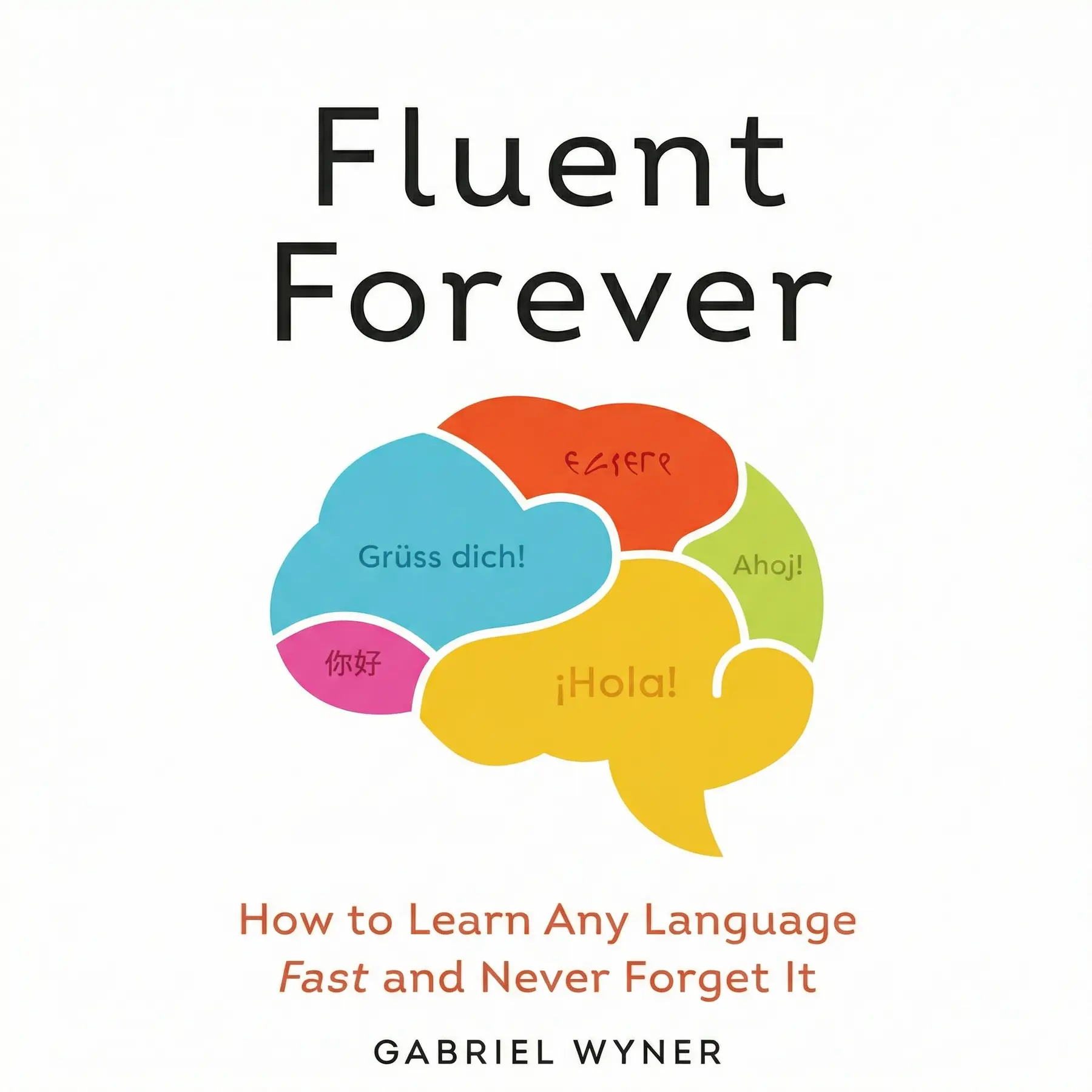
Fluent Forever: How to Learn Any Language Fast and Never Forget It
Discover a neuroscience-based approach to language learning that focuses on pronunciation, visual memory, and spaced repetition. Polyglot Gabriel Wyner reveals how to stop translating and start thinking directly in your target language.
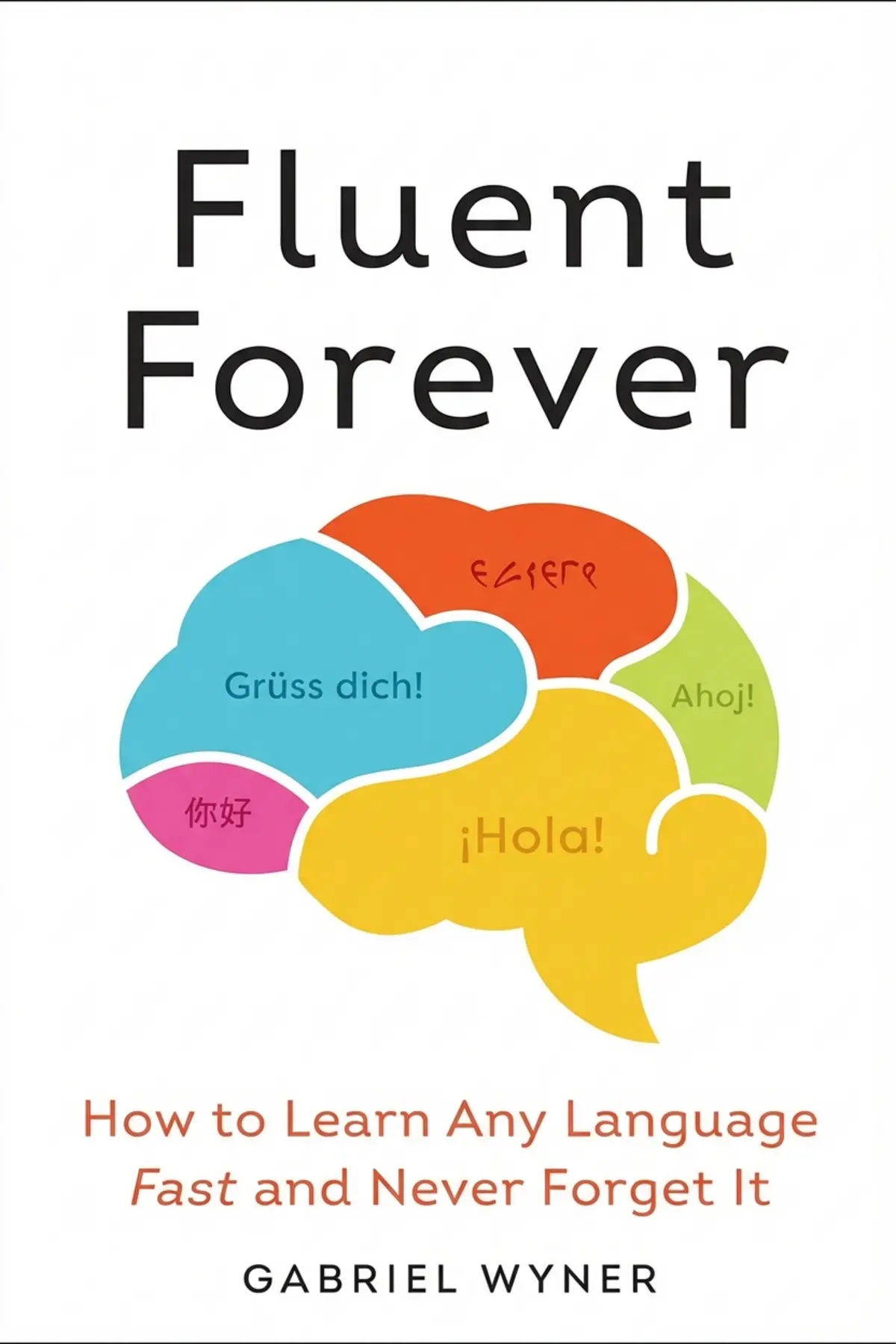
Table of Content
1. Introduction
1 min 38 sec
Why does language learning feel like such an uphill battle for so many of us? We’ve all been there—slaving away over dry textbooks, staring at endless lists of vocabulary, and feeling that sinking sensation when a word we thought we knew completely vanishes the moment we need it. It’s a common struggle that leads many to believe they simply aren’t ‘good’ at languages. But what if the problem isn’t your brain? What if the problem is the method?
In Fluent Forever, Gabriel Wyner turns the traditional classroom model on its head. He argues that we often try to learn languages in a way that goes against our biological design. By merging insights from neuroscience with practical techniques used by polyglots and opera singers, Wyner offers a roadmap to fluency that is not only faster but significantly more effective. He famously used these exact methods to master German in a mere fourteen weeks, showing that with the right tools, anyone can bypass the years of struggle.
This journey is about more than just memorizing words; it’s about hacking your memory, training your ears, and creating a personalized system that makes learning feel less like a chore and more like a game. We’re going to explore how to build deep neural connections, why your brain craves images over translations, and how to use the ‘forgetting curve’ to your advantage. By the end of this summary, you’ll have a clear strategy for attacking a new language—or any memory-based challenge—with the confidence that what you learn will stay with you forever.
2. Creating Deep Neural Connections
1 min 53 sec
Discover why some memories vanish instantly while others stick for life, and how to use four levels of brain processing to your advantage.
3. The Dominance of Visual Memory
1 min 52 sec
Learn why images are the brain’s favorite language and how to use them to bypass the need for translation.
4. Recall vs. Review
1 min 47 sec
Explore the science of the ‘forgetting curve’ and why the act of searching your memory is more powerful than rereading your notes.
5. The Magic of Spaced Repetition
1 min 46 sec
Discover how timing your study sessions can maximize retention and turn short-term memories into long-term knowledge.
6. Building a Foundation of Sound
1 min 54 sec
Why the secret to learning a language like a child starts with your ears, not your eyes.
7. Gamifying Your Vocabulary
1 min 46 sec
How to use digital tools and personal associations to make new words meaningful and memorable.
8. The Natural Order of Language
1 min 43 sec
Understand the ‘Language Machine’ in your head and why following a specific developmental sequence is vital for success.
9. Mastering Grammar Through Storytelling
1 min 47 sec
Learn a clever mnemonic technique to tackle complex grammar rules and irregular word forms without the headache.
10. The Power of Immersion and Monolingualism
1 min 50 sec
Why you should ditch the bilingual dictionary and embrace the discomfort of a ‘target-language-only’ environment.
11. Putting it All Together
1 min 37 sec
A final look at how to synthesize these techniques into a daily practice that leads to lasting language mastery.
12. Conclusion
1 min 48 sec
As we wrap up our exploration of Gabriel Wyner’s Fluent Forever, the throughline is clear: fluency is a product of biological alignment. We’ve seen that the brain isn’t a dry storage unit for abstract data; it’s a dynamic, image-loving, sound-sensitive ‘language machine’ that thrives on personal connection and strategic challenge. By focusing on pronunciation first, you prime your hardware. By using visuals and the PAO technique, you give your brain the colorful, narrative hooks it craves. And by utilizing spaced repetition, you turn the inevitable process of forgetting into your greatest ally in the quest for long-term retention.
The path to mastering a new language doesn’t have to be paved with boredom and frustration. Instead, it can be a process of constant ‘aha’ moments and small, dopamine-fueled victories. The key is to stop being a passive consumer of information and start being an active architect of your own memory.
As a final, actionable tip to take with you today: try ‘backchaining’ when you encounter those long, intimidating words that seem impossible to pronounce. Instead of starting at the beginning and getting stuck, start with the very last sound. Say it out loud. Then add the second-to-last sound before it, and so on, building the word from back to front. This clever trick bypasses our brain’s tendency to stumble over the start of unfamiliar sequences and makes even the most complex linguistic monsters manageable. Whether you’re aiming for German, Japanese, or any language in between, remember that you have the internal machinery to succeed. You just need to give it the right fuel. Happy learning!
About this book
What is this book about?
Have you ever spent months studying a language only to forget everything the moment you try to speak? Fluent Forever challenges the traditional classroom approach by showing that the secret to fluency lies in how our brains are biologically wired to remember. Author Gabriel Wyner, who mastered multiple languages in record time, breaks down a system that bypasses the frustration of rote memorization. The book promises a revolutionary method built on three pillars: learning pronunciation first to prime your ears, using images instead of translations to build direct mental connections, and utilizing Spaced Repetition Systems (SRS) to lock information into your long-term memory. By understanding the neuroscience of memory and the natural order of language acquisition, you can transform a tedious chore into an engaging, game-like experience. This summary explores how to build a personalized learning system that ensures you never forget what you've learned, ultimately allowing you to reach fluency faster and more enjoyably than you ever thought possible.
Book Information
About the Author
Gabriel Wyner
Gabriel Wyner is a polyglot who discovered the key to rapid language learning through his background as an opera singer and engineer. He achieved fluency in German in just 14 weeks, followed by French in five months and Russian in ten months. He has also studied Hungarian and Japanese. Wyner holds degrees in engineering and vocal arts, which helped him develop a unique focus on phonetics and memory. He shares his techniques through his popular website, fluent-forever.com.
Ratings & Reviews
Ratings at a glance
What people think
Listeners find this language learning guide remarkably effective for expanding vocabulary, utilizing a unique method and order of educational exercises. Furthermore, the work simplifies the process of learning a new tongue, offering tools for various specific languages and clarifying why mastering pronunciation matters. They also value how easy it is to read, its wealth of materials, clear walk-throughs, and overall impact, viewing it as well worth the money. On the other hand, perspectives on user-friendliness vary, as some find the guide simple to track while others feel it isn’t straightforward.
Top reviews
Witthaya
Wow, I finally understand why I failed high school Spanish. Gabriel Wyner treats language like a sport rather than a dry academic subject, which completely changed my perspective on the whole process. He breaks down the neuroscience of the hippocampus in a way that actually makes sense for someone who isn't a scientist. The focus on pronunciation before even touching grammar felt counterintuitive at first, but it is the secret sauce to making words stick. I used to spend hours translating in my head, but his "no translation" rule helped me start thinking in my target language almost immediately. It’s a dense read with a lot of resources, yet it remains incredibly readable and engaging throughout. If you're tired of the usual textbook slog, this is the blueprint you need.
Show morePrapaiwan
Ever wonder why children learn languages so much faster than adults do? Gabriel Wyner demystifies the whole process by explaining how our adult brains filter out "foreign" sounds that we don't recognize. The chapter on accent being the "ultimate gesture of empathy" really resonated with me on an emotional level. It’s not just about sounding like a native; it’s about bending your mind to match another culture’s way of existing. The step-by-step instructions on creating personalized flashcards are brilliant because they force you to engage with the material rather than just passively reading it. Personally, I’ve found that my listening comprehension has skyrocketed since I started focusing on phonetics first. This book provides an incredibly solid foundation and enough resources to keep you busy for years.
Show moreFon
The chapter on the seahorse and the nut—the hippocampus and amygdala—is worth the price of the book alone. Wyner has a gift for making complex neurobiology feel accessible and even exciting. I never realized how much my emotions played a role in whether or not I remembered a new word. By creating my own flashcards with personal images, I’m finally building connections that don't just disappear after a week. In my experience, this is the first book that actually explains the "mechanics" of the human brain in relation to fluency. The step-by-step instructions for pronunciation are incredibly helpful for someone like me who has always struggled with "foreign" sounds. It’s a powerful, novel technique that actually delivers on its promises if you put in the effort.
Show morePui
Absolute game-changer. I’ve always treated language learning like a chore, but Wyner makes it feel like an addictive video game. His use of Spaced Repetition Systems (SRS) has completely supercharged my memorization process. Frankly, I never thought I’d be able to "think" in another language, but skipping the translation phase made it happen almost by accident. The book is readable, funny, and incredibly effective for anyone willing to do the legwork. He provides a roadmap that is both scientific and intensely personal. I love that he emphasizes making the journey your own. If you want a practical way to keep information from "leaking out of your ears," buy this book. It’s easily the best investment I’ve made in my education this year.
Show moreAubrey
Picked this up after seeing it recommended on several polyglot blogs and I’m mostly impressed. Wyner’s background as an opera singer gives him a unique edge on phonetics that most language teachers completely ignore. I love the technical breakdown of the Spaced Repetition System, though I will say that setting up Anki is a bit of a headache for the tech-illiterate. He provides a step-by-step guide, but it still feels like a massive time investment before you even get to learn your first real sentence. To be fair, once the system is running, the vocabulary building is incredibly efficient and powerful. The book is packed with resources for specific languages, making it well worth the money for any serious student. It’s not a "get fluent in 30 days" scheme; it’s a legitimate, rigorous methodology.
Show moreKwan
As someone who has struggled with language learning for decades, this book was a breath of fresh air. The author’s central thesis—that we shouldn't translate—is a total game-changer for those of us stuck in the "decoding" phase. He compares learning a language to fencing, where you have to drill the movements until they become automatic. Truth is, most of us just want to open our mouths and have the right words come out without overthinking. The book is extraordinarily powerful for building a massive vocabulary, even if the flashcard creation process is a bit tedious. While I found the section on IPA symbols a little dry, the overall effectiveness of his sequence cannot be denied. My only gripe is that it requires a level of discipline that might be hard for casual hobbyists to maintain.
Show moreSin
Finally got around to reading this and I'm glad I did, though it's quite a commitment. The book is packed with specific resources, from word frequency lists to IPA guides, which makes it feel like a complete toolkit. I really appreciated the explanation of the "forgetting curve" and why cramming never actually works for long-term retention. Wyner’s writing style is punchy and often funny, which helps when you’re wading through the more technical aspects of memory. Gotta say, the emphasis on images over English translations has really helped me stop "mental switching." However, the sheer volume of work he recommends for the first few months might be intimidating for beginners. It’s a rigorous approach that demands a lot of your time, but the results seem to speak for themselves.
Show moreElan
This book is basically a time machine for anyone who has wasted years on Rosetta Stone or Duolingo. Wyner cuts through the fluff and tells you exactly what you need to do to reach actual fluency. The logic of learning 625 basic words through images before tackling grammar is just brilliant. Not gonna lie, the sections on IPA can be a bit overwhelming if you aren't a linguistics nerd. But if you push through, the payoff is a much more natural-sounding accent and better listening skills. The book demystifies the entire language acquisition process and replaces it with a data-driven system that works. It’s a bit of an "all or nothing" approach, which might not suit every learner’s lifestyle. Still, it’s one of the most comprehensive resources I’ve ever found on the subject.
Show moreNiphon
After hearing so much hype about this "revolutionary" method, I found the reality to be a bit of a mixed bag. On one hand, the advice to avoid translation and use images is solid and scientifically backed. On the other hand, the book feels like it could have been a long blog post. He spends a lot of time explaining why things work, which is interesting, but the how is mostly just "go use this specific app." To be fair, the resources in the back are quite useful for finding specific dictionaries and audio tools. I just felt like the "Fluent Forever" title is a bit of a marketing stretch. It takes an immense amount of work to follow his plan, and it's not nearly as straightforward as the Amazon summary suggests. It's a good book, but it wasn't the magic bullet I was hoping for.
Show moreSai
Not what I expected based on the glowing reviews I saw online. Frankly, I hate flashcards with a passion, and this book is essentially a 300-page love letter to Anki. Wyner claims this method makes learning fun, but it felt like I was doing data entry instead of actually communicating with people. The whole "pronunciation first" thing sounds great in theory, but spending weeks on phonemes before learning basic greetings is incredibly demoralizing. Look, I get that he’s an opera singer and cares about accents, but I just want to be able to order a coffee without a "perfect" accent. It feels more like a technical manual for software than a book about the beauty of languages. If you don't enjoy digital SRS systems, you will find this incredibly tedious and difficult to follow.
Show moreReaders also enjoyed
AUDIO SUMMARY AVAILABLE
Listen to Fluent Forever in 15 minutes
Get the key ideas from Fluent Forever by Gabriel Wyner, plus 5,000+ more titles in English and Thai.
- 5,000+ titles
- Listen as much as you want
- 7-day free trial
- Cancel anytime







