
A Year with Peter Drucker: 52 Weeks of Coaching for Leadership Effectiveness
Joseph A. Maciariello
Richard Rumelt strips away the corporate jargon to reveal the true essence of strategy. Learn how to identify real problems, create decisive policies, and execute coherent actions that lead to genuine success.
1 min 46 sec
In the world of business and leadership, the word strategy is thrown around constantly. It is the centerpiece of every annual report and the buzzword of every high-level meeting. Yet, if you ask ten different executives what strategy actually means, you might get ten different answers. Many people believe that strategy is about setting big, hairy, audacious goals or crafting a stirring vision for the future. They think that if they just aim high enough and use enough sophisticated language, they have a strategy. But according to Richard Rumelt, most of what passes for strategy today is actually what he calls bad strategy. It is a hollow shell filled with fluff, designed to avoid the hard work of making choices and identifying real obstacles.
A good strategy is something entirely different. It doesn’t start with a wish; it starts with a cold, hard look at reality. It is a problem-solving activity that identifies a specific challenge and then organizes a company’s resources to overcome it. Think of it as a bridge between where you are and where you want to go—a bridge built on logic, focus, and action. In the following sections, we are going to explore why so many organizations get this wrong and how you can get it right. We will look at how to strip away the fluff, how to make the difficult choices that others avoid, and how to find the hidden leverage points that can turn a struggling organization into a market leader. By the time we finish, you will see that strategy isn’t about having a secret formula for success; it’s about the disciplined application of common sense to complex problems. You will understand that while goals tell you where you want to be, strategy tells you exactly how you are going to get there. Let’s dive in and look at why the most common mistakes in strategy happen and how you can avoid them by focusing on the core essentials.
2 min 17 sec
Discover why lofty goals and buzzwords aren’t a substitute for a real plan and learn to spot the ‘fluff’ that often masks a lack of direction.
2 min 38 sec
Learn about the three non-negotiable elements that form the heart of every successful strategic plan: diagnosis, policy, and action.
2 min 18 sec
Explore why the most difficult part of strategy is often choosing what not to do and how to overcome the internal resistance to commitment.
2 min 13 sec
Learn how to spot the ‘pivot points’ in your industry and act on insights before your competitors even see the opportunity.
2 min 11 sec
See how a legendary military victory illustrates the power of coordinating limited resources into a single, overwhelming tactical advantage.
2 min 10 sec
Learn to look beyond the obvious changes in your market to find the hidden ‘second-order’ opportunities that others miss.
2 min 01 sec
Understand how to protect your success using isolation mechanisms and how to increase the value of the resources you already control.
1 min 52 sec
Shift your mindset to view strategy as an experiment, using real-world feedback to constantly refine and improve your approach.
2 min 04 sec
Discover why we often ignore history’s lessons and how to gain an ‘outside view’ to protect yourself from catastrophic overconfidence.
1 min 42 sec
As we reach the end of our exploration into Good Strategy, Bad Strategy, the throughline should be clear: true strategy is about the disciplined application of focus and logic to a specific challenge. It is not about slogans, and it is not about having a vision without a plan. We have seen that a good strategy requires a ‘kernel’—a solid diagnosis of the problem, a clear guiding policy to address it, and a set of coherent actions that work together. We have also learned that strategy requires the courage to make hard choices, the insight to find leverage, and the humility to learn from the outside view.
If you want to put these ideas into practice today, start by looking at your current goals. Ask yourself: Is this a strategy, or just a wish? If you don’t have a plan for ‘how’ you will reach those goals, you have work to do. Identify the biggest obstacle standing in your way right now—that is your diagnosis. Then, decide on a single direction you will take to overcome it, and make sure every action you take from this point forward supports that direction. Stop trying to do everything and start doing the one thing that will have the biggest impact.
Finally, remember that strategy is a living process. Approach your plans with the curiosity of a scientist. Test your ideas, watch the results, and be willing to adjust when reality tells you something new. By stripping away the fluff and focusing on the core essentials of problem-solving, you can move past the confusion of bad strategy and start building a path to genuine, lasting success. Strategy isn’t a secret kept by the elite; it’s a tool available to anyone willing to look reality in the face and make a choice.
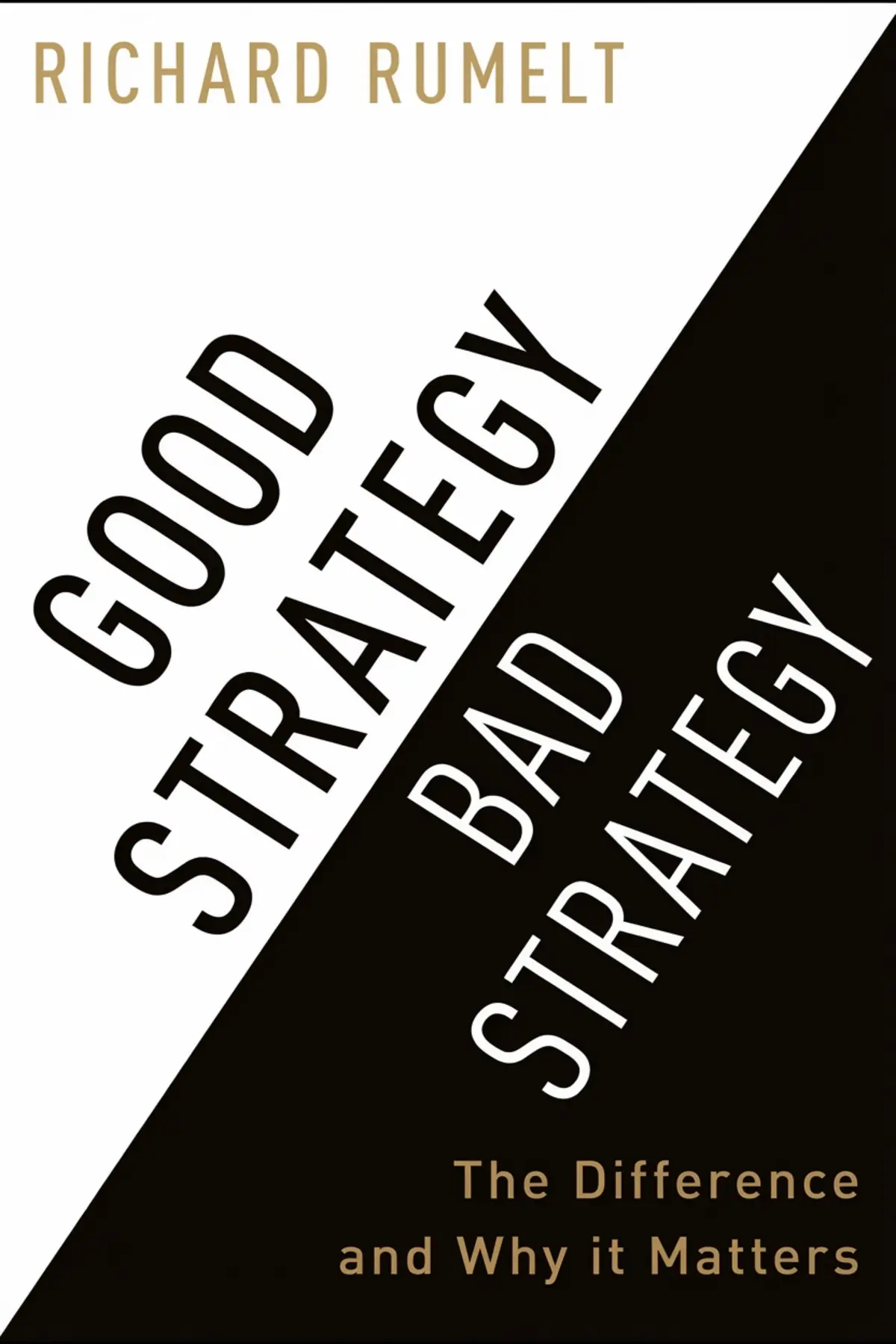
The word strategy is used everywhere today, but rarely is it used correctly. In many boardrooms and planning sessions, what people call strategy is actually just a mix of ambitious goals, motivational slogans, and dense professional jargon. In this summary of Good Strategy, Bad Strategy, Richard Rumelt argues that a real strategy is much more than a vision statement or a wish list. It is a specific and coherent response to an identified challenge. This summary provides a clear roadmap for distinguishing between effective planning and empty fluff. By examining historical military triumphs, corporate turnarounds, and market-shifting innovations, we explore the essential components of a strategy's core—the kernel. You will learn how to diagnose complex situations, develop guiding policies that focus your strengths, and design actions that work in harmony. Whether you are leading a global corporation or navigating your own career, these insights offer a practical framework for making hard choices and gaining a decisive advantage over competitors.
Richard Rumelt holds the Harry and Elsa Kunin Chair in Business and Society at UCLA Anderson School of Management. He has also been named by The Economist as one of the 25 living people with the strongest influence on management concepts and has been described as a giant in the field of strategy by McKinsey Quarterly.
Listeners find this guide offers extensive insights into strategic thinking, contrasting effective and ineffective methods with lucidity. Furthermore, the material is highly accessible and valuable for corporate leadership, and one listener pointed out the author's profound expertise spanning multiple sectors and fields. The prose is also noted for being concise, and listeners enjoy the blend of theoretical concepts and formal definitions paired with compelling stories from diverse backgrounds.
This book is a breath of fresh air in a sea of vapid business literature that usually just recycles the same tired slogans. I particularly loved the case studies, specifically the deep dive into NVidia and how they navigated the 3dfx rivalry by focusing on a faster release cycle. Rumelt doesn’t just give you a "how-to" guide; he teaches you how to think like a strategist by analyzing high-stakes situations across different industries. Frankly, the way he differentiates between a "wish-list" of goals and a "coherent set of actions" should be required reading for every CEO. It’s succinct where it needs to be and provides deep knowledge that feels grounded in reality rather than academic theory.
Show moreEver wonder why most corporate mission statements feel like word salad that nobody actually understands or follows? Rumelt answers that by exposing "bad strategy" for what it is: a refusal to make hard choices or face the actual problem. I’ve been using his three-step approach to fix my department’s planning, and the results of focusing on a "proximate objective" are already visible. To be fair, some of the examples are a bit dated since the book is over a decade old, but the underlying principles are timeless. It’s not just about ambition; it’s about the "how" and the "why" behind every move you make. Truly excellent content that cuts through the noise of modern management.
Show moreThe chapter on the bottling industry alone was worth the price of admission for its sheer depth of analysis. Rumelt doesn’t just stay in the boardroom; he looks at the entire system of competition, showing how good strategy exploits a competitor's weaknesses. I loved how he dismantled "The Power of Positive Thinking" in the context of business, proving that desire doesn't replace the need for a solid plan. The way he defines "fluff" as empty buzzwords used to mask a lack of direction is something I see in my industry every single day. If you want to move beyond corporate "vision" and into real execution, you need to read this masterclass on strategic thinking.
Show moreWow, I didn't realize how much I was conflating ambition with actual strategy until I sat down with this book. The distinction between a "wish-list" of goals and a "coherent response to a challenge" is something that will stay with me for a long time. Rumelt’s writing is surprisingly engaging for a business text, using mysteries and uncovering solutions in a way that keeps you turning the pages. He provides a clear-eyed view of how to identify the critical issues facing an organization without getting bogged down in generic "strategic planning" templates. It’s a masterclass in clear thinking that every aspiring leader should have on their shelf for frequent reference.
Show moreFinally got around to reading this staple, and the "kernel" concept—diagnosis, guiding policy, and coherent action—is a total game-changer. Rumelt manages to strip away the usual corporate nonsense that clutters most management books today. While I found some of the later sections on asset markets a bit of a detour, the core methodology remains incredibly solid. It's refreshing to see someone admit that strategy isn't just about having a big vision or relying on "positive thinking." Instead, it’s about identifying the one or two critical pivot points that actually move the needle for an organization. Some parts are a bit long-winded, but the breakdown of how to face a challenge head-on is invaluable for any leader.
Show moreAs someone who has sat through endless "strategic" planning sessions that were really just goal-setting exercises, this book was a revelation. It explains that a "guiding policy" isn't just a vision statement; it's the bridge between a diagnosis and the actions you actually take. I appreciated the breadth of examples, ranging from the military tactics of Admiral Nelson to the competitive landscape of the bottling industry. My only real gripe is that it can be a bit repetitive, hammering the same points home long after the reader has grasped them. Still, the focus on "coherent action" over "empty slogans" makes it a top-tier resource for anyone in leadership who wants to move beyond buzzwords.
Show moreThe truth is, most business books are 300 pages of filler for one good idea, but Rumelt actually provides several. He cuts through the "mumbo-jumbo" of modern management and reminds us that strategy is about focus and concentration of resources on a specific pivot point. I found the section on the agricultural firm that makes Pom particularly engaging because it showed strategy in a less "tech-heavy" light. While the author’s tone can be a bit haughty at times, his insights into why organizations fail to face their challenges are genuinely profound. It’s a readable, useful guide that helped me distinguish between actual planning and mere motivation. Highly recommended for managers at all levels.
Show moreAfter hearing Paul Boag recommend this on his podcast, I had to see if it lived up to the reputation. It’s a very solid exploration of what it means to actually "do" strategy, though it does run a bit long in the middle sections. The concept of "proximate objectives"—setting goals that are actually achievable with current resources—is such a simple but neglected idea in most high-level planning. Rumelt is definitely an expert, and even if his style is a bit surly, his critique of Cornell’s mission statement had me laughing out loud. I’d suggest skipping the final part on asset markets, but the rest of the book is absolute gold for practitioners.
Show moreLook, Rumelt clearly knows his stuff, but the tone of this book often veers into being surly and unnecessarily arrogant. He spends a lot of time dunking on "bad" strategists—the whole Chad Logan anecdote felt like a weirdly personal call-out that didn't add much value to the reader. While the diagnosis of "fluff" in corporate mission statements is spot on, the book suffers from some selective hindsight where every success is framed as a genius strategy. I also felt that Part 3, where he discusses thinking like a strategist, felt disconnected from the practical "kernel" framework introduced earlier. It’s an insightful read, but you really have to dig through his personal musings to find the actionable bits.
Show moreNot what I expected based on the hype surrounding this title in the business world. To be frank, the entire book could have been a long-form essay or a single chapter without losing any of its primary impact. Rumelt spends way too much time on "storytelling and myth-making," making himself the hero of every consulting anecdote while belittling others for their "bloviating." It felt more like a collection of memoirs and musings designed to secure a legacy than a practical guide for managers. The section regarding the boom-bust cycle of markets felt completely irrelevant to the core thesis and only served to make an already long book feel even more tedious and disconnected.
Show moreJoseph A. Maciariello
Deborah Gruenfeld
Mike Michalowicz
Hamilton Helmer

Margaret Heffernan
AUDIO SUMMARY AVAILABLE
Get the key ideas from Good Strategy, Bad Strategy by Richard Rumelt, plus 5,000+ more titles in English and Thai.







