

Afropean: Notes From Black Europe
Johny Pitts
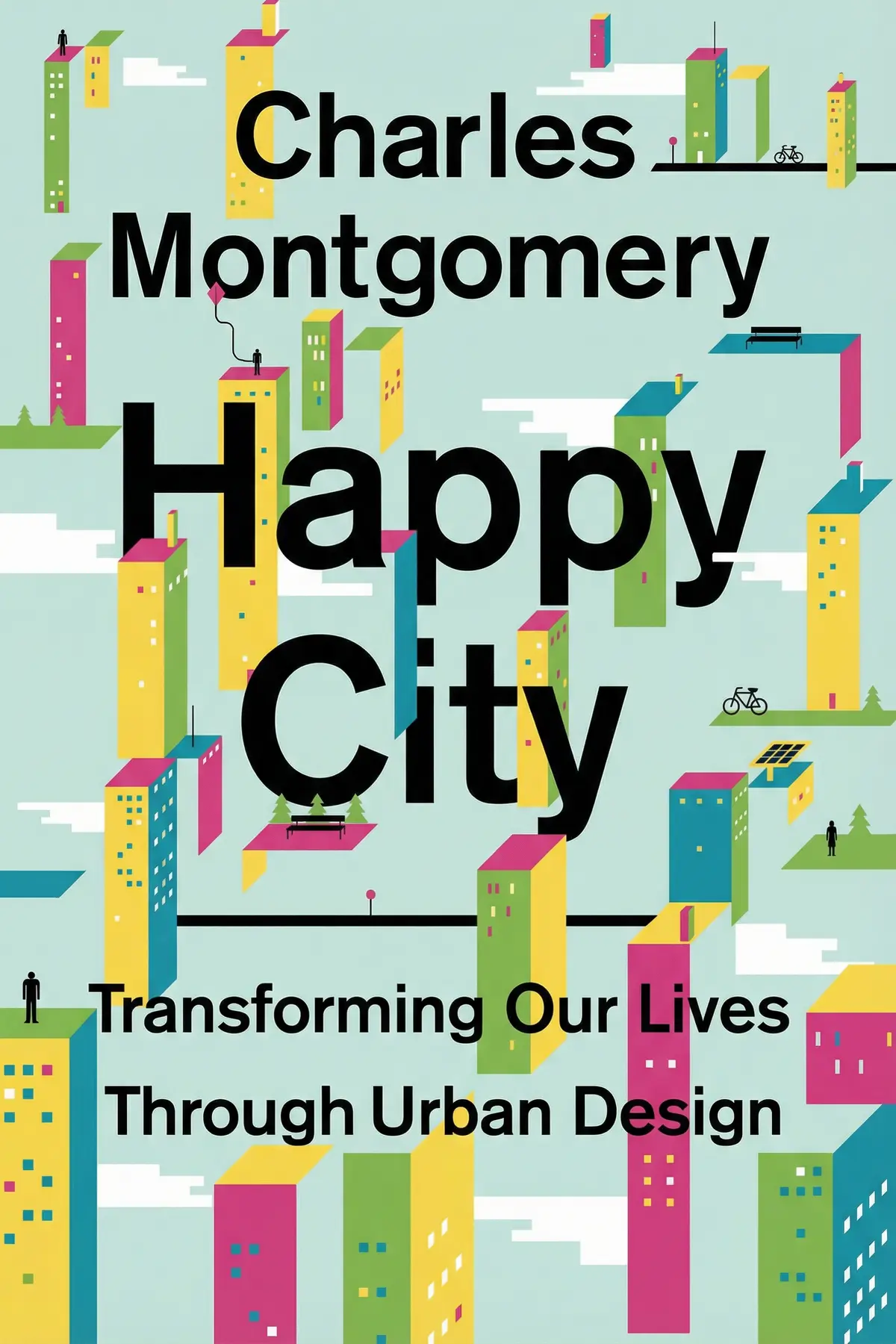
Happy City examines the intersection of urban planning and human psychology, exploring how the design of our streets, transit, and public spaces can either degrade or dramatically improve our individual and collective well-being.
1 min 32 sec
Have you ever walked through a city like London, Tokyo, or Paris and felt an immediate surge of energy? There is something almost magical about the atmosphere in these places—a specific “vibe” that signals creativity, social life, and vitality. We often think of these feelings as accidental, or perhaps just the result of a city’s history. But what if that feeling of happiness was actually a result of the way the streets were paved, where the trees were planted, or how the buses moved?
In Happy City, we are going to look at the powerful, often invisible connection between the design of our urban environments and our internal sense of well-being. For too long, we have built cities based on efficiency, industry, or the needs of the automobile. However, by looking at modern psychological research and real-world case studies, we can see that there is a better way to live. This journey explores how cities can be reshaped to reduce our stress, foster deep social bonds, and even create more equality among citizens.
We will dive into why the dream of the suburban life didn’t quite deliver the happiness it promised, why a small park with messy bushes might be better for your brain than a pristine lawn, and how some mayors are taking bold risks to return the streets to the people. By the end, you’ll see the city not just as a place where you live, but as a machine for creating joy—if only we can learn to design it correctly. The throughline of this exploration is simple: our happiness is not just an internal state; it is a product of the world we build around ourselves.
2 min 28 sec
Explore why the historical move away from crowded industrial cities toward the sprawling suburbs ultimately led to more exhaustion and less satisfaction for residents.
2 min 15 sec
Understand how the presence of cars and the state of city maintenance can either build or destroy the social fabric of a neighborhood.
2 min 07 sec
Discover why diverse and complex natural environments within cities are more beneficial for our well-being than large, empty green spaces.
2 min 17 sec
Learn how the sensory overload of big cities can lead to social withdrawal and how smart architecture can provide the necessary escape.
2 min 14 sec
Explore common psychological traps that lead people and planners to make poor decisions about where and how to live.
2 min 07 sec
Discover how the way we move through a city—whether by car, bike, or on foot—directly affects our physiological stress and joy.
2 min 07 sec
Examine how prioritizing public transit over private vehicles can reduce social inequality and raise the collective well-being of a city.
1 min 36 sec
As we have seen, the city is much more than a collection of buildings and roads. It is a complex ecosystem that has a direct, measurable impact on our psychological and physical health. We have moved from the cramped misery of the industrial age to the isolated exhaustion of the suburban sprawl, but we are finally learning that the key to a “happy city” lies in the balance of human needs.
The evidence is clear: our well-being flourishes when we have access to diverse nature, when our streets are safe for walking and cycling, and when our neighborhoods are designed to foster small, manageable social circles. We have seen that the most successful urban transformations—from the pedestrian streets of Copenhagen to the equitable transit of Bogotá—start with a shift in perspective. We must stop designing cities for cars and start designing them for people.
What does this mean for you? It means that your environment matters more than you might realize. If you have the choice, seek out neighborhoods that offer “active mobility” and social connection. If you are a resident of a city that feels draining, know that it doesn’t have to be this way. Small changes, like adding greenery to a street or advocating for better bike lanes, can ripple out to improve the lives of thousands. The ultimate takeaway is that happiness is a shared project. By demanding better urban design, we aren’t just improving our own lives; we are helping to build a world where everyone has the opportunity to thrive. The city of the future doesn’t have to be a place of stress—it can be the greatest engine for human joy ever created.
What truly makes a city feel "alive"? In Happy City, journalist Charles Montgomery takes readers on a journey through the evolution of urban living, from the grime of the industrial age to the isolated sprawl of modern suburbs. The book serves as an eye-opening exploration of how the physical layout of our environments dictates our stress levels, our social connections, and our overall happiness. Montgomery argues that the car-centric urban planning of the late 20th century has failed us, leading to longer commutes and social fragmentation. The promise of the book is that we can fix this. By analyzing successful urban experiments in cities like Bogotá, Copenhagen, and Paris, Montgomery reveals that the most vibrant and joyous cities are those that prioritize human connection, diverse nature, and equitable access to resources. Whether it is through the introduction of car-free zones or the creation of pocket parks, the design of our urban landscapes has the power to transform our lives. This summary unpacks the psychological and sociological tools necessary to demand and build cities that don't just house us, but help us flourish.
Charles Montgomery is a celebrated journalist with a deep focus on the intersection of urban environments and human behavior. His expertise in urban engagement has earned him significant recognition in the literary world. Notably, in 2005, his work titled The Shark God was honored with the Charles Taylor Prize, underscoring his ability to weave complex social narratives into compelling prose.
Listeners consider this a fantastic selection for urbanists, pointing to its detailed research and impactful design concepts. They also appreciate the way it bridges quality urbanism with happiness data, with one listener highlighting the finding that walking or biking improves a person's mood. Additionally, the writing is lively and anecdote-driven, and listeners find the overall experience to be both encouraging and mentally stimulating.
This book is a complete eye-opener regarding the ways our physical environment dictates our moods. Montgomery doesn't just preach urbanism; he connects the dots between transit and our actual neurotransmitters. I spent my morning commute in bumper-to-bumper traffic thinking about his section on how car-dependent sprawl breeds isolation and cortisol. It’s a dense read, packed with data, but the narrative flow keeps it from feeling like a textbook. Truth is, I’ll never look at a cul-de-sac the same way again. The way he juxtaposes the "freedom" of the car with the actual freedom of a walkable neighborhood is brilliant. It makes you realize that our cities are currently designed for machines rather than humans. My only gripe is that it leans a bit heavily on the "suburbs are evil" trope without offering enough middle-ground solutions for those who can't just move to Copenhagen tomorrow. Still, it’s essential reading for anyone who lives in a city.
Show morePicked this up during a particularly frustrating month of commuting, and it was exactly the validation I needed. Montgomery masterfully argues that the "American Dream" of a big house and a long drive is actually a recipe for unhappiness. He uses a mix of sociology and urban design to show how sprawl increases our obesity rates and kills our social lives. The book is filled with great examples, from the mural-painted intersections in Portland to the "beaches" of Paris. It’s well-researched but reads like a conversation with a very smart, very passionate friend. Personally, I found the section on the "social paradox" of density—where we can be surrounded by people but still lonely—to be the most insightful part of the entire work. It’s not just about building bike lanes; it’s about building trust and connection within our neighborhoods.
Show moreAs someone who has spent years living in car-centric Atlanta, reading this felt like a diagnosis for a disease I didn't know I had. Montgomery’s exploration of how our environment shapes our social bonds is nothing short of revolutionary. He beautifully describes the difference between looking at "asphalt and sharp edges" versus the "softly branching trees" of a human-scaled street. The book is optimistic and hopeful, focusing on how we can reclaim our streets for people rather than just throughput for vehicles. I especially loved the focus on the "Happy City" as a collective project. It’s not just about individual choices; it’s about the policies that govern our lives. The writing style is vivid, though it can get a little flowery in the descriptive passages. It’s the kind of book that makes you want to go outside and start a community garden immediately.
Show moreThe chapter on the "Share-It Square" in Portland was worth the price of the book alone. It’s a fascinating look at how small, grassroots interventions can bypass bureaucratic red tape to create meaningful community spaces. Montgomery is a gifted storyteller, turning what could be boring topics like "zoning" into compelling narratives about human connection. He really nails the "human interest" aspect of urbanism. I do think he could have addressed accessibility for the disabled community a bit more thoroughly, as a lot of the "walkable" solutions assume a high level of mobility. Regardless, the book is a masterclass in why we need to rethink our shared spaces. It’s empowering to realize that the way our cities are built isn’t inevitable—it’s a choice we make every day through design and policy.
Show moreWow. This book completely shifted my perspective on my own neighborhood. I never realized how much the lack of sidewalks was impacting my ability to actually know my neighbors. Montgomery’s writing is punchy and direct, yet he manages to weave in some truly beautiful observations about human nature. He argues that we have evolved to need social interaction, and our cities are currently designed to starve us of it. The stories of Bogotá’s transformation under Peñalosa were particularly moving and showed that radical change is possible even with limited resources. It’s a rare non-fiction book that manages to be both scientifically grounded and emotionally resonant. I found myself highlighting passages on almost every page. It’s a call to rethink what we value in our lives: is it the square footage of our homes, or the quality of our connections?
Show moreEver wonder why some neighborhoods feel vibrant while others feel like soul-crushing voids? Montgomery explores this through a fascinating lens of behavioral science and urban planning. I was particularly captivated by the stories from Bogotá and how radical changes to bus systems can actually increase a population's overall happiness. The prose is engaging and accessible, moving quickly between psychological studies and real-world anecdotes. To be fair, he does gloss over some of the real concerns people have about density, like noise and privacy, which makes the argument feel a bit one-sided at times. However, the core message—that we can design for joy—is incredibly powerful. It’s a call to arms for better public spaces. If you're interested in how architecture impacts mental health, this is the gold standard for modern urbanist thought.
Show moreNot what I expected at all, but in a good way. I thought this would be a dry manual on urban planning, but it’s actually more of a psychological study. The author asks a fundamental question: what makes us happy? Then he shows how our cities are actively preventing those things from happening. Not gonna lie, the data on how much time we waste in cars is depressing. But the book balances that out with inspiring stories of cities that fixed themselves. The narrative about the man pressured into village-style babysitting was a bit weird for me—I value my anonymity!—but I see the point he was making about social cohesion. It’s a thought-provoking read that will stay with me for a long time. Definitely recommended for anyone who feels "stuck" in their suburban routine and wants to see the world differently.
Show moreAfter hearing so much hype, I finally dived in and found a very well-researched piece of advocacy. Montgomery does a stellar job of synthesizing complex ideas from economics, psychology, and architecture into a cohesive argument for the dense city. The strength of the book lies in its global perspective, jumping from Vancouver to Copenhagen to the Netherlands. It’s an engaging read, though it occasionally conflates "weight" with "health" in a way that feels a bit dated and simplistic. Still, the core premise that our current development model is broke—socially, physically, and financially—is hard to argue with. Look, if you want a book that explains why your 90-minute commute is making you miserable, this is the one. It provides the vocabulary to talk about things we often feel but can't quite articulate in our daily lives.
Show moreFinally got around to reading this staple of urban design, and it’s easy to see why it’s so highly regarded. It’s a passionate, evidence-based plea for more human-centric urban planning. Montgomery excels at showing how the design of a street can literally change the way you feel about a stranger. While it’s definitely America-centric, the principles of walkability and transit-oriented development are universal. To be fair, some of the "happiness" measurements he cites—like skin moisture sensors—felt a little like pseudo-science to me. I would have preferred more focus on hard economic outcomes and less on participant-reported feelings. But as a "happiness project," it succeeds in making you rethink the value of your environment. It’s a great read for anyone who wants to be a leader in their community or just wants to understand the city better.
Show moreFrankly, I found this to be a bit of a repetitive "urbanist gospel" that didn't offer much for those who actually enjoy their privacy. While Montgomery makes some great points about the health benefits of walking, he treats anyone who prefers a suburban yard like they’ve been brainwashed. The citations are all tucked away in the back, which makes some of his grander claims about "science proving happiness" feel a bit dubious and unsupported. I struggled with the tone; it felt quite condescending toward the reality of why people choose sprawl, such as better schools or safety. There’s some interesting history here regarding zoning laws and racism, which I appreciated. But by page 200, I felt like I was reading the same three arguments over and over again. It’s a decent primer for beginners, but seasoned urbanists might find it a bit shallow.
Show moreJohny Pitts
bell hooks

Fay Bound Alberti
Daniel Goleman
Virginia Woolf
Tracy Rosenthal
Jessica Valenti
AUDIO SUMMARY AVAILABLE
Get the key ideas from Happy City by Charles Montgomery, plus 5,000+ more titles in English and Thai.







