
21 min 10 sec
Hate the Game: Economic Cheat Codes for Life, Love, and Work
A strategic guide to navigating life’s complexities using economic principles and game theory, offering practical tools for making better decisions in careers, relationships, and financial management.
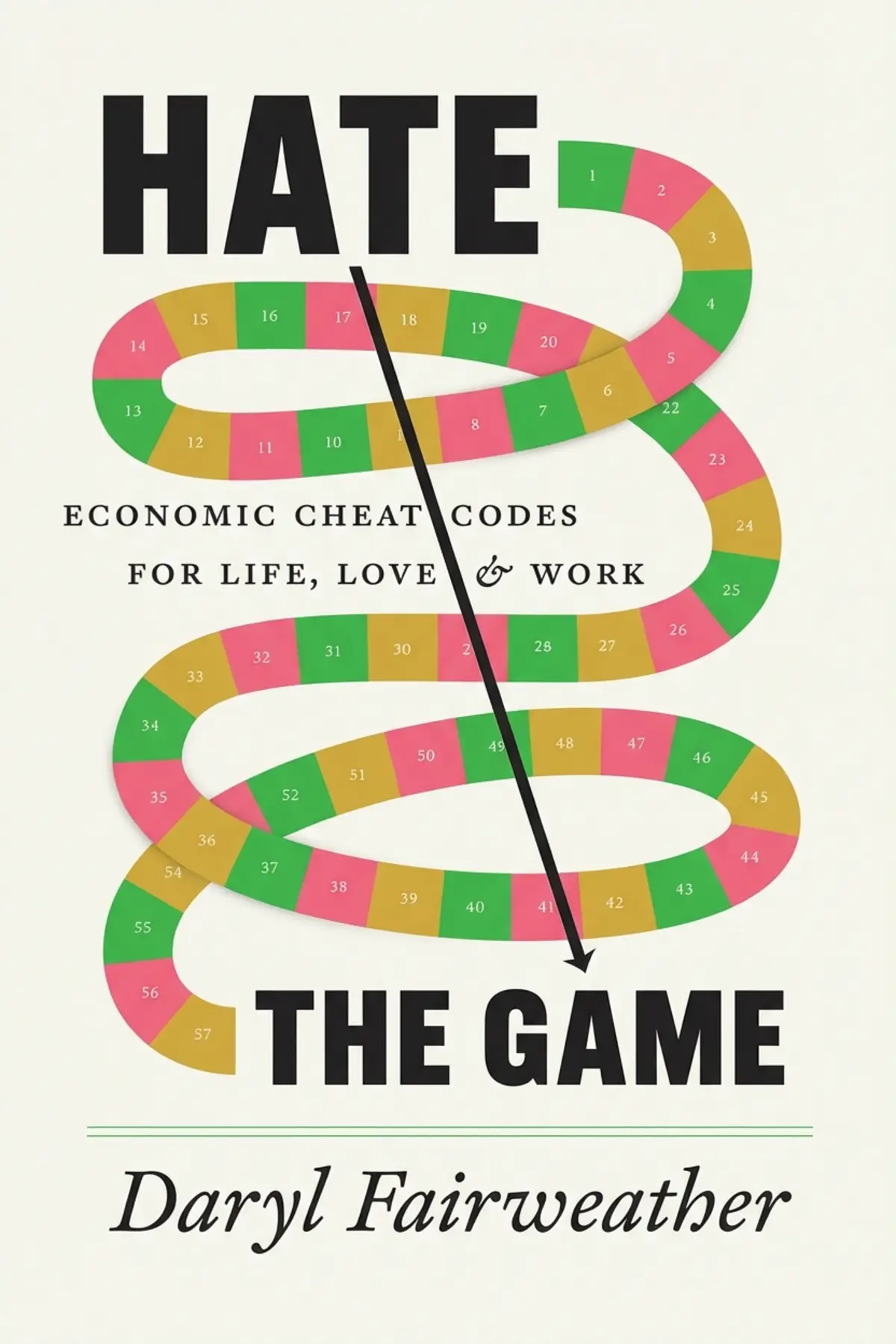
Table of Content
1. Introduction
2 min 09 sec
Life often feels like a game where the rules are obscured, the referees are biased, and the stakes are impossibly high. Whether you are navigating a tricky job offer, managing the rising cost of living, or trying to sustain a long-term partnership, it can feel as though you are playing a match where you didn’t get the playbook. Many of us move through these challenges feeling like we are constantly playing catch-up, reacting to the moves of others rather than making our own. But what if there was a way to see the board more clearly? What if the frustrations of daily life could be analyzed through a strategic lens that reveals the hidden patterns beneath the chaos?
This is the core promise of the insights shared by Daryl Fairweather. By blending the rigorous logic of game theory with the psychological nuance of behavioral economics, we can start to see life not as a series of random misfortunes, but as a series of strategic interactions. Game theory provides the tools to predict how others might behave and how to weigh the consequences of our own choices. Behavioral economics goes a step further, explaining why our brains sometimes lead us toward irrationality—and how to course-correct. Together, these frameworks offer more than just academic theory; they offer a way to regain a sense of agency.
In this summary, we are going to explore how to turn economic theory into real-world strategy. We will look at how to identify which games are actually worth your time and how to handle the lopsided information that often defines our biggest negotiations. We will also dive into the ‘game’ of love and the ‘game’ of money, showing how strategic planning can protect you from your own future biases and the traps of scarcity. The goal here isn’t just to survive the game, but to learn how to play it with purpose and clarity. By the end, you’ll be able to spot the underlying dynamics of almost any situation, allowing you to move from feeling like a pawn to acting like a grandmaster of your own life story.
2. Selecting the Right Game
3 min 15 sec
Before you can win, you must understand what you are playing for and whether the game itself offers any long-term value beyond a simple reward.
3. Negotiation and the Power of Information
3 min 28 sec
The outcome of any deal isn’t just about who has more power; it is about who knows more and who is willing to walk away.
4. The Trap of Overthinking and Uncertainty
3 min 14 sec
In complex systems, trying to outsmart everyone else can lead to a recursive loop of frustration and diminishing returns.
5. Applying Strategic Framing to Marriage
3 min 22 sec
Viewing a long-term partnership as a series of commitment and negotiation games can help prevent common pitfalls and strengthen the bond.
6. Escaping the Scarcity Trap and Financial Corners
3 min 31 sec
Financial decisions are often dictated by a lack of options, making the priority not just saving, but expanding your field of choices.
7. Conclusion
2 min 11 sec
As we wrap up this exploration of Daryl Fairweather’s Hate the Game, it is clear that the world is a complex place, but it is not a random one. By looking through the lens of an economist, we can see that our lives are shaped by the games we choose to play, the information we manage to gather, and the commitments we are brave enough to make. We’ve learned that the most important investment you can make isn’t in a stock or a piece of real estate, but in your own human capital—the skills and experiences that stay with you regardless of the market’s whims.
We’ve seen how negotiations are won not by the loudest voice, but by the person who understands the hidden needs and alternatives of everyone at the table. We’ve explored the trap of overthinking, realizing that sometimes the best decision is the ‘good enough’ one that allows us to move forward without paralysis. We’ve looked at the intimate architecture of marriage and the harsh realities of financial scarcity, finding that in both cases, success comes from long-term strategic planning rather than short-term emotional reactions.
The throughline of all these insights is agency. You may not be able to change the rules of the global economy or control how your partner feels every single day, but you can change how you respond. You can choose to stop playing games that offer no growth. You can choose to protect yourself against your own future biases. And you can choose to focus on expanding your options rather than just surviving your constraints.
Take a moment to look at your own life right now. Which games are you currently playing? Are they building your capital, or are they just games of luck and status? By applying these ‘cheat codes’—the logic of game theory and the wisdom of behavioral economics—you can start to navigate the challenges of life, love, and work with a new sense of confidence. Don’t just hate the game; learn the rules, find the patterns, and start playing to win on your own terms. Thank you for listening to this BookBits summary. If you found these insights helpful, please leave us a rating and join us next time as we dive into another guide for a smarter life.
About this book
What is this book about?
Have you ever felt like the rules of life were written by someone else, or that the system is intentionally designed to keep you one step behind? In Hate the Game, economist Daryl Fairweather argues that while the 'game' of life can often feel rigged, understanding the underlying mechanics of game theory and behavioral economics can provide you with a powerful set of cheat codes. This summary breaks down how to apply sophisticated strategic thinking to your most personal and professional challenges. From the high-stakes world of celebrity management and the power dynamics of pop groups like Destiny’s Child to the intimate negotiations within a marriage, the book provides a roadmap for making smarter choices. It explores why we often overthink simple decisions while under-preparing for life-altering ones. By looking at concepts like human capital, asymmetric information, and corner solutions, the book promises to transform you from a frustrated participant into a savvy player who knows exactly when to double down and when to walk away. It is an exploration of how to reclaim agency in a world that often feels out of your control.
Book Information
About the Author
Daryl Fairweather
Daryl Fairweather is the chief economist at Redfin, where she focuses on U.S. housing markets and consumer decision-making. She previously served as a senior economist at Amazon and contributes regularly to outlets like Forbes, with her insights also featured in 60 Minutes, Today, the New York Times, and Bloomberg.
Ratings & Reviews
Ratings at a glance
What people think
Listeners find this work highly educational, especially appreciating the way it simplifies complex game theory ideas. Beyond that, the material is enjoyable to consume, and one listener considers it a vital resource for those studying economics. They also value the writer's professional authority, as one review points out her PhD background in economics.
Top reviews
Suda
Ever wonder why you keep making the same mistakes in relationships or at work? Daryl Fairweather explains that it’s usually because you don’t understand the rules of the game you’re actually playing. The marriage section was a standout for me, specifically the discussion on 'brinkmanship' and how it erodes trust in long-term partnerships. I’ve never seen a prenuptial agreement described as a form of strategic foresight rather than a lack of romance, and it totally changed my perspective. The book is effortless to read and uses great pop culture references, like the Destiny's Child manager situation, to illustrate its points. It makes economics feel human and accessible for once.
Show moreAom
Economics isn't just for Wall Street guys, and Fairweather proves it with this insightful guide to life’s 'games.' As someone who actually studied econ in college, I still found plenty of value here because she applies the math to messy, real-world emotions. Her explanation of the 'beauty contest' game in financial markets was the best I’ve ever read. The book teaches you when to play and, more importantly, when to walk away from a rigged system. It’s a must-read for anyone who feels like they’re constantly playing catch-up in a world that wasn't designed for them. Truly a practical toolkit for making braver decisions.
Show moreJonathan
If you're an econ major looking for real-world utility, or just someone tired of typical self-help fluff, this is for you. Fairweather uses her PhD background to explain why we feel so powerless in certain systems and how to flip the script. The idea that we play different games for different reasons—pleasure, rewards, or learning—was a massive 'aha' moment for me. I’ve already started applying the 'inside/outside option' framework to my current job search and it’s helped my confidence immensely. It’s rare to find a book that is this intellectually stimulating while remaining so grounded in the practicalities of paying bills and managing a family.
Show moreOat
Fairweather’s PhD shines through in how she deconstructs complex game theory concepts without making them feel like a dry textbook. I particularly appreciated the breakdown of 'utility functions' and how our internal values dictate the games we choose to play. To be fair, some of the personal anecdotes felt a bit detached from the average reader’s reality, especially the parts about her high-level career trajectory. However, the 'Game Recaps' at the end of each chapter are incredibly practical for anyone trying to navigate workplace politics. She reframes negotiation as an information game, which is a total game-changer for anyone who feels they lack traditional power. It's a solid bridge between academic theory and actual life advice.
Show morePrae
After hearing Daryl on the radio, I was excited to see how she applied her economic expertise to everyday life. The concept of 'strategic returns' vs. short-term wins in your career is something every young professional needs to hear. Sometimes a low-paying job is the best move if it builds your human capital for the next level. I did find some of the advice on overthinking a bit contradictory—it’s hard to 'stop digging' when you're an overanalyzer by nature. Still, her advice on treating negotiation as an information game rather than a power struggle is worth the price of the book alone. It’s a smart, modern take on life strategy.
Show moreCooper
Finally got around to finishing this and I'm glad I did, even if I didn't agree with every single point. The focus on empathy over ego in negotiations was a refreshing take that you don't usually see in business books. I loved the breakdown of how scarcity narrows your focus and makes long-term thinking almost impossible. It's a compassionate look at why people struggle. My only gripe is that the tone sometimes shifted abruptly between very casual pop culture talk and serious economic data. It made the reading experience a little jarring at times, but the core messages are strong enough to carry it through. Worth checking out.
Show moreTaweesak
The section on 'corner solutions' was eye-opening because it explains why people in poverty make choices that seem irrational to outsiders. It’s not about lack of intelligence; it’s about a lack of options and the mental burden of scarcity. While I found those insights brilliant, the rest of the book felt a bit inconsistent in its pacing. Some chapters were dense with strategic advice, while others veered too far into personal storytelling that didn't quite land for me. Look, it’s a decent read for someone looking for a fresh perspective on self-help, but it might not satisfy those looking for a rigorous economic analysis. It's somewhere in the middle.
Show moreSamroeng
Truth is, the book tries to bridge too many gaps at once—memoir, self-help, and academic theory—and doesn't always succeed. Some of the animal anecdotes felt a bit like filler, though I did enjoy the track athlete example regarding motherhood and workplace inequality. The advice on making 'good enough' decisions to avoid paralysis is something I’ll definitely try to implement, as I’m a chronic overthinker. However, I felt the book lacked a cohesive thread beyond 'life is a game.' It’s a collection of interesting thoughts and economic concepts, but it didn’t quite come together as a unified guide for me. A light, 'meh' read overall.
Show moreZanya
This felt more like a personal diary with a few economic terms sprinkled on top to justify the title. I came into this expecting deep dives into game theory and strategic decision-making, but instead, I got a lot of stories about her personal life that didn't always translate to my own experiences. Frankly, if you've taken even a basic 101 course in economics, most of the concepts like 'sunk cost fallacy' or 'incentives' will feel incredibly elementary. The writing is engaging and she’s clearly very smart, but the 'cheat codes' promised felt like common sense dressed up in fancy jargon. I wanted more strategy and less memoir.
Show moreChon
Not what I expected based on the title or the hype on social media. I found it very difficult to connect with the author’s 'lived experiences' because they felt so specific to a high-earning, elite professional world. The advice felt like stuff I could have found in a long-form LinkedIn post or a basic blog about productivity. Where was the actual game theory? Most of it was just anecdotal evidence supported by survivorship bias. It's disappointing because the premise of 'economic cheat codes' is so strong, but the execution felt thin and lacked the depth I wanted from a PhD-level economist. I finished it feeling like I hadn't learned anything new.
Show moreReaders also enjoyed
Adults in The Room: My Battle With Europe’s Deep Establishment
Yanis Varoufakis
A Guide to the Good Life: The Ancient Art of Stoic Joy
William B. Irvine
A High-Performing Mind: Strengthen Your Mind and Live Your Best Life
Andrew D. Thompson
AUDIO SUMMARY AVAILABLE
Listen to Hate the Game in 15 minutes
Get the key ideas from Hate the Game by Daryl Fairweather, plus 5,000+ more titles in English and Thai.
- 5,000+ titles
- Listen as much as you want
- 7-day free trial
- Cancel anytime







