
22 min 41 sec
How to Be a Capitalist Without Any Capital: The Four Rules You Must Break to Get Rich
By Nathan Latka
Discover a provocative blueprint for wealth that rejects traditional business norms. Nathan Latka reveals how to build a fortune by copying competitors, automating systems, and leveraging existing assets without needing large capital.
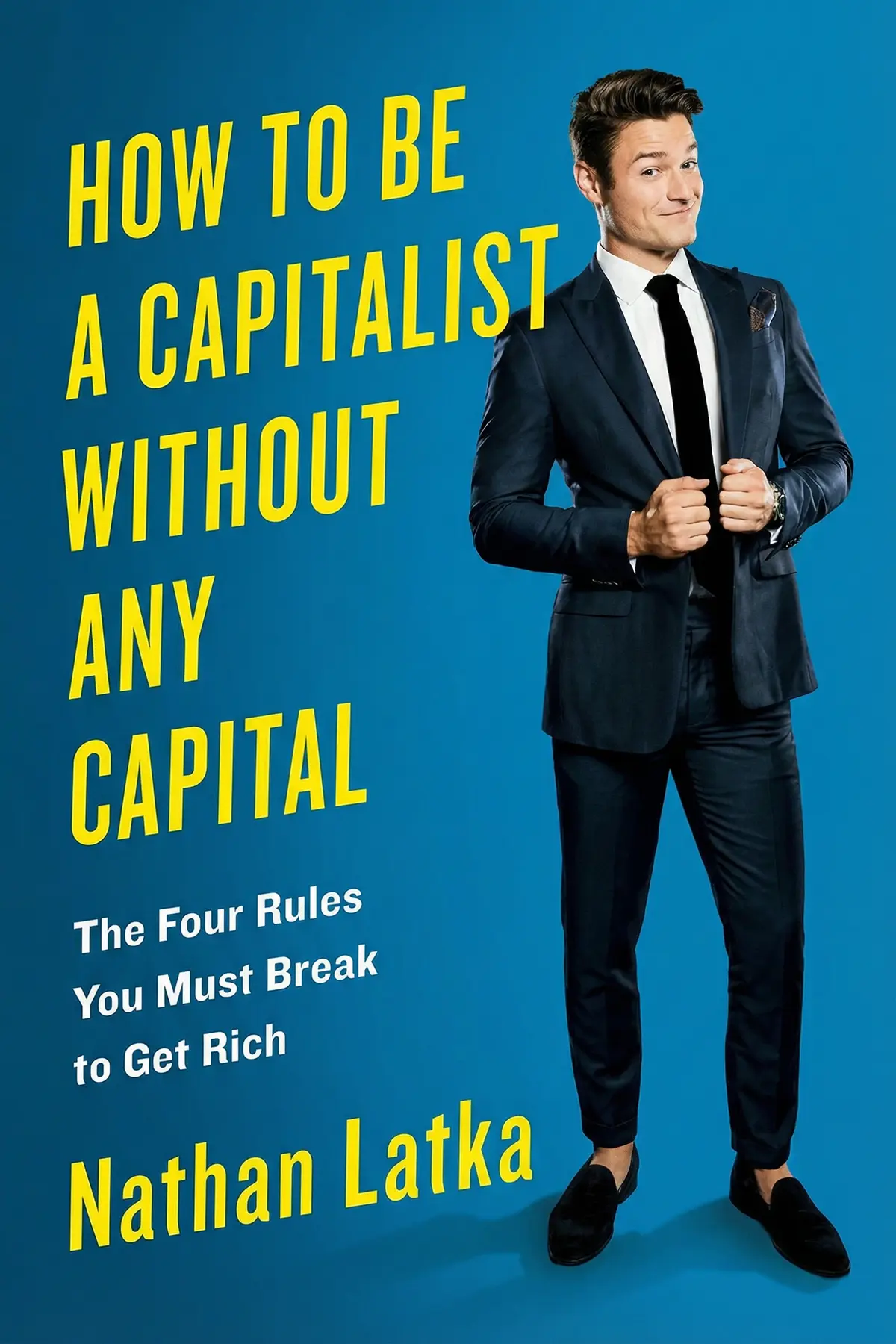
Table of Content
1. Introduction
1 min 58 sec
We are often raised on a very specific narrative regarding success. It usually goes something like this: find one thing you are good at, work harder than everyone else, and wait for your big, original idea to change the world. This is the classic myth of the creative genius, a solitary figure like Steve Jobs or Elon Musk, who blazes a trail through sheer force of will and innovation. But what if that story is actually a trap? What if the real secret to wealth isn’t about being original, but about being clever with the resources that already exist around you?
This is the world of the modern capitalist, as envisioned by Nathan Latka. Latka didn’t start with a trust fund or a revolutionary patent; he started with about a hundred dollars and a willingness to look at the business world through a different lens. He realized early on that the traditional rules of business—specialization, goal-setting, and pure originality—are often the very things that hold people back from true financial freedom.
In this summary, we are going to deconstruct the traditional playbook and replace it with something much more practical for the person who doesn’t have millions of dollars to burn. We will explore why having multiple, seemingly unrelated income streams is actually safer than having a prestigious career. We’ll look at why ‘copycatting’ is a legitimate and highly effective business strategy, and how you can stop chasing vague goals and start building automated systems that do the work for you.
The core throughline here is leverage. It is about learning how to use other people’s platforms, other people’s ideas, and even other people’s time to build your own empire. We are moving away from the idea of the ‘self-made man’ who does everything himself, and toward the ‘smart capitalist’ who builds a machine that generates wealth while they sleep. If you have ever felt that the standard path to success is too slow or too risky, get ready to see a different way forward. This isn’t just about working harder; it is about changing the rules of the game so that the odds are finally in your favor.
2. The Power of Diversified Income Streams
2 min 21 sec
Forget everything you heard about specializing in one career. Learn why being a ‘jack of all trades’ is the ultimate safety net for modern wealth builders.
3. Strategic Imitation Over Originality
2 min 22 sec
Innovation is overrated and expensive. Discover why the most profitable businesses often start by taking someone else’s idea and giving it a simple twist.
4. Prioritize Systems Over Goals
2 min 34 sec
Setting goals might actually be holding you back. Learn how to build automated systems that produce results whether you’re at your desk or on vacation.
5. The Pickaxe and Shovel Strategy
2 min 07 sec
You don’t have to find the gold to get rich in a gold rush. Learn how to profit by supporting the industries that are already booming.
6. Maximizing Assets Instead of Just Saving
2 min 17 sec
Stop trying to save your way to wealth. Discover how to turn your everyday possessions into active income generators that pay for your lifestyle.
7. Living Large on a Budget Through Travel Hacking
2 min 22 sec
Wealth isn’t just about what you make; it’s about what you keep. Learn the secret strategies the ‘New Rich’ use to travel the world in luxury for pennies.
8. Acquiring Digital Assets for Scalable Growth
2 min 17 sec
Buying an existing business can be faster than starting one. Discover why digital companies and distribution channels are the best targets for savvy investors.
9. Maximizing Revenue Through Scarcity and Feedback
2 min 16 sec
Learn how to squeeze more profit out of fewer customers. Discover the simple question that can double your income and the power of saying ‘no’ to growth.
10. Conclusion
2 min 07 sec
As we have seen, the path to wealth envisioned by Nathan Latka is not about following the herd or sticking to safe, traditional career paths. It is about a fundamental shift in perspective. To be a capitalist without capital, you must be willing to break the rules that others follow blindly. You have to embrace being a generalist, find the value in imitation, and prioritize the creation of systems over the pursuit of vague goals.
We’ve covered how to build a resilient financial life by diversifying your income and how to ride the coattails of successful industries by selling ‘pickaxes’ rather than digging for gold yourself. We’ve explored the radical idea of turning your personal liabilities, like your home and car, into assets that pay for your life. And we have looked at how to scale a business through smart acquisitions and the strategic use of scarcity.
The throughline of all these strategies is the rejection of the idea that you must trade your time for money. The goal is to move as quickly as possible into a position where you own assets and systems that generate value independently of your direct labor. Whether it’s through travel hacking to live a luxury life on a budget or using a ‘Starbucks test’ to automate your business tasks, every strategy is designed to give you back your most precious resource: your time.
A great way to start putting this into practice immediately is to look for opportunities right in your own community. You don’t always need a complex spreadsheet to find a good investment; sometimes, you just need to keep your eyes open. If you see a local business that is always busy, has a great atmosphere, and is run by passionate people—like a popular local hostel or a thriving specialty café—pay attention. Those are the ‘boots on the ground’ indicators of success that no algorithm can match.
Becoming a capitalist is ultimately about taking control of the machine. It’s about stopping being a cog and starting to be the operator. By applying these rules and having the courage to ignore conventional wisdom, you can build a life of abundance and freedom, starting with whatever resources you have right now. The rules are there to be broken—so go ahead and start building your empire.
About this book
What is this book about?
This summary explores a radical approach to entrepreneurship that prioritizes efficiency and smart leverage over original invention. It challenges the conventional wisdom that success requires unique ideas or specialized expertise. Instead, it offers a pragmatic guide for the modern 'capitalist' who wants to build multiple income streams by following the path of least resistance. You will learn why staying in one lane is a financial risk and how to use the success of others as a springboard for your own ventures. The promise of this narrative is to provide a step-by-step framework for creating sustainable wealth using very little of your own money. By focusing on systems, outsourcing, and strategic acquisitions, you can move away from trading your time for dollars. Whether it is through 'selling pickaxes' to booming industries or turning a personal home into a profit center, these strategies are designed to help you achieve financial independence by playing the game of capitalism with a completely different set of rules.
Book Information
About the Author
Nathan Latka
Nathan Latka is a successful entrepreneur who began his journey with only $119 in his bank account at the age of 19. He founded Heyo, a marketing tool for Facebook businesses, and the SaaS-focused cloud computing firm. Latka is also the host of the well-known podcast, Top Entrepreneurs, where he interviews global CEOs to uncover their business strategies. How to Be a Capitalist Without Any Capital is his debut book, distilling his unconventional methods for wealth creation.
Ratings & Reviews
Ratings at a glance
What people think
Listeners view this book as a vital resource for business owners, delivering actionable suggestions and novel strategies for building wealth. Additionally, the writing is extensive and straightforward, with one listener highlighting the specific detail found in the table of contents. They also appreciate its overall worth, with one review emphasizing how it provides financial proof to its rhetoric.
Top reviews
Dome
Nathan Latka is a polarizing figure, but you cannot deny that this book delivers exactly what it promises on the cover. Most business gurus hide behind vague metaphors and high-level strategy that doesn't actually help a beginner, yet Latka provides actual email scripts and negotiation templates. To be fair, he is incredibly blunt about his own success, which might rub some people the wrong way if they aren't used to that level of aggressive confidence. I found the section on 'selling axes to gold miners' to be a total game-changer for my side hustle strategy. Instead of trying to build the next big thing from scratch, he shows you how to profit from existing ecosystems. It is a fast read that I finished in a single sitting because the flow is just that engaging. If you are tired of the same old corporate advice, this is the blueprint you need for actual wealth creation.
Show morePongpan
Finally got around to reading this and the table of contents alone is worth the price of admission. Latka provides financial proof to his rhetoric, which is something you rarely see in this genre of entrepreneurship books. He isn't just talking about ideas; he's showing you the bank statements and the specific deals that made him a multimillionaire. I especially loved the chapter about not specializing in one narrow field because it goes against everything we are usually told about career success. The concept of being a 'jack of all trades' to ensure you always have a safety net resonated deeply with my own experiences. Some might find him shameless, but in a world of fake influencers, his brutal honesty about ripping off rivals' ideas is refreshing. This is a comprehensive guide for anyone who wants to stop trading time for money and start building real capital.
Show moreClara
The chapter on buying instead of building changed my entire perspective on what it means to be an entrepreneur today. Nathan Latka breaks down the math of wealth creation in a way that is both easy to understand and incredibly motivating. There is absolutely no BS here; he gives you the specific details on how to get sponsorship deals using social media influence. I love that he includes the specific emails so you don't have to guess how to phrase your outreach. People might call him a troll, but he is a super-smart hustler who understands how the modern economy actually works. By focusing on creating systems that make others' lives easier, he has built a self-sustaining empire that most people only dream of. This book is addictive, and I found it nearly impossible to put down once I started the first chapter. Get it if you're ready to stop following the rules and start winning.
Show moreLadawan
Ever wonder how some people just seem to 'get it' without having a massive trust fund to start with? This book dives deep into the nuts and bolts of building a venture by breaking every traditional rule in the playbook. I really appreciated the focus on creating automatic systems and outsourcing humdrum tasks to places like Upwork or Fiverr for a few dollars. It is a refreshing take on the 'New Rich' lifestyle that Tim Ferriss popularized, though it definitely pushes those concepts to a more extreme level. My only gripe is that the tone can be a bit egotistical at times, especially when he starts quoting himself in the chapter headers. Despite the occasionally cringe-inducing self-promotion, the practical advice on purchasing already functioning businesses is worth the price of the book alone. It is a solid roadmap for anyone trying to transition from a standard hustle to something truly scalable.
Show moreNarongrit
Look, I get why people find Nathan annoying, but the advice here is actually very practical if you are willing to do the work. The book focuses heavily on getting the most out of your existing assets and saving money through clever travel hacks and negotiations. I found the section on 'time blindness' particularly insightful because we always overestimate what we can do in a day. By using his specific scripts for sponsorship deals, I was able to renegotiate a contract for my own podcast last week. While he does repeat the importance of Toptal and other freelance services a bit too often, the core message of rule-breaking is vital. It’s not a perfect book, and the ego is definitely present on every page, but the actionability is high. If you want a luxurious life of plenty, you have to be willing to think differently than the average employee.
Show moreDuang
Picked this up because I wanted actual scripts, not just high-level fluff that leaves you wondering what to do next. Nathan delivers on that front, providing the exact emails he uses to land deals and acquire companies with zero down payment. It’s a playbook for people living in the real world who need to pivot to scalable revenue streams quickly. I’m a parent, so a lot of the 'hustle 24/7' stuff doesn't apply to me, but the automation tips are golden. The book does a great job of explaining how to move away from the round-the-clock grind and increase your hourly ROI. I did find the repetitive mentions of certain freelance platforms a bit tiring after the third time. Still, the grit required to pull this off is up to the reader, and Nathan provides a very solid roadmap. It is definitely a level up from the standard business fare.
Show morePor
The truth is, this book is essentially a modern-day '4-Hour Workweek' on steroids, for better or worse. While I do like his emphasis on focusing on multiple income streams, I found the author’s personality to be incredibly distracting. There is literally a shirtless picture of him in front of a resort, and the constant bragging about his acquisitions starts to feel like a repetitive advertisement. Some of the advice seems very specific to the tech world and might not translate well for the general public or those with more traditional careers. However, if you can look past the 'dbag' persona, there are some genuine nuggets of wisdom regarding ROI on your time. It’s a bit of a mixed bag because the tactics are actionable, but the delivery is often annoying and overly polarizing. Read it for the big picture ideas, but take the specific flexes with a grain of salt.
Show moreNikolai
As someone who has been in the SaaS world for a while, I found the advice a bit hit or miss throughout the chapters. On one hand, the strategy of buying small startups instead of building from scratch is a brilliant way to skip the 'zero to one' phase. On the other hand, a lot of the book feels like a giant advertisement for Nathan’s own products and data platforms. He quotes himself alongside people of significant stature, which comes off as a bit of a poser move to be honest. The advice is polarizing; you will either love his aggressive 'rent-seeking' approach or find it morally questionable regarding how he treats employees. It is a worthwhile read if you are trying to set up side businesses, but it lacks the depth needed for a truly sustainable long-term enterprise. It’s good for a quick mindset shift, nothing more.
Show morePensri
Not what I expected, but interesting nonetheless if you can stomach the author's incredibly loud personality. Nathan doesn't just want to be successful; he wants you to know exactly how much more successful he is than you. This egotistical tone permeates every chapter, making it a bit of a chore to get through the more brag-heavy sections. That being said, his honesty about how he monetizes data from his interviews is actually quite fascinating and relatively rare to see in print. The real estate portion felt a bit less valuable compared to the tech and SaaS sections, which are clearly his bread and butter. It’s a bit of a 'New Rich' rip-off in parts, but with a more predatory, capitalistic edge that some will find useful. I think the summary at the beginning is probably enough for most people to get the gist. Only dive deep if you really love the hustle culture vibe.
Show moreSuthinee
Frankly, I struggled to get past the author's tone to find the actual value hidden in these pages. He comes across as a wanna-be contrarian who is more interested in promoting his own brand than helping the reader. The shirtless resort photo and the self-quotes are just the tip of the iceberg when it comes to the vanity displayed here. Most of the advice only applies to a very specific tech scenario and ignores the complexities of building a real, lasting company. While the emphasis on multiple income streams is good, the 'rules' he suggests breaking often feel more like simple rent-seeking. It feels like a long-form advertisement for his podcast and data tools rather than a genuine instructional manual for entrepreneurs. If you have a toddler or a demanding full-time job, many of these 'hacks' are simply impossible to implement. There are much better, less annoying business books out there.
Show moreReaders also enjoyed

AUDIO SUMMARY AVAILABLE
Listen to How to Be a Capitalist Without Any Capital in 15 minutes
Get the key ideas from How to Be a Capitalist Without Any Capital by Nathan Latka, plus 5,000+ more titles in English and Thai.
- 5,000+ titles
- Listen as much as you want
- 7-day free trial
- Cancel anytime







