


14 min 27 sec
Joy Inc.: How We Built a Workplace People Love
Discover how Rich Sheridan built Menlo Innovations by prioritizing human joy over rigid processes, proving that a happy, collaborative culture is the ultimate driver of business success and innovation.
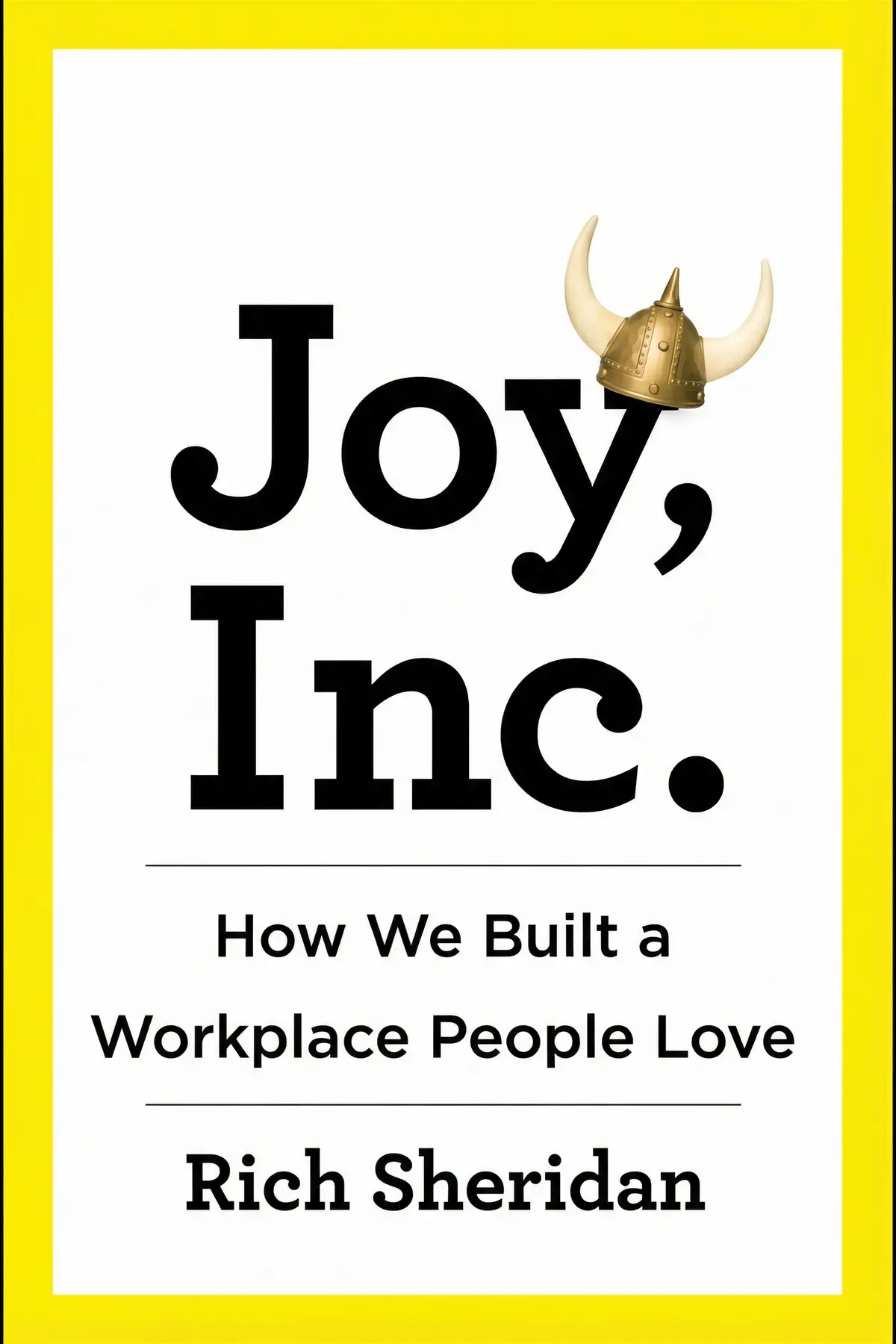
Table of Content
1. Introduction
1 min 34 sec
Most of us have been conditioned to believe that work is meant to be a grind. We associate the professional world with sterile gray cubicles, endless email threads, and the quiet desperation of waiting for the weekend. But what if the secret to building a world-class company wasn’t found in more complex software or stricter management protocols, but in the simple, human emotion of joy? This is the central throughline of our exploration today.
Rich Sheridan, the leader of Menlo Innovations, decided to challenge the traditional corporate narrative. He realized that when people are miserable, they are rarely creative or efficient. Conversely, when people feel a sense of belonging and purpose, they achieve things that seem impossible. This summary isn’t just about making employees smile; it’s about how to use joy as a rigorous business strategy to unleash the full potential of a team.
Throughout this journey, we will look at how the physical environment affects our psychology, why the way we communicate can either build or destroy trust, and how rituals can turn a group of strangers into a tight-knit family. We’ll see how a software company found success by letting parents bring their babies to the office and why they chose to trade high-tech tools for paper and markers. By the end, you’ll see that joy is not just a luxury—it is the foundation of a sustainable, innovative, and highly profitable business. Let’s dive into the mechanics of building a company that people actually love.
2. The Strategic Power of Joy
2 min 00 sec
Discover why the pursuit of a higher purpose creates more sustainable success than the pursuit of fame, and how joy acts as a vital motivator.
3. Designing for Flexibility and Flow
1 min 49 sec
Learn how the physical layout of an office can break down mental barriers and stimulate the creative spark through movement and openness.
4. The Vitality of Direct Communication
1 min 47 sec
Explore why ‘high-speed voice technology’—the act of simply talking to one another—outperforms digital communication in building strong teams.
5. Cultivating Joy through Rituals and Artifacts
1 min 56 sec
See how unique traditions, from Viking helmets to communal walks, turn abstract values into a tangible and shared company culture.
6. Hiring for the Kindergarten Skill Set
1 min 47 sec
Find out why personal traits and the ability to play well with others are far more valuable to a joyful company than raw technical genius.
7. The Freedom to Fail and the Safety to Try
1 min 58 sec
Understand how psychological safety and ‘failing fast’ allow for radical innovation, including the unique practice of bringing babies to work.
8. Conclusion
1 min 36 sec
As we wrap up our look at the Menlo Innovations story, it becomes clear that joy is not a soft sentiment, but a hard-edged business discipline. By focusing on people over processes, Sheridan has demonstrated that a company can be both highly efficient and deeply human. We’ve seen how an open, flexible office design stimulates the mind, and how rituals like the Viking helmet and afternoon ‘walkies’ turn a workspace into a community. We’ve explored the importance of hiring for character over credentials and the necessity of creating a safe harbor for experimentation and failure.
The ultimate takeaway is that if you want to change the output of your company, you must first change the environment in which your people operate. Tearing down the physical walls in an office is often the first step toward tearing down the mental walls that block innovation. When you prioritize the well-being and connection of your team, you create a self-sustaining engine of productivity.
So, as you step back into your own professional world, ask yourself: Where can I inject a bit more transparency? How can I make my colleagues feel safer to take a risk today? You don’t need a multi-million dollar budget to start building your own ‘Joy Inc.’ You just need the courage to prioritize human connection and the willingness to let your team play. Because in the end, a joyful workplace isn’t just a place where people are happy—it’s a place where the best work of their lives actually happens.
About this book
What is this book about?
Have you ever wondered if a workplace could actually be a source of genuine happiness? Joy Inc. explores the radical transformation of corporate culture through the lens of Menlo Innovations, a software company that decided to put people first. Author Rich Sheridan argues that joy isn't a fluffy byproduct of success, but rather the essential engine that drives it. By stripping away the traditional barriers of cubicles, silent emails, and hierarchical fear, Sheridan reveals a blueprint for a business model where collaboration and human connection are the primary goals. The book promises to show leaders and employees alike that high productivity and deep satisfaction are not mutually exclusive. Through unconventional practices—like pairing employees at single computers, inviting babies into the office, and using Viking helmets in meetings—Sheridan demonstrates how to build an environment where experimentation is encouraged and failure is seen as a learning tool. This is a guide to moving past the grind of modern corporate life toward a professional existence defined by shared purpose, clear communication, and collective achievement.
Book Information
About the Author
Rich Sheridan
Rich Sheridan is the CEO of Menlo Innovations, a software design and development firm located in Ann Arbor, Michigan. Known for his unique approach to leadership and culture, Sheridan has become a prominent voice in the movement to humanize the tech industry and create joyful work environments.
Ratings & Reviews
Ratings at a glance

What people think
Listeners find this to be a wonderful work that brings happiness to the office and is filled with real-world applications. They value the motivating material, as one listener points out that it triggers meaningful discussions inside their organization. The book is praised for being imaginative within an inventive setting, while one listener highlights how it encourages original thinking. Listeners prize its new outlook on employment, with one characterizing it as a total transformation of their professional surroundings.
Top reviews
Mint
Finally got around to reading Joy Inc., and it feels like a total overhaul of everything I thought I knew about professional culture. Sheridan provides a blueprint for an environment where human dignity isn't just a buzzword but the actual engine of production. I loved the practical stories about 'High-Speed Voice Technology'—which is really just talking to each other—and the radical idea of bringing infants into the office to support parents. It is a bit idealistic, and I do wonder if these methods truly scale to massive, global corporations, but the inspiration alone is worth the price of admission. My leadership team has already started implementing the 'visual management' boards he describes to track our progress. It has sparked some genuinely deep conversations about why we do what we do every day. Fantastic read!
Show moreGift
The chapter on ethnographic research and 'High-Tech Anthropologists' was a total game-changer for my perspective on product design. Sheridan doesn't just talk about being happy; he talks about building things that actually matter to the people who use them. This isn't just another dry management manual; it's a creative manifesto for building a workplace that people actually want to show up to. Not gonna lie, the idea of no more 'emergency' weekend emails sounds like a dream I’m ready to wake up in. It’s packed with innovation-driving tactics that any manager could adapt, regardless of their industry. I’ve already bought copies for my entire executive board to read because it prompts such deep internal reflection.
Show moreMattanee
Wow. This book is a complete overhaul of the traditional corporate mindset. I finished it in two sittings and immediately started rethinking our entire onboarding process. The concept of 'joy' as a business result is so simple, yet so revolutionary when you see how Sheridan implements it through pairing and open communication. It’s not just about beanbags and free snacks; it’s about the fundamental way human beings interact with their labor and each other. Personally, I found the stories about parents bringing their kids to work moving, even if it seems impractical for my specific office. It’s a fantastic, heart-centered approach to business that we desperately need more of in today's cutthroat world.
Show moreEleni
Truth is, I was skeptical that a book with 'Joy' in the title would have any real substance, but I was pleasantly surprised. This is a practical, step-by-step look at how to build a culture of discipline and delight. Sheridan’s writing style is accessible and engaging, making complex project management concepts feel like common sense. I was particularly impressed by the 'Pairing' system—not just for coding, but for cross-training and eliminating the risk of one person holding all the knowledge. It’s an inspirational read that prompts deep reflection on what we should expect from our employers. It’s easily one of the most creative business books I’ve read in years, delivering a fresh perspective on what 'work' can be.
Show moreBun
As a software engineer who has dealt with my fair share of burnout, this was a breath of fresh air. The focus on pair programming and eliminating the 'fear of failure' resonates deeply with anyone who has ever stared at a bug for eight hours alone. To be fair, some of the rigid structure feels a bit like an assembly line, which the author even admits to by using the factory metaphor. That might rub some 'rockstar' developers the wrong way because they lose that sense of individual ownership. I also wish there was more about how this works in a post-pandemic, remote-first world since Sheridan is quite anti-WFH. Regardless, the creativity it fosters is undeniable and the book is packed with practical examples for team building.
Show moreUbolrat
Ever wonder if there’s a way to work that doesn’t leave you feeling hollow by Friday afternoon? Joy Inc. argues that intentional culture is the answer, and Sheridan backs it up with tons of tactical examples from his own firm. I was particularly struck by the 'Show and Tell' sessions which seem to bridge the gap between developers and clients perfectly. Look, I’m not sure I’m ready to sit next to the CEO every day or share a computer with a partner, but the spirit of the book is infectious. It challenges the 'hero' culture that plagues tech and replaces it with collaborative innovation. A few parts felt a little repetitive, but the core message is vital for any growing business.
Show moreRin
After hearing Rich speak at a conference, I had to dive into the full story of Menlo Innovations. The book is an excellent deep-dive into how they use physical space and social contracts to eliminate the silos that usually kill productivity. I love the focus on 'making mistakes early' to keep costs down and morale high. My only real gripe is that it feels a bit dated regarding remote work; the author is very insistent that you have to be in the same room to be effective. In today’s world, that’s a tough pill to swallow for many top-tier talents. However, the principles of accountability and empathy are still incredibly relevant and worth studying for any leader.
Show moreLuckana
Picked this up because our company is going through a massive transition and we needed a fresh perspective on team structure. While I don't think we can replicate the Menlo model exactly—the noise levels alone would be a huge adjustment for us—there are so many 'nuggets' of wisdom here. The way they handle 'estimating' work using physical cards is a brilliant way to make abstract concepts tangible for clients. It’s an analytical look at how human psychology drives production. I did find the author's tone a bit self-congratulatory at times, but the results he’s achieved are hard to argue with. Definitely a must-read for anyone interested in Agile or lean management.
Show moreRodrigo
To be fair, Sheridan has clearly built something unique at Menlo, but I struggled with how applicable this is outside of a small software shop. The 'factory' metaphor he uses is quite telling—he values process and predictability over individual autonomy. While the book is full of joy-focused rhetoric, the actual day-to-day sounds incredibly noisy and socially draining for many personality types. I appreciate the transparency about their experiments, but the lack of discussion on cultural diversity made the team feel a bit monolithic. It’s a decent read for the 'Agile' crowd, but take the universal claims with a grain of salt. It is hard to see this working in healthcare or manufacturing without a massive rethink.
Show moreSomporn
Not what I expected at all. In my experience, a workplace that claims to be a 'joyful factory' is usually anything but. The book reads more like a massive PR brochure for Menlo Innovations rather than a balanced guide on leadership or transformation. While the concept of joy is great, the implementation sounds like a total nightmare for anyone who needs a quiet space to concentrate. Imagine trying to code while your coworker’s baby is crying or while someone is constantly talking over your shoulder in a forced pair. Sheridan seems a bit too enamored with his own systems to acknowledge that this 'nirvana' might be hell for introverts. It’s an interesting experiment, but the 'one right way' attitude feels very out of touch with modern professional needs.
Show moreFeatured in
Readers also enjoyed

7 Powers: The Foundations of Business Strategy
Hamilton Helmer

A Bigger Prize: How We Can Do Better Than the Competition
Margaret Heffernan


A Year with Peter Drucker: 52 Weeks of Coaching for Leadership Effectiveness
Joseph A. Maciariello
AUDIO SUMMARY AVAILABLE
Listen to Joy Inc. in 15 minutes
Get the key ideas from Joy Inc. by Rich Sheridan, plus 5,000+ more titles in English and Thai.
- 5,000+ titles
- Listen as much as you want
- 7-day free trial
- Cancel anytime







