
59 Seconds: Change Your Life in Under a Minute
Richard Wiseman
Discover how the Japanese philosophy of Kaizen can transform your life through tiny, manageable changes. Learn to bypass the fear of failure and build lasting habits using the power of incremental improvement.
1 min 44 sec
Every year, millions of people embark on a familiar journey. We ring in the New Year with bold declarations and grand resolutions. We promise to overhaul our diets, master a new language, or finally get our finances in order. But by the time mid-January rolls around, many of those grand plans have already begun to gather dust. Why is it so difficult to make change stick? The answer often lies in the scale of our ambitions. We try to take a massive leap into the unknown, and the sheer magnitude of the change triggers a natural, subconscious resistance. It feels too big, too scary, and eventually, too exhausting.
There is, however, a different way to approach transformation—one that doesn’t involve radical shifts or immense willpower. This is the philosophy of Kaizen. Rooted in Japanese culture and business history, Kaizen is the art of continuous, incremental improvement. It suggests that if we want to change our lives, we shouldn’t aim for a hundred-percent overhaul in a single day. Instead, we should look for ways to improve by just one percent. These tiny, almost invisible shifts might seem insignificant in the moment, but over time, they accumulate into something truly profound.
In this summary, we are going to explore how you can take these principles of small-scale change and apply them to every facet of your daily routine. We will look at how high-performance teams use these methods to dominate their fields and how you can use them to reclaim your time, energy, and focus. The throughline here is simple: by reducing the friction of change and lowering the stakes of every individual action, you can build a life of constant growth without the fear of falling off the wagon. Let’s dive into the world of Kaizen and see how the smallest steps can lead to the biggest destinations.
2 min 26 sec
Explore how a post-war business strategy became a global phenomenon for personal success by focusing on long-term sustainability over instant, flashy results.
2 min 15 sec
Learn why your brain resists new habits and how to perform a life inventory to identify exactly where your current routines need a gentle adjustment.
2 min 17 sec
Discover the ‘contagious enthusiasm’ generated by making changes so small they feel effortless, yet lead to world-class results over time.
2 min 15 sec
Break your grandest visions into short, medium, and long-term milestones, ensuring you always have a clear path forward without feeling overwhelmed.
2 min 11 sec
Utilize traditional Japanese journaling techniques and modern tools to visualize your growth and maintain accountability through honest self-reflection.
2 min 08 sec
Recognize that habit formation is a unique journey for everyone, requiring patience and the grace to start small again whenever life gets in the way.
1 min 59 sec
As we wrap up our exploration of Kaizen, it’s worth reflecting on the core shift in perspective this philosophy offers. Most self-help systems ask you to find more willpower, more discipline, and more intensity. Kaizen asks for something different: more awareness and more patience. It suggests that the path to a better life isn’t paved with heroic, one-time efforts, but with the quiet accumulation of tiny victories. By choosing the path of incremental growth, you are choosing a path that respects your psychology and your reality. You are acknowledging that while big changes are scary, small steps are manageable. And as those small steps pile up, they create a momentum that eventually becomes unstoppable.
Think about the throughline we’ve discussed: analyzing your current state, setting the bar low to bypass resistance, structuring your goals, tracking your progress with mindfulness, and staying flexible when life gets messy. This isn’t just a strategy for efficiency; it’s a strategy for long-term happiness and resilience. You are building a version of yourself that is constantly evolving, one percent at a time.
If you’re ready to start your own Kaizen journey today, here is a simple, actionable place to begin: look at your physical environment. Many of us feel overwhelmed by clutter in our homes or workspaces. Instead of planning a massive weekend-long cleaning marathon that will leave you exhausted, try the Kaizen approach. Choose one single drawer, one shelf, or even just one digital folder on your computer. Commit to spending just five minutes tidying it up once a week. That’s it. It’s so small you can’t possibly fail. Once that one spot is clear, you’ll likely find that the sense of accomplishment—that ‘contagious enthusiasm’—makes you want to tackle the next one. This is the magic of Kaizen. One small step, then another, until your entire world has been transformed.
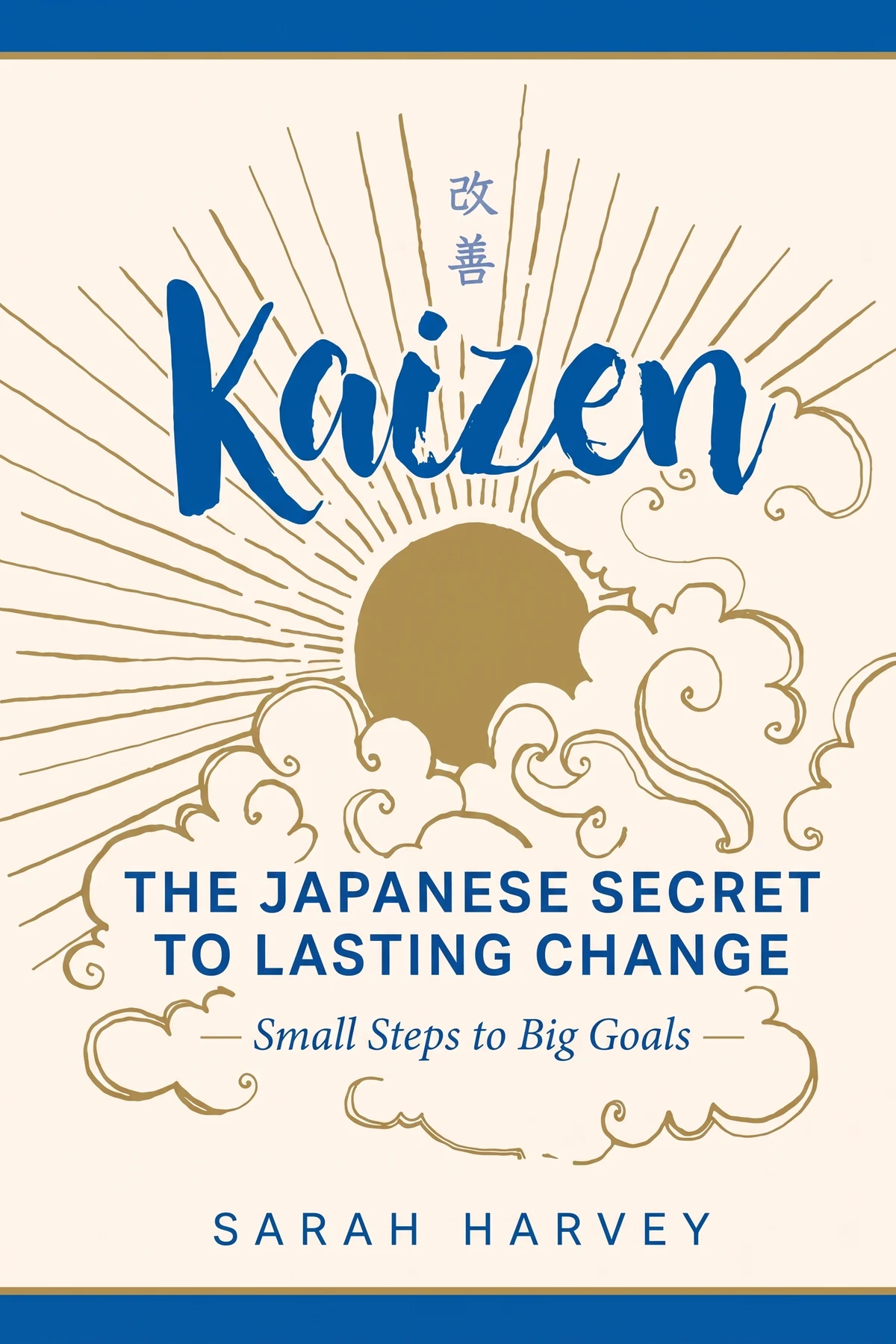
Kaizen offers a refreshing departure from the high-pressure world of 'overnight transformations' and 'life hacks.' Instead, it introduces a time-tested Japanese method centered on continuous, small-scale growth. Originally designed to streamline manufacturing and business efficiency, Sarah Harvey demonstrates how these same principles can be applied to our personal lives, from improving our health and finances to revitalizing our careers and relationships. The book provides a roadmap for anyone who has ever felt overwhelmed by the prospect of change. By focusing on one-percent gains rather than massive leaps, Kaizen promises a sustainable path toward your goals. You will learn how to audit your current lifestyle, set realistic benchmarks, and use simple tracking methods to maintain momentum. It is an essential guide for those looking to build resilience and achieve excellence without the burnout that often accompanies traditional self-improvement methods.
Sarah Harvey is a writer and publishing professional. Her journey with the philosophy of continuous improvement began while she was living in Tokyo, working as a publishing consultant. It was there that she was first introduced to the concepts of Kaizen and witnessed their impact firsthand. Currently residing in London, she works for a literary agency. Kaizen: The Japanese Method for Transforming Habits, One Small Step at a Time marks her debut as an author.
Listeners find that perspectives vary on whether this work provides enough fresh material for those already knowledgeable about habit-forming books, yet many value the author’s kind and compassionate style of self-improvement. They also appreciate the useful advice for implementing gradual changes across several life areas, including wellness, money, and home management. Additionally, listeners enjoy the historical background shared regarding the Kaizen philosophy and its Japanese cultural origins. They also highlight the book’s supportive voice, with one listener noting that the tiny, "miniscule steps" help the journey feel especially achievable and relaxed.
Ever wonder why big changes never seem to stick? Harvey's take on the Japanese philosophy of continuous improvement is exactly the antidote I needed for my burnout. Instead of demanding massive overhauls, the book advocates for tiny, almost invisible 1% shifts that build momentum over time. I particularly loved the sections on 'sunshine files' and the gentle way she suggests managing social media habits. The history of how Toyota utilized these principles was fascinating, giving the advice some serious weight beyond just another 'self-care' guide. While some might find the tips simple, the empathy in her writing makes it feel achievable rather than a chore. It’s a gorgeous, soothing read that now lives on my nightstand for whenever I feel overwhelmed by life's demands. It really helped me reframe my morning routine without the typical guilt.
Show moreThe chapter on work-life balance for freelancers was worth the price of the book alone. Sarah Harvey captures the essence of Kaizen beautifully, translating a corporate concept into a deeply personal and spiritual practice. I loved the emphasis on 'forest bathing' and connecting with nature as part of the improvement process. The photography and layout are stunning, making it a very tactile and calming experience to flip through. Unlike other productivity gurus who focus on 'crushing it,' Harvey focuses on 'sustaining it.' It’s the first time I’ve felt like I could actually stick to a system because it allows for human error and slow progress. Truly a gem for anyone seeking a more mindful way to exist in our fast-paced world. Small plates and mindful eating have already changed my relationship with lunch breaks!
Show moreThis book is like a warm hug for your productivity. After reading James Clear’s Atomic Habits, I wanted something with a bit more of a cultural and aesthetic focus, and this delivered. Harvey’s tone is gentle, empathetic, and entirely devoid of the 'drill sergeant' vibe found in most business books. I’ve implemented the '24-hour rule' for shopping and the morning routine tips, and the difference in my stress levels is night and day. The way she links the history of Japanese reconstruction to personal growth is both clever and inspiring. It’s a beautiful reminder that we are all works in progress. I’ve already bought two more copies to give as gifts to friends who are feeling burnt out. The focus on fulfilling relationships as the foundation for success really hit home for me.
Show moreFinally, a productivity book that doesn't make me feel like a failure for not waking up at 5 AM every day. Harvey’s approach is refreshing because it’s rooted in kindness and the reality of a messy life. The concept of 'brain dumping' to clear mental clutter has already helped my work-from-home anxiety significantly. I also enjoyed the 'non-essential' shopping checklist—waiting 24 hours before a purchase is a simple trick, but it works. My only gripe is that some chapters feel a bit more developed than others; the section on health felt a little biased by the author's own negative experiences with sport. Still, for anyone who finds typical 'hustle culture' books aggressive, this gentle guide to incremental growth is a breath of fresh air. It’s practical, pretty, and very easy to digest over a weekend.
Show moreAs someone who struggles with 'all or nothing' thinking, this book provided a much-needed perspective shift. The idea that you can improve your life through 'miniscule steps' that don't cause stress is revolutionary if you’re used to failing at New Year's resolutions. I’ve already started applying the 1% rule to my kitchen organization and it’s surprisingly effective. The author's personal journey living in Japan adds a nice layer of authenticity to the text. I did notice the slight edge whenever she discussed gym culture, which felt a bit unnecessary, but I ignored it for the sake of the better tips. It’s a very practical manual for anyone looking to declutter their mind and their home without the pressure of a total lifestyle overhaul. The tips on digital detoxing using the Forest app were particularly helpful.
Show moreStarting a new habit is usually terrifying for me, but this book made the process feel entirely manageable. Harvey explains how to break down massive goals into tiny, digestible tasks that bypass our brain's natural fear of change. I particularly liked the section on 'intentional eating' and the advice to focus on the first three mouthfuls of a meal. It’s these little nuggets of wisdom that make the book stand out from the crowded shelf of habit literature. While some of the advice is definitely repetitive if you’ve been in the self-improvement space for a while, the Japanese cultural context kept me engaged. The section on managing money through small, mindful tweaks was also surprisingly grounded and useful. A very solid, comforting read that encourages you to be your own best friend rather than your own boss.
Show moreAfter hearing so much buzz about this 'magic' Japanese method, I finally got around to reading Harvey’s interpretation. To be fair, the book is beautifully presented and the writing is incredibly accessible, almost like a cozy chat with a friend. I appreciated the breakdown of the history and the way she explains the word’s etymology. However, I struggled with how much of it felt like 'common sense' repackaged with a fancy name. Do I really need a book to tell me that cleaning my room or eating mindfully will make me feel better? The sections on money management and relationships were sweet but lacked the rigor I was hoping for. It’s a lovely gift book for someone starting their wellness journey, but seasoned self-help readers might find it a bit too elementary. It's more of a gentle reminder than a roadmap.
Show morePicked this up on a whim because the cover was so inviting and I've always been a bit of a Japanophile. The truth is, the book is a bit of a mixed bag. On one hand, the historical background of Kaizen transitioning from US-led industrial training to a cornerstone of Japanese culture was genuinely enlightening. On the other hand, the practical advice often veers into the overly simplistic, like the suggestion to drink water every time you use the bathroom. I enjoyed the colloquial tone for the most part, but it did feel a bit 'lifestyle blog' at times. It’s a quick, breezy read that serves as a nice reminder to slow down, though it probably won’t change your life if you’re already disciplined. It’s nice to have on the shelf, but don't expect a masterclass in behavioral psychology.
Show moreLook, I really wanted to love this, especially since my office uses Kaizen for lean management, but it felt remarkably thin. The author spends a lot of time on personal anecdotes that felt slightly misplaced; there’s a recurring tone of resentment regarding fitness and personal trainers that I found distracting. If you’ve read James Clear or any major habit-building literature, you’ve heard 90% of this before. Drink more water, go for a walk, sleep more—these aren't exactly revolutionary insights for a grown adult. While the cultural context regarding Japan was interesting, it didn't save the book from feeling like a collection of blog posts. It’s probably fine for a complete beginner to self-help, but for anyone looking for deep psychological or organizational systems, this isn't it. I felt the colloquial tone undermined the actual philosophy.
Show moreFrankly, I found this entire book to be an exercise in stating the obvious. The author’s writing style is quite colloquial, but it often tips over into sounding unprofessional and strangely bitter about her past. The frequent jabs at gyms and physical activity were particularly off-putting for me. I was expecting a deep dive into the methodology used by giants like Toyota, but instead, I got a series of basic life tips like 'wear comfortable shoes' and 'tidy your desk.' It felt like a collection of Instagram captions expanded into a book. If you want to learn about the actual philosophy and mechanics of Kaizen, look elsewhere. This is self-help for people who don't actually want to do the hard work of change. I was disappointed by the lack of original research or novel applications.
Show moreRichard Wiseman
William B. Irvine
Andrew D. Thompson
Deepak Chopra
AUDIO SUMMARY AVAILABLE
Get the key ideas from Kaizen by Sarah Harvey, plus 5,000+ more titles in English and Thai.







