
21 min 52 sec
Madness in Civilization: A Cultural History of Insanity, from the Bible to Freud, from the Madhouse to Modern Medicine
By Andrew Scull
Explore the complex cultural history of mental illness in Western civilization. This summary traces the evolving definitions of madness from ancient divine punishments to the rise and fall of the modern asylum system.
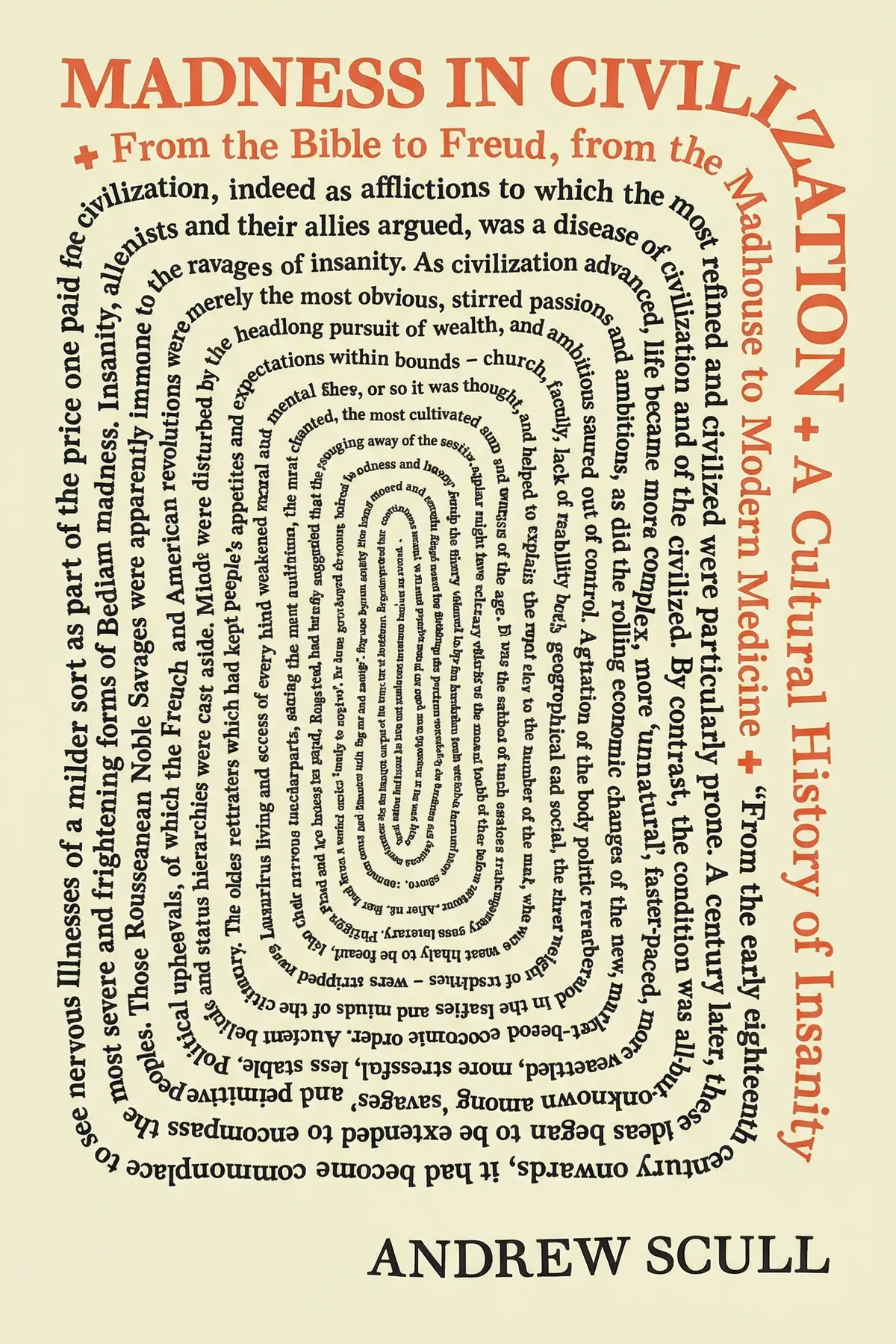
Table of Content
1. Introduction
2 min 01 sec
When we look at our cultural history, the figure of the ‘madman’ is everywhere. We see it in the tragic decline of Shakespeare’s King Lear, the obsessive drive of Captain Nemo in the works of Jules Verne, and even in the ancient stories of kings and prophets found in the Bible. But beyond these artistic portrayals lies a much darker, more complicated reality: the actual lives of people who lived with mental illness throughout history.
We often like to believe that human history is a straight line moving from ignorance toward enlightenment. We assume that as time passes, we naturally become more compassionate and more scientifically accurate in our treatments. However, as we will explore in the following pages, the history of madness is far from a simple progression. It is a story of radical shifts, where old ideas are discarded only to reappear later in different forms, and where breakthroughs in science often went hand-in-hand with horrific institutional abuse.
In this journey through the past, we will investigate how different eras answered the most fundamental questions of mental health: Is madness caused by the gods, or is it a failure of the body? Is it a spiritual crisis, or a social inconvenience? We will look at how the ancient Greeks attempted to cure the mind through diet, how the infamous ‘Bedlam’ hospital became a symbol of chaos, and how the massive trauma of World War I forced the medical establishment to rethink everything they thought they knew about human resilience.
This isn’t just a history of medicine; it is a history of what it means to be human and what happens when society decides that certain people no longer fit the definition of ‘rational.’ By the end of this summary, you will have a new perspective on the modern mental health landscape, seeing it not as a finished product, but as the latest chapter in a long, often disturbing throughline of human civilization. Let’s begin by looking at the very first attempts to explain why the human mind sometimes breaks.
2. Ancient Interpretations of Madness
2 min 12 sec
Ancient civilizations struggled to decide if mental disturbances were a curse from the heavens or a physical malfunction, leading to vastly different treatments and social statuses.
3. The Bridge of Arabic Medical Wisdom
1 min 57 sec
While much of classical medical knowledge was lost during the fall of empires, Arabic scholars preserved and expanded upon these ideas, creating a vital link to the modern age.
4. The Enlightenment and the Witch Hunt Paradox
2 min 15 sec
The dawn of rationalism in Europe did not immediately lead to better treatment; instead, it coexisted with a period of mass hysteria and violent persecution.
5. Life on the Margins and the Failure of Charity
1 min 59 sec
For the vast majority of human history, the mentally ill were not institutionalized but were instead forced to survive as outcasts on the fringes of society.
6. The Commercialization of the Madhouse
1 min 52 sec
The shift from street vagrancy to institutionalization was driven as much by the desire for profit and social hygiene as it was by a desire to help.
7. The Rise and Fall of Moral Treatment
2 min 00 sec
A brief, optimistic period in the late 18th century suggested that kindness and routine could cure madness, but this ideal eventually collapsed under the weight of overcrowding.
8. From 'Madness' to 'Mental Illnesses'
1 min 55 sec
As medical science advanced, the monolithic concept of ‘madness’ began to break apart into distinct clinical diagnoses with specific biological causes.
9. Freud, Shell Shock, and the Trauma Revolution
1 min 59 sec
The discovery of the subconscious and the massive trauma of industrial warfare changed the focus of treatment from the brain’s physical structure to its hidden memories.
10. The End of the Asylum and the Modern Crisis
1 min 52 sec
The closure of large institutions was a victory for human rights, but it created new challenges as society struggles to support those who fall through the cracks.
11. Conclusion
1 min 50 sec
As we reach the end of this historical survey, one thing becomes strikingly clear: madness is not a static medical fact, but a mirror that reflects the values, fears, and prejudices of every era. We have seen the ‘mad’ transformed from divinely touched prophets to demon-possessed witches, from physical specimens with unbalanced humors to ‘undesirables’ hidden away for profit, and finally to patients with chemical imbalances in need of clinical care.
While we can certainly be proud of the scientific advances that have allowed us to move away from chains and exorcisms, we must also remain humble. History shows us that every generation believes they have finally ‘solved’ the mystery of the mind, only for the next generation to look back in horror at their methods. The closing of the massive asylums in the 20th century was a necessary step for human rights, yet the current reality of the mentally ill in our prisons and on our streets suggests that we are still failing to provide a truly compassionate and integrated solution.
The throughline of Andrew Scull’s work is that madness is an inextricable part of the human condition. It is not something that can be ‘cleansed’ from civilization. Instead, it is something that civilization must learn to live with, understand, and support. The way we treat those in mental distress is perhaps the ultimate test of how ‘civilized’ we actually are.
As you move forward, consider the ‘madness’ you see in the world today—not as a fringe problem for doctors to solve in private, but as a central part of our shared human story. By understanding the mistakes and the rare moments of insight from our past, we can hopefully build a future that offers more than just containment, but real belonging and dignity for every mind, no matter how troubled it may be.
About this book
What is this book about?
What does it mean to lose one’s mind, and how has that definition changed across the centuries? This summary of Andrew Scull’s work provides a sweeping historical analysis of how Western society has perceived, treated, and often marginalized the mentally ill. It moves through the ancient world, where madness was seen as both a divine gift and a bodily imbalance, into the Middle Ages and the Enlightenment, where religious superstition and emerging rationalism often clashed with tragic results. You will learn about the dark history of institutions like Bedlam, the brief hope of the moral treatment movement, and the eventual rise of the pharmaceutical and psychoanalytic eras. By examining the roles of art, religion, and science, the narrative reveals that our understanding of mental health is not a straight line of progress, but a shifting reflection of cultural values. The promise of this exploration is a deeper understanding of the societal structures that continue to shape the lives of those suffering from mental distress today.
Book Information
About the Author
Andrew Scull
Andrew Scull is a distinguished British sociologist known for his deep expertise in the history of medicine and psychiatry. He currently holds the position of Professor of Sociology and Science Studies at the University of California, San Diego. Beyond his academic contributions, he is the author of several influential works, including Madhouse: A Tragic Tale of Megalomania and Modern Medicine. His career has been dedicated to uncovering the social and institutional frameworks that define human madness.
Ratings & Reviews
Ratings at a glance
What people think
Listeners find the text to be an excellent academic resource, with one listener calling it a masterpiece of scholarly synthesis. They also value how readable the material is.
Top reviews
Gioia
Andrew Scull has crafted what feels like the definitive monograph on the societal perception of mental illness throughout history. The level of scholarly synthesis here is staggering, managing to pull together threads from ancient philosophy, religious fervor, and modern neuroscience. Truth be told, it’s a heavy read that demands your full attention, but the payoff for anyone interested in sociology or medical history is immense. He doesn't shy away from the darker corners of our past, detailing the horrific treatments that were once considered cutting-edge. It serves as a sobering reminder of how civilization often treats those it cannot easily categorize or control. Every chapter feels like a deep dive into a different layer of the human psyche.
Show moreKru
Few books manage to be this informative while simultaneously making your skin crawl with descriptions of historical 'cures.' I was particularly haunted by the chapters on Henry Cotton and the brutal era of lobotomies, which Scull recounts with a necessary, chilling detachment. This isn't just a history of doctors; it’s a history of the suffering and alienation experienced by the victims of 'progress.' The author’s pessimistic tone feels earned given the cyclical nature of how we treat the mentally ill, moving from chains to chemicals without ever truly solving the underlying social issues. It is a brilliant, if disturbing, piece of work that everyone should read to understand our current psychiatric landscape.
Show moreWilliam
Finally got around to reading this for my history of science seminar, and it lived up to the hype as an essential resource. Scull provides an incredible overview of how society handles those it cannot integrate, using 'madness' as a litmus test for civilization itself. The chapters on the transition to the 'medical model' are particularly strong, showing how authority was established over the minds of the vulnerable. Frankly, the illustrations alone are worth the price of admission, providing a visual history that is just as compelling as the text. It’s an ambitious project that succeeds in making complex sociological theories accessible to those willing to do the work.
Show morePraepimon
The way this volume weaves fine art and literature into the grim reality of the asylum is genuinely striking and unique. Scull demonstrates that madness isn’t just a biological fluke but a cultural mirror that reflects the anxieties of the time. While I appreciated the inclusion of numerous illustrations, I found the author’s prose to be a bit dry and overly didactic at times. It reads more like a textbook than a narrative history, which might put off casual readers looking for a light non-fiction pick. Still, the analysis of how Victorian society viewed the 'spleen' compared to modern psychiatric diagnoses is incredibly sharp. It’s a dense, rewarding study for those willing to put in the effort.
Show moreLuke
As someone who works in the mental health field, seeing the trajectory from demonic possession to the 'pharmaceutical revolution' was eye-opening. Scull does an excellent job of showing that our current reliance on pills isn't necessarily the 'happy end' many believe it to be. He critiques the way psychiatry has traded conversation for chemistry, often ignoring the person in favor of the symptom. The book is beautifully produced with context-rich illustrations that bring the historical descriptions to life. My only real gripe is that the ending felt a bit abrupt, leaving me wanting more of his perspective on future alternatives. It's a solid, four-star resource for anyone serious about the topic.
Show moreSom
Don’t go into this expecting a triumphant story of medical progress or a happy ending for the human spirit. Scull’s perspective is relentlessly bleak, viewing the history of psychiatry as a series of failed experiments and societal exclusions. He highlights how we’ve moved from burning 'witches' to locking people in Bosch-like hellholes, and finally to our modern era of medicated isolation. The writing style is sophisticated and requires a high level of literacy, which makes it feel like a true academic monograph. Personally, I found the section on Freud to be the most balanced part of the book, acknowledging his flaws while recognizing his revolutionary communicative approach. It’s a somber but necessary exploration.
Show morePacharapol
Scull provides a sweeping, panoramic view of how we define the boundaries of sanity across different eras. I was impressed by how he links the rise of the 'bolondház' to broader economic shifts and the need for a productive workforce. It’s fascinating to see how 'laziness' was often conflated with mental defect in the eyes of the early modern state. While the book is quite Euro-centric, as other reviewers have noted, it remains a powerful critique of Western institutional power. The author’s disdain for the sarlatans of the past—and some of the present—is palpable and adds a bit of bite to the academic tone. A very strong four stars.
Show moreTawee
It took me nearly two months to wade through this because of the sheer density of the information presented. Scull is clearly an expert, but he tends to get bogged down in minute details that occasionally stall the book's momentum. Look, if you need a resource for academic research, this is probably the gold standard of scholarly synthesis in the field. But for a general reader, the structure can feel a bit repetitive as it moves through various historical stages of institutionalization. I found myself skimming some of the more technical passages about 19th-century frenology just to get to the more engaging social commentary. Interesting, certainly, but also quite exhausting.
Show moreManee
Is it a masterpiece of synthesis? Yes, but it feels strangely detached from the personal or spiritual experience of madness. Scull treats 'the insane' as objects of study or victims of policy rather than individuals with their own internal narratives. He deals with religious beliefs only as historical curiosities rather than as living frameworks that people still use to interpret their mental states today. The prose is elegant but cold, lacking the emotional resonance I was hoping for in a book about such a deeply human subject. I walked away with a lot of facts but very little feeling for the people behind the diagnoses.
Show moreSophia
While the research is undoubtedly deep, I found the scope incredibly frustrating due to its overwhelming focus on Western, white history. The title suggests a global exploration of 'Civilization,' yet the experiences of BIPOC communities and non-Western cultures are almost entirely sidelined or ignored. It feels like a massive oversight to discuss the history of mental health without acknowledging how diverse cultures outside the Euro-American bubble have managed insanity. To be fair, the sections on the 17th-century 'bolondházak' and the rise of the medical model are well-written. However, the lack of representation makes the book feel like an incomplete puzzle rather than the comprehensive history it claims to be.
Show moreReaders also enjoyed

A Splendid Exchange: How Trade Shaped the World
William J. Bernstein
Alcoholics Anonymous
Alcoholics Anonymous World Services

A Spy Among Friends: Philby and the Great Betrayal
Ben Macintyre



1491: New Revelations of the Americas Before Columbus
Charles C. Mann

A Year in the Life of William Shakespeare: 1599
James Shapiro
AUDIO SUMMARY AVAILABLE
Listen to Madness in Civilization in 15 minutes
Get the key ideas from Madness in Civilization by Andrew Scull, plus 5,000+ more titles in English and Thai.
- 5,000+ titles
- Listen as much as you want
- 7-day free trial
- Cancel anytime







