

A Bigger Prize: How We Can Do Better Than the Competition
Margaret Heffernan
Learn how Navy SEALs navigate high-stakes chaos. This summary explores the specific attributes, stress-regulation techniques, and leadership shifts required to turn unpredictable pressure into a foundation for consistent, elite performance.
1 min 41 sec
Think back to the most stressful moment you’ve ever faced. Perhaps it was a sudden career shift, a financial emergency, or a personal crisis that felt like the world was shifting beneath your feet. In those moments, our first instinct is often to scramble for control. We want to plan our way out of the mess. But as any high-level operator will tell you, the plan is often the first thing to disappear when the pressure mounts. This is the reality that the US Navy SEALs live every day.
Consider the 2011 mission to capture or kill Osama bin Laden. It was one of the most meticulously planned operations in military history. Every variable was considered, every movement rehearsed. Yet, the moment the team arrived, a helicopter crashed. In an instant, the plan was useless. The success of that mission didn’t come from sticking to a script; it came from the team’s ability to master uncertainty as it unfolded. They didn’t panic; they adapted. They didn’t freeze; they executed.
In this exploration of the strategies used by these elite performers, we are going to look at how you can transform your relationship with the unknown. We’ll move beyond the idea of just surviving stress and look at how to use it as a fuel for success. Whether you are leading a massive corporation or just trying to navigate the complexities of your own life, the principles of composure, focus, and adaptability are universal. We’ll see how the SEALs manage their biology, their goals, and their teams to ensure that even when the helicopter crashes, the mission succeeds. The throughline of this journey is simple: you cannot control the world, but you can absolute master your response to it. Let’s dive into how that happens.
2 min 15 sec
Discover why the secret to overcoming massive obstacles lies in your brain’s chemical response to tiny victories. We explore how breaking down a goal creates the necessary momentum to survive.
2 min 13 sec
Your nervous system doesn’t have to hijack you. Learn the biological hacks—from panoramic vision to strategic breathing—that let you override stress and think clearly when it matters most.
1 min 56 sec
Your resume won’t save you when everything falls apart. Discover why Navy SEALs prioritize the operating system over the apps—and how identifying your core attributes transforms uncertainty into your competitive edge.
2 min 08 sec
When everything else is stripped away, your identity becomes your lifeline. Discover how knowing who you are—not just what you do—transforms survival from impossible to inevitable.
2 min 02 sec
Your biggest dream feels impossible because you’re staring at the mountain. Learn how breaking it into immediate, winnable objectives—the DPO framework—transforms uncertainty into a series of solvable puzzles.
1 min 55 sec
When crisis hits, the person in charge often knows the least. Discover how SEALs flip the hierarchy upside down—letting expertise, not rank, decide who leads in each moment.
2 min 03 sec
Your values on the wall won’t save you when chaos hits. Discover how Navy SEALs turn abstract principles into crystal-clear behavioral commitments that let teams perform flawlessly without a leader present.
1 min 32 sec
As we wrap up this journey through the strategies of the Navy SEALs, it is clear that mastering uncertainty is not about becoming superhuman. It is about understanding the very human systems of the brain and the body and learning how to work with them rather than against them. We’ve seen that in the face of chaos, the best path forward is often the smallest one—the next winnable step. We’ve learned that our vision and our breath are the remote controls for our nervous system, allowing us to stay calm when the world is screaming.
We’ve also explored the deep importance of attributes over skills, and how our internal identity serves as an anchor when the maps we’ve drawn are no longer accurate. Whether you are using the DPO framework to reach a long-term goal or building a team that can lead itself through dynamic subordination, the core message remains the same: uncertainty is not an obstacle to be avoided, but an environment to be mastered.
Take these tools—the box breathing, the micro-goals, the behavioral clarity—and start applying them in your daily life. Don’t wait for a crisis to practice. The more you build these habits in the quiet moments, the more naturally they will appear when the pressure is on. Remember that the elite performers we admire aren’t fearless; they are simply better at managing their response to fear. By embracing the unknown and focusing on what you can control, you turn every challenge into an opportunity for growth. You are now equipped to navigate the unpredictable, and in doing so, to become a true master of uncertainty.
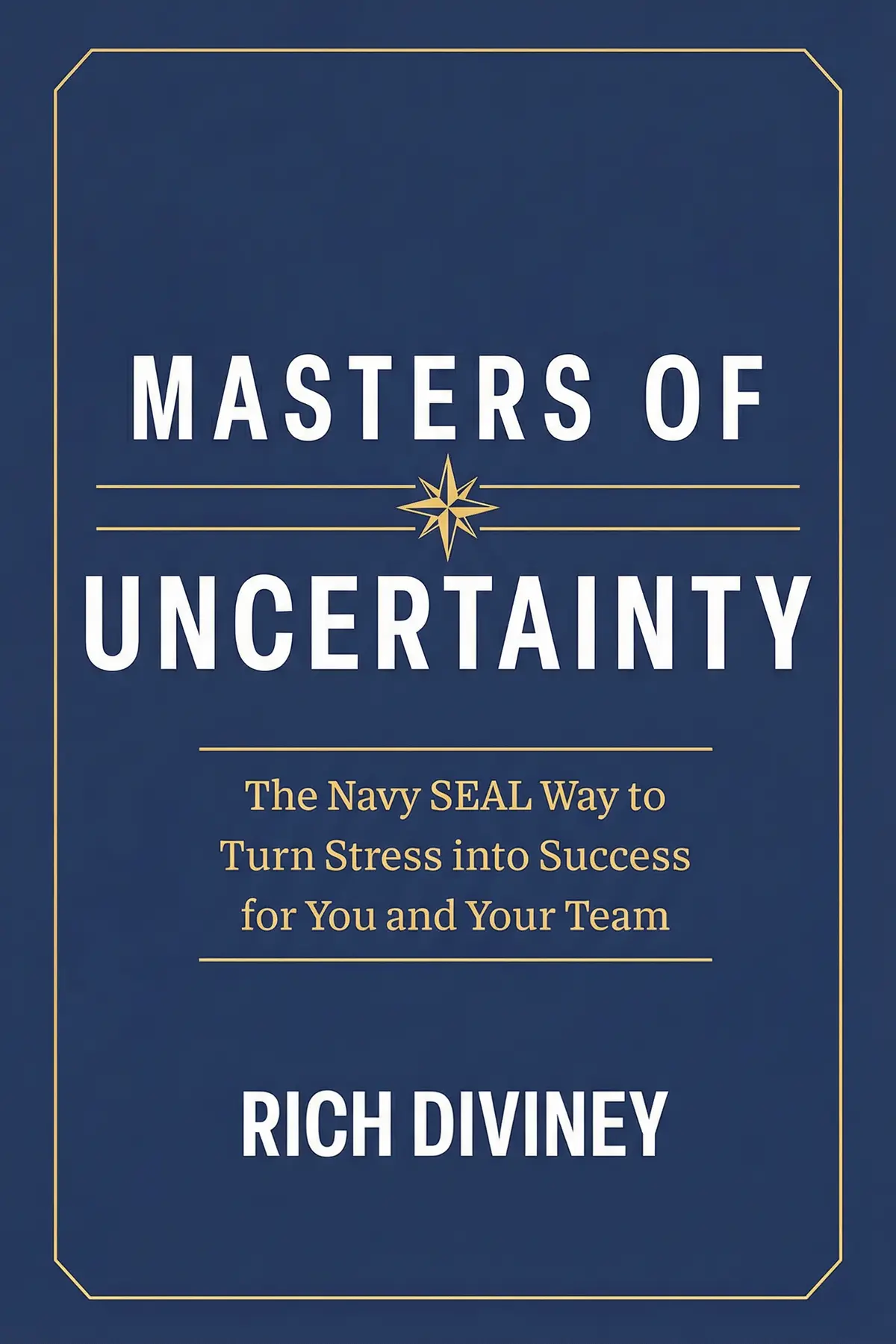
Uncertainty is a constant, yet most of us are poorly equipped to handle the stress it brings. In this summary, we explore how the world’s most elite special operations units thrive in environments where nothing goes according to plan. The core promise is that high performance isn't about avoiding chaos, but about mastering your internal response to it. Through the lens of a former Navy SEAL commander, we look at the difference between learned skills and innate attributes. You'll learn why what you do matters less than who you are when things go sideways. We'll examine practical tools for regulating your nervous system and shifting team leadership dynamically based on the situation at hand. By the end, you’ll have a toolkit for breaking down overwhelming objectives and building a culture of trust. Whether you’re leading a corporate team or navigating personal transitions, these strategies provide a roadmap for maintaining clarity and momentum when the future is anything but certain.
Rich Diviney is a retired Navy SEAL commander with over 20 years of experience, including more than 13 overseas deployments, primarily in Iraq and Afghanistan. As the officer in charge of training for a specialized command, he played a key role in a highly selective SEAL process that identifies optimal performers. Since retiring, he’s become a sought-after speaker, consultant, and facilitator, teaching leadership and high-performance strategies to top organizations. He’s also the author of The Attributes.
Listeners consider this manual a perceptive and valuable tool for managing stressful settings and individual hurdles. Although views differ regarding the significant focus on combat stories and the overall style, people value the functional systems offered for simplifying overwhelming scenarios into achievable small-scale objectives. Additionally, they point out how well the particular stress-management methods work, with one listener remarking that the DPO (Duration, Pathway, Outcome) method is especially beneficial for staying concentrated during intense moments. They also describe the writing as direct and brief, noting that the helpful end-of-chapter recaps ensure the Navy SEAL-derived concepts are simple to look up and implement.
Rich Diviney has written a masterclass in psychological resilience that goes far beyond typical leadership manuals. He reframes stress not as a villain to be defeated, but as a vital survival tool that sharpens focus when we need it most. I found the DPO framework—Duration, Pathway, and Outcome—incredibly grounding during a high-stakes project last month. By narrowing my focus to the immediate 'moving horizon,' the overwhelming nature of the task simply evaporated. It’s practical, punchy, and surprisingly human. The chapter summaries are great for quick reference when life starts feeling chaotic again. Highly recommended for anyone in high-pressure roles.
Show moreWow, the raid on Osama bin Laden serves as such a gripping opening to illustrate that even the best plans fail. This isn't about avoiding chaos—it's about performing because of it. I loved the focus on 'moving horizons' and how our brains need dopamine from small wins to keep going. The DPO method helped me restructure my daily workflow immediately. It turns out that looking too far ahead is exactly what causes my paralysis. By focusing on the next manageable step, the impossible feels attainable. If you feel stuck or overwhelmed by the unpredictability of life, buy this book immediately. It is a game-changer.
Show moreSuccess isn’t about the plan working perfectly; it’s about what you do when the helicopter crashes. That’s the core message here, and Diviney delivers it with total clarity. I’ve started using the physiological sigh and box breathing during my commute, and the difference in my stress levels is night and day. The book excels at taking high-stakes military concepts and translating them into everyday life. Whether it’s running a marathon or just getting through a tough week, the emphasis on micro-goals is vital. This is easily one of the most practical books on mindset I have read in years. It’s concise, effective, and deeply empowering.
Show moreUncertainty is the only constant we can actually depend on, and this book teaches you how to embrace that fact. The transition from narrow focus to panoramic vision is a technique I now use every time I feel a panic attack coming on. It works. The writing is clear, direct, and avoids the fluff found in most self-help books. I appreciated the chapter summaries because they make it easy to go back and find specific strategies like the DPO framework. This book gave me the tools to stop fearing the unknown and start seeing it as an opportunity for growth. It is truly an excellent resource.
Show morePicked this up after a recommendation from a colleague, and the concept of 'dynamic subordination' really changed my perspective on team management. In my experience, rigid hierarchies crumble under pressure, so seeing how SEALs allow leadership to shift based on expertise rather than rank was eye-opening. Diviney explains that for this to work, you need deep trust and a clear understanding of each member's unique attributes. The distinction between learned skills and inherent attributes is a nuance most business books miss. My only gripe is that the middle sections felt slightly repetitive. Still, the actionable frameworks make it a worthwhile purchase for any team lead.
Show moreAs someone who struggles with anxiety, the 'What do I know right now?' question has become my new mantra. This book isn't just for elite soldiers; it’s for anyone whose brain spirals into doubt when things go sideways. Diviney breaks down the neurobiology of uncertainty in a way that is accessible without being overly academic. I especially liked the part about 'eye movement desensitization' for stress regulation. It’s a short, powerful read that gives you a literal toolkit for your mind. It takes work to implement, but the steps are clear. The Navy SEAL branding is heavy, but the psychological core is what matters.
Show moreAfter hearing Diviney on a podcast, I wanted to see if the DPO framework was legit. It is. The book is essentially a manual for regulating your nervous system while making decisions. I liked how he explains that your identity—who you are—is what guides your actions when you're too tired to think. 'As a SEAL, what is the right action?' is a powerful internal prompt. I’ve adapted it for my own career. While the military talk is a bit thick at times, the underlying principles of adaptability and 'dynamic subordination' are pure gold for modern organizations. Definitely worth a spot on your shelf.
Show moreLook, the advice here is solid, but the delivery feels very 'American military' in a way that might not resonate with everyone. I appreciated the specific techniques like box breathing and shifting to panoramic vision to lower the heart rate. Those are things you can actually use in a boardroom. However, the book leans heavily on SEAL anecdotes that feel a bit recycled if you’ve read similar titles. The story about the 450-pound man, George, was a highlight because it showed the universal application of micro-goals. To be fair, it’s an easy read, but I wish there was more data and fewer war stories.
Show moreThe anecdote about the SEAL trainee who disobeyed a dangerous order was fascinating, but I felt the book overall was a bit superficial in its scientific claims. It’s a very fast read, which is great for busy people, though I found myself wanting more sources for the claims about 'reptilian brains' and dopamine loops. The theory makes sense, and the examples are helpful for context, but it feels like it’s missing a layer of depth. Personally, I wasn't as interested in the third part of the book regarding organizational identity. It’s a good 3.5-star book if you want a motivational boost with some practical tips, but don't expect a deep scientific treatise.
Show moreFrankly, I found the lack of academic citations frustrating. Diviney makes bold claims about neurobiology and dopamine loops that feel more like 'bro-science' than peer-reviewed research. While the SEAL stories are entertaining, they often feel repetitive and overly polished for a civilian audience. I wanted more substance and fewer anecdotes about training evolutions. If you like the standard 'Navy SEAL leadership' genre, you’ll enjoy it, but for those seeking a deep dive into psychological theory, it’s a bit thin. The DPO concept is okay, yet it’s essentially just basic project management with a tactical coat of paint. It just didn't land for me.
Show moreMargaret Heffernan



William B. Irvine
AUDIO SUMMARY AVAILABLE
Get the key ideas from Masters of Uncertainty by Rich Diviney, plus 5,000+ more titles in English and Thai.







