
7 min 38 sec
Net Positive: How Courageous Companies Thrive by Giving More Than They Take
Net Positive explores how businesses can achieve long-term success by solving global problems. It advocates for a model where companies give back more to society and the environment than they take.
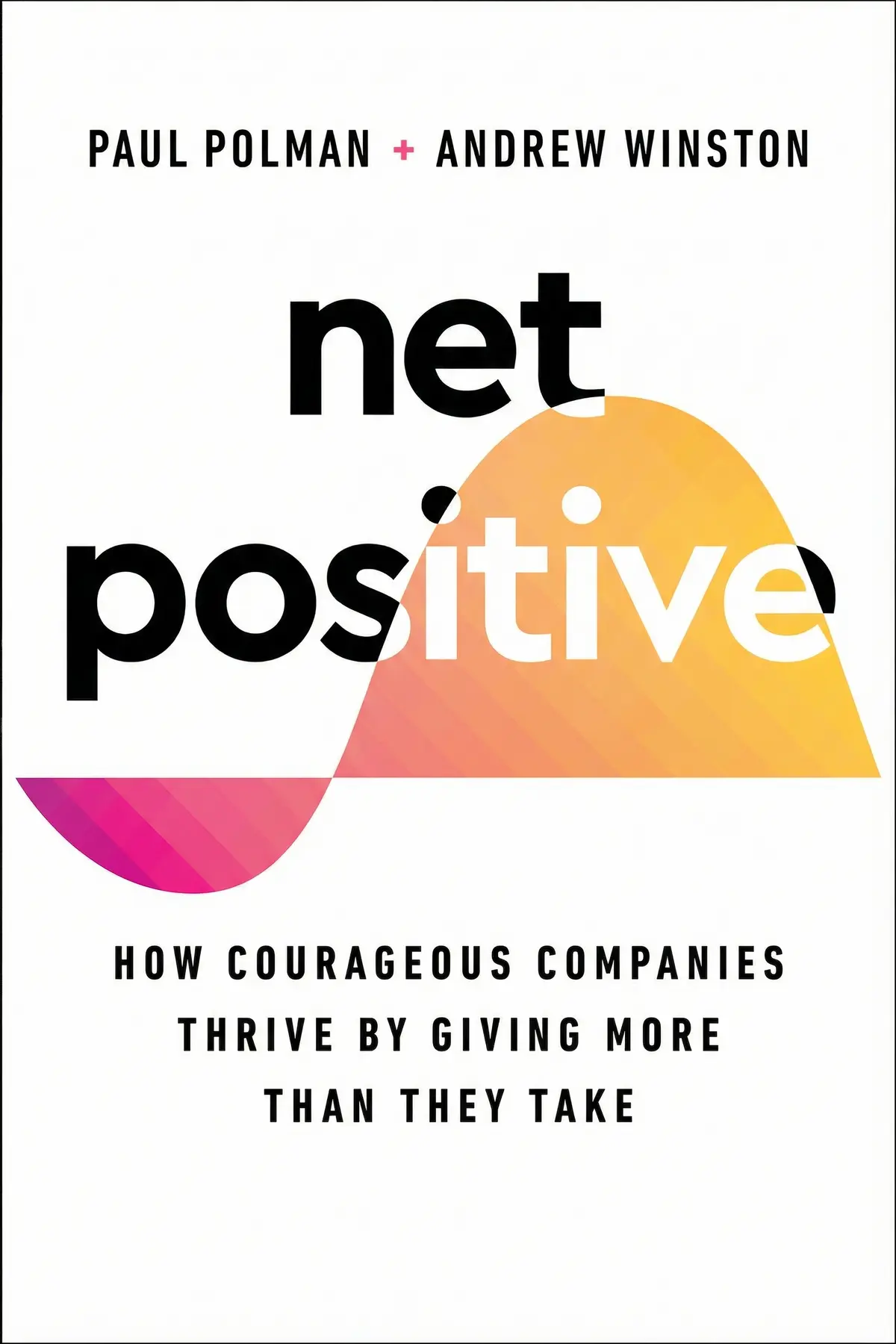
Table of Content
1. Introduction
1 min 04 sec
Imagine a world where the more successful a company becomes, the healthier the planet gets and the more communities thrive. For a long time, we have been told that business is a zero-sum game: for a company to win, someone else—or the environment—must lose. But there is a growing realization that this old way of thinking is a dead end. In today’s world, we are seeing a shift toward a more profound purpose. Leaders are beginning to ask a radical question: Is the world better off because your company is in it?
This is the core of the net positive philosophy. It’s an invitation to step away from the narrow pursuit of short-term profits and toward a model that prioritizes the well-being of every stakeholder involved. Over the course of this summary, we will explore what it looks like when a business decides to give more than it takes. We will look at how this transformation requires a new kind of courageous leadership and a fundamental restructuring of how success is defined. It is about moving past the idea of just doing less harm and embracing the challenge of doing more good.
2. Redefining the Purpose of Business
1 min 28 sec
What if corporate success was measured by how much a company improves the world rather than just the bottom line? This idea challenges traditional profit-centric models.
3. The Necessity of Long-Term Strategic Vision
1 min 21 sec
Breaking free from the pressure of quarterly reporting is essential for making sustainable choices. Discover how visionary leaders reclaim their time to focus on what matters.
4. The Characteristics of Net Positive Leadership
1 min 25 sec
Transforming a company requires more than just management skills; it requires empathy, humility, and a strong moral compass. Learn the traits of the new corporate leader.
5. Collaboration and Systemic Change
1 min 18 sec
No single company can solve global challenges alone. Building partnerships is the key to creating a ripple effect of positive change throughout entire industries.
6. Conclusion
1 min 02 sec
In conclusion, becoming a net positive business is not just an idealistic goal—it is a strategic necessity for the twenty-first century. As we have seen, this journey involves redefining the very purpose of a corporation, moving away from short-term greed toward a commitment to long-term value for all stakeholders. It requires leaders who are willing to lead with their hearts as much as their heads, utilizing humility and courage to navigate uncharted waters.
By giving more than they take, companies can become the engines of progress our world so desperately needs. They can restore the environment, empower communities, and still achieve remarkable financial success. The throughline here is clear: the most successful businesses of the future will be those that take the most responsibility for the world today. As you reflect on these ideas, consider how you can apply the principles of purpose and partnership in your own professional life. The shift to a net positive world starts with leaders who are brave enough to believe that business can, and should, be a force for good.
About this book
What is this book about?
For decades, the corporate world has been driven by a singular focus: maximizing shareholder value at any cost. This book argues that this model is no longer sustainable or even profitable in the long run. Instead, it proposes the net positive approach, where a company’s success is measured by its total impact on the world, including its employees, communities, and the natural environment. Through the lens of transformative leadership, the authors demonstrate that businesses can actually grow more resilient and profitable by taking responsibility for the challenges our planet faces. The narrative promises to show leaders how to move beyond simple corporate social responsibility into a realm where doing good is the primary engine of the business itself. It provides a blueprint for creating organizations that are not just less harmful, but are actively restorative and regenerative.
Book Information
About the Author
Paul Polman
Paul Polman is a highly respected figure in the corporate world, renowned for his commitment to sustainable business practices and his tenure as the CEO of Unilever, where he championed responsible business models and environmental sustainability. He is lauded for his visionary leadership and has been a prominent advocate for corporate responsibility and sustainability, playing pivotal roles in various international organizations focused on global economic and environmental issues.
Ratings & Reviews
Ratings at a glance
What people think
Listeners find this work to be a top recommendation for industry professionals, as it provides quality perspectives and is packed with real-world applications. They also value the book’s emphasis on corporate responsibility and ecological footprint, with one listener remarking that it represents a noteworthy contribution to environmental and business literature. Furthermore, they find the message quite motivating, with one review pointing out how a focus on purpose and sustainability can serve to inspire employees.
Top reviews
Book
Wow, what a refreshing and deeply inspirational take on the role of business in society. This isn't just another dry manual on corporate social responsibility; it’s a call to arms for leaders to rediscover their purpose. I was particularly struck by the stories of leaders who prioritized long-term health over short-term financial metrics, like the example of CVS removing cigarettes. The book successfully argues that purpose-led companies attract better talent and build more resilient brands. In my experience, seeing sustainability as an innovation driver rather than a cost center is the mindset shift we desperately need. Each chapter offers a vision of a more equitable world where businesses help fix global problems instead of creating them. It’s easily one of the most noteworthy contributions to environmental and business literature I’ve read in years.
Show moreTang
Finally got around to reading this, and I’m impressed by how Polman and Winston explode fifty years of corporate dogma. The stories about Unilever’s refusal to report quarterly earnings were particularly fascinating and show what real courage looks like in finance. They provide a compelling argument for why we must move toward a circular economy where less than 9% of products are wasted. I loved the emphasis on 'the heart' and the Latin roots of courage, reminding us that leadership is deeply personal. This book doesn't just talk about the environment; it addresses inequality, living wages, and the future of humanity. It’s a seminal work that every CEO should keep on their desk as a reminder of what’s at stake. If you care about the intersection of climate change and business, this is essential.
Show moreSelin
Not what I expected, but in the best way possible. I thought this would be a dry business text, but it’s actually a very human look at how we can reshape global systems. The chapter on partnerships alone is worth the price of the book, as it provides a roadmap for scaling solutions that no single company could handle alone. Polman's first-hand account of the Unilever turnaround is legendary, and hearing the 'why' behind those decisions is incredibly powerful. The authors effectively argue that transparency and radical honesty are the only ways to build trust in a skeptical world. Personally, I found the data points on diversity and the financial outperformance of ESG-focused indexes to be the perfect ammunition for internal debates. This is a brilliant, necessary, and ultimately hopeful book for the next generation of leaders.
Show moreBee
This book serves as a vital blueprint for anyone navigating the complex world of modern corporate sustainability. Polman and Winston move beyond the usual buzzwords to explain how a company can actually thrive by giving more than it takes from the planet. While the focus on Unilever is heavy, the practical examples from other giants like IKEA and Microsoft provide a necessary broader perspective. The authors make a compelling case that profit should be a result of doing good, not the only goal. Personally, I found the sections on courageous leadership particularly moving because they highlight the need for a moral compass in the boardroom. It isn’t perfect—some sections feel a bit like a victory lap—but the overall message is too important to ignore in our current climate.
Show moreSin
As a consultant working in the ESG space, I found the 'Net Positive' framework incredibly useful for framing difficult client conversations. The authors do a great job of explaining the 'quarterback' role of the sustainability officer and how that role must permeate every department. One of the best takeaways for me was the six-level framework for impact, which challenges companies to look far beyond their own internal operations. I appreciate how they tackle the 'SMART' goal obsession, suggesting that truly net-positive goals must often be uncomfortably ambitious. Some might find the tone a bit preachy, but the sense of urgency they establish is entirely appropriate given the scale of the climate crisis. It is a highly recommended read for professionals who want to see how sustainability can be embedded into core strategy.
Show moreFord
Ever wonder how a massive global corporation can actually contribute to biodiversity or social equity? This book attempts to answer that by breaking down the traditional profit-centric approach. The narrative underscores the importance of visionary leadership, specifically traits like humility and empathy which are often ignored in business schools. I particularly liked the discussion on partnerships, showing how collaborating with competitors and NGOs is the only way to drive systemic change. Not gonna lie, some of the personal political injections felt a bit out of place and potentially polarizing for a global audience. However, the core message about taking ownership of all social and environmental impacts—even 'spillover' ones—is a game changer. It’s a thick read, but the insights on turning around a giant like Unilever are genuinely valuable.
Show moreNarong
After hearing Polman speak on a podcast, I had high expectations for this book, and for the most part, it delivered. The writing is clear and the sense of urgency regarding the climate and social inequality is palpable. It’s not just about minimizing harm anymore; the bar has been raised to actually improving the lives of everyone a company touches. I did find the sections on supply chain ethics and living wages particularly eye-opening, especially the stats on the gender pay gap. While it can feel a bit repetitive if you read it cover-to-cover in one sitting, it’s great to dip in and out of for inspiration. It provides a noteworthy contribution to the debate on the future of capitalism. Definitely a must-read for anyone in a leadership position who wants to stay relevant.
Show moreOtt
Picked this up after seeing it recommended during my MBA, but I found the experience to be a bit of a mixed bag. To be fair, the core concepts regarding 'Net Positive' companies are transformative and necessary for today’s business landscape. However, the writing style can feel quite repetitive, especially in the middle chapters where it feels like they are just circling the same ideas. You get the sense that you’ve read the same message ten times by the time you reach page 150. Truth is, if you are already well-versed in ESG or stakeholder capitalism, there might not be enough 'new' material here to keep you fully engaged. It’s a solid introduction for those new to the space, though the memoir-style reflections on Polman’s time at Unilever occasionally distract from the actionable advice.
Show moreJoy
Look, the core message here is noble, but the execution often feels like it's circling back to the same points without adding much depth. I appreciated the specific examples, such as the comparison between the long-term focus of certain companies versus the cost-cutting obsession at places like Kraft Heinz. That being said, the prose can be quite dense and the tone is somewhat academic at times. It took me a while to get through because it didn't feel like the concepts were being progressively unpacked. Instead, it felt like a series of essays that all reached the same conclusion about 'giving more than you take.' It is an interesting book that tables important concepts, but it could have been much tighter and half as long without losing its impact.
Show morePlernpiriya
The focus on Polman’s tenure at Unilever felt less like a strategic business guide and more like a self-congratulatory memoir. Frankly, it felt like the authors were mostly preaching to the choir throughout the entire narrative. I was looking for concrete data and new frameworks to convince skeptical CEOs, but instead, I found mostly anecdotes and 'decent human being' platitudes. By the ninth chapter, the repetitive nature of the arguments made it difficult to stay focused. It’s hard to see how this would move the needle for a conventional executive who is solely focused on quarterly returns. While the intentions are clearly noble, the execution lacks the analytical depth I expected from such high-profile authors. It’s a bit of a letdown if you’re looking for a deep dive into the mechanics of ESG.
Show moreReaders also enjoyed

7 Powers: The Foundations of Business Strategy
Hamilton Helmer

A Bigger Prize: How We Can Do Better Than the Competition
Margaret Heffernan

A Year with Peter Drucker: 52 Weeks of Coaching for Leadership Effectiveness
Joseph A. Maciariello
AUDIO SUMMARY AVAILABLE
Listen to Net Positive in 15 minutes
Get the key ideas from Net Positive by Paul Polman, plus 5,000+ more titles in English and Thai.
- 5,000+ titles
- Listen as much as you want
- 7-day free trial
- Cancel anytime







