
15 min 27 sec
Of Boys and Men: Why Modern Men Struggle, Why It Matters, and How to Fix It
Richard Reeves explores the structural and cultural factors causing boys and men to struggle in education and the workforce, offering a compassionate, policy-driven roadmap to help them thrive in the modern era.
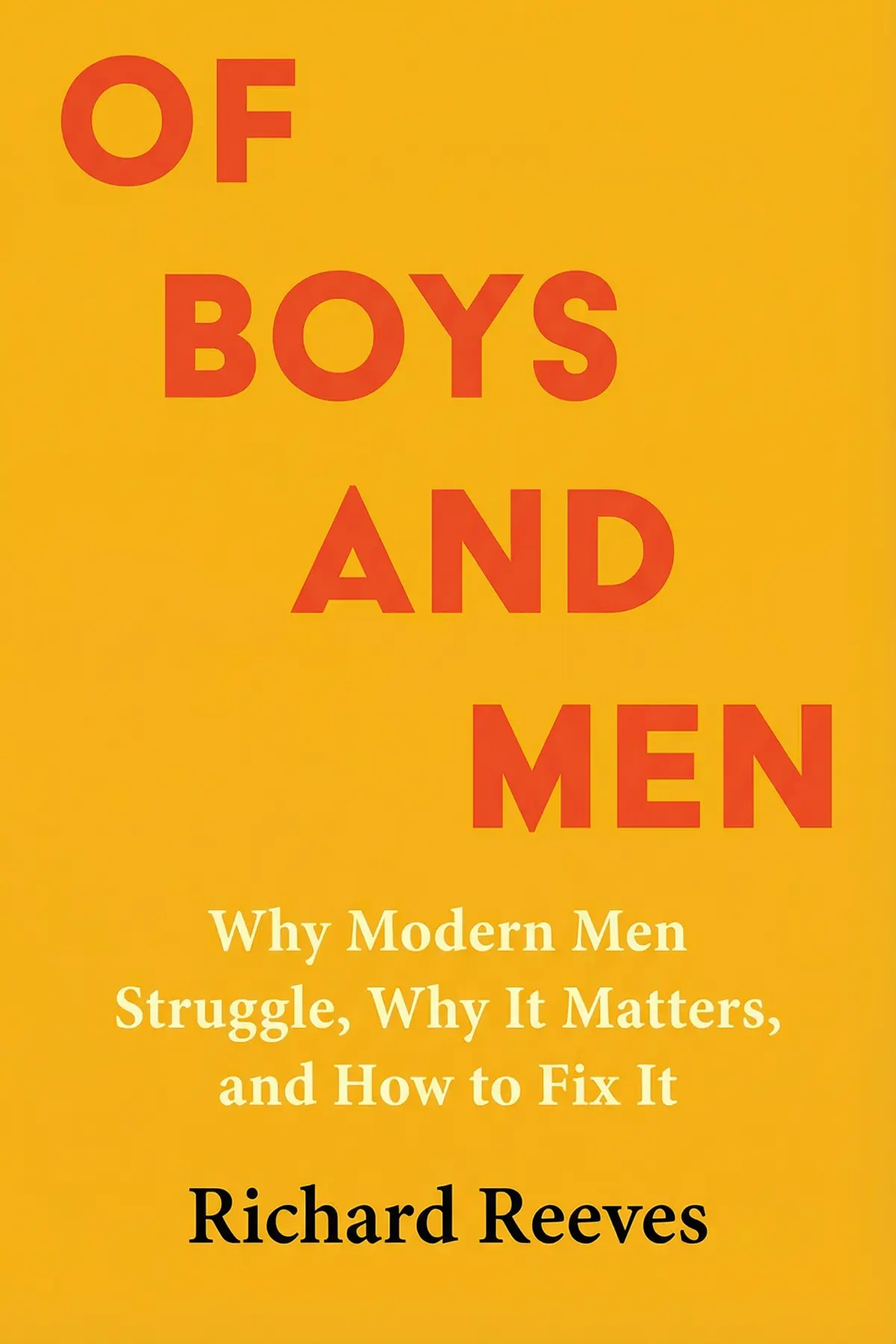
Table of Content
1. Introduction
1 min 36 sec
For the better part of the last fifty years, when we talked about gender equality, we were talking about women. It made perfect sense. Historically, women were barred from higher education, shut out of the boardroom, and restricted in their personal agency. The movement to correct these imbalances has been one of the greatest success stories of modern civilization. However, as we look around today, a new and unsettling picture is starting to form. While women continue to break glass ceilings, a significant number of boys and men are falling through the floor.
Richard Reeves, a seasoned policy expert, noticed something troubling in the data. Across almost every metric of social health—graduation rates, workforce participation, and mental well-being—males are losing ground. Yet, discussing this crisis is often seen as controversial or even a distraction from women’s rights. Reeves argues that this is a dangerous mistake. If we don’t address the real, tangible struggles that boys and men face today, we leave a vacuum that can be filled by more extreme and less constructive voices.
In this exploration, we are going to look at the intersection of biology, economics, and culture. We will see how a school system designed for one type of development is inadvertently leaving boys behind, and how a changing economy has stripped many men of their traditional sense of purpose. Crucially, this isn’t about rolling back the clock or reversing the gains of women. It’s about building a society where everyone has the tools to flourish. By the end of this summary, you’ll understand why the “boy crisis” is a collective problem and what specific, structural changes can help bridge the widening gap.
2. The Academic Reversal
1 min 48 sec
Explore the surprising shift in educational achievement where girls have not only caught up but are now significantly outperforming boys at nearly every level.
3. The Biological Mismatch in the Classroom
1 min 57 sec
Understand how the natural differences in brain development between genders can create a hidden bias in our current school systems.
4. Economic Shifts and the Loss of Male Purpose
1 min 45 sec
Investigate how the decline of traditional industry and the rise of a service-oriented economy have uniquely impacted men’s earning power and employment.
5. The HEAL Gap
1 min 40 sec
Discover why getting men into Health, Education, Administration, and Literacy roles is just as important as getting women into STEM.
6. The Dad Deficit and the Changing Family
1 min 45 sec
Examine how the evolution of women’s economic independence has necessitated a new, more involved definition of fatherhood.
7. The Crisis of Despair
1 min 43 sec
Look at the sobering reality of mental health challenges for men and how a lack of social integration leads to tragic outcomes.
8. Redshirting and Structural Solutions
1 min 46 sec
Learn about the bold proposal to give boys an extra year of development before starting school and other ways to level the playing field.
9. Conclusion
1 min 27 sec
The challenges facing boys and men today are not a sign that women have made too much progress, but a sign that our institutions have failed to adapt to a changing world. We’ve seen how the educational system, while opening doors for girls, has inadvertently left boys struggling with a developmental mismatch. We’ve explored how the economy has shifted, leaving many men without the traditional roles that once gave them a sense of purpose and worth. And we’ve touched on the tragic human cost of this disconnection—a rise in isolation, addiction, and despair.
However, the throughline of Richard Reeves’ work is one of hope and action. The crisis of the male is not an insoluble mystery; it is a policy challenge that can be met with creativity and compassion. By implementing practical changes like delaying school starts for boys, aggressively recruiting men into healthcare and education, and redefining fatherhood as a vital, non-economic role, we can start to close the gap.
Ultimately, the goal is not to bring women down to help men, but to raise everyone up. A society where men are educated, employed, and emotionally connected to their families is a society that is safer, more prosperous, and more stable for everyone. It is time to stop viewing gender equality as a zero-sum game and start building a world where of boys and men, we can say: they are thriving once again.
About this book
What is this book about?
For decades, the conversation around gender equality has focused almost exclusively on the advancement of women. While that progress remains vital, a new and different crisis has quietly emerged. Today, boys and men are falling behind in school, dropping out of the labor force, and struggling to find their place in the family structure. This isn't just a personal failure for millions of individuals; it’s a systemic breakdown that affects the health of our entire society. In Of Boys and Men, author Richard Reeves takes a data-driven look at why males are stumbling. He examines the biological differences in brain development that make traditional schooling harder for boys, the economic shifts that have rendered many traditional male jobs obsolete, and the cultural changes that have left many fathers feeling redundant. The book promises more than just a diagnosis of these problems; it offers a series of bold, actionable solutions—from changing when boys start school to recruiting more male teachers and healthcare workers—to ensure that the success of women doesn't come at the cost of failing men.
Book Information
About the Author
Richard Reeves
Richard Reeves is a Senior Fellow at the Brookings Institution. He has authored several books, including Yes, Boys Can!, which aims to empower boys through the stories of notable men. Reeves served as director of strategy to the UK’s Deputy Prime Minister between 2010 and 2012 and led Demos, a London-based political think-tank. His background includes a range of policy and research roles that enrich his writing and advocacy on social and policy issues.
Ratings & Reviews
Ratings at a glance
What people think
Listeners find the book to be highly informative and well-researched, packed with facts to support its points. They also value its accessibility, with one listener noting it is a quick read, and praise its writing quality, with one review highlighting its well-argued structure. Furthermore, the work receives positive feedback for its impact; one listener describes it as a courageous look at the data, while another says it provides a clear pathway to improving life for all. Listeners appreciate the book’s take on gender equality, with one review noting its thorough coverage of gender studies, sociology, economics, and political science.
Top reviews
Ray
Richard Reeves manages to navigate a cultural minefield with incredible grace and a mountain of data. The book is remarkably easy to read for something so grounded in sociology and economics, avoiding the dry academic tone that usually plagues these subjects. I especially appreciated his focus on 'HEAL' jobs—health, education, administration, and literacy—and his explanation of why we need more men in these roles to help balance the workforce in a changing economy. While his proposal to start boys in school a year later than girls is definitely going to be a hard sell for most parents, the evidence he presents is hard to ignore. To be fair, he doesn't have all the answers for the 'angry male' dynamic we see online today, but he's asking the right questions. We can support women's progress while also admitting that many of our boys are struggling to find their footing. This is a must-read for anyone who cares about the future of our social fabric.
Show moreNong
As a mother of three young boys, this book felt like a lifeline in a world that often seems to have forgotten their specific struggles. I’ve watched my own sons struggle with the 'sit still and listen' expectations of early elementary school, so the idea of starting them later actually makes a lot of sense to me. Reeves writes with a lot of heart and humility, often referencing his own experiences as a father to ground the data. Not gonna lie, some of the chapters on the decline of the traditional male provider role were a bit depressing to get through. But the book remains ultimately hopeful, suggesting that we can create a new model of masculinity that values caregiving and interpersonal skills. It’s well-researched and avoids the usual finger-pointing, making it a rare find in the current political climate. Every parent of boys should probably have a copy of this on their shelf for reference.
Show moreSaengdao
Wow, a nuanced take on masculinity that doesn't immediately descend into culture war nonsense. Reeves has done something truly remarkable by providing a comprehensive look at the intersection of sociology, economics, and psychology without ever falling into the trap of alienating half of his audience with partisan rhetoric. He argues that the structural advantages men once held are disappearing, and rather than trying to bring back the past, we need to help men adapt to the future. The writing quality is top-notch, keeping the reader engaged even during the more data-heavy sections. I appreciated that he never suggests we should roll back the gains made by women; instead, he advocates for a 'pro-boy' and 'pro-girl' world simultaneously. Some might find his tone a bit too cautious, but in today's climate, that's exactly what we need. This book is a clear-eyed look at a growing crisis, and I hope it starts some much-needed conversations.
Show moreWittaya
This book is a courageous look at the data surrounding the decline of men in education and the workforce. Reeves manages to be both empathetic and clinical, a difficult balance to strike when talking about such a charged topic. I was particularly struck by the statistics on how current 'gender-neutral' programs often fail to help boys, who seem to require more targeted outreach. Not everyone will agree with his solutions, but the fact that he's offering them at all is a step in the right direction. To be fair, the book can be a bit repetitive in its middle sections, hammering home the same points about the education gap. However, the overall impact is undeniable. It’s a well-structured argument that proves gender equality isn't a zero-sum game. If we want a healthy society, we have to ensure that both halves are thriving. This book is the first step toward making that happen.
Show moreDarawan
Ever wonder why the conversation about gender feels so lopsided lately? Reeves argues that we can care about two things at once, and his balanced approach is a breath of fresh air. Truth is, the stats on male suicide and educational attainment are genuinely alarming when you see them all laid out in one place. I found the writing quality to be exceptional, as he weaves personal anecdotes about his own sons with rigorous policy analysis. My only real gripe is that he occasionally treats biological differences as a 'mystery' or a fixed point, which some readers might find a bit reductive or even frustrating. Still, his argument that masculinity shouldn't be a zero-sum game is powerful. It's a quick read but one that stays with you long after you close the cover. If you've been feeling like the discourse is too polarized, this book offers a much-needed middle ground for everyone involved.
Show moreNatchaya
Picked this up on a whim after seeing the Atlantic excerpt and I’m glad I did. This isn't some angry screed; it's a thoughtful, data-driven look at why so many men feel lost in the 21st century. The chapters on the 'Manosphere' and the rise of figures like Jordan Peterson were particularly insightful, explaining the vacuum that these influencers are filling. Reeves is a talented writer who knows how to make complex economic shifts feel personal and urgent. I did find the pacing a bit uneven toward the end, and some of the solutions felt a little repetitive. Nevertheless, the central thesis—that we need to help boys without hurting girls—is handled with great care throughout the text. It’s a courageous book that refuses to take the easy way out by blaming one side or the other for everything. Definitely worth the afternoon it takes to read it.
Show moreSupaporn
After hearing several podcasts about the 'male malaise,' I finally sat down with the source material. Reeves is an excellent guide through the thorny issues of gender gaps in the modern world. His focus on the need for more male role models in 'nurturing' professions like teaching and nursing is particularly well-argued. It's high time we stopped viewing these as 'women's work' and started seeing them as essential roles for a functioning society. The book is informative and remarkably fast-paced for a non-fiction title. My only criticism is that he doesn't spend enough time on the intersection of race and class, which he admits are huge factors in how these issues play out. Still, for a general overview of the current state of boys and men, you won't find a better researched book. It’s a refreshing change from the usual shouting matches we see on social media every day.
Show moreKae
Frankly, I went into this expecting a manifesto, but what I found was a dense collection of statistics that didn't always lead to a clear solution. Reeves is great at identifying the problem—boys are falling behind in school, and men are dropping out of the labor force at record rates. However, I struggled with his proposed fixes, like 'redshirting' all boys by default. It feels like a structural band-aid for a much deeper cultural issue regarding how we define 'manliness' today. The writing is clear and well-argued, but I felt like he skirted around the toxic influence of the manosphere a bit too carefully. In my experience, the lack of ambition he notes in young men is tied to a crisis of purpose that more government programs can't easily fix. It's an informative read that will spark plenty of debates, even if you don't agree with every conclusion. I appreciate the effort, but it left me with more questions than answers.
Show moreLeila
The chapter on the 'redshirting' proposal—starting boys in school a year later—is easily the most controversial part of the book for me. While Reeves backs it up with plenty of evidence about brain development and pre-frontal cortex maturity, it feels like a massive logistical nightmare for working-class families. That said, I can't deny that the 'male malaise' he describes is real; I see it in my own nephews who lack any drive to leave home or start careers. The book is facts-galore, providing a clear pathway for understanding how the shift from a brawn-based to a brain-based economy has left many men behind. Personally, I would have liked to see more focus on mental health resources specifically tailored for men. It’s a solid read that offers a lot of food for thought but left me wanting more practical, immediate advice. Reeves is clearly a brilliant guy, but his policy-heavy approach might not reach the men who need it most.
Show moreArnav
Look, I really wanted to like this, but the author's insistence on biological differences felt like a step backward. While the data on education is eye-opening, Reeves seems to downplay how much the patriarchy still benefits men at the very top while ignoring how it harms those at the bottom. He quotes a few authors who I find problematic, and his dismissal of 'toxic masculinity' as a term felt like he was coddling his male audience. To be fair, the book is very well-written and easy to digest, which is probably why it's so popular right now. But the idea that men are 'falling' because women no longer need them as 'props' is a hard pill to swallow. I wanted more interrogation of why boys don't respect female role models, rather than just a call for more male teachers. It’s an interesting contribution to the field, but it didn't quite land for me.
Show moreReaders also enjoyed

A Biography of Loneliness: The History of an Emotion
Fay Bound Alberti

A Force for Good: The Dalai Lama's Vision for Our World
Daniel Goleman


A Room of One’s Own
Virginia Woolf

Abolish Rent: How Tenants Can End the Housing Crisis
Tracy Rosenthal

Abortion: Our Bodies, Their Lies, and the Truths We Use to
Jessica Valenti


Afropean: Notes From Black Europe
Johny Pitts
AUDIO SUMMARY AVAILABLE
Listen to Of Boys and Men in 15 minutes
Get the key ideas from Of Boys and Men by Richard Reeves, plus 5,000+ more titles in English and Thai.
- 5,000+ titles
- Listen as much as you want
- 7-day free trial
- Cancel anytime







