
A Promised Land
Barack Obama
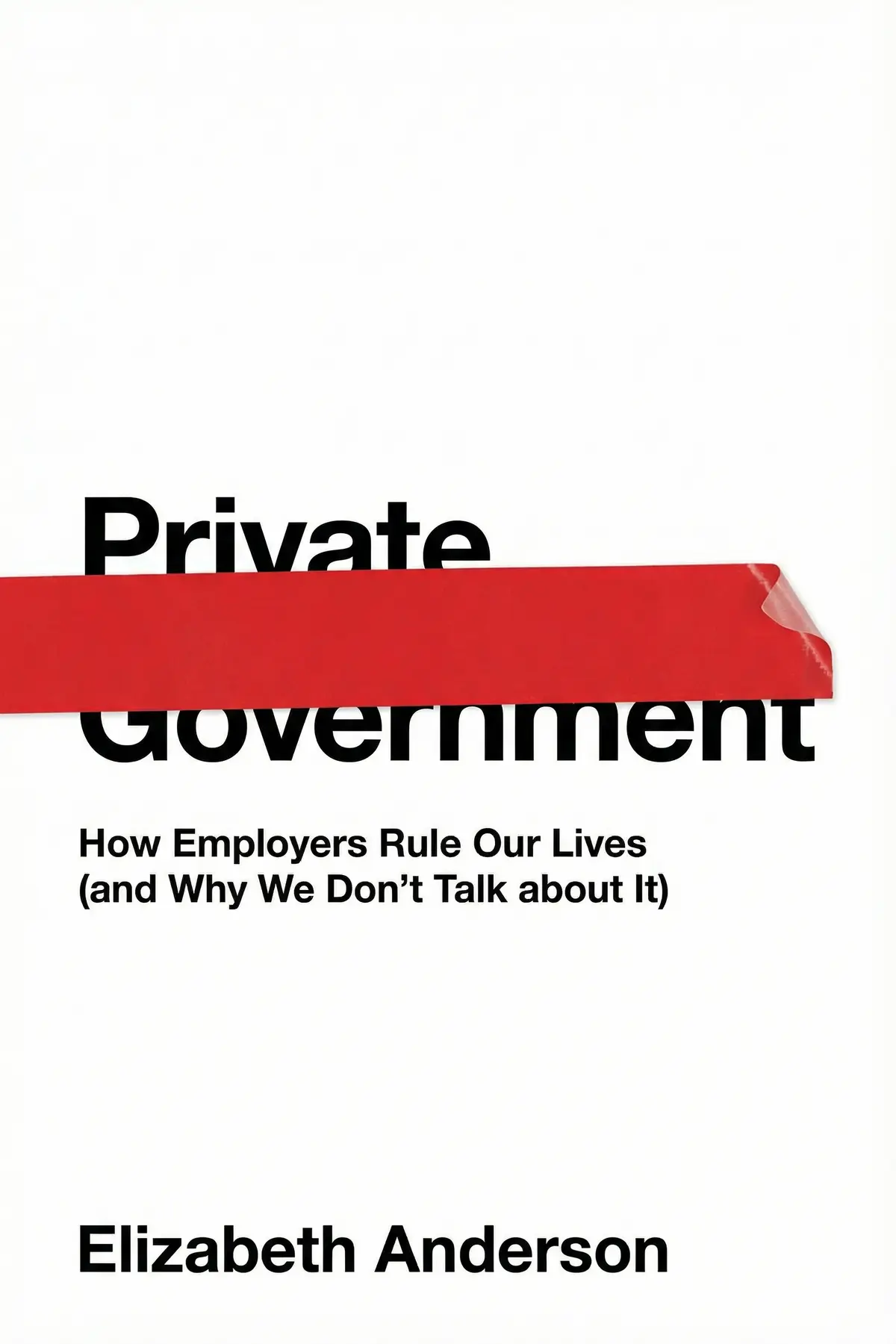
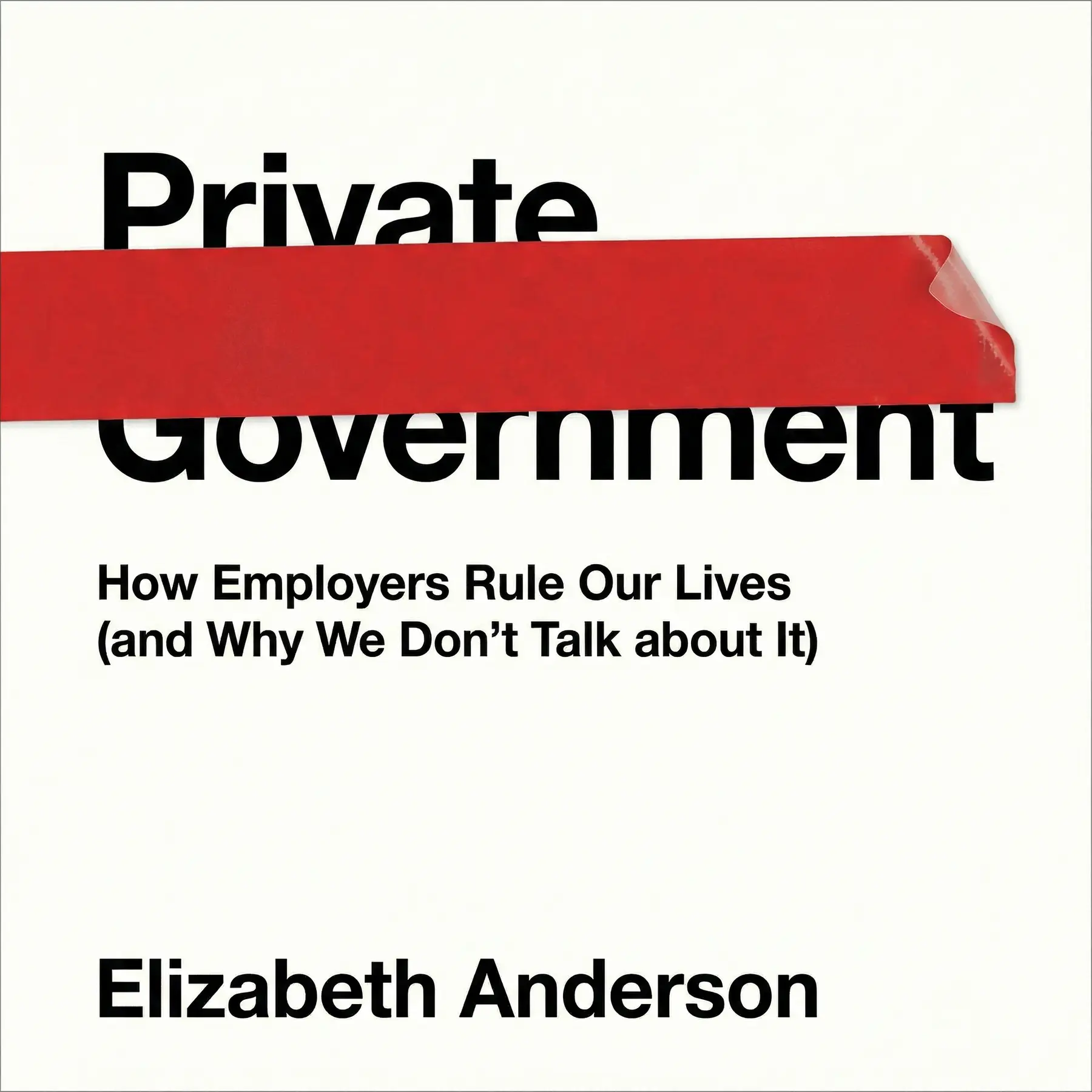
Elizabeth Anderson challenges the myth of the free market by revealing how modern workplaces function as private governments. She explores the authoritarian power employers hold over workers and proposes democratic reforms to reclaim personal liberty.
1 min 44 sec
For most of us, the workday follows a familiar rhythm. We wake up, commute, and settle into a routine governed by managers, deadlines, and company policies. We often think of this arrangement as a simple exchange: our time and skills for a steady paycheck. In a society that prides itself on being ‘free,’ we are told that the market is the ultimate expression of liberty—a place where we enter into contracts as equals and are free to leave whenever we choose. But if we take a closer look at the reality of the modern office or factory floor, that narrative of freedom begins to crumble.
In Private Government, Elizabeth Anderson invites us to confront a startling reality: for the vast majority of people, the workplace is not a neutral space of free exchange. Instead, it is an authoritarian governing structure. It is a place where we lose many of the rights we enjoy as citizens of a democracy the moment we clock in. Anderson argues that we have been blinded to this reality by an outdated economic ideology that originated before the Industrial Revolution—a time when the dream of everyone being their own boss actually seemed possible.
Today, that dream has been replaced by a system where employers hold immense, often unchecked power over their employees. This power extends far beyond the tasks assigned on a job description; it reaches into our privacy, our speech, and even our lives outside of work hours. Throughout this summary, we will explore why we’ve stopped talking about this lack of freedom, how the modern corporation functions like a centralized dictatorship, and what we can do to bring the principles of democracy into the world of work. It is a journey that asks us to redefine what it means to be free in a world where our livelihoods are tied to the whims of private authorities.
2 min 29 sec
Discover why the structure of the modern company mirrors a dictatorship more closely than a free association of equals, challenging our common assumptions about workplace liberty.
2 min 28 sec
Explore the counterintuitive idea that modern enterprises operate like centrally planned economies, using surveillance and total control to manage their internal populations.
2 min 30 sec
The authority of a boss often extends far beyond the office walls, influencing your health, your politics, and even your basic physical needs.
2 min 33 sec
Is the ‘right to quit’ truly a safeguard for liberty? Discover why leaving a job is often a choice between one dictatorship and another.
2 min 18 sec
Unpack the historical and philosophical reasons why we’ve limited our definition of government to the public sector, and how this narrow view protects private power.
2 min 21 sec
What makes a government ‘private’? Learn how the exclusion of workers from decision-making creates a system where their interests simply don’t matter.
2 min 25 sec
Explore the practical alternatives to corporate autocracy, from labor unions to European-style co-management and worker cooperatives.
2 min 17 sec
Travel back to the 18th century to understand why thinkers like Adam Smith originally saw the market as a tool for liberation, not oppression.
2 min 20 sec
Learn how the rise of large-scale manufacturing shattered the dream of independence and trapped the majority of the population in ’employment.’
1 min 35 sec
Elizabeth Anderson’s Private Government is a powerful wake-up call that challenges us to look past the slogans of the ‘free market’ and see the reality of our daily working lives. We have spent centuries fighting for democratic rights in our political systems, ensuring that we are not subjects of a king but citizens with a voice. Yet, for forty or more hours every week, most of us relinquish those rights and enter a world where our dignity and autonomy are at the mercy of an unelected authority. By framing the workplace as a private government, Anderson provides us with the tools to critique this power and to imagine a more just alternative.
The throughline of this exploration is clear: freedom is not just the absence of a state; it is the presence of a voice in the institutions that govern us. The current model of the corporation, born from the Industrial Revolution and protected by outdated ideologies, is fundamentally at odds with the values of a free society. Whether through stronger unions, European-style codetermination, or worker-owned cooperatives, the path forward requires us to democratize the economy just as we have democratized the state.
Ultimately, Anderson reminds us that the economy is not a law of nature, but a human creation. We have the power to change the rules of the game. Recognizing the workplace as a government is the first step toward ensuring that ‘liberty and justice for all’ isn’t something that stops at the office door. As you go back to your own workplace tomorrow, ask yourself: Am I a citizen here, or a subject? And if the answer is the latter, what can we do together to change it?
For centuries, the market has been celebrated as a realm of freedom and equality, where individuals trade as peers. However, Private Government argues that this vision is a relic of a pre-industrial era. In the modern world, the workplace has transformed into a site of immense power imbalance. Most employees today live under the rule of a private government—an authority that can monitor their behavior, restrict their speech, and even control their personal lives off the clock, all with little to no accountability. Elizabeth Anderson explains how the Industrial Revolution destroyed the dream of widespread self-employment, forcing the majority into hierarchical organizations. By examining the legal and social structures that allow employers to act as dictators, this book promises to change how you view your job, your boss, and your rights. It calls for a fundamental shift toward workplace democracy, suggesting that the only way to truly protect individual freedom is to give workers a collective voice in the institutions that govern their daily lives.
Elizabeth Anderson is a distinguished professor of philosophy and women’s studies at the University of Michigan. Her scholarly work spans political philosophy, ethics, and feminist theory, focusing on themes of democracy, market society, and egalitarianism. She is the author of Value in Ethics and Economics and The Imperative of Integration, the latter of which received the American Philosophical Association's 2011 Joseph B. Gittler Award for its significant contributions to the philosophy of the social sciences.
Listeners find the book intellectually stimulating and appreciate how readable it is. Insights are perceived differently, as some find the material profound while others point out that the work is a compilation of various essays.
Elizabeth Anderson presents a chillingly effective argument that our workplaces are essentially communist dictatorships operating within a democratic state. The way she traces the history from Adam Smith’s optimistic free-market vision to the soul-crushing reality of the Industrial Revolution is eye-opening. Most of us assume that 'government' only exists in the public sphere, but Anderson proves that bosses exert more control over our lives than any elected official. Truth is, the anecdotes about poultry workers forced to wear diapers due to lack of bathroom breaks should be required reading for every labor lawyer. While the academic responses included in the back are a bit dry, Anderson’s own writing is sharp, accessible, and deeply necessary for the modern era. This book shifted my entire perspective on what it means to be 'free' at work.
Show moreEver wonder why we lose our basic constitutional rights the moment we clock into work? Anderson tackles this head-on by exposing the myth of the 'free' labor market. She makes a compelling case that the workplace is a site of arbitrary authority where workers have almost no voice. I particularly enjoyed the section where she dismantles the idea that 'quitting' is a sufficient solution to workplace abuse. Leaving a job isn't always an option when your healthcare and survival are tied to it. The writing style is surprisingly punchy for a philosopher, and she doesn't mince words when describing the indignities of modern labor. This is a vital contribution to the conversation about democracy and why it shouldn't stop at the office door.
Show moreWow, the final section where Anderson responds to her critics is worth the price of admission alone. She absolutely eviscerates the notion that workers are 'free' just because they can walk away from a job. Her use of data regarding sexual harassment and wage theft provides a necessary reality check to the more theoretical arguments. The book is incredibly thought-provoking and challenges the very foundation of how we view corporate power. I’ve been recommending this to everyone in my union because it perfectly articulates why collective bargaining is a matter of liberty, not just wages. It is readable, urgent, and deeply researched. Even if you don't agree with every conclusion, you can't ignore the evidence she presents about the lack of dignity in the modern workplace.
Show moreAfter years of feeling like my office was a small fiefdom, this book finally gave me the vocabulary to explain why. Elizabeth Anderson is a genius for identifying the 'private government' that exists under the guise of private property. She reminds us that the pioneers of the free market, like Adam Smith, would be horrified by the modern corporate structure. The examples of surveillance and control over workers' private lives are genuinely terrifying. This book isn't just about economics; it's about the fundamental human need for autonomy and respect. It is a short read but packs a massive punch. If you’ve ever felt like your boss owned your soul, you need to read this to understand the systemic reasons why. It's a game-changer for political theory.
Show morePicked this up after hearing about the comparisons between modern bosses and dictators, and it did not disappoint. The chapter on the Skylab astronauts who went on strike in space was a fantastic example of how micromanagement backfires. Anderson is remarkably good at explaining why we’ve accepted a lack of autonomy as the 'natural' state of employment. She argues that we’ve basically traded our liberty for a paycheck, which is a hard pill to swallow but feels accurate. My only gripe is that the book is quite slim and structured as a collection of essays rather than a cohesive narrative. It makes the pacing feel a bit disjointed at times. Still, the insights regarding the 'public-private' divide are incredibly sharp and worth your time.
Show moreAs a long-time manager in the corporate world, I found Anderson’s perspective on 'private government' incredibly validating and uncomfortable. We often pretend that employment is a simple contract between equals, but the reality is much more lopsided. This book highlights how employers use their power to regulate off-duty behavior, from social media posts to political affiliations. I found the historical analysis of pre-industrial markets fascinating, specifically how the dream of self-employment was crushed by large-scale manufacturing. Some of the academic rebuttals in the second half are a bit dense and pedantic. Nevertheless, the central thesis remains strong and very readable for a non-academic audience. It definitely makes you rethink the ethics of the standard 9-to-5 hierarchy.
Show moreNot what I expected from a political philosophy book, but in a good way. It's rare to find a thinker who can connect 18th-century economic theory to the fact that people are literally denied bathroom breaks in 2024. Anderson’s ability to deconstruct the 'ideology of the market' is impressive. She shows how we’ve been brainwashed into thinking that only the state can be tyrannical. Gotta say, the responses from the other professors were a mixed bag, but Anderson’s final rebuttal was a masterpiece of rhetoric. She really knows how to defend her positions against the usual 'just quit' arguments. It is a quick, punchy read that will make you look at your supervisor in a completely different light. Highly recommended for anyone interested in labor rights.
Show moreWhy does this book feel like a classroom lecture that never quite hits the pavement of real life? I appreciated the core concept of 'private government,' and I definitely agree that many employers act like petty tyrants. However, the author spends an exhausting amount of time on the Levellers and 17th-century English history. If you are looking for actionable solutions to fix toxic management or improve labor laws, you will likely walk away disappointed. It is a brilliant piece of political philosophy, but it lacks the 'how-to' for the average employee struggling under a bad boss. The middle section featuring various academic responses felt like filler that slowed down the momentum. It is a thought-provoking read for sure, but it is too theoretical for my taste.
Show moreFrankly, the structure of this book is a bit of a mess, even if the ideas are gold. It starts with two lectures, then gives you four different critiques, then a final response from the author. It feels more like a bound journal than a proper book. I loved the first forty pages where she explains how companies function as private governments. That part is brilliant and easily five-star material. However, the momentum dies once the other academics start bickering about definitions and historical interpretations. It's a bit of a slog to get through the middle sections just to get back to Anderson’s final thoughts. If you can handle the disjointed format, there are some truly profound insights about the nature of modern coercion here.
Show moreTo be fair, the premise had me excited, but the execution was bogged down in dusty historical trivia that felt disconnected from today. I was hoping for a modern critique of tech companies or the gig economy. Instead, I got a deep dive into the 1600s and the philosophical musings of John Lilburne. The book is very short, yet it still manages to feel repetitive because it repeats the same three points in different ways. Also, the inclusion of several other authors' critiques makes it feel like I’m reading a transcript of a faculty lounge debate. It’s too academic for the casual reader and too light on data for a serious policy wonk. If you want a history lesson, this is fine, but it’s not the radical call to action the title suggests.
Show moreBarack Obama
Masaji Ishikawa
John Rawls
Miles Taylor
William B. Irvine
AUDIO SUMMARY AVAILABLE
Get the key ideas from Private Government by Elizabeth Anderson, plus 5,000+ more titles in English and Thai.







