
16 min 25 sec
Public Opinion
Explore Walter Lippmann’s foundational study on how media, psychological shortcuts, and limited personal experience create a pseudo-environment that shapes public opinion and challenges the traditional ideals of democratic participation.
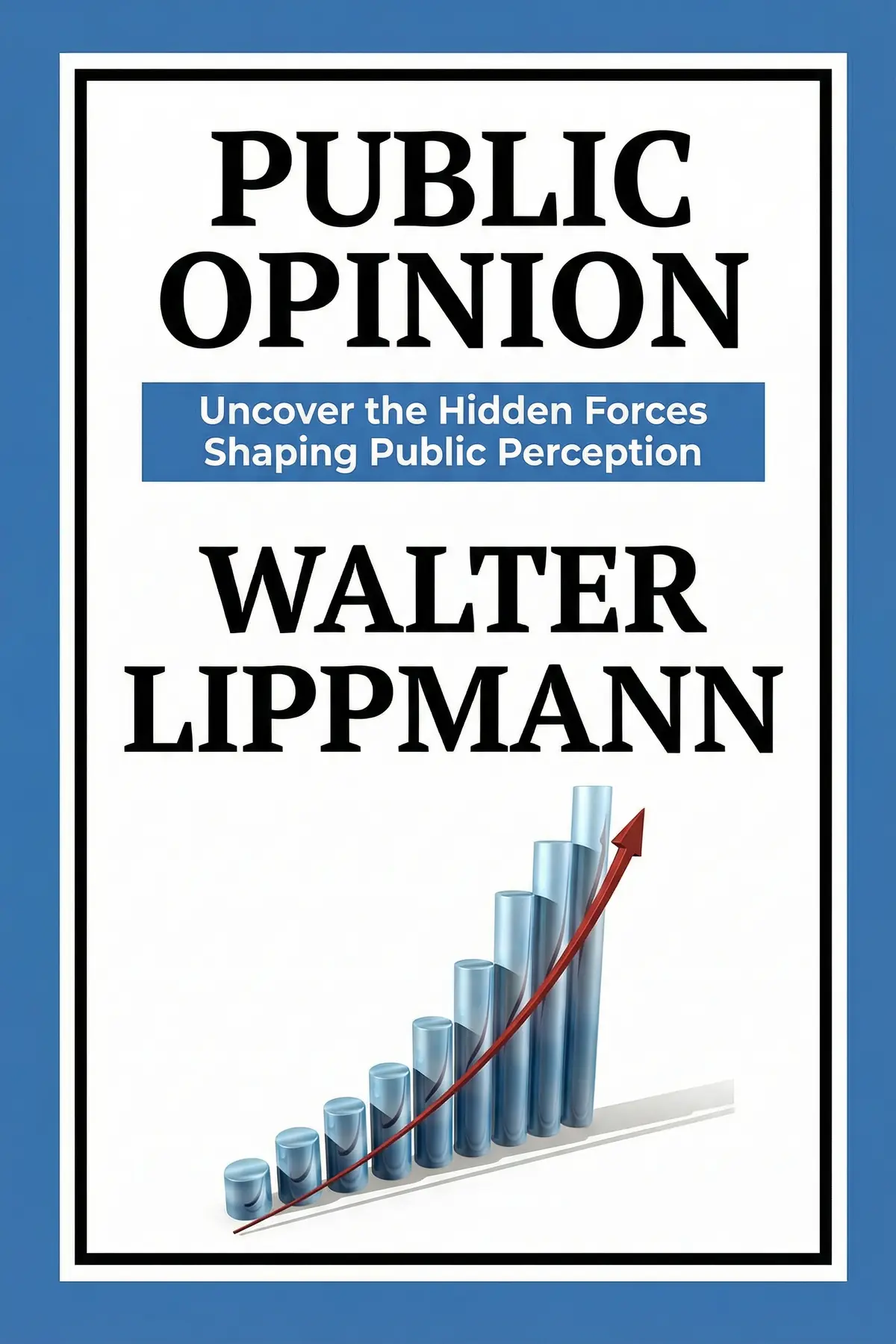
Table of Content
1. Introduction
1 min 48 sec
Imagine, for a moment, an idyllic island in the middle of the ocean during the summer of 1914. On this island, a small group of English, French, and German nationals live together in perfect harmony. They share meals, they trade goods, and they enjoy a peaceful, communal existence. But there is a catch: they are cut off from the rest of the world. They have no telegraph, no daily newspaper, and no radio.
For several weeks, while they continue their friendly interactions, their home countries are actually at war. Thousands of people are dying on battlefields in Europe, yet on this island, the residents still treat each other as friends because no one has told them they are supposed to be enemies. Their reality is based entirely on their direct, local experience. But the moment a ship arrives with news of the Great War, their world changes instantly. Their neighbors are no longer just neighbors; they are suddenly representatives of a hostile power.
Walter Lippmann uses this striking story to introduce a concept that is even more relevant today than it was a century ago: the idea of the pseudo-environment. He argues that we rarely, if ever, react to the world as it actually is. Instead, we react to a version of the world that has been constructed for us—a mental map made of news reports, cultural stories, and our own past experiences.
This summary will take you deep into Lippmann’s analysis of how public opinion is formed. We will explore the barriers that stand between us and the truth, the mental shortcuts we use to make sense of a chaotic world, and the ways in which our democratic systems are challenged by these psychological realities. By the end, you’ll see why our perceptions are often distorted and how that distortion affects everything from how we vote to how we view our fellow citizens. Let’s begin by looking at the walls we build around our own reality.
2. The Construction of a Pseudo-Environment
2 min 10 sec
Discover how the gap between the real world and our mental images creates a fictional reality that dictates our every move and social interaction.
3. Natural and Artificial Barriers to Perception
2 min 21 sec
Explore the physical, social, and political obstacles that filter the information we receive, leaving us with a fragmented view of the world.
4. The Efficiency and Danger of Stereotypes
2 min 11 sec
Learn why our brains use simplified mental images to categorize the world and how these shortcuts can lead to systemic prejudice.
5. Interests, Emotion, and the Manipulation of the Will
2 min 15 sec
Examine the ways in which leaders and advertisers bypass logic to tap into our deepest desires and fears to drive public consensus.
6. The Commercial Press and the Distortion of News
2 min 07 sec
Uncover the structural flaws in the news industry that prioritize audience retention and advertising over the objective delivery of truth.
7. The Path Toward a Functional Democracy
2 min 04 sec
Explore Lippmann’s controversial solutions for reform, including the use of expert intelligence to bridge the gap between facts and policy.
8. Conclusion
1 min 29 sec
As we wrap up our journey through Walter Lippmann’s Public Opinion, the throughline becomes clear: the greatest challenge to a healthy society isn’t just external enemies or bad policies, but the internal limitations of the human mind. We are all living in a ‘pseudo-environment’—a mental version of the world that is often a poor substitute for reality. Between us and the truth lie barriers of censorship, social isolation, and the seductive efficiency of stereotypes.
Lippmann’s work serves as a powerful reminder that our opinions are rarely as objective as we think they are. They are the products of a complex machinery involving our own personal interests, the emotional appeals of leaders, and the commercial pressures of the media. When we realize that everyone else is also reacting to their own unique, distorted map of reality, it becomes easier to understand why our political and social lives are so filled with friction.
The actionable takeaway here is to become an active gardener of your own pseudo-environment. Don’t take the pictures in your head for granted. Challenge your stereotypes, seek out diverse sources of information that make you uncomfortable, and recognize when you are being manipulated by symbols or emotional slogans. Democracy requires more than just a vote; it requires the discipline to look past the drama of the news and the comfort of our biases to find the truth that lies beneath. In a world of constructed realities, the most revolutionary act you can perform is to seek out the world as it actually is.
About this book
What is this book about?
Public Opinion is a seminal examination of the gap between reality and our perception of it. Walter Lippmann argues that the world is too vast and complex for any individual to perceive directly, leading us to rely on a 'pseudo-environment' constructed by media, culture, and stereotypes. This book dives into the psychological barriers that prevent us from seeing the truth, such as censorship, social isolation, and the inherent limitations of human attention. The promise of this work is a deeper understanding of why modern democracy often feels dysfunctional. Lippmann explores how interests are manipulated by leaders and how the commercial nature of the press further distorts our collective worldview. By analyzing the mechanics of how we form 'the pictures in our heads,' Lippmann provides a blueprint for media literacy and a sobering look at the challenges facing a truly informed citizenry. It is an essential guide for anyone looking to understand the hidden forces that drive political discourse and social behavior.
Book Information
About the Author
Walter Lippmann
Walter Lippmann was a renowned American journalist, philosopher, and political commentator known for his influential work on media and public opinion. His seminal book Public Opinion explored the ways media and psychological factors shape public perceptions and democratic processes. Lippmann’s career spanned several decades, during which he earned acclaim for his insightful analyses and his role in shaping modern journalism and political thought.
Ratings & Reviews
Ratings at a glance
What people think
Listeners find the material highly educational, with one noting its exceptional analysis of factual information. They also appreciate how accessible the writing is, though one listener remarked that it reads more like a political science book.
Top reviews
Pranee
This book is an absolute masterclass in social psychology and political science, despite being over a century old. Lippmann’s central thesis about the 'pictures in our heads' is perhaps the most convincing explanation for the polarization we see today. He brilliantly illustrates how we rely on internal stereotypes to navigate a world that is far too complex for any single human brain to fully grasp. Frankly, it is an incredibly dense and demanding read that requires your full attention. It challenges the romantic notion of the 'omni-competent citizen' and replaces it with a sobering look at how information is actually processed. You might find his reliance on a class of 'disinterested experts' a bit elitist, but his diagnosis of the problem is undeniable. Every student of journalism or politics needs to sit down with this text to understand why the truth is so elusive.
Show morePenelope
Finally got around to reading this foundational text, and the sections on World War I propaganda are chillingly relevant today. Lippmann describes a world where the 'bewildered herd' is led by emotional appeals rather than rational discourse, a sentiment that feels very modern. He argues that since nobody can truly know everything about the world, we rely on shortcuts that are easily manipulated by those in power. I was particularly struck by his description of the private citizen as a 'deaf spectator' in the back row of a play. It perfectly captures that feeling of being swept along by global forces that you cannot see or influence. This isn't just a history book; it is a warning about the fragility of informed consent in a technological age. If you can handle the academic tone, the rewards of finishing this are massive.
Show moreKofi
After hearing so much about the 'death of truth' in the social media age, I found Lippmann’s 1922 perspective surprisingly prophetic. He predicted exactly how direct communication between leaders and the masses could bypass the traditional gatekeepers of the press. The way he describes the 'manufacture of consent' is a direct precursor to everything Chomsky would write decades later. I particularly enjoyed his analysis of how strike actions are portrayed in the media based on the self-interest of the readers. He points out that people usually side against strikers simply because the strike inconveniences their daily lives, not because of any moral judgment. This kind of brutal honesty about human selfishness and cognitive bias is what makes the book a classic. It’s a long journey, but the intellectual payoff is well worth the effort for any serious reader.
Show moreMax
Wow, I did not expect a book on 1920s media to feel like a modernized version of Plato's famous Allegory of the Cave. Lippmann starts with that exact reference and then spends several hundred pages showing how we are still staring at shadows on a wall. He argues that our 'public opinion' is just a reaction to those shadows rather than the real world outside the cave. I found his description of the 'expert' as a necessary guide to be a very provocative and challenging idea. It forced me to rethink my own assumptions about how much a regular citizen can actually know about complex international policy. The prose is beautiful, almost poetic at times, which helps balance out the heavy political science themes. This is a foundational text that explains the DNA of our modern information crisis.
Show moreA
Ever wonder why two people can look at the same news report and come to entirely different conclusions? Lippmann answers this by exploring the gap between the real environment and the 'pseudo-environments' we construct for ourselves. The truth is that we are all living in worlds of our own making, fueled by the limited information we receive through the filters of the press. I found the sections on the psychology of how we perceive evidence to be the most rewarding parts of the entire book. However, the middle sections regarding World War I and military reports feel a bit bogged down in historical specifics. While these examples were likely vital in 1922, they make the pacing feel a bit uneven for a modern reader. Regardless, the core arguments about the limitations of democracy in a massive, interconnected society are still profoundly relevant and arguably quite frightening.
Show moreHugo
The chapter on the nature of news versus truth really opened my eyes to the structural failings of our current media landscape. Lippmann explains that news and truth are not the same thing; news is simply a signal of an event, while truth brings hidden facts to light. He argues that because we aren't willing to pay for news, advertisers and special interests inevitably fill the gap. I was surprised to see that these complaints were just as prevalent a hundred years ago as they are in the era of social media. Personally, I think his critique of journalism is the strongest part of the book and deserves more attention from modern critics. The writing style is definitely a bit old-fashioned and some sentences are quite long, which makes it a slow read. Still, the intellectual depth here is far superior to most of the political commentary you see on television today.
Show moreOmar
Picked this up to better understand modern media bias, and I was floored by how little has actually changed in a century. Lippmann identifies the 'stereoype' as our primary tool for making sense of the world, and he isn't entirely wrong. We all use these shortcuts to avoid the mental paralysis of trying to understand every single global event. Look, the book is definitely a slog in places, especially when he starts talking about the intricacies of the telegraph and old press services. But if you stick with it, you get a very clear picture of why democracy is so difficult to maintain. He doesn't offer easy answers, and his call for critical thinking at the end feels almost like a desperate plea. It is a brilliant, if somewhat depressing, examination of how we form our political identities.
Show moreGabriel
Not what I expected when I first picked this up based on a strong recommendation from a colleague. It reads much more like a dry, academic political science textbook than a casual piece of cultural criticism. I appreciated the deep dive into how the press functions, but the sections on World War I felt like they belonged in an entirely different book. While the concept of the 'pseudo-environment' is fascinating, I found myself getting lost in the historical minutiae of French government censorship. It is certainly informative, but you have to be in the right headspace to tackle the prose. To be fair, Lippmann’s insights on how we simplify complex issues into digestible stereotypes are brilliant. I just wish the book were a bit more concise and focused on those psychological elements rather than wandering into the weeds of 1920s labor politics.
Show moreViolet
To be fair, parts of this book are incredibly dated, especially when Lippmann wanders into the weeds of 1920s labor politics and guild socialism. I struggled to stay engaged during the chapters that focused on specific military dispatches from the First World War. However, the overarching theme of how we personify abstractions and create allegories to simplify the world is still very sharp. He describes how we take a complex social issue and turn it into a simple drama with heroes and villains. This psychological insight alone makes the book worth at least a browse, even if you end up skimming the more historical sections. It is a very honest book, which is refreshing, even if that honesty leads to some pretty bleak conclusions about our collective intelligence. Just be prepared for a very academic experience rather than a fast-paced page-turner.
Show moreKasemsan
As someone who believes deeply in the power of the individual voter, Lippmann’s dismissal of the common man felt incredibly condescending. He treats the public as an incoherent mass that is incapable of understanding the complexities of the world without the help of elite experts. This 'top-down' approach to democracy is exactly what leads to the kind of technocratic overreach that many people find so frustrating today. I found his prose to be quite elegant, but the underlying cynicism regarding human nature was very difficult to swallow. The truth is that he basically advocates for a form of soft authoritarianism where a few 'boffins' decide what the rest of us should think. While I agree that stereotypes are a real problem in our thinking, his solution feels far more dangerous than the illness he is trying to cure. It was an interesting historical read but a very irritating one.
Show moreReaders also enjoyed
A Warning
Miles Taylor
Abolish Rent: How Tenants Can End the Housing Crisis
Tracy Rosenthal
Abortion: Our Bodies, Their Lies, and the Truths We Use to
Jessica Valenti

Adults in The Room: My Battle With Europe’s Deep Establishment
Yanis Varoufakis
21 Lessons for the 21st Century
Yuval Noah Harari
AUDIO SUMMARY AVAILABLE
Listen to Public Opinion in 15 minutes
Get the key ideas from Public Opinion by Walter Lippmann, plus 5,000+ more titles in English and Thai.
- 5,000+ titles
- Listen as much as you want
- 7-day free trial
- Cancel anytime







