
13 min 18 sec
Running Lean: Iterate from a Plan A to A Plan That Works
By Ash Maurya
Running Lean provides a systematic framework for entrepreneurs to validate their business ideas quickly. It focuses on achieving product-market fit through continuous testing, customer feedback, and lean business modeling for maximum efficiency.
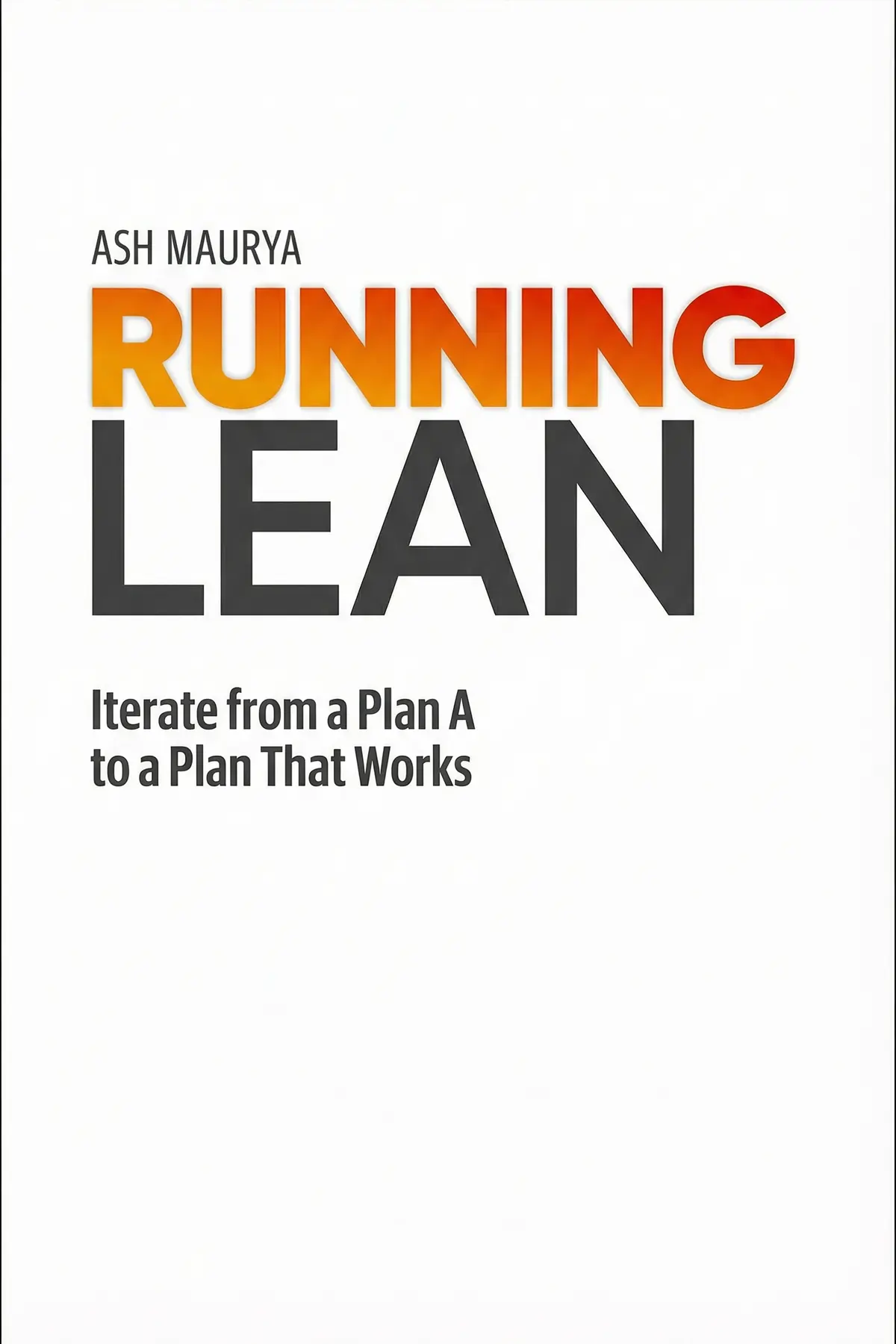
Table of Content
1. Introduction
1 min 16 sec
Every entrepreneur starts with a dream, a vision of a product that will change the world—or at least change their bank account balance. We often imagine that the path to success is a straight line from a brilliant idea to a finished product. But the reality is that the vast majority of startups fail. They don’t fail because the founders lacked passion or because the engineers couldn’t code. They fail because they spent months or years building the wrong thing. They followed a plan that looked great on paper but fell apart the moment it hit the real world.
This is where the philosophy of running lean comes into play. It’s not about being cheap; it’s about being fast and efficient with your most valuable resource: time. Instead of betting everything on a single ‘Plan A,’ the lean approach is about iterating—moving from that initial idea to a plan that actually works through a process of constant validation.
In this summary, we are going to explore a systematic process for reducing the risk of failure. We’ll look at how to map out your business on a single page, why you should stop relying on surveys, and how to know when you’ve finally found that elusive ‘product-market fit.’ The goal is to stop guessing and start knowing what your customers truly need. Let’s dive into how you can build something people will actually pay for without wasting a fortune in the process.
2. Mapping Your Vision on a Lean Canvas
1 min 36 sec
Discover how a simple one-page diagram can replace the traditional, bulky business plan and allow for rapid adjustments as your idea evolves.
3. The Engine of Validation
1 min 33 sec
Learn why the Build-Measure-Learn loop is the essential mechanism for testing your assumptions and avoiding costly mistakes.
4. The Power of Direct Conversation
1 min 28 sec
Find out why personal interviews are far more effective than surveys or focus groups for understanding your customer’s deepest pain points.
5. Defining Your Unique Value Proposition
1 min 32 sec
Master the art of crafting a clear, compelling message that instantly tells customers why they should care about your product.
6. Building the Minimum Viable Product
1 min 26 sec
Explore the strategy of building a demo or a functional prototype to test your core solution before committing to full-scale development.
7. Tracing the Customer Lifecycle
1 min 29 sec
Understand how to identify and fix the ‘leaks’ in your business by monitoring the journey from first contact to loyal customer.
8. Achieving Product-Market Fit
1 min 34 sec
Recognize the signs of real traction and learn how to iterate or pivot until your product perfectly matches the market’s needs.
9. Conclusion
1 min 24 sec
The journey of building a startup is often portrayed as a heroic gamble, but as we’ve seen, it doesn’t have to be. By following the principles of running lean, you can transform entrepreneurship from a high-stakes roll of the dice into a systematic process of learning and discovery.
The core of this approach is humility. It requires you to admit that your initial ‘Plan A’ is likely flawed and that the real answers exist outside of your own head. By using the Lean Canvas to document your assumptions, the Build-Measure-Learn loop to test them, and personal interviews to understand your customers, you create a feedback loop that constantly pushes you toward the truth.
Remember, the goal isn’t just to build a product; it’s to build a successful business model. This means being willing to kill off features that don’t work, listen to feedback that hurts your ego, and pivot when the data shows a better path.
As you move forward, the most actionable piece of advice is this: get out of your office. Don’t fear feedback—seek it out. Whether you’re a solo founder or leading a large team, start by talking to ten potential customers this week. Don’t try to sell them anything; just try to understand their world. If you can find a problem that is truly worth solving, and you remain flexible enough to iterate your way to the solution, you’re no longer just running an idea—you’re running lean. And that is the fastest way to turn a vision into a reality.
About this book
What is this book about?
Many startups fail not because they can’t build a product, but because they build something nobody wants. Running Lean offers a solution to this problem by providing a step-by-step roadmap for taking an idea from its initial conception to a successful market launch. It replaces long, rigid business plans with a flexible, one-page diagram called a Lean Canvas. The book emphasizes the importance of learning over planning. By using the Build-Measure-Learn feedback loop, entrepreneurs can test their assumptions in the real world before wasting precious time and capital. The promise of this approach is a leaner, faster, and more reliable way to find a business model that actually works, ensuring that your product addresses a genuine pain point in the market.
Book Information
About the Author
Ash Maurya
Ash Maurya is a seasoned entrepreneur and the founder of several successful startups, including WiredReach. He is a leading voice in the lean startup movement, working closely with other founders to help them apply lean methodologies to their ventures. Maurya also serves as a mentor at various startup accelerators, where he shares his expertise in product-market fit and business model validation.
Ratings & Reviews
Ratings at a glance
What people think
Listeners find the book's insights highly valuable, with one individual noting it reflects 10 years of startup consulting experience. Furthermore, the fundamental guidance for new entrepreneurs and straightforward ideas make it a functional resource. Listeners also consider the content beneficial, including one who mentioned it helped them save time and money.
Top reviews
Chatri
This book is a masterclass in pragmatism for anyone actually trying to build something from scratch. Instead of theorizing about success, Maurya provides a clear roadmap that helped me avoid dumping thousands into a failing idea. The Lean Canvas alone justifies the purchase price because it forces you to confront the riskiest parts of your business model before you write a single line of code. Frankly, I wish I’d found this years ago when I was chasing vanity metrics instead of real customer validation. It’s an essential handbook that translates vague 'startup vibes' into a repeatable, scientific process.
Show moreMilk
As someone who identifies as an engineer by trade, I initially approached this text with a massive amount of skepticism. I was looking for technical agile strategies, but what I found was something much more valuable: a way to apply the scientific method to a business plan. Maurya explains how to treat your product as an experiment, using customer interviews to extract hard data rather than just seeking ego-boosting compliments. It shifted my focus from purely 'how to build' to 'what is actually worth building' for the user. This isn't just for 'entrepreneurs'—it's for anyone who wants to create solutions that actually solve real-world problems.
Show moreEthan
The section on vanity metrics was a total wake-up call for my current project. Instead of obsessing over hits or downloads, Maurya pushes you to find 'early adopters' who are willing to give you a real commitment. I appreciate how he breaks down the 'Unfair Advantage' concept, forcing you to think about what cannot be easily bought or copied by competitors. Truth is, the book is a bit dated in its specific examples, but the core principles remain incredibly relevant in today's saturated market. If you are struggling to get past the initial 'idea' phase, this systematic approach to testing hypotheses is exactly what you need.
Show morePor
Finally got around to finishing this, and it’s easily one of the most actionable startup books on my shelf. It takes the abstract concepts of the lean movement and turns them into a step-by-step workbook that any founder can follow. The emphasis on defining your MVP based on qualitative feedback rather than just your own 'vision' is a hard pill to swallow but absolutely necessary. You might find some of the concepts basic if you’re a veteran, but for a first-timer, this is the gold standard. It’s about building a business model that is actually viable, not just a product that looks cool.
Show moreTern
Ever wonder why most startups fail within the first eighteen months? It is usually because they build something nobody wants, and this book tackles that head-on with a very specific, iterative framework. To be fair, the first chapter contains the meat of the argument, and the subsequent sections can feel like an expansion of those initial points. Some might find the repetition annoying, but for me, it hammered home the importance of the problem/solution fit. While the writing style occasionally drifts into a 'blogger' tone, the underlying logic is sound enough to ignore the fluff.
Show moreFilm
Wow, I am genuinely impressed by how much practical wisdom is packed into these pages. It is obvious that the author has spent over a decade in the trenches of startup consulting because the advice feels lived-in and battle-tested. Look, the process is quite detailed—maybe even a bit overwhelming for a total novice—but that complexity is necessary to navigate the 'Plan A' trap. I particularly liked the distinction between users and customers; knowing who actually pays the bills is a lesson many founders learn too late. It’s a solid resource that will save you both time and capital if you actually follow the steps.
Show moreJoshua
After hearing so much buzz about the Lean Canvas, I finally decided to dive into the full source material. The book serves as a comprehensive manual for iterating your way to success before you run out of resources or patience. While some sections feel a bit repetitive, the focus on 'getting out of the building' to talk to real people is a message that cannot be repeated enough. I found the advice on customer interviews particularly enlightening, specifically the part about listening for pain points rather than pitching your own solution. It’s a grounded, tactical guide that avoids the 'self-important' tone common in business literature.
Show moreCamila
Not what I expected from a business book, but in a surprisingly good way. Instead of high-level fluff, you get a grit-and-grind look at how to validate a business model through small, fast experiments. The focus on 'Speed, Focus, and Learning' as an intersection for success is a framework I now use daily with my own team. Not gonna lie, the author’s writing can be a bit 'over-enthusiastic blogger' at times, which might grate on some readers. However, the practical value of the checklists and interview scripts far outweighs any minor stylistic gripes I might have.
Show moreSomboon
Personally, I found the amount of detail in the latter half of the book to be a bit suffocating. While the 'Plan A' concept is brilliant, the process introduced to move beyond it becomes so complex that it’s hard to follow the thread. It feels like a rewrite of more popular startup books but with a heavier emphasis on a very specific, rigid methodology. Got to say, I preferred the first version of this book for its simplicity, as this one feels like it’s trying too hard to be a definitive textbook. It’s decent for a one-time read, but it didn't quite hit the mark for me.
Show moreMaja
Picked this up with high hopes but ended up feeling like I was reading a collection of old blog posts. The author lacks the deep institutional background of other business theorists, and it shows in the way he over-simplifies complex market dynamics. Most of the content is just a rehash of Eric Ries’s work, rephrased with more 'rules' and 'steps' that feel artificially inflated to fill pages. If you have already read the foundational lean literature, you can probably skip this one without missing much. It’s a weak attempt at universalizing theories that don't always apply to larger, more complex ventures.
Show moreReaders also enjoyed
7 Powers: The Foundations of Business Strategy
Hamilton Helmer
Alibaba: The House That Jack Ma Built
Duncan Clark
Be Obsessed or Be Average
Grant Cardone
Being Boss: Take Control of Your Work and Live Life on Your
Kathleen Shannon
Better and Faster: The Proven Path to Unstoppable Ideas
Jeremy Gutsche
AUDIO SUMMARY AVAILABLE
Listen to Running Lean in 15 minutes
Get the key ideas from Running Lean by Ash Maurya, plus 5,000+ more titles in English and Thai.
- 5,000+ titles
- Listen as much as you want
- 7-day free trial
- Cancel anytime







