
15 min 20 sec
Simply Said: Communicating Better at Work and Beyond
By Jay Sullivan
Simply Said provides a practical roadmap for transforming professional communication by shifting the focus from the speaker to the audience, offering tools for clearer writing, more impactful speaking, and stronger leadership presence.
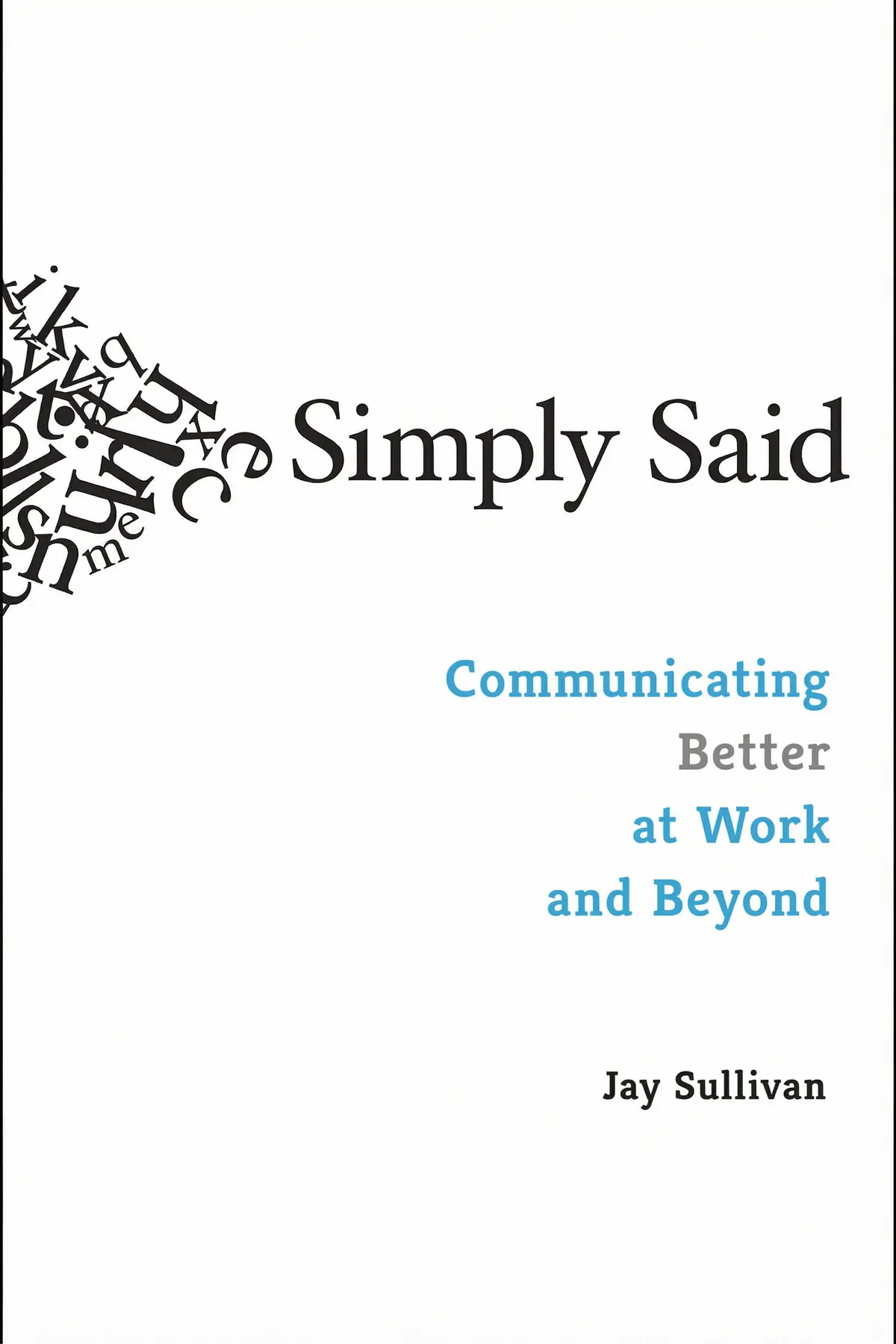
Table of Content
1. Introduction
1 min 33 sec
In our daily professional lives, we spend a massive amount of time communicating, yet it is often the area where we feel the most friction. We send emails that go ignored, give presentations that fail to spark action, and have conversations that leave us feeling misunderstood. At the heart of this struggle is a common misconception: we often think communication is about us—about our knowledge, our ideas, and our delivery. However, the true secret to connection lies in a radical shift of perspective.
This summary explores the core philosophy of Simply Said, a guide that argues that the most effective communicators are those who relentlessly focus on their audience. Whether you are addressing a single colleague or a stadium full of listeners, your success depends on your ability to frame your message around what the other person needs and cares about. This isn’t just a soft skill; it is a strategic advantage that can redefine your career and your relationships.
Throughout this discussion, we will walk through the essential pillars of this approach. We will look at how to build a message from the ground up by putting the listener first, how to use your physical presence and voice to command attention without being overbearing, and how to write with a precision that respects your reader’s time. We will also dive into the nuances of different professional contexts, the unique responsibilities of communication in a leadership role, and the art of facilitating groups so that every voice is heard. By the end, you’ll have a clear framework for becoming a more intentional, impactful communicator in every facet of your life.
2. The Audience-First Mindset
2 min 08 sec
True influence begins by moving past your own ego and expertise to focus entirely on what your listener actually needs from you.
3. Physical and Vocal Presence
1 min 56 sec
Your body and voice are the vehicles for your message; learn how to use them to create a genuine connection with your listeners.
4. Precision in Writing
2 min 00 sec
In a world of information overload, your writing must be immediate, structured, and profoundly respectful of the reader’s time.
5. Adapting to the Environment
2 min 05 sec
Each communication setting has its own rules; success comes from knowing how to shift your style to fit the room.
6. The Leader as a Communicator
2 min 04 sec
Leadership is less about giving orders and more about creating an environment where open and safe dialogue can flourish.
7. Mastering Group Success
2 min 04 sec
Facilitating a group requires a delicate balance of guidance and openness to ensure every session yields actionable results.
8. Conclusion
1 min 30 sec
In the end, the core message of Simply Said is that communication is a skill that can be studied, practiced, and mastered by anyone. It is not a mysterious talent reserved for the naturally charismatic; rather, it is a disciplined commitment to being present for others. By shifting your focus away from your own internal state and toward the needs and experiences of your audience, you transform every interaction.
We have seen how this audience-first approach informs everything from the way you stand and speak to the way you structure an email or lead a meeting. We’ve explored the importance of creating psychological safety so that ideas can flow, and the necessity of being clear and concise to show respect for others’ time. Communication is the bridge between your ideas and the world’s reactions to them. When that bridge is built with empathy, clarity, and intentionality, there is no limit to what you can achieve.
As you move forward, try to take one small piece of this framework and apply it to your next interaction. Perhaps it’s a strategic pause during a presentation, or a more direct opening sentence in an email. These small shifts in how we connect with others can lead to profound changes in our professional impact and the quality of our relationships. Remember, the goal is not to be a perfect speaker or writer, but to be a clear, authentic, and audience-focused communicator who makes every interaction matter.
About this book
What is this book about?
Communication is often the most significant hurdle in professional environments, yet it is frequently approached as a self-centered exercise. Simply Said challenges this habit, teaching readers that effective connection is rooted in prioritizing the listener’s needs over the speaker’s expertise. The book provides a comprehensive guide to mastering various forms of interaction, from the physical nuances of public speaking and the structural requirements of clear email writing to the complex dynamics of leading teams and facilitating high-stakes group discussions. By focusing on clarity, empathy, and strategic preparation, it promises to help anyone move from merely delivering information to truly influencing and inspiring others in any professional or personal context.
Book Information
About the Author
Jay Sullivan
Jay Sullivan is an experienced consultant and former Managing Partner at Exec|Comm, LLC, specializing in audience-focused communication for professionals. A versatile writer and educator, he has contributed to The New York Times and Reader’s Digest, and wrote a regular column for the New York Law Journal. His previous work, Raising Gentle Men, received prestigious recognition from the Catholic Press Association. Sullivan's background includes legal practice and teaching in Jamaica.
Ratings & Reviews
Ratings at a glance
What people think
Listeners find this book expertly written with chapters that are easy to digest, appreciating the actionable tips and real-world examples that sharpen communication skills. The content also draws praise for its presentation advice, with one listener observing its thorough coverage of various scenarios, and listeners find the concepts simple to put into practice. Furthermore, they value its accessibility as a fast read, and one listener notes its effectiveness in helping to shape their mindset.
Top reviews
Tippawan
Jay Sullivan hits the nail on the head with his approach to workplace interactions. The advice is remarkably practical and easy to implement in your daily routine. I appreciate how the chapters are broken down into digestible bites, making it a very quick read for busy professionals. Truth be told, I’ve already noticed a shift in my mindset regarding how I approach difficult conversations with my team. It’s well-written and filled with real-world examples that bring the concepts to life for anyone struggling to be heard.
Show moreOmar
The chapter on audience-centric communication completely flipped my perspective on how I draft my weekly reports. Instead of focusing on getting my own point across, I now spend more time thinking about what information my manager actually needs to succeed. Gotta say, the transition from being an information-dumper to a strategic communicator has improved my professional relationships significantly. The book is well-written with clear, actionable steps that don't feel like typical corporate jargon. I particularly enjoyed the section on how to handle emails to ensure they are collaborative rather than just directive.
Show moreSuthinee
Communication isn't just about what you say, but how you’re heard, and Sullivan manages to distill that idea perfectly. The book offers a mindset shift that encourages you to step into the shoes of your audience before you even open your mouth. Not gonna lie, I used to just read my slides during presentations, which I now realize was incredibly boring for everyone involved. The practical examples provided in each chapter helped me relook at my own flaws and fix them in real-time. It’s an excellent resource for anyone looking to become a more thoughtful and effective communicator in any field.
Show moreKanokwan
Picked this up during a career pivot and found the section on collaborative email styles to be an absolute lifesaver. Coming from a background where communication was mostly about giving orders, I needed a way to soften my tone without losing my authority. Sullivan provides a fantastic roadmap for writing emails and conducting meetings that feel more like a conversation and less like a lecture. The book is incredibly readable and doesn't waste your time with unnecessary fluff or complicated theories. It's one of those rare business books that you can actually finish in a few sittings and start using the next day.
Show moreEleanor
Transitioning into a professional corporate environment felt like learning a second language until I found this guide. Coming from a background where directive, authoritative communication was the norm, I struggled to adapt to the more collaborative tone required in my new office. Sullivan’s breakdown of how to move away from just passing down information to actually engaging an audience was a revelation for me. The book helped me realize that my presentations were often just reading off slides rather than inviting interaction. While some sections felt a bit basic, the overall impact on my writing style has been significant.
Show morePete
After hearing several coworkers rave about the presentation tips, I decided to give it a shot. The book is packed with good illustrations that show you exactly how to structure your thoughts before a big meeting. Personally, I found the chapters on interactive presentations to be the most beneficial because I’ve always struggled with keeping an audience engaged. Sullivan emphasizes focusing on the needs of the listener rather than your own agenda, which is a simple but powerful shift. The writing is concise and the examples are relatable, making it easy to digest over a weekend.
Show moreNam
Finally got around to finishing this for our office bookclub, and the consensus was largely positive. We had a long discussion about the habits we’ve formed over the years and which ones are actually helping us communicate better. It was incredibly reassuring to learn that some of our effective habits are backed by Sullivan’s expertise. In my experience, books like this can be hit or miss, but the consistent coverage of different scenarios makes this one a winner. The practical tips for meetings and presentations were easy to implement right away, even if some parts felt like common knowledge.
Show moreNina
Is there anything ground-breaking within the pages of Sullivan's latest work? To be fair, the author isn't trying to reinvent the wheel, but rather to polish the basics of human interaction. I found the advice on meeting etiquette and concise writing to be useful, if a bit repetitive at times. Everything is laid out clearly, which stays true to the book’s title, yet I was hoping for more advanced strategies. It’s a solid resource for new hires, but seasoned professionals might find it a bit too elementary for their needs.
Show moreSomboon
Look, the book is a bit dry in parts, even if the advice provided by the author is fundamentally sound. I appreciated the specific focus on moving away from authoritative communication styles toward more collaborative methods of engagement. For anyone struggling with writing emails that sound too bossy or directive, the tips here will be a massive help. The layout is clean and the tone is professional, though I wish there were a few more anecdotes to break up the technical advice. It's a decent guide for sharpening your professional edge without needing to read a massive textbook.
Show moreMeen
Not what I expected given the hype, as most of the advice felt like common sense you’d pick up in any entry-level job. Frankly, I was disappointed by the lack of depth in the sections regarding complex negotiations or high-stakes leadership scenarios. While the book is certainly a quick read and easy to navigate, it felt a little too simplistic for someone with a decade of experience. The focus on 'simple' is taken a bit too literally here, leaving me wanting more nuanced psychological insights into communication. It might work for some, but it didn't offer the growth I was looking for.
Show moreReaders also enjoyed


AUDIO SUMMARY AVAILABLE
Listen to Simply Said in 15 minutes
Get the key ideas from Simply Said by Jay Sullivan, plus 5,000+ more titles in English and Thai.
- 5,000+ titles
- Listen as much as you want
- 7-day free trial
- Cancel anytime







