
18 min 42 sec
Singletasking: Get More Done One Thing at a Time
By Devora Zack
This summary explores why multitasking is a myth that drains productivity and increases stress, offering a practical framework for regaining focus through the power of singletasking to achieve more by doing less.
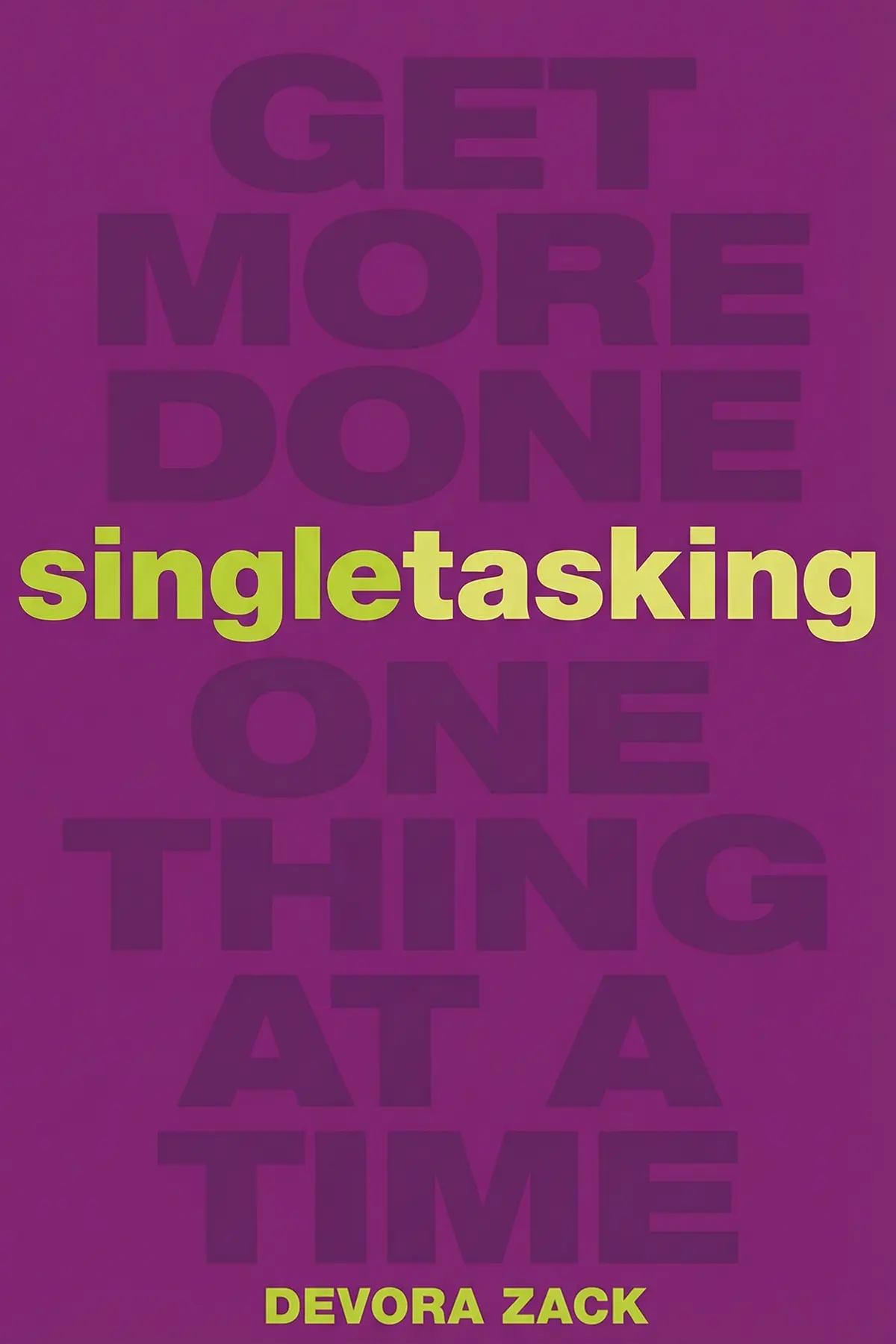
Table of Content
1. Introduction
1 min 52 sec
Imagine your typical morning. You might be checking emails while eating breakfast, or perhaps you’re catching up on the news while walking the dog. On the surface, this feels like efficiency. It feels like you are getting ahead of the day before it even begins. We have been told for years that multitasking is the ultimate productivity hack, a necessary survival skill for the modern era. But what if that belief is actually the very thing preventing you from reaching your potential?
The reality is that trying to juggle multiple tasks at once doesn’t just split your attention; it fragments your effectiveness and spikes your stress levels. It creates a shallow existence where many things are started, but nothing is done with true excellence. This is where the concept of singletasking comes in. It is more than just a technique; it is a fundamental shift in how we approach our work and our lives.
In this summary, we are going to explore why our brains simply aren’t built to handle simultaneous demands and why the pursuit of doing everything at once is costing us billions of dollars and thousands of lives every year. We will look at how moving into a state of ‘flow’ can transform your output and how simple changes to your environment and schedule can protect your most valuable resource: your focus. By the end of this journey, you’ll see that the secret to getting more done isn’t adding more to your plate—it’s learning to commit fully to one thing at a time.
2. The Dangerous Myth of the Multitasking Mind
2 min 42 sec
Think you can drive and text at the same time safely? Discover why your brain is physically incapable of processing two complex tasks simultaneously.
3. Our Evolutionary Resistance to Distraction
2 min 33 sec
Explore the biological reasons why our ancestors survived through focus and how modern overstimulation is physically changing the structure of our brains.
4. Strategies for Reclaiming Your Attention
2 min 54 sec
Learn how to build a fortress around your focus using practical techniques like cluster tasking and scheduling buffers for the unexpected.
5. The Social Power of Undivided Attention
2 min 03 sec
Discover how presence can transform your professional and personal relationships, using a surprising lesson from a world leader.
6. Recharging Through Reflection and Rest
2 min 23 sec
Why doing nothing is actually one of the most productive things you can do, and how silence helps solve your most stubborn problems.
7. The Connection Between Focus and Fulfillment
2 min 30 sec
See why the most satisfied people are those who can immerse themselves in the present, and what a world-class violinist learned from children.
8. Conclusion
1 min 45 sec
The journey from the chaotic world of multitasking to the focused realm of singletasking isn’t an overnight transformation, but it is one of the most rewarding shifts you can make. As we have seen, the idea that we can do more by doing many things at once is a biological fallacy. It drains our energy, hurts our brains, and dilutes the quality of our relationships. By choosing to singletask, you are choosing to respect your own cognitive limits and honor the people around you.
The core message is clear: your productivity and your peace of mind are found in the ‘crucial few’ rather than the ‘trivial many.’ You can start today by simply looking at your to-do list and identifying what is truly essential. Cut the fat from your schedule and commit to finishing one important task before moving to the next. Use the strategies we discussed—like clustering your tasks and building in buffer time—to protect your focus from the inevitable interruptions of daily life.
Remember that every time you choose to give your full attention to a single person or a single project, you are investing in your own excellence. You are moving away from a life of frantic, shallow activity and toward a life of depth, purpose, and genuine achievement. Singletasking is the bridge to a more productive career and a significantly happier life. Take a breath, put the distractions aside, and focus on the one most important thing right now. That is where your true power lies.
About this book
What is this book about?
In a world that constantly demands our attention, we often fall into the trap of believing that the more things we do at once, the more we accomplish. This book argues that the opposite is true. Singletasking reveals that multitasking is not a skill to be mastered, but a harmful habit that fractures our attention, lowers our quality of work, and even puts our physical safety at risk. The core promise of this work is a return to sanity and efficiency through the deliberate practice of focusing on a single task at a time. By examining the neurological limits of the human brain and the psychological benefits of immersion, the book provides a roadmap for restructuring your day. You will learn how to manage digital distractions, handle interruptions from others, and group your tasks to maximize cognitive flow. Ultimately, the guide shows how narrowing your focus can broaden your results, leading to a more productive career, deeper personal relationships, and a significantly higher level of overall life satisfaction.
Book Information
About the Author
Devora Zack
Devora Zack is a leadership consultant and the founder of Only Connect Consulting. Her expertise in leadership consulting has provided the foundation for several books, including Networking for People Who Hate Networking and Managing for People Who Hate Managing.
Ratings & Reviews
Ratings at a glance

What people think
Listeners find this guide beneficial for boosting efficiency in any activity and value its inspiring message. The content is both thoroughly researched and educational, incorporating a sense of humor that makes for an engaging experience. They are impressed by the steady flow, with one listener highlighting how it mends personal connections, while another points to its functional networking strategies tailored for introverts.
Top reviews
Stella
Wow. Ever wonder why you feel like a fried circuit board by 3 PM? Devora Zack explains exactly why: your brain is literally shrinking from the stress of constant overstimulation. I found the sections on cortisol and the prefrontal cortex absolutely fascinating because they provided a biological reason for my lack of focus. This isn't just another dry business book; Zack’s humor makes the "scary" science much easier to swallow. The concept of "cluster tasking"—grouping similar chores together—has already saved me hours of mental energy this week. Honestly, the most impactful part for me was the realization that being "plugged in" is actually perceived as rude and unprofessional by high-level executives. It’s a wake-up call for anyone who thinks they’re being productive by answering emails during meetings. This is a must-read for anyone feeling scattered. It works.
Show moreBae
Finally got around to reading this after struggling with burnout, and it feels like a weight has been lifted. Zack’s background in leadership consulting really shines through in her practical approach to time management. I’ve read her other books for introverts, and this has that same relatable vibe. The idea that our brains aren't evolved for multitasking was the permission I needed to stop trying to be a superhero. I especially liked the "time-shifting" strategy to balance high productivity with necessary decompression. It’s not just about doing more; it’s about doing things better and being happier. Personally, I found the pacing to be perfect for a busy professional. It’s motivational without being cheesy, and the advice is actually doable in a real-world office. It really restores your focus.
Show moreAiden
The chapter on the "Parking Lot" technique alone is worth the price of admission. I constantly have random ideas popping into my head while I’m trying to focus, and having a dedicated place to "park" them has saved my workflow. Devora Zack writes with a blend of directness and wit that makes the pages fly by. I was shocked to learn that constant multitasking can actually shrink gray matter in the brain—talk about a motivation to change! The book is well-researched but stays light enough to be an enjoyable weekend read. I also appreciated the emphasis on building a "buffer" into your schedule for the unexpected. It’s a very grounded, realistic take on how to navigate a world that is constantly trying to steal your attention. Five stars. Truly helpful.
Show moreKasemsan
Zack brings a much-needed dose of reality to our notification-obsessed culture with a writing style that is both punchy and accessible. The book focuses on the "how" of regaining focus rather than just the "why," which I appreciated. I particularly liked the "parking lot" technique for managing those intrusive thoughts that pop up when you're trying to work deep. My only real gripe is that some of the workplace examples felt a little unnatural and didn't quite map onto my own experience in a fast-paced environment. However, the core message about active listening and respect in relationships really resonated with me. We often forget that singletasking isn't just about work; it's about being present for the people we care about. It’s a solid professional tune-up that I’ll probably revisit every year to keep my habits in check. Good stuff.
Show moreNarut
As someone who struggles to sit still, the concept of "cluster tasking" was a total game-changer for me. I’ve spent years trying to do five things at once, only to end up with five half-finished projects and a massive headache. Zack’s directness helped me see that I wasn't being efficient; I was just being frantic. I loved the advice on setting boundaries, like telling colleagues you’re "off-line" for a few hours to actually get work done. To be fair, some of the research cited felt a bit loosely connected to the office environment, but the practical hacks more than made up for it. The book is short and moves quickly, which I appreciated given the subject matter. It’s a great tool for anyone who needs to "reboot" their work habits and find some tranquility in a chaotic schedule. Worth the time.
Show moreMadison
Singletasking is a refreshingly direct antidote to the toxic productivity culture that demands we do everything at once. Zack’s basic premise is that we aren't actually multitasking; we are just rapidly switching tasks and losing efficiency every time. This resonated with me because I’ve noticed how much longer things take when I’m constantly checking Slack. The book is full of actionable advice, though some of the quizzes felt a bit like filler. I really appreciated the focus on active listening and how being "plugged in" can damage our professional reputation. Gotta say, it’s a great reminder that our full attention is the most valuable thing we can give to our work and our peers. While some examples are a bit over-the-top, the core message is vital for anyone working in a high-pressure environment today.
Show moreSirirat
After hearing so much hype about Devora Zack’s work, I went in with high expectations, but I ended up feeling a bit middle-of-the-road about it. The central idea—that multitasking is a lie—is 100% accurate and timely. However, the book feels like it’s stretching a very simple concept across way too many pages. I found myself skimming through the repetitive chapters halfway through. Truth is, if you’ve practiced basic mindfulness or used a Pomodoro timer, you already know most of what is being taught here. The quizzes and exercises are a nice touch for those who like interactive books, but they felt a bit "self-help 101" to me. It’s a decent introductory text for someone who is completely new to productivity, but seasoned pros might find it a bit basic. It’s not a bad book, just not a groundbreaking one.
Show moreNarongrit
Look, I appreciate the humor and the quick pacing of this guide, but I couldn't shake the feeling that this could have been an essay. The author makes some great points about how divided attention hinders our memory and increases stress hormones like cortisol. That part was eye-opening! But after the first few chapters, the book starts to repeat the same "focus on one thing" mantra without adding much new depth. I did enjoy the section on how singletasking improves social skills and active listening, as it added a human element to the productivity talk. Still, the workplace anti-patterns she describes felt a bit dated and didn't always ring true for modern remote work. It’s a helpful reminder to slow down, but don’t expect a deep philosophical dive into the nature of attention. Just okay.
Show morePrinya
Let’s be real: this book could have been a five-page PDF or a decent blog post. While I agree with the core message that multitasking is a myth and that we are all just "task-switching" our way to burnout, the text repeats this point ad nauseam. Zack relies heavily on personal anecdotes that sometimes feel forced or a bit cringe-worthy in a professional setting. I was looking for deep, peer-reviewed science on how our selective attention functions, but instead, I got a lot of surface-level advice about putting my phone away. To be fair, the "parking lot" idea for stray thoughts is helpful, but you have to wade through a lot of filler to find those small gems. It’s a quick read. However, if you’ve already read a few books on time management, you won’t find anything revolutionary here. I’d recommend just looking up a summary online instead.
Show moreWichai
The core thesis here is undeniably correct, but the execution left me wanting much more substance. I struggled with the tone; at times the humor felt misplaced, and the workplace scenarios were so grotesque they became distracting. For example, some of the arguments regarding texting while driving felt like a stretch when trying to prove why I shouldn't check email at my desk. There is a lot of "multitasking of thoughts" within the book itself, which is ironic for a text promoting focus. Frankly, it felt like a collection of blog posts that were expanded to meet a publisher's word count. I didn't feel like I gained a clear structure or a deep understanding of the cognitive science involved. If you want the gist, just read the introduction and skip the rest. It’s a shame because the topic is so important.
Show moreReaders also enjoyed
AUDIO SUMMARY AVAILABLE
Listen to Singletasking in 15 minutes
Get the key ideas from Singletasking by Devora Zack, plus 5,000+ more titles in English and Thai.
- 5,000+ titles
- Listen as much as you want
- 7-day free trial
- Cancel anytime







