
A Liberated Mind: How to Pivot Toward What Matters
Steven C. Hayes
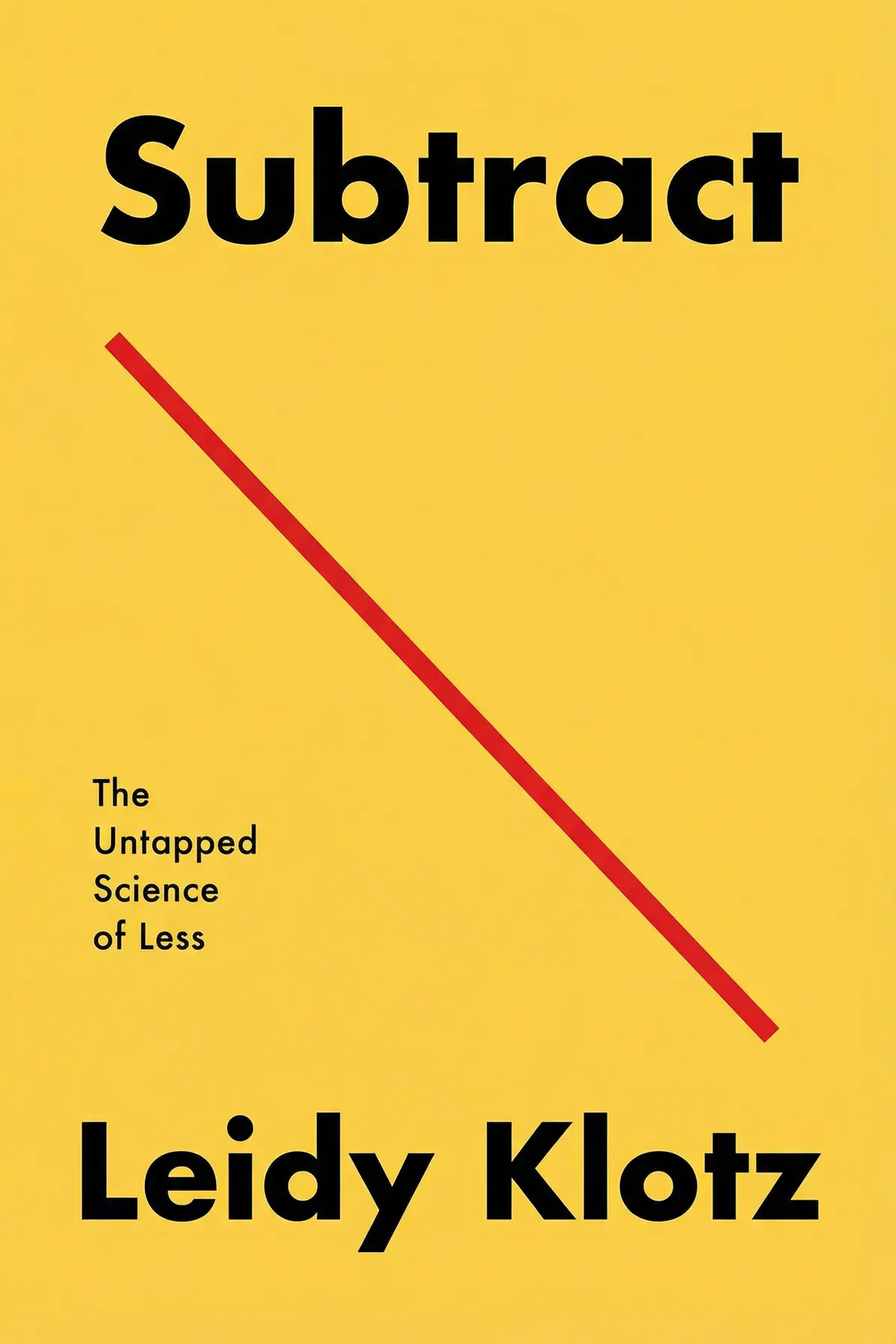
Explore the psychological and evolutionary reasons why we instinctively add more to our lives. This summary reveals how embracing subtraction can lead to better design, more effective leadership, and a more fulfilling existence.
1 min 56 sec
Think about the last time you felt overwhelmed. Perhaps your email inbox was overflowing, your kitchen counters were buried under gadgets you rarely use, or your calendar was a solid block of back-to-back meetings. In those moments, what was your first instinct to fix the problem? If you are like most people, your solution likely involved addition. You might have looked for a new app to organize your emails, bought a new shelving unit to hold the gadgets, or tried to squeeze in a new time-management system to handle the meetings.
We live in a world that is obsessed with ‘more.’ From the sprawling skyscrapers of our cities to the ever-expanding features on our smartphones, our culture and our minds seem programmed to believe that improvement is synonymous with addition. We have been conditioned to think that to make something better, we must put something into it. But what if the most powerful tool for change isn’t addition at all? What if the secret to solving our most complex problems—and living more balanced lives—is actually subtraction?
This is the central inquiry of the work we’re exploring today. We are going to look at the hidden science of ‘less’ and why it is so often overlooked. We will journey through human history, look into our biological evolution, and examine the economic forces that keep us on a treadmill of acquisition. Along the way, we will discover that subtraction is not just about ‘getting rid’ of things; it is a sophisticated, intentional process of refinement.
By the end of this summary, you will understand why your brain keeps reaching for more and, more importantly, how you can start training yourself to see the opportunities for less. We’ll see how this shift in perspective can help us tackle everything from architectural design and personal productivity to the deep-seated issues of social inequality. It’s time to stop thinking of subtraction as a loss and start seeing it as a way to unlock progress.
2 min 36 sec
Discover how removing a major piece of infrastructure transformed a city’s waterfront, illustrating why taking things away is often the most effective way to innovate.
2 min 41 sec
Understand the psychological experiments that prove our brains are naturally wired to favor addition over subtraction when solving problems.
2 min 51 sec
Explore how our biological instincts, from signaling competence to the search for food, drive our constant desire to acquire and add.
2 min 31 sec
Trace the history of human civilization back to its earliest structures to see how our obsession with building and adding shaped our societies.
2 min 51 sec
Examine how modern economic systems, particularly since the mid-20th century, have solidified addition as a moral and social imperative.
2 min 37 sec
Learn how viewing social issues through a systems lens can reveal that removing barriers is often more effective than adding support.
2 min 47 sec
Understand the concept of ‘satisficing’ and why we must exert extra effort to move past mediocre additions and reach the beauty of subtraction.
2 min 00 sec
As we wrap up our journey through the science of ‘less,’ the throughline becomes clear: our default setting is addition, but our greatest opportunities for progress lie in subtraction. We’ve seen how our biology, our history, and our economic systems have all conspired to make us overlook the power of taking things away. We are like the bowerbird, instinctively gathering ‘stuff’ to prove our worth, or the hunter-gatherer, fearing that any loss is a threat to survival.
But we are more than our instincts. We have the ability to step back and analyze the systems we’ve built. We can recognize that the ‘more’ we keep reaching for is often what’s keeping us stuck. Whether it’s the physical freeway blocking a city’s potential, the mental bias that makes us overcomplicate a simple Lego bridge, or the economic structures that trade our time for more possessions, the answer is often found in the ‘not’—in the things we choose to remove.
Subtraction is not about deprivation or living in a void. It is about clearing away the noise to hear the music. It’s about removing the barriers that prevent equality and the clutter that prevents clarity. It is a form of intentional design that requires more thought, more courage, and more effort than simple addition ever will.
So, as you step back into your daily life, try to practice ‘subtractive thinking.’ The next time you feel the urge to buy something new to solve a problem, or add a new task to your list to feel productive, pause. Ask yourself: ‘What can I take away instead?’ Look for the freeway in your own life that might be blocking your view of the waterfront. Remember that true sophistication is not found in how much you can add, but in how much you can leave behind while still achieving your goal. By embracing the science of less, you don’t just simplify your world—you expand your possibilities.
Most of us live in a state of constant accumulation, whether it’s the clutter in our homes or the endless tasks on our to-do lists. We act as if adding is the only way to solve a problem or improve our circumstances. This exploration challenges that deep-seated assumption by introducing the science of subtraction. It explains that our brains are naturally wired to overlook the option of taking things away, leading us to miss out on simpler, more elegant solutions. The promise of this summary is a fundamental mental shift. By understanding our biological and cultural bias toward more, we can begin to see the power in less. From urban planning and historical monuments to modern economics and social justice, the narrative shows how removing the unnecessary can be more transformative than adding the new. It provides a framework for identifying the blocks we can remove to create better systems, clearer thoughts, and more impactful lives. Ultimately, it’s about learning to see the subtraction-shaped holes in our thinking.
Leidy Klotz is a professor of Engineering at the University of Virginia. His professional focus lies at the intersection of design and behavioral science, where he studies the complex connections between how we build the world and how our minds process those designs.
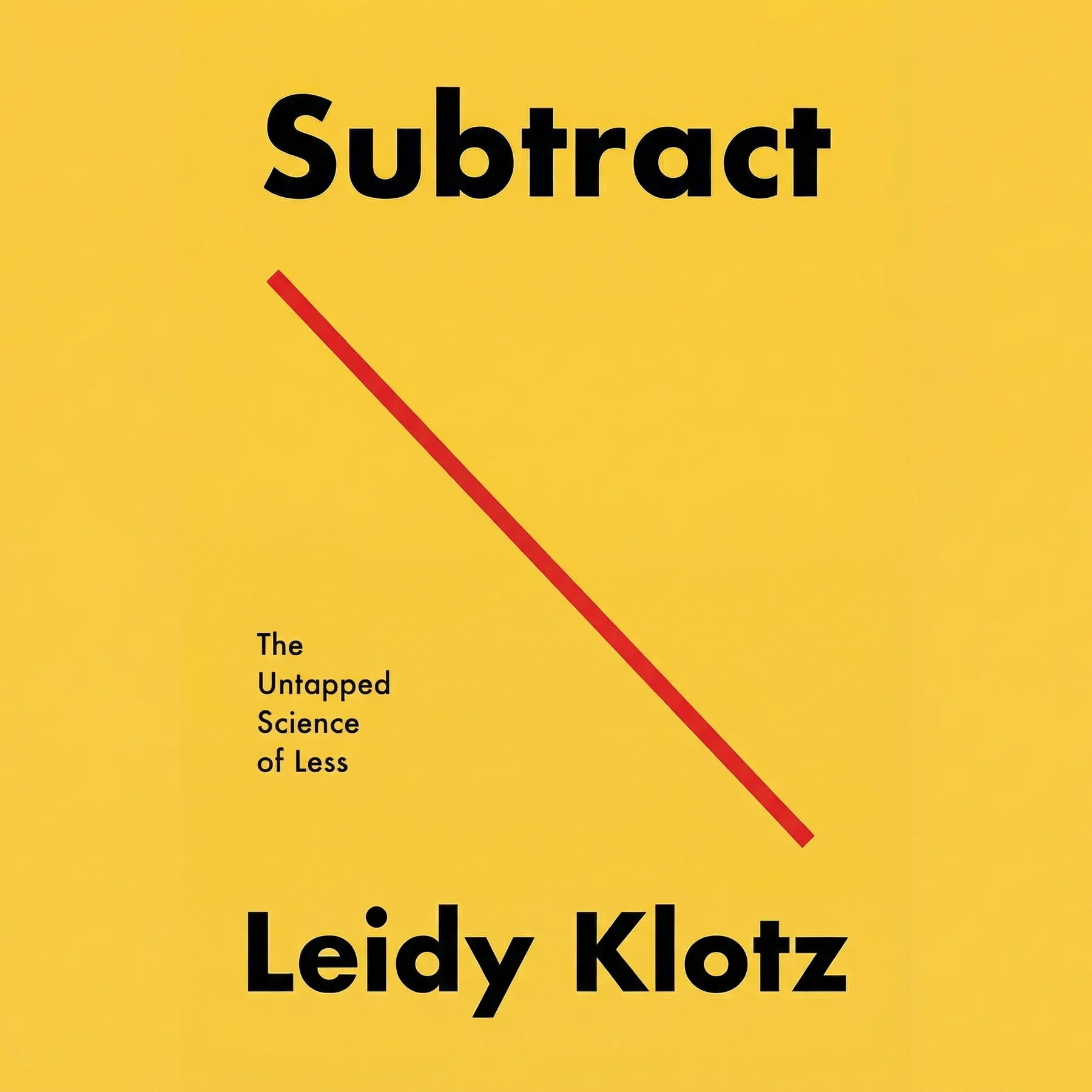
Listeners find the book insightful, with one listener noting it provides an approachable look at centuries of philosophy, and another highlighting its thorough problem-solving instructions. The premise is engaging, and listeners appreciate the examples of subtraction’s power, with one listener noting it can be more impactful than adding. However, the readability receives varied feedback; some listeners find it a captivating and pleasant experience, while others describe it as a disappointing, unfocused read. The text is considered too long and contains an excess of anecdotes, making it feel rambling and tedious.
This book genuinely changed how I approach my daily to-do list and my home life. We are biologically programmed to add, add, and add some more, which is why we all feel so overwhelmed and burnt out. Klotz explains this through a mix of evolutionary biology and design theory that is easy to digest. I loved the Jenga analogy—it’s such a simple way to visualize how subtraction creates balance and opportunity. Some might find the anecdotes about his family a bit much, but I thought they made the high-level concepts feel more grounded. If you are a minimalist or just someone looking to reclaim your mental bandwidth, you need to read this. It’s an eye-opening look at our own cognitive blind spots.
Show moreWow. This is a critical way to think for any facet of life, whether you are a parent, a professional, or just someone trying to simplify. Klotz’s ability to layer engineering principles onto everyday decision-making is truly remarkable. We often think of subtraction as a sacrifice, but he shows it’s actually an act of creation. The chapter on 'distilling' to find the essence of a system was a game-changer for my business strategy. I’ve already started applying the 'Invert' and 'Expand' laws to my workflow with great results. This isn't just a book about decluttering your house; it’s about decluttering your mind and your systems. It's an excellent piece of writing that I’ll be recommending to everyone I know.
Show moreAfter hearing Klotz on a podcast, I knew I had to dive deeper into his framework. Our world is obsessed with growth and capital accumulation, so the idea of subtraction feels almost revolutionary in a capitalist market. The book is a beautiful defense of 'via negativa.' I found the anecdotes about Da Vinci and Lao Tzu to be very inspiring. It reminded me that perfection isn't when you have nothing left to add, but when you have nothing left to take away. While some people complained about the length, I actually enjoyed the slow build and the variety of examples across history. It helped the concept sink in. It’s a rare book that actually changes the way you look at a bridge or a building.
Show moreAs an engineer, I found the core thesis of this book incredibly refreshing and applicable to my daily work. We often forget that removing material or simplifying a process is a deliberate design choice, not just an afterthought. The story of Anna Keichline and her invention of the hollow cement block was a standout highlight for me. It perfectly illustrates how subtracting can lead to something more efficient and lighter. While I agree with other reviewers that the book meanders into social issues that felt a bit shoehorned in, the technical and psychological insights are top-notch. It makes you realize how often we default to 'more' just to show we’ve done something. I’ll be keeping a 'stop-doing' list from now on.
Show morePicked this up on a whim for a work book club and was pleasantly surprised by the depth of the research. The idea that we view subtraction as a 'loss' rather than a 'gain' is a profound realization that explains so much about corporate bloat and government bureaucracy. Look, some of the scientific claims about human history 40,000 years ago felt a bit speculative, but the modern psychological experiments are hard to argue with. I especially liked the discussion on 'synaptic pruning' and how our brains actually develop by losing connections. It's a very accessible exploration of a complex topic. Even though it's a bit long-winded at times, the takeaways regarding how to 'persist to less' are worth the price of admission.
Show moreFinally finished this one, but I have mixed feelings about the experience. The central premise—that our brains are hardwired to add rather than subtract—is absolutely fascinating and supported by some great behavioral studies. I especially loved the Lego bridge experiment where people almost always added bricks to level it out instead of just removing one. However, the irony of a book about subtraction being this bloated is hard to ignore. It really feels like an article-length idea that was stretched to meet a publisher's word count. To be fair, Klotz has a nice writing style, but he repeats himself constantly. If you can get past the repetitive anecdotes about his toddler and his shoe collection, there is a very valuable lesson here about how we over-complicate our lives and our designs.
Show moreEver wonder why we always choose to add a new shelf instead of getting rid of the clutter? Klotz explores the psychology of 'more' through the lens of evolutionary biology, and the results are mostly interesting. It is a solid look at why we suffer from information overload and decision fatigue. The problem is that the book doesn't always practice what it preaches. It's quite wordy and the narrative structure is a bit messy. I appreciated the sections on 'scaling subtraction' in organizations, but the middle of the book really drags. It is a good, thought-provoking read if you have the patience for it, but it definitely needed a more ruthless editor to trim the fat and get to the essence.
Show moreThe central concept is brilliant, but the execution left me feeling quite frustrated by the end. Klotz spends an exorbitant amount of time on excursions into climate change and systemic racism that felt decidedly preachy and out of place in a book supposedly about engineering and psychology. Frankly, it felt like he was trying to check every social justice box rather than focusing on his actual expertise. The writing is incredibly repetitive, making the same point about our additive bias over and over again. It’s a shame because the 'via negativa' philosophy is powerful, but this book fails to showcase that beauty. It’s a classic case of a great 20-page paper being forced into a 300-page book. Ironic, isn't it?
Show moreTruth is, I expected a practical guide on minimalism but got a rambling manifesto that lacks focus. The author has a background in engineering, yet the book feels surprisingly un-scientific in its approach to several topics. He makes huge leaps between simple Lego experiments and complex global issues like climate change without providing enough connective tissue. The evidence for some of his historical links is thin at best. For a book titled 'Subtract,' there is an awful lot of filler here. I found the tone to be a bit condescending at times, especially when he discusses 'cultural multitudes.' It’s an interesting premise for a podcast episode or a magazine feature, but it just doesn't hold up as a full-length book.
Show moreNot gonna lie, I struggled to stay awake through most of these chapters and basically had to force myself to finish. The book is the definition of a rambling, tedious read that doesn't know when to quit. I agree that 'less is more,' but I didn't need 300 pages of repetitive stories to get the point. It felt like the author was just trying to fill space with anecdotes about his sneakers and his kids. Within five minutes of opening it at night, I was totally shlumped. It is probably more effective than a high dose of melatonin if you need to fall asleep quickly. I'm honestly shocked this got so much hype when it’s so thin on actual substance. Save your time and just read a summary online.
Show moreSteven C. Hayes
Deborah Gruenfeld
Anthony Pratkanis

Richard Wiseman
AUDIO SUMMARY AVAILABLE
Get the key ideas from Subtract by Leidy Klotz, plus 5,000+ more titles in English and Thai.







