
16 min 37 sec
The Art of Explanation: How to Communicate with Clarity and Confidence
By Ros Atkins
Discover a systematic approach to clear communication. This guide reveals how to strip away complexity, engage any audience, and deliver impactful messages with the precision of a world-class news broadcaster.
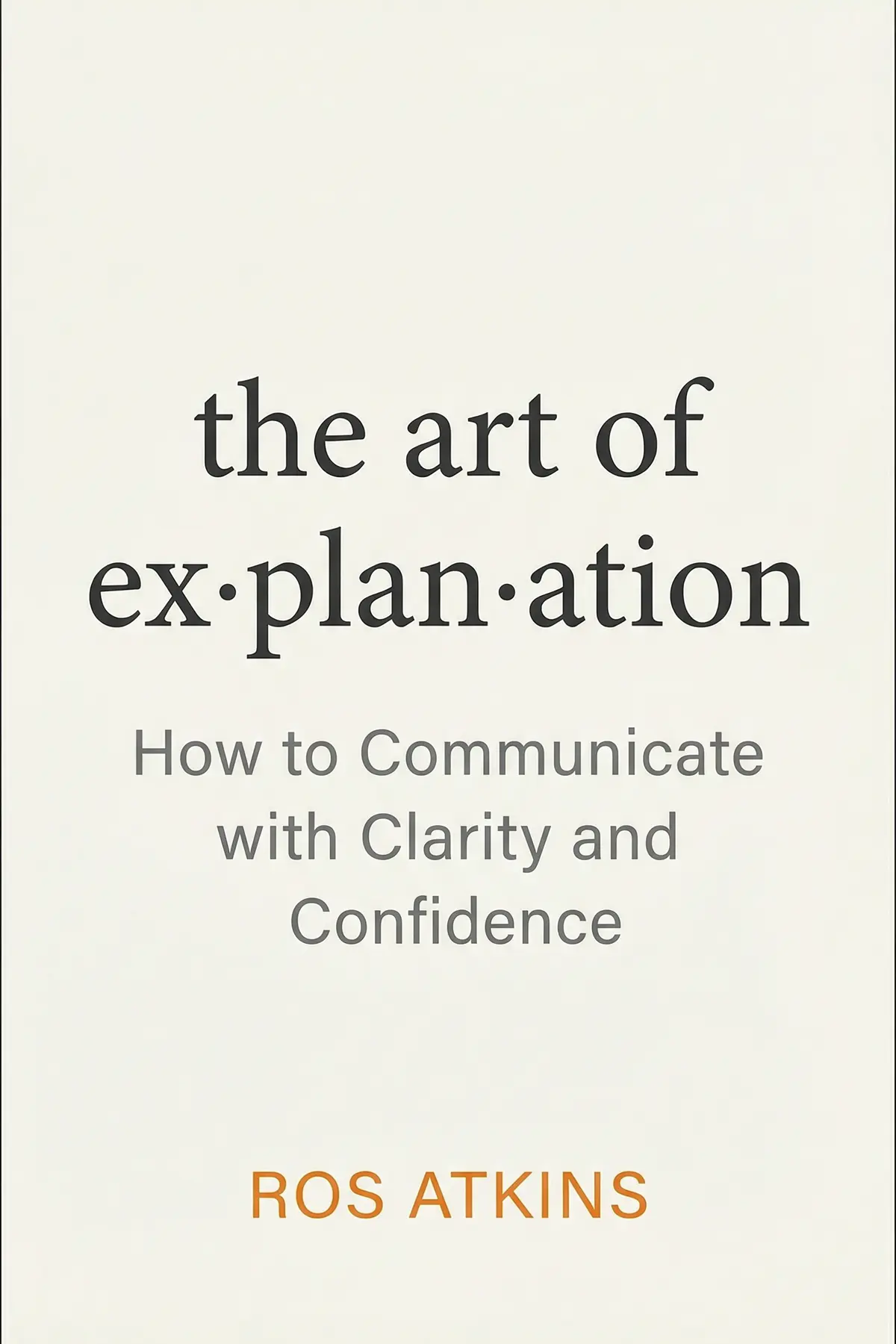
Table of Content
1. Introduction
2 min 03 sec
We have all been there: you are in the middle of explaining a project or an idea, and you suddenly realize the person across from you has completely checked out. Perhaps they are staring at their phone, or maybe their eyes have simply taken on that tell-tale glassy look of confusion. It is a frustrating moment because you know the information you’re sharing is important, yet somehow, the connection has been severed. The gap between what you know and what they understand feels like a chasm.
This isn’t just a problem for public speakers or professors; it is a challenge we face every single day. We encounter it when we try to update our boss on a complicated task, when we write an email to a client, or even when we are trying to explain a news story to a friend. Often, we assume that if we know our subject well enough, the explanation will just take care of itself. But as we’ve all experienced, expertise doesn’t automatically translate into clarity. In fact, sometimes the more we know, the harder it is to remember what it’s like not to know, leading us to bury our listeners in jargon and unnecessary detail.
This is where the art of explanation comes in. It is not a mystical talent that some people are born with and others aren’t. Instead, it is a deliberate, repeatable process. It is about taking the messy, chaotic web of information in your head and refining it into a straight, sturdy line that someone else can follow. It requires a blend of empathy for your listener, a ruthless commitment to simplicity, and a strategic approach to structure.
In the following pages, we are going to explore a framework developed in the fast-paced world of international newsrooms—a place where clarity isn’t just a preference, it’s a necessity. We will look at how to break down the anatomy of a perfect explanation and how to tailor your message specifically for the people in front of you. We will walk through a seven-step crafting process that ensures your message is both lean and powerful. Finally, we will look at how to maintain that clarity when you are put on the spot and how to master the short-form communication that dominates our digital lives. By the end, you won’t just be communicating; you’ll be making sure your ideas truly land.
2. The Ten Pillars of a Perfect Explanation
2 min 58 sec
What makes some explanations stick while others vanish instantly? Explore the core attributes that transform a dense block of information into a clear, memorable narrative.
3. Adopting the Listener's Perspective
2 min 11 sec
Communication is a two-way street, yet we often drive it alone. Learn the five crucial questions that ensure your message is perfectly tuned to your audience’s ears.
4. A Systematic Workflow for Crafting Your Message
2 min 40 sec
Clarity doesn’t happen by accident; it’s a result of a disciplined process. Walk through the seven steps that take an idea from a messy draft to a polished gem.
5. Navigating Dynamic and Unpredictable Situations
2 min 33 sec
What happens when your carefully planned explanation meets a sudden question or a shrinking time limit? Learn the mental tactics for staying clear under pressure.
6. The Power of Brevity and Digital Precision
2 min 23 sec
In a world of information overload, the person who can say it in thirty seconds is king. Master the art of the ‘short-form’ explanation for the digital age.
7. Conclusion
1 min 49 sec
As we wrap up this journey through the mechanics of clear communication, it’s worth reflecting on the core philosophy behind it all. Explanation is not just an exchange of data; it is an act of generosity. When you take the time to simplify, to organize, and to tailor your message, you are making life easier for your audience. You are removing the mental heavy lifting that so often stalls progress and breeds misunderstanding.
We have explored the ten pillars that give an explanation its strength, from the foundational need for simplicity to the strategic use of context. We have seen how the ‘listener-first’ perspective can change the entire tone of a conversation, and we’ve walked through a seven-step workflow that turns communication into a repeatable science rather than a stressful gamble. We have also learned how to stay sharp in dynamic moments and how to use brevity as a tool for influence in our distracted world.
The throughline in all of this is intentionality. Most people communicate by instinct, but the most effective communicators communicate by design. They know that every word should have a job to do and that every piece of information should earn its place.
So, as you move forward, start small. For your next email, try the ‘Bottom Line Up Front’ approach. For your next meeting, try to identify your ‘strands’ before you walk in. Observe how people react when you provide them with a clear path to understanding. You will likely find that as your explanations become more refined, your influence grows. People will start coming to you not just for what you know, but for how you help them understand the world. That is the true power of this art—it doesn’t just make you a better speaker; it makes you a more effective leader, a more reliable teammate, and a much more persuasive advocate for your ideas. The tools are now in your hands. Use them to make yourself heard.
About this book
What is this book about?
Have you ever struggled to make a complex point during a meeting, only to see your colleagues' eyes glaze over? The Art of Explanation provides a comprehensive framework for solving this universal problem. Drawing on years of experience in high-pressure journalism, the book offers a structured methodology for distilling information into its most potent form. It moves beyond vague advice about being clear and instead provides a tactical toolkit for various scenarios, from formal presentations to spontaneous emails. The promise of this work is simple yet profound: by mastering the mechanics of explanation, you can ensure your ideas are not just heard, but fully understood and remembered. You will learn how to identify the specific needs of your listeners, how to organize your thoughts into logical strands, and how to adapt your delivery when things don’t go according to plan. Whether you are a student, a professional, or someone simply looking to be better understood, this guide transforms communication from a source of anxiety into a powerful, reliable skill.
Book Information
About the Author
Ros Atkins
Ros Atkins is a British journalist and broadcaster known for his clear and concise communication style. He is the creator and presenter of the viral Ros Atkins on... explainer videos, which have gained widespread recognition for their ability to break down complex topics. With years of experience in high-pressure newsrooms, Atkins has become a leading figure in journalism, renowned for his expertise in delivering impactful and engaging explanations.
Ratings & Reviews
Ratings at a glance
What people think
Listeners describe this book as captivating and straightforward to follow. They value the practical knowledge provided, with one listener mentioning its knack for making complex topics feel simple.
Top reviews
Samroeng
As a professional communicator, I found that Atkins has a way of stripping away the fluff to reveal the core of a message. I've watched his BBC explainers for years, so seeing the methodology behind them laid out in this book was eye-opening. The structure he proposes isn't just theory; it’s a rigorous system for anyone who needs to be understood in high-stakes environments. Frankly, the advice on refining your language to be succinct is worth the price of admission alone. While some might find the repetition tedious, it reinforces the habit-building necessary for true clarity. It’s an essential manual for the modern information age.
Show morePhu
The way this book demystifies the process of sharing complex ideas is nothing short of brilliant. We live in a world where everyone is shouting for attention, and Atkins provides a blueprint for actually being heard. Not gonna lie, I used to struggle with over-explaining and losing my audience's interest halfway through a presentation. By following his advice on distilling context to just the essentials, I've already noticed a shift in how my colleagues respond to my pitches. It makes the 'art' of communication feel like a repeatable science. If you want to make the complicated feel simple for others, this is the text you need to study.
Show moreWeera
After hearing Ros Atkins on a podcast, I knew I had to pick this up. This is easily the most practical book on communication I’ve read in years. It’s not just about 'being a good speaker'—it’s about the grueling process of preparation that happens before you even open your mouth. Atkins' trials and triumphs at the BBC serve as the perfect backdrop for his lessons. The system he builds is designed to be used perennially, forging a habit of clarity that is rare in today’s noisy world. It’s a dense read, sure, but the depth is exactly what makes it so useful. Highly recommended for anyone in leadership roles.
Show moreJin
Listening to the audiobook version was a bit of a double-edged sword. Atkins has a fantastic voice for narration, making the 'Explainer' style feel very natural and engaging throughout the listen. However, I couldn't help but feel that I was missing out on some visual reinforcement, like diagrams or charts, that might exist in the print edition. The book excels at taking the deluge of data we face daily and showing how to filter it for an audience. I especially appreciated the sections on email communication, as that's where most of my professional friction occurs. It’s a very practical guide, even if it gets a bit repetitive in the middle chapters.
Show moreEvelyn
Finally got around to reading this, and it’s a masterclass in structure. What I love about Atkins' approach is his unapologetic focus on the 'work' behind the explanation. He doesn't pretend there's a magic bullet; he insists on a reflexive system that requires constant practice and refinement. The anecdotes from his career at the BBC provide a nice context, even if I would have preferred more links to the actual videos he references. Some sections are definitely more relevant to journalists than corporate types, but the core principles remain universal. It’s a sturdy, informative guide that I’ll likely keep on my desk for reference when drafting major reports.
Show morePairot
Look, if you’re looking for a quick fix, this isn't it. Atkins has written a detailed manual that demands you actually put in the effort to improve your communication skills. The 7-step process is a bit daunting at first glance, but once you start applying it to daily tasks like emails or briefing notes, it starts to make sense. Personally, I found the emphasis on 'just enough' background information to be the most helpful takeaway. We often drown people in data when they only need the narrative. My only gripe is that the book is quite long and could have benefited from the very succinctness it preaches.
Show moreDimitri
The chapter on 'Organise the Information' was exactly what I needed. As someone who works in knowledge management, I found the specific frameworks for structuring data to be quite helpful. The book covers every medium, from speaking to writing to email, in an easy-to-remember way that actually sticks. Got to say, I appreciate that he doesn't shy away from the complexity of the subjects he tackles. He just shows you how to package that complexity so it doesn't overwhelm the recipient. It’s a bit repetitive in places, but that’s clearly by design to ensure the methods become reflexive. A very solid four-star read for any professional.
Show moreGun
Ever wonder if a book can be too thorough for its own good? This work offers a solid framework for anyone struggling with clarity, but it feels incredibly over-written at times. Atkins introduces a 10-point Anatomy alongside a 7-step Process, which honestly feels like overkill and leads to a lot of redundancy. The truth is, many of the 'insights' are things you likely already know—like knowing your audience or rehearsing—but they are packaged here with extreme detail. I found myself skimming the investigative anecdotes to find the actual actionable tips. It's a useful resource for beginners, but experienced presenters might find it a bit dry and unnecessarily dense.
Show moreJom
Not what I expected, but it has its moments. I thought this would be a more psychological look at how humans process information, but it’s really more of a handbook for preparing papers and presentations. While the advice is certainly sound, it feels quite verbose and I struggled to maintain interest during some of the longer investigative stories. To be fair, the table of contents is excellent and serves as a great summary on its own. If you’ve never had formal training in public speaking or essay writing, you will get a lot of value out of this. For others, it might feel a bit redundant.
Show morePriya
This book fell completely flat for me. I was expecting deep, actionable strategies for knowledge management, but instead, I got a lot of Captain Obvious advice. The chapter on 'Organising the Information' promised so much yet delivered very little that I hadn't heard in a basic high school composition class. To be fair, Atkins is a master of his craft on screen, but that charisma doesn't quite translate to the page here. The processes are needlessly complicated, with far too many steps for someone working in a fast-paced business environment. It’s a lot of words to explain things that should be much more straightforward.
Show moreReaders also enjoyed


AUDIO SUMMARY AVAILABLE
Listen to The Art of Explanation in 15 minutes
Get the key ideas from The Art of Explanation by Ros Atkins, plus 5,000+ more titles in English and Thai.
- 5,000+ titles
- Listen as much as you want
- 7-day free trial
- Cancel anytime







