
13 min 41 sec
The Art of Letting Go: Stop Overthinking, Stop Negative Spirals, and Find Emotional Freedom
By Nick Trenton
Unlock emotional freedom by mastering the art of letting go. Nick Trenton provides psychological strategies to stop overthinking, silence your inner critic, and embrace life’s inherent uncertainties with resilience and self-compassion.
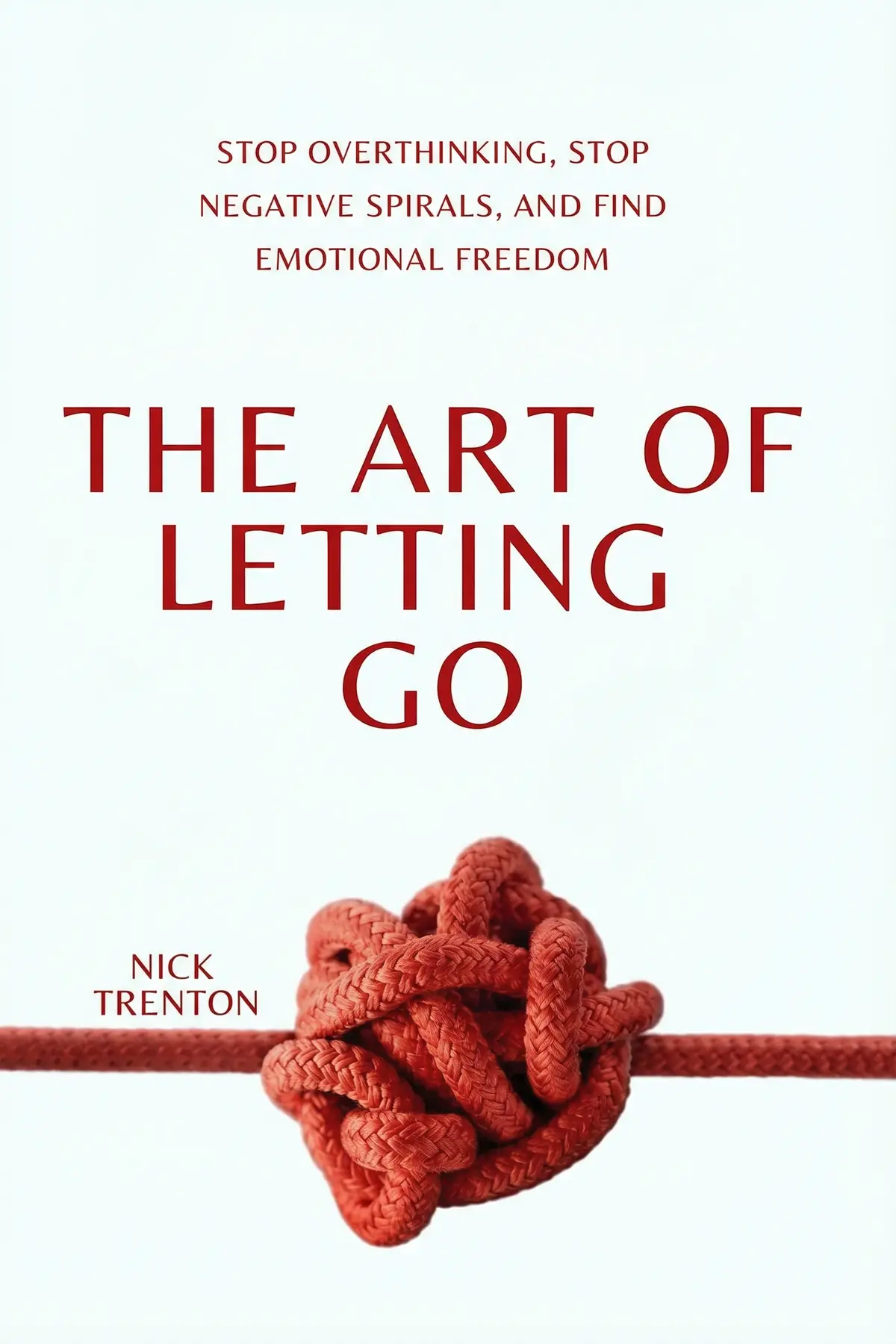
Table of Content
1. Introduction
1 min 24 sec
Imagine for a moment that your mind is a backpack. For years, you’ve been tucking things away into it: a mistake you made five years ago, a harsh comment from a former boss, the fear that you’re not quite hitting the milestones society expects of you. At first, the weight was manageable. But over time, the straps have started to dig into your shoulders. Your pace has slowed. You’re so focused on the strain of carrying that weight that you’ve stopped noticing the beauty of the path you’re actually walking on. This is the weight of the ‘un-let-go.’
In our deep dive into Nick Trenton’s work, The Art of Letting Go, we are going to explore how to finally set that backpack down. This isn’t just about ‘moving on’ in a vague, superficial sense. It is a psychological overhaul. We are going to look at why our brains are hardwired to cling to control and how that impulse actually creates the very anxiety we’re trying to avoid.
Through the course of this summary, we’ll establish a throughline of emotional liberation. We will learn to distinguish between the things we can change and the things we must accept. We will discover how to turn the volume down on the internal judge that tells us we aren’t enough. Most importantly, we will see that letting go isn’t an act of loss; it’s an act of massive gain. It’s about making room for the life you actually want to live, rather than the one you feel obligated to defend. Let’s explore how to find that freedom.
2. The Boundary of Influence
2 min 02 sec
Identify the invisible line between what you can change and what you must accept to stop wasting your precious emotional energy on the uncontrollable.
3. The Power of Perspective Distancing
2 min 19 sec
Learn to step out of the storm of your own emotions and view your life through a wider, more objective lens to gain clarity and calm.
4. From Perfectionism to Excellentism
2 min 09 sec
Break free from the suffocating trap of being perfect and discover a more sustainable, human way to strive for high standards.
5. Cultivating the Growth Mindset
2 min 03 sec
Transform your relationship with failure by viewing every obstacle as a essential lesson rather than a dead end.
6. Rewriting the Internal Script
2 min 16 sec
Discover how to separate your true identity from the negative self-talk that holds you back by treating your inner critic like a fictional character.
7. Conclusion
1 min 28 sec
As we reach the end of this journey through The Art of Letting Go, the throughline should be clear: your emotional freedom is a choice that you make every single day. We have explored how to distinguish between your sphere of influence and the chaotic external world, learning that true peace comes from focusing inward. We’ve seen how ‘excellentism’ provides a human alternative to the crushing weight of perfection, and how a growth mindset transforms every failure into a stepping stone.
What this all boils down to is the realization that you are not your thoughts, you are not your past, and you are certainly not your inner critic. You are the observer and the author of your experience. By practicing self-distancing and externalizing those negative scripts, you reclaim the power to define yourself on your own terms.
So, as you step back into your daily life, I invite you to check the weight of that metaphorical backpack we talked about earlier. Is there a ‘control’ issue you can drop? Is there a perfectionist standard you can trade for excellence? The art of letting go isn’t something you master overnight. It is a practice—a rhythmic loosening of the grip. But with every small act of release, you become lighter, more resilient, and more present. You aren’t losing anything; you are finally making room for the life you were meant to live. Go forward with the knowledge that you have the tools to be free. The path is open, the weight is gone, and the rest of your story is yours to write.
About this book
What is this book about?
The Art of Letting Go explores the heavy psychological burden of trying to control the uncontrollable. Many of us remain tethered to past regrets, rigid expectations, and harsh self-criticism, leading to a state of chronic overthinking and emotional exhaustion. Nick Trenton offers a roadmap for breaking these cycles by applying principles from behavioral psychology and Stoic philosophy. The book promises a shift from a reactive life to a proactive one. It introduces the concept of the dichotomy of control, teaching readers how to partition their mental energy toward things they can actually influence. By moving from perfectionism to 'excellentism' and adopting a growth mindset, you learn to see setbacks as data points rather than personal failures. Ultimately, this guide is about rewriting your internal narrative and externalizing the negative voices that hold you back, leading to a life of greater tranquility and purpose.
Book Information
About the Author
Nick Trenton
Nick Trenton possesses a professional background in economics and behavioral psychology. He is the acclaimed author of several wellness-focused titles, including Stop Overthinking and The Overthinking Cure. Trenton’s writing is deeply informed by his unique evolution from a farm boy to a professional observer of human behavior. He specializes in providing practical, actionable strategies for emotional well-being and personal development.
Ratings & Reviews
Ratings at a glance
What people think
Listeners find the book thought-provoking, noting that it is packed with actionable advice and inspiration. Opinions on how easy the material is to consume vary, as some listeners find it a simple listen while others describe it as more difficult.
Top reviews
Finn
As someone who was referred to this book by my therapist, I found the insights to be incredibly grounding. I have always struggled with finding inner peace because I try to control every single outcome in my life. This book served as a gentle call out that helped me see my own toxic patterns. The advice on focusing on what you can influence rather than what you cannot is life-changing. I really appreciated the focus on self-compassion and the idea that we don't have to be perfect. The structure is simple to follow and doesn't feel overwhelming like a lot of other psychology-backed books. It has become a handy reference guide for whenever I feel my anxiety starting to spike again. It truly helps you find a sense of calm in the chaos.
Show moreOmar
Nick Trenton has a talent for taking complicated psychological concepts and making them feel incredibly simple. This book is a must-read for anyone who feels stuck in a loop of past regrets or future anxieties. It provides a clear path toward emotional freedom by incorporating practical stoic lessons into every single chapter. I loved the emphasis on building a resilient mindset rather than just looking for a quick fix. To be fair, the book is a bit repetitive in places, but the core message is very powerful. It helped me understand that letting go is a journey that requires constant practice and patience. By applying the tools shared here, I have been able to find a lot more clarity. It is easily the most simplified and effective book I have read on this topic.
Show morePriya
The chapter on brain dumping and self-distancing techniques provided me with immediate relief from my overthinking. I appreciate how Nick Trenton breaks down complex stoic principles into steps that anyone can actually follow. Many books in this genre are too abstract, but this one feels like a toolkit for the mind. While some of the writing is a little bit clunky, the actual advice is very helpful. It helped me realize how much energy I waste on things that are outside of my control. I started using the nonjudgmental observation method during my morning commute, and it really changed my mood. This is a pragmatic guide for people who are tired of feeling emotionally overwhelmed by their daily lives. I would recommend it for its practical tools even if it is repetitive.
Show moreHarper
Wow, I did not expect a book about letting go to feel like such a warm conversation. It feels like talking to a wise friend who understands exactly what you are going through. The author guides you through the process of accepting your feelings with a lot of compassion and clarity. I found the sections on shifting your mindset to be particularly authentic and easy to digest. It isn’t about forcing yourself to be happy, but rather about creating space to just breathe. Some might find the tone a bit too simple, but for me, that was the beauty of it. It made the concept of emotional freedom feel attainable rather than just another chore on my list. This is a lovely little guidebook for personal growth.
Show moreChatri
Not what I expected from a book on stoicism, but it ended up being exactly what I needed. Many philosophy books are too dry, but this one focuses on the personal and emotional side of things. It provides a roadmap for organizing a cluttered mind and stopping the cycle of constant worry. The writing style is very approachable, which makes it easy to read a few pages before bed. I did notice some of the repetition mentioned by other reviewers, but it helped reinforce the ideas. Learning to regulate my emotions has already brought some transformative changes to my daily performance at work. It is a beautiful reminder that letting go is not about loss, but about making room for joy. I’m glad I gave this one a chance.
Show moreJoy
Frankly, I had mixed feelings about this book while I was reading through the first few chapters. On one hand, the author provides some very useful tools like brain dumping and mindfulness practices. On the other hand, some of the advice feels a bit too close to emotional dissociation. You have to be careful about how you apply these techniques to your own life and mental health. The writing can also be quite repetitive and uses the pronoun 'one' much more than is actually necessary. Despite these minor issues, the book does offer a lot of value for someone looking to quiet their mind. It is a good starting point for building a more resilient and peaceful inner life. Just take some of the broader examples with a grain of salt.
Show moreSomsak
Picked this up because I have been struggling with a lot of mental clutter lately. It is a very quick read, but the self-published nature of the book is impossible to ignore. Some of the techniques, like brain dumping, are genuinely helpful for organizing a chaotic mind. On the other hand, the examples provided for these techniques are often too simplistic to be useful. One story about a woman letting go of her boss’s anger felt like it was written for a toddler. Truth is, the book oscillates between being a wise guide and a collection of recycled Pinterest quotes. It is better than The Untethered Soul in terms of practicality, but it lacks that book's depth. It’s an okay starting point for beginners.
Show moreBae
Ever wonder why so many self-help books today feel like they were written in a single weekend? This guide has some solid ideas about mindfulness and nonjudgmental observation, but it is extremely repetitive. I felt like the author was saying the same thing in five different ways just to hit a page count. Personally, I think the advice is a bit too cliche for anyone who has read more than one book on the subject. There is a lot of talk about 'letting go' without enough explanation of the actual mental mechanics involved. It’s not a bad book, but it certainly isn't the groundbreaking masterpiece some people claim. It works as a basic refresher but don't expect any deep psychological insights.
Show moreRoo
After hearing a lot of hype about Nick Trenton, I expected something far more polished than this. The core concepts are decent enough, but the execution makes the reading experience incredibly tedious. I found myself getting irritated by the constant use of the abstract third person. Every sentence seems to start with 'one should' or 'one must,' which feels distant and academic. To be fair, there is some good information buried in the middle of all the repetition. However, you have to wade through reams of rephrased content to find a single original thought. It clearly lacks the touch of a professional editor who could have tightened the prose. This reads more like a first draft than a finished book.
Show moreMai
This book was a massive disappointment and felt like it was churned out by an AI. The logic in the examples is completely missing and feels deeply confusing to a mature reader. I found myself asking 'What?!' after reading some of the ridiculous scenarios provided by the author. One specific scenario about a cheating partner suggests we should simply ask why they were unsatisfied. That is harmful advice that encourages people to internalize the betrayal of others. I found the writing to be dry, passionless, and entirely lacking in real human empathy. If you want to learn about stoicism, look for a source with actual substance. It feels like a collection of generic blog posts slapped together without a central editor. I really regret spending my time on this surface-level guide.
Show moreReaders also enjoyed
A High-Performing Mind: Strengthen Your Mind and Live Your Best Life
Andrew D. Thompson
Alcoholics Anonymous
Alcoholics Anonymous World Services
Abundance: The Inner Path to Wealth
Deepak Chopra
A Liberated Mind: How to Pivot Toward What Matters
Steven C. Hayes
AUDIO SUMMARY AVAILABLE
Listen to The Art of Letting Go in 15 minutes
Get the key ideas from The Art of Letting Go by Nick Trenton, plus 5,000+ more titles in English and Thai.
- 5,000+ titles
- Listen as much as you want
- 7-day free trial
- Cancel anytime







