
21 min 50 sec
The Extended Mind: The Power of Thinking Outside the Brain
Explore how human intelligence reaches far beyond the skull. This guide reveals how your body, your surroundings, and your relationships function as essential extensions of your thinking process and cognitive power.
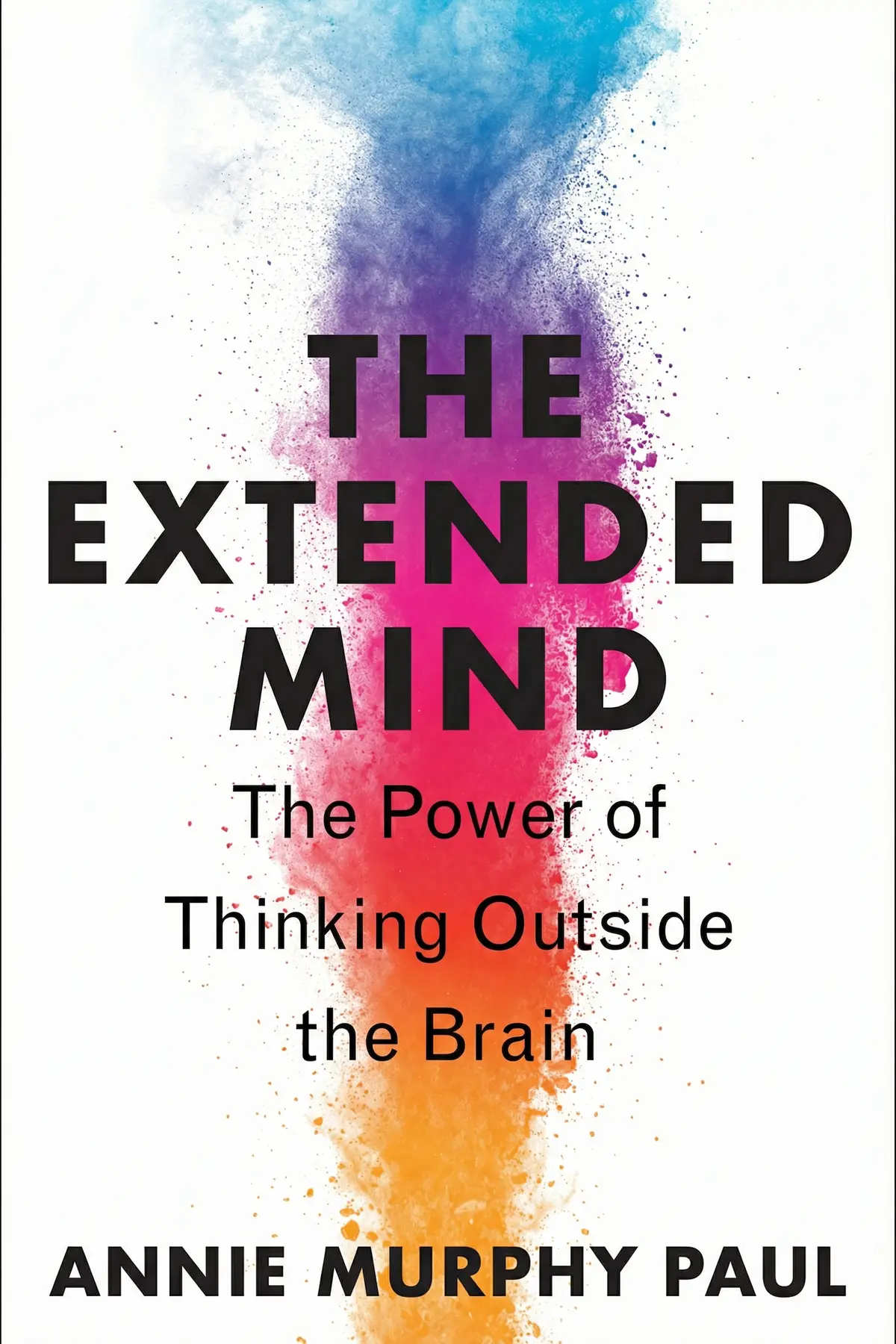
Table of Content
1. Introduction
1 min 46 sec
In the closing years of the twentieth century, a radical idea began to circulate in the halls of philosophy and cognitive science. It started with a simple, provocative question: where does the mind stop and the rest of the world begin? For most of us, the answer seems obvious. We feel our thoughts happening behind our eyes; we assume our consciousness is safely tucked away inside the bone of our skulls. We have been taught to view the brain as a lone processor, a biological supercomputer that does all the heavy lifting of thinking in isolation.
But what if that view is not only limited but fundamentally wrong? In 1998, Andy Clark and David Chalmers argued that our minds are not trapped in our heads. Instead, they suggested that human cognition is deeply entangled with our tools, our surroundings, and our bodies. They proposed that a computer or a notebook isn’t just something we use; it becomes a functional part of our cognitive architecture. This ‘extended mind’ theory has since moved from a fringe philosophical concept to a central pillar of modern psychological research.
In this exploration of Annie Murphy Paul’s work, we are going to dismantle the ‘brain-bound’ myth. We will look at how the mind reaches out into the physical world to boost its performance. We’ll see how our very physiology acts as a storehouse for wisdom that our conscious minds haven’t yet grasped, and how the spaces we occupy can either stifle our genius or set it free. By the end of this journey, you’ll understand that thinking isn’t just something you do with your brain—it’s something you do with your whole being and the entire world around you. This throughline—the transition from internal processing to external extension—will guide us through every insight, showing us how to reclaim the full potential of our expanded intelligence.
2. The Intelligence of the Body
2 min 25 sec
Your physical sensations are more than just feelings; they are a sophisticated data stream that reflects your subconscious wisdom and guides your best decisions.
3. Thinking Through Motion
2 min 38 sec
Static thinking is an evolutionary anomaly; our brains perform at their peak when our bodies are in motion, unlocking higher levels of focus and creativity.
4. The Language of the Hands
2 min 23 sec
Gestures are not just visual aids for the listener; they are cognitive tools that help the speaker organize thoughts and find words faster.
5. Nature as a Cognitive Filter
2 min 39 sec
Natural environments do more than just relax us; they provide a specific visual structure that restores our focus and sparks creative breakthroughs.
6. The Architecture of Ownership
2 min 37 sec
The spaces we inhabit shape the thoughts we produce; true creativity requires environments that offer both privacy and a sense of personal control.
7. Thinking with Physical Maps
2 min 46 sec
Don’t just keep ideas in your head; by offloading them onto physical objects, you leverage your brain’s superior spatial reasoning to solve abstract problems.
8. The Power of Social Cognition
2 min 36 sec
Solitary thinking is often rigid; by engaging in debate and collaborative problem-solving, we tap into a collective intelligence that exceeds the sum of its parts.
9. Conclusion
2 min 00 sec
As we wrap up our journey through the extended mind, let’s reflect on the profound shift we’ve just explored. We began with the traditional image of the brain as a closed system—a lonely processor in a dark room. But we’ve seen that this image is an illusion. Your mind is not a prisoner of your biology; it is a traveler that moves through your body, your tools, your landscapes, and your relationships.
By tuning into your interoceptive signals, you tap into a subconscious wisdom that data alone can’t provide. By moving your body and gesturing with your hands, you unburden your brain and sharpen your focus. By seeking out the fractals of the natural world and the autonomy of a well-designed workspace, you restore your mental energy and invite creative breakthroughs. And by offloading your thoughts into physical maps and engaging in the social friction of debate, you expand your cognitive bandwidth far beyond its biological limits.
The throughline of this summary is clear: we think best when we think outside the brain. The ‘brain-bound’ model is a relic of a time before we understood the deep connectivity of the human experience. In a world that is becoming increasingly complex and demanding, relying on your brain alone is like trying to run a modern city on a single generator. The world is full of cognitive ‘power plants’—from the quiet of a forest to the energy of a collaborative team—waiting for you to plug in.
As an actionable closing, take one small step today to extend your mind. If you’re stuck on a problem, don’t just sit there. Go for a walk. Draw a map of your ideas on a large piece of paper. Call a friend and explain what you’re trying to do. Or, as a special practice, try the mindfulness body scan to listen to what your body is already trying to tell you. When you stop trying to do everything inside your head, you’ll find that the world is ready to help you think.
About this book
What is this book about?
Have you ever felt that your brain alone wasn't enough to solve a complex problem? The Extended Mind challenges the traditional view that thinking happens solely within the brain's biological boundaries. Drawing on the groundbreaking work of philosophers and scientists, this summary explores the revolutionary idea that our minds are actually spread across our bodies, the physical spaces we inhabit, and the social networks we build. You will discover how to tap into your body's subconscious signals, why movement can sharpen your mental acuity, and how natural environments restore your focused attention. From the walls of a biographer’s office to the collaborative debates of Nobel-winning physicists, this exploration provides a new framework for understanding intelligence. The promise is a shift from the 'brain-bound' model to an 'extended' approach, allowing you to work more effectively, think more creatively, and harness the hidden resources of the world around you. By learning to think outside the brain, you can transcend the limits of biological memory and processing power.
Book Information
About the Author
Annie Murphy Paul
Annie Murphy Paul is a highly regarded science writer whose work frequently appears in prominent publications like The New York Times Magazine and Scientific American. She is the author of several influential books, including Origins and The Cult of Personality. Her expertise in the nature of intelligence is widely recognized, and her TED Talk on the subject has reached a global audience of over 2.6 million viewers.
Ratings & Reviews
Ratings at a glance
What people think
Listeners characterize the book as educational and deeply researched, with one individual mentioning the wealth of evidentiary data included. It is also considered a timely and crucial read for teachers and support personnel. However, reactions to the writing are split; some enjoy the text as a reader, while others describe it as uninteresting. Furthermore, listeners differ on the book’s length, with several suggesting it is too long.
Top reviews
Maksim
Finally got around to reading this, and the timing couldn't be better for my current burnout. I was particularly struck by the "cooperative eye hypothesis" and the idea that even eating spicy food in a group can boost collective productivity. It sounds strange, but Paul provides enough scientific backing to make you rethink every mundane interaction in your daily life. The section on hand gestures was a personal highlight for me because I’ve always been a restless 'hand talker.' Knowing that these movements actually help us process and retrieve information makes me feel much less self-conscious about my fidgeting. This isn't just another pop-science book; it's a blueprint for living a more integrated, less mentally exhausted life. The writing is accessible, though she does tend to hammer home the same points a few times too many. Definitely a must-read if you feel like your brain is a computer that’s running too many tabs at once.
Show moreArt
The chapter on how movement affects the brain of those with dementia was worth the price of the book alone. Paul makes a convincing case that real physical exercise is far more effective than the 'mind games' or puzzles we usually prescribe for aging brains. I’ve started applying her suggestions by taking my meetings while walking, and the difference in my clarity of thought is night and day. It’s incredibly validating to hear that my need to move around isn’t a distraction but a vital part of my cognitive process. The book is well-researched and timely, offering a much-needed critique of our sedentary, screen-focused culture. Even though it's quite long, the insights regarding how we 're-spatialize' data through drawing and mapping are immediately applicable. This is essential reading for anyone who feels trapped by the limitations of their own skull. I can't recommend it enough for people who want to work smarter, not harder.
Show moreSamart
What kind of creatures are we if we aren't just brains in a jar? Annie Murphy Paul answers this with a resounding argument for our biological connection to the world around us. This book is a masterclass in synthesis, pulling together disparate fields like evolutionary biology and social psychology to prove that our best thinking happens outside our heads. The discussion on how the prefrontal cortex acts as a rigid censor was eye-opening, especially when paired with the solution: physical movement and natural settings. I particularly loved the final principles about creating 'cognitively congenial situations' to manage our daily mental load. It’s a refreshing change from the usual self-help fluff that focuses solely on willpower or 'mindset.' Instead, Paul gives us permission to move, fidget, and collaborate in ways that feel natural. It’s a big, meaty book that requires some time to digest, but the payoff is a completely new way of looking at your own intelligence. Absolutely brilliant.
Show moreMichael
Annie Murphy Paul’s exploration of 'thinking outside the brain' is a revelatory, if slightly dense, journey into cognitive science. As an educator, I found the chapters on how students absorb lessons through movement much more compelling than the traditional 'sit and listen' model. The book argues that our brains weren't built for the modern cubicle; we need physical gestures and natural environments to actually function. While some sections felt a bit like a repetitive self-help manual, the sheer volume of research backing her claims is impressive. I’ve already started encouraging my students to fidget more and use their hands while explaining complex theories. It's a timely reminder that our biology hasn't caught up to our technology. My only real gripe is that it occasionally feels like a collection of Gladwellian anecdotes rather than a cohesive thesis. Still, the core message about offloading cognitive labor is something everyone should consider.
Show moreYam
Ever wonder why a simple walk in the park suddenly solves a problem you’ve been stuck on for hours? Paul explains this through the lens of the prefrontal cortex, showing how our 'harsh administrator' needs a break from the noise to let creativity flow. The book offers a fascinating look at how we can use the space around us to 'offload' information, making our mental labor more efficient. I loved the "9 principles" at the end, as they provided a clear curriculum for applying these ideas to a workspace. Frankly, the advice on avoiding open-plan offices and incorporating natural light is stuff we should already know, but seeing the data makes it harder to ignore. Some of the writing felt a bit stilted, especially in the middle chapters where the lists of facts seemed to go on forever. However, the practical tips on externalizing thoughts into artifacts are game-changers for anyone in a creative field.
Show moreFrida
As someone who has always struggled to focus in open-plan offices, reading this felt like a huge vindication. Paul explains why these environments are often productivity killers, using research to show how surveillance and noise inhibit our best thinking. The book does a fantastic job of synthesizing complex neuroscience into actionable advice, like the importance of 'offloading' ideas onto physical artifacts. I did find the pacing a bit slow in the middle, and she occasionally over-explains concepts that feel intuitively obvious. But the breadth of her research—from stock traders' 'gut feelings' to the benefits of spicy food during group meals—is truly impressive. It’s a dense read, but one that rewards patience with a new perspective on how to structure your day. If you’re a manager or an architect, you really need to sit down with this book and rethink how we design workspaces. It’s not just about comfort; it’s about how we actually process information.
Show moreDarius
Look, we’ve all been told to 'think harder,' but Paul suggests we should actually be thinking 'wider' by using our surroundings. The concept of the 'extended mind' isn't just a metaphor; it's a physiological reality that involves our hands, our movements, and the very air we breathe. I was fascinated by the section on how 're-socializing' tasks—like teaching a peer—forces a deeper level of understanding than solo study ever could. The book provides a great set of nine principles that serve as a practical curriculum for mental extension. While I agree with other reviewers that the writing can feel a bit stilted and repetitive, the content itself is too important to dismiss. It’s a timely intervention in a world where we are increasingly isolated behind screens. I’ve already started sketching out my projects more often instead of just staring at a blank document. Small changes, but they make a massive difference in how I approach problem-solving.
Show moreMarasri
Not what I expected, but I can see why it’s gaining so much traction in educational circles. The core idea—that our mind extends to our tools and peers—is powerful, yet the book’s structure is quite uneven. I struggled with the final section on groupthink, which felt a bit like the author was reaching for conclusions that the data didn't quite support. To be fair, her points about how we 're-socialize' information are brilliant, but the specific examples of large-scale scientific collaboration felt misinterpreted. The writing style fluctuates between engaging narratives and dry, almost clinical lists of trivial studies. I found the chapter on the "Attention Draining Effect" of lyrics and television while studying to be particularly relevant for my kids. It’s a solid 3-star read: great concept, okay execution. If you can handle a bit of repetitive filler, there’s plenty of valuable information to be found here.
Show moreRoydao
Picked this up after seeing it on several 'best of' lists, and while the ideas are strong, I found the prose a bit tedious. There’s no denying that the "extended mind" is a fascinating organizing principle for thinking about human intelligence. However, the author tends to hammer her points into the ground with page after page of supporting studies that eventually start to blur together. I found myself agreeing with the "cooperative eye hypothesis" and the value of recess for kids, but did we really need five different anecdotes to prove the same thing? Personally, I think the book would have been far more effective at half its length. It feels like it’s trying too hard to be the next big 'thinking' book in the vein of Daniel Kahneman. There is value here, especially for teachers and students, but be prepared for some skippable paragraphs where nothing new is being transmitted. It’s a decent resource, just not a particularly exciting read.
Show moreGung
This book should have been a long-form article rather than a three-hundred-page slog. While the central premise—that we think with our bodies and environments—is genuinely fascinating, the execution is unfortunately repetitive. Paul falls into that typical journalist-turned-expert trap where every minor study is treated like a world-shattering revelation. I found myself skimming through the endless anecdotes about stock traders' gut instincts and the "Attention Draining Effect" just to get to the actual meat. It's frustrating because there are brilliant nuggets of insight hidden under layers of fluff and over-explanation. If you enjoy the Gladwell style of storytelling where a heart-warming story leads into a light touch of science, you might love this. For me, it felt like the author didn't trust the reader to get the point the first five times she made it. I appreciate the research, but the signal-to-noise ratio is just too low.
Show moreReaders also enjoyed
Acting with Power: Why We Are More Powerful Than We Believe
Deborah Gruenfeld
Age of Propaganda: The Everyday Use and Abuse of Persuasion
Anthony Pratkanis
59 Seconds: Change Your Life in Under a Minute
Richard Wiseman
AUDIO SUMMARY AVAILABLE
Listen to The Extended Mind in 15 minutes
Get the key ideas from The Extended Mind by Annie Murphy Paul, plus 5,000+ more titles in English and Thai.
- 5,000+ titles
- Listen as much as you want
- 7-day free trial
- Cancel anytime







