
Abundance: The Inner Path to Wealth
Deepak Chopra
Discover how to harness empathy as a transformative tool for personal healing, stronger relationships, and global change by balancing deep emotional connection with essential self-care and healthy boundaries.
1 min 26 sec
Have you ever wondered why some people seem to naturally navigate social tensions while others feel completely overwhelmed by the emotions of those around them? We often think of empathy as a fixed personality trait—something you are either born with or you aren’t. But what if we looked at it differently? What if empathy was actually a form of ‘genius’—a dynamic, practical skill that can be studied, practiced, and mastered to heal not just our own inner worlds, but our relationships and the broader society?
In this exploration of Judith Orloff’s insights, we are going to dive deep into the mechanics of connection. We will uncover why being a ‘sensitive’ person isn’t a liability, but a profound strength when managed correctly. You will learn that empathy isn’t just about being ‘nice’; it’s about a sophisticated level of emotional attunement that allows you to step into someone else’s emotional landscape without losing your own footing.
Throughout this discussion, we’ll move from the internal to the external. We’ll start by defining what this emotional superpower really is and how it differs from similar feelings like sympathy. Then, we will look inward to discover your specific empathic style, which is the key to protecting your energy. Finally, we’ll see how these tools apply to the way we lead, the way we forgive, and the way we contribute to a world that often feels fractured. By the end, you’ll have a clear throughline for transforming empathy from a passive feeling into an active, healing force in your daily life.
2 min 12 sec
Explore the distinct differences between feeling for someone and feeling with them, and learn why empathy is the essential foundation for true compassion.
2 min 33 sec
Discover the four primary ways people process empathy and how recognizing your specific style can prevent emotional exhaustion.
2 min 26 sec
Learn a practical four-step process to turn your empathic skills inward, fostering self-acceptance and healing inner trauma.
2 min 16 sec
Master the art of empathic listening and healthy giving to build resilient, balanced relationships without losing yourself.
2 min 26 sec
Examine how empathy scales from individual interactions to leadership and global healing through the power of forgiveness and prayer.
1 min 24 sec
As we conclude this journey through the landscape of empathy, the most important takeaway is that empathy is a skill you can choose to grow every single day. It is not a fixed trait, but a dynamic capacity for connection that begins within your own heart. By understanding your unique empathic style—whether you are a logical Thinker, a deep Feeler, an intuitive Senser, or a spiritual Mystic—you gain the power to navigate the world without losing your sense of self.
We have seen how self-empathy acts as a shield against burnout and how empathic listening can transform your relationships from the inside out. We’ve also explored how these principles scale up to leadership and global healing, proving that compassion is one of the most practical tools we have for creating change. The throughline here is simple but profound: when we lead with empathy, we move from a place of isolation to a place of shared humanity.
As you move forward, try to implement the four-step self-empathy process when you’re feeling stressed. Practice listening without the urge to fix. Most importantly, be patient with yourself as you develop this emotional genius. By mastering the art of ‘feeling with’ others while maintaining your own healthy boundaries, you contribute to a more understanding, resilient, and compassionate world. You have the power to heal your sensitive self and, in doing so, help heal the world around you.
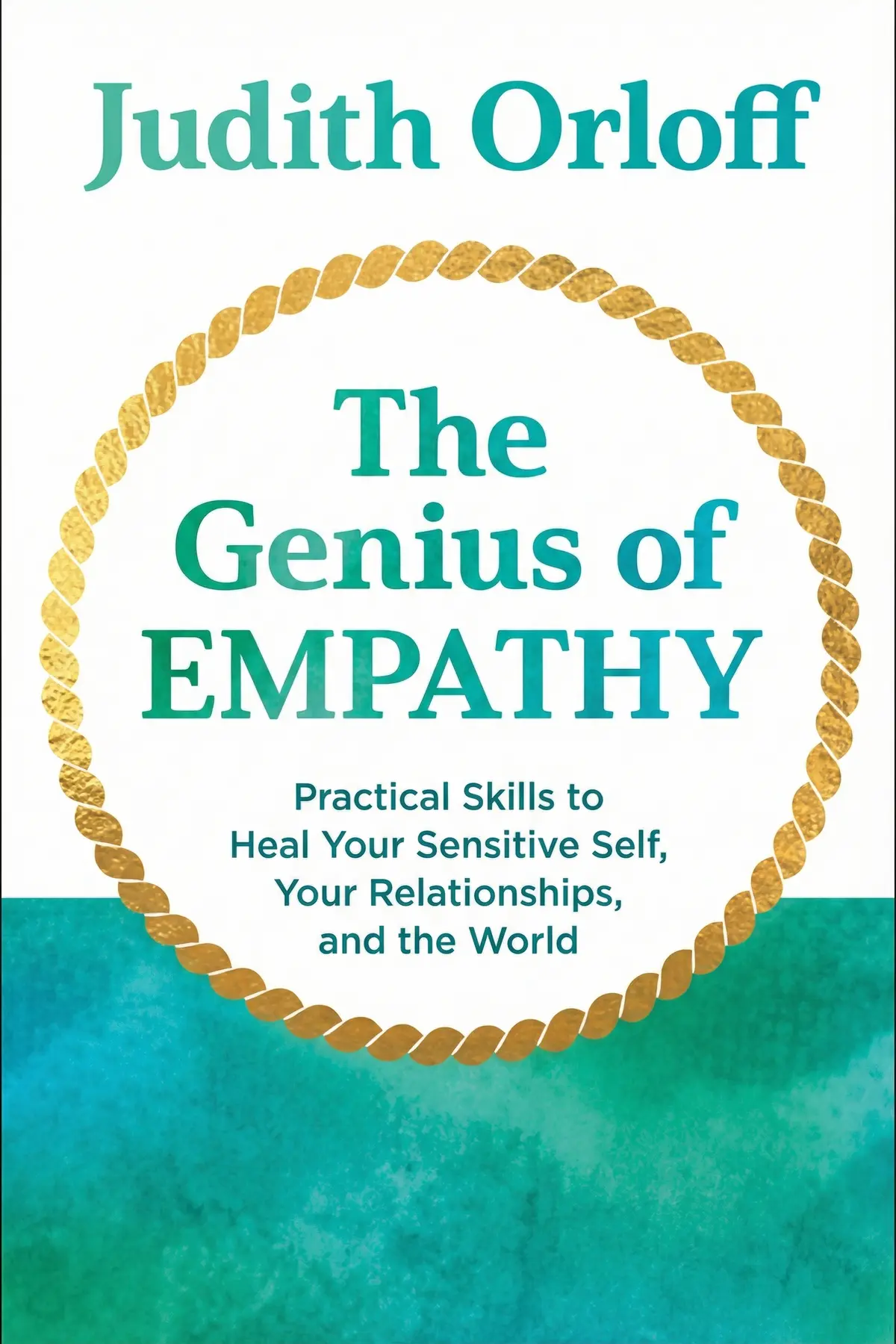
The Genius of Empathy explores the profound capacity of humans to connect with the emotions of others, framing this ability as a practical skill rather than just a personality trait. The book delves into how empathy differs from sympathy and compassion, offering a roadmap for individuals to identify their unique empathic style—whether they lean toward logical thinking, deep feeling, intuitive sensing, or spiritual connection. By following this guide, listeners learn to cultivate self-empathy through specific internal dialogues and visualization techniques. The promise of the book is a life of more meaningful connections, where one can offer support to others without succumbing to burnout or emotional exhaustion. It extends these principles to leadership and global healing, suggesting that empathy and forgiveness are the keys to a more compassionate world.
Judith Orloff is a renowned psychiatrist and an empath who integrates traditional medicine with intuition and spirituality in her work. She is a New York Times best-selling author known for her books The Empath’s Survival Guide and Emotional Freedom. Orloff’s expertise lies in her unique approach to mental health, combining scientific knowledge with holistic practices to promote overall well-being.
Listeners find this work a life-changing guide to empathy, with one listener noting its exploration of diverse categories of empaths. Furthermore, the book is considered enlightening, as one listener emphasizes the way it merges emotional intelligence with functional methods. They also prize its hands-on guidance and clear prose, with one listener characterizing it as a must-read for empaths. The religious themes are well-received, and one review highlights the recurring use of the word prayer throughout the text.
As someone who has always felt a bit like an emotional sponge, Dr. Orloff’s latest work felt like a long-awaited permission slip. The way she breaks down the four distinct empathic styles—Emotional, Intuitive, Cognitive, and Spiritual—really helped me understand why I feel so drained in certain crowds. It isn't just a fluffy self-help guide; there is real substance here regarding the nervous system and how we can prevent ourselves from becoming overstimulated. Personally, I found the chapters on setting boundaries to be the most impactful because I’ve always struggled with people-pleasing. Sometimes the writing gets a little flowery, but the core advice on self-preservation is vital. It’s a transformative tool for anyone who feels too much and doesn't know where to put that energy.
Show moreWow, the section on empathic listening alone is worth the price of admission for anyone in a leadership role or even just struggling in their marriage. It moves beyond basic 'active listening' into a deeper form of connection that feels both healing and practical. I appreciated the inclusion of prayer and spiritual reflection throughout the text, as it adds a layer of depth that many psychology books miss. However, I will say that the transition between the scientific neuroscience bits and the more mystical 'energy sponge' talk can be a little jarring at times. Regardless, the actionable strategies for soothing a fried nervous system are top-notch. I’ll definitely be keeping this on my shelf to refer back to when I feel a burnout coming on.
Show moreEver wonder why certain people just seem to drain the life right out of you? Orloff dives deep into the 'vulnerable narcissist'—those who use their own insecurities to manipulate your compassion—and it was a total game-changer for me. Truth is, I always thought I was the problem for feeling exhausted after helping people, but this book taught me about 'energy sponges' and how to set better filters. The writing is accessible and the tone is incredibly supportive, like a warm hug for your soul. It’s not just a book; it’s a manual for surviving in a world that can sometimes feel very cold and disconnected. Highly recommend for the 'emotional' and 'intuitive' types out there.
Show moreAfter hearing about 'The Genius of Empathy' on a podcast, I was curious if it would offer anything new beyond her previous books. I’m happy to report that this feels like a more mature, refined version of her message. The inclusion of the four unique styles—cognitive, emotional, intuitive, and spiritual—adds a lot of necessary nuance to the conversation. I especially appreciated the mention of how empathy can be a valuable medical tool; it’s a perspective we need more of in healthcare today. Some of the descriptions of narcissists felt a little repetitive if you’ve followed her work for years, but for a newcomer, this is the definitive guide. It’s a motivating, visionary book that I’ll be gifting to several friends.
Show moreFinally got around to finishing this after seeing so many people recommend it for the 'empath' community. What surprised me was how much focus Orloff puts on the idea that not everyone actually deserves your empathy. That felt incredibly cathartic to read! We are often told to just keep giving, but this book argues that being selective is actually a requirement for your own health. The breakdown of the four styles—I lean heavily towards Intuitive—made so much sense and helped me realize I’m not just 'sensitive,' I’m just processing energy differently. It’s a great read for anyone who feels like they are constantly carrying the weight of the world on their shoulders.
Show moreDr. Judith Orloff has a way of blending hard science with intuitive wisdom that is actually quite rare in the wellness space. I received an ARC of this book, and I was genuinely impressed by the depth of the research into how empathy functions as a form of intelligence. The chapter on the 'Genius of Empathy' highlights how sensitivity is a superpower rather than a weakness, provided you have the right tools to manage it. My favorite part was the exploration of cognitive empathy—it showed me how to stay calm in a crisis without totally disconnecting from my feelings. It’s a very readable, structured guide that doesn't just diagnose problems but offers real solutions for daily life.
Show moreI won this book through a giveaway and wasn't sure what to expect, but I found the breakdown of the four empathic styles surprisingly enlightening. To be fair, I’ve read a lot of Orloff’s work before, so some of the 'empath' terminology wasn't new, but the focus on 'targeted empathy' felt like a fresh evolution of her ideas. The book is full of examples and tips that help you navigate tricky social dynamics, especially with those who suffer from empathy-deficient disorders. I do wish there was a bit more focus on the workplace specifically, but the general advice is solid. It’s an interesting and informative read for anyone looking to level up their emotional intelligence.
Show moreThis book doesn't just tell you to be nice; it teaches you how to protect your own light while still showing up for others. I particularly liked the distinction between forgiving a person and forgiving the act—it’s a nuance that is often lost in self-help literature. The strategies for dealing with bullies and sociopaths are incredibly practical and gave me a lot of confidence to handle some difficult colleagues. It’s a fast read, but you’ll want to take it slow to actually practice the exercises she suggests for grounding yourself. In my experience, this is one of the more comprehensive guides on how to use empathy as a tool for personal and global healing.
Show moreThe information here is undeniably valuable, but the tone occasionally veers into 'American self-help' territory which might be a bit much for some readers who prefer a drier, more clinical approach. Frankly, the distinction between the grandiose and vulnerable narcissist was the highlight for me, as it provided a clear lens through which to view past toxic relationships. Dr. Orloff explains how these individuals use emotional crumbs to keep empaths hooked, which was a major 'aha' moment. While I appreciated the focus on energy medicine, I think a few of the exercises felt a bit repetitive by the end of the book. Still, if you can look past the slightly overly-earnest prose, there is some very wise counsel regarding forgiveness and releasing old resentments without excusing the harm done.
Show moreLook, Orloff provides a solid framework for understanding sensitivity, though some of the spiritual elements felt a little less grounded than the psychological parts. I’m more of a 'Cognitive' empath, so the sections on divining empathy and becoming a vessel for spirit didn't quite resonate with my personal worldview. That said, the practical advice on preventing empathy overwhelm is excellent and very much needed in our current high-stress culture. The author’s expertise in psychiatry shines through in the sections about the nervous system and trauma healing. Even if you aren't into the 'vibes' aspect of her teaching, there is plenty of clinical wisdom here to make it a worthwhile investment of your time.
Show moreDeepak Chopra
Alcoholics Anonymous World Services
Steven C. Hayes
Richard Wiseman
AUDIO SUMMARY AVAILABLE
Get the key ideas from The Genius of Empathy by Judith Orloff, plus 5,000+ more titles in English and Thai.







