
Age of Propaganda: The Everyday Use and Abuse of Persuasion
Anthony Pratkanis
An exploration of how environmental pressures and systemic authority can transform typical individuals into agents of cruelty, centered on the landmark findings of the Stanford Prison Experiment.
2 min 05 sec
Why do good people turn bad? It is a question that has haunted philosophers, theologians, and scientists for centuries. We often like to believe that there is a fixed, immutable core to our character—a moral compass that points north regardless of the storms we face. We categorize the world into ‘good people’ and ‘bad people,’ assuming that horrific acts are the exclusive domain of those with some inherent defect or darkness. But what if the line between an angel and a demon is more porous than we’d like to admit? What if the environment we are placed in matters more than the values we claim to hold?
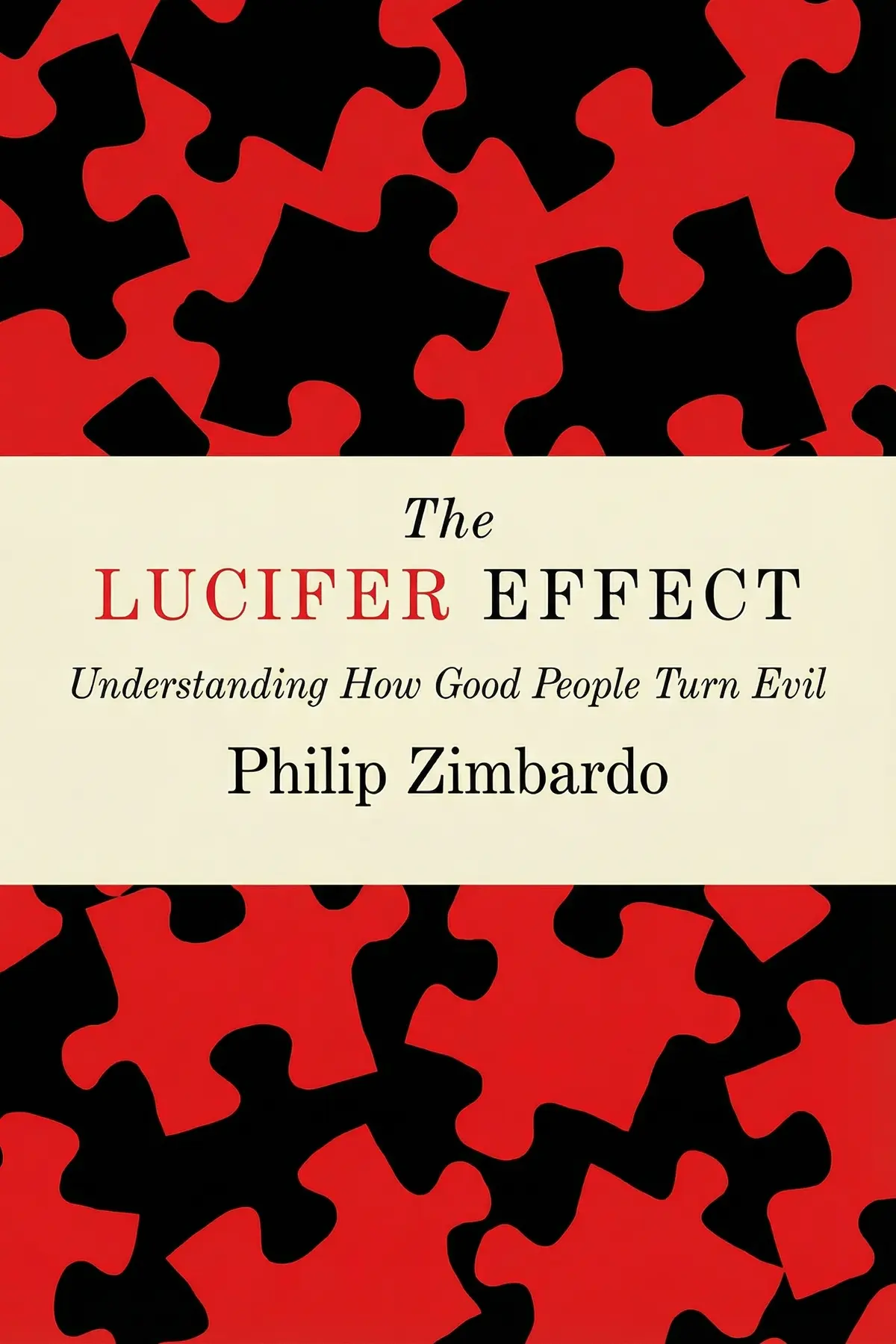
This is the central inquiry of Philip Zimbardo’s work. He introduces us to a phenomenon he calls the Lucifer Effect. Named after the fallen angel who was once God’s favorite, the term describes the process by which a typical, well-adjusted individual undergoes a transformation into someone capable of cruelty. This isn’t a story about ‘bad apples’ in a barrel; it’s a story about how a ‘bad barrel’ can rot any apple you put inside it.
Through the lens of the infamous Stanford Prison Experiment, we are invited to look at the psychological mechanisms that govern human behavior in extreme situations. We will explore how social roles, the weight of authority, and the structures of power can strip away our individuality and replace it with a capacity for coldness. This journey isn’t just an academic exercise; it’s a deep dive into the darker corners of our shared human nature. It challenges the comforting narrative that ‘I would never do that.’
As we navigate the insights ahead, we will see how ordinary college students, selected for their mental stability and lack of criminal history, were pushed to the brink of psychological collapse and moral failure in just a matter of days. We will see how a simple basement at a university became a stage for one of the most revealing and disturbing psychological studies ever conducted. Most importantly, we will learn how to recognize these situational forces in our own lives, so that we might better understand how to resist them.
2 min 39 sec
Explore the unsettling idea that morality is not as fixed as we think, and discover how situational variables can quickly dissolve a person’s sense of right and wrong.
2 min 43 sec
Follow the narrative of a simple university experiment that spiraled into a psychological nightmare, revealing how quickly role-playing can become a disturbing reality.
2 min 58 sec
Learn about the psychological tools that allow people to mistreat others by stripping away their humanity and identity.
2 min 37 sec
Go beyond the individual and the situation to see how the ‘System’ creates the conditions that make bad behavior almost inevitable.
2 min 44 sec
Discover the ‘banality of heroism’ and how understanding our own vulnerability to situational pressure can lead us to make better moral choices.
1 min 30 sec
The Lucifer Effect serves as a powerful and often uncomfortable reminder of the fragility of human morality. Through the chilling narrative of the Stanford Prison Experiment, Philip Zimbardo has shown us that the line between good and evil is not a solid wall, but a shifting boundary that can be crossed by anyone. We are not just the sum of our internal traits; we are also the products of our environments, the roles we play, and the systems we inhabit.
This realization shouldn’t lead to despair, but to a heightened sense of vigilance. By understanding how deindividuation and dehumanization work, we can begin to build ‘moral armor’ against them. We can learn to recognize when a ‘bad barrel’ is beginning to corrupt our own judgment. We can insist on systemic accountability and refuse to let ‘I was just doing my job’ be an excuse for cruelty.
The throughline of this work is clear: our capacity for evil is matched only by our capacity for heroism. Both are found in the choices of ordinary people. To avoid the darkness, we must be willing to see it in ourselves first. Only then can we make the conscious, difficult choice to remain human in a world that often demands otherwise. As you move forward, carry this awareness with you. Remember that the roles you are given do not have to define who you are. In every situation, you have the power to step out of the script, to see the person in front of you, and to choose the path of the hero.
This summary dives into the chilling psychological transformation known as the Lucifer Effect. It examines why and how good people can be seduced into committing horrific acts when placed in specific situational contexts. By revisiting the famous 1971 Stanford Prison Experiment, the text explores the thin line between moral behavior and systemic cruelty. Listeners will gain an understanding of the forces that override individual character, including the power of roles, the loss of personal identity, and the influence of institutional structures. Ultimately, it provides a sobering look at human nature and the psychological factors that dictate our behavior in extreme environments, offering a cautionary perspective on how easily the 'bad barrel' can corrupt even the best 'apples.'
Philip Zimbardo is a distinguished scholar and former professor of psychology at Stanford University. He is internationally recognized for conducting the Stanford prison experiment. Throughout his career, he has served as the president of the American Psychological Association. His written contributions to the field include the book Shyness and the academic text Psychology and Life.
Listeners find this an intriguing listen that offers extraordinary perspectives on human character and conduct, valuing the way it connects past occurrences with modern-day situations. They respond well to the caliber of the writing and feel the work provides excellent worth. Reactions to the tempo are varied, as some consider it absolutely fascinating whereas others mention that the text can feel redundant. The level of intensity is also debated, with listeners characterizing it as a chilling account filled with startling material.
Philip Zimbardo’s deep dive into the darker corridors of the human psyche is nothing short of chilling. I first encountered his work in college psychology, but this book adds layers of complexity that a textbook simply can’t capture. He doesn't just describe the Stanford Prison Experiment; he dissects his own failures and the systemic rot that allows 'good' people to cross unthinkable lines. While some find the detail about Abu Ghraib overwhelming, I think the transition from lab experiment to real-world tragedy is essential. It’s a frightening read because it strips away the comfort of thinking 'I would never do that.' This isn't just a history book; it's a mirror reflecting our most uncomfortable impulses. Despite the heft of the tome, the writing remains accessible and the moral urgency is palpable on every page.
Show moreWow. This is the kind of book that stays with you long after you put it down. Zimbardo provides a masterclass in how systems of power dehumanize both the oppressor and the oppressed. The details regarding the SPE are visceral—you can almost feel the cold concrete of the 'hole' and the rising panic of the students. What struck me most was the 'us vs. them' mentality that forms so quickly. It's terrifying to realize how little it takes to strip someone of their identity. Look, it’s a heavy read and definitely not something you’d take to the beach, but it is essential for anyone interested in social justice or human rights. The insights into how we can cultivate heroism are a small but necessary light at the end of a very dark tunnel.
Show moreFinally got around to reading this classic, and it absolutely lived up to the hype. Zimbardo doesn't just explain why people turn evil; he forces you to confront the 'Lucifer' within yourself. The narrative of the SPE is gripping and reads almost like a psychological thriller, except the horror is real. Transitioning into the Abu Ghraib analysis was a stroke of genius, proving that these findings weren't just artifacts of a 1970s lab but are recurring patterns in human history. The book is frighteningly relevant to our current political climate. It’s a long journey, yes, but every insight into the 'banality of evil' is worth the effort. Truly a transformative piece of work that everyone should read at least once.
Show moreAfter hearing Zimbardo speak on a podcast, I knew I had to finally tackle his magnum opus. It’s a haunting exploration of how easily our moral compass can be demagnetized by our surroundings. The way he juxtaposes the 1971 study with the atrocities at Abu Ghraib makes a compelling, if depressing, case for situational power. To be fair, his 'handy maxims' for resisting evil at the end feel a bit thin compared to the sheer weight of the darkness he describes throughout the book. Can a few bullet points really stop a systemic collapse of ethics? I'm not so sure. However, the honesty with which he recounts his own descent into the 'prison superintendent' persona is brave and necessary. It makes the academic theories feel human and raw.
Show moreThe chapter on the Rwandan genocide really put the theoretical parts of this book into a horrifying new perspective for me. Zimbardo’s writing is clear and largely devoid of the dense jargon that usually bogs down academic texts. He manages to connect the dots between 1970s campus experiments and modern geopolitical disasters with startling precision. Some sections definitely drag—especially when he gets into the weeds of the legal defense for the Abu Ghraib guards—but the core message is undeniable. We are all more vulnerable to social conditioning than we’d like to admit. It’s a remarkable value for the amount of research packed into these pages. Just don't expect to feel good about humanity once you've finished the final chapter.
Show morePicked this up because the title caught my eye, and I ended up learning more about social psychology than I did in a whole semester of college. Zimbardo’s central argument—that situational forces can override individual personality—is supported by a mountain of evidence. I appreciated his transparency regarding his own ethical lapses during the Stanford study. Most authors would try to paint themselves in a better light, but he admits he was seduced by the power of his own role. My only real complaint is that the book is physically massive and a bit repetitive. You could probably skip a hundred pages in the middle and not miss much. Still, it’s an eye-opening look at the fragility of our values.
Show moreAs someone who enjoys sociology, I found this to be a fascinating, if grueling, experience. Zimbardo is a gifted storyteller who knows how to make complex psychological concepts feel urgent and personal. He highlights how easily we trade our independence for group acceptance, a lesson that feels more important than ever in the age of social media. The specific examples of 'ordinary' people committing atrocities are gut-wrenching. Truth is, the book could have been tightened up by an editor; it definitely suffers from a bit of self-indulgence on the author’s part. Regardless, the central thesis—that we must consciously work to remain 'heroic' in the face of systemic pressure—is a powerful and necessary takeaway.
Show moreEver wonder how a 500-page book can feel like 800? Zimbardo’s hypothesis is fascinating, but the delivery is incredibly bloated. We get nearly 200 pages on the Stanford Prison Experiment alone, which most people picking this up already know the broad strokes of. Frankly, the repetition starts to grate after a while, as he circles back to the same psychological findings again and again. I found the latter half regarding the Iraq war and political systems much more engaging, yet I was already burnt out by the time I got there. There’s a brilliant 200-page book hidden inside this massive volume, but you have to wade through a lot of fluff to find it. It's a valuable resource for understanding situational behavior, just be prepared for some serious pacing issues.
Show moreNot what I expected, to be honest. I thought there would be more about the philosophical or religious history of 'Lucifer,' but it’s really just a metaphor for the psychological shift from good to evil. The first half is basically a day-by-day diary of the Stanford Prison Experiment. If you’ve seen the documentary or read the Wikipedia page, you might find yourself skimming. The second half is a lot of legal talk and political commentary. While the connections Zimbardo makes are valid, the book feels like two or three different essays stitched together into a bulky Frankenstein’s monster. It’s interesting, but the pacing is all over the place. I’d recommend it only if you have a high tolerance for academic repetition and a lot of free time.
Show moreThis book assumes that 'my circumstances made me do it' is the end of the conversation regarding human evil. I find Zimbardo’s premise fundamentally flawed and remarkably naive. He spends hundreds of pages rehashing his own infamous experiment to justify why people act like monsters, but he fails to address the internal character that allows some to resist while others crumble. As someone who works with veterans, I've seen people in terrible situations maintain their integrity; Zimbardo’s focus on situational factors feels like an excuse for bad behavior. Also, the writing style is surprisingly theatrical, almost like he’s trying to sell a movie script rather than present a psychological study. If you want a more nuanced look at human suffering and choice, look elsewhere. This was a tedious, forgettable read.
Show moreAnthony Pratkanis
Richard Wiseman
Steven C. Hayes
AUDIO SUMMARY AVAILABLE
Get the key ideas from The Lucifer Effect by Philip Zimbardo, plus 5,000+ more titles in English and Thai.







