
A Year with Peter Drucker: 52 Weeks of Coaching for Leadership Effectiveness
Joseph A. Maciariello
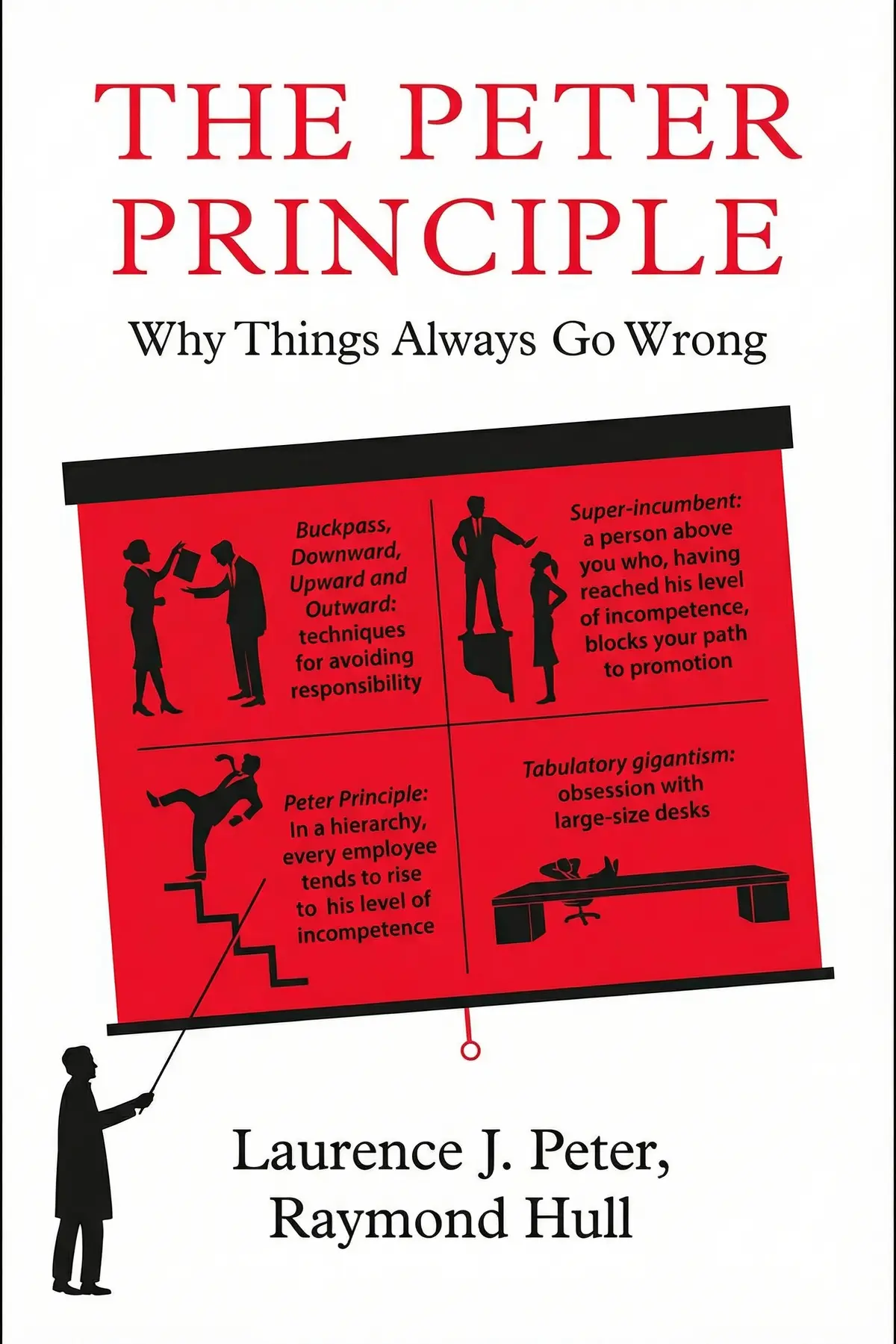
The Peter Principle explores the satirical yet strikingly accurate observation that employees in a hierarchy rise until they are no longer capable, eventually filling every role with someone who cannot do the work.
1 min 30 sec
We have all been there. You are sitting in a meeting, listening to a supervisor stumble through a presentation, or waiting for a department head to make a decision that seems like common sense, and you find yourself asking: How did this person get this job? It is one of the great mysteries of the modern professional world. We are taught that the cream rises to the top, but often, it feels like the workplace is actually designed to move people away from what they are good at and toward tasks they find impossible.
This is the core of the phenomenon known as The Peter Principle. It is a concept that is both deeply funny and slightly terrifying because it suggests that failure isn’t just a possibility in our careers—it is an inevitability. If you are good at your job, you will be rewarded with a different job. If you are good at that one, you will be moved again. This cycle only stops once you find a job you are actually bad at. At that point, the promotions stop, and you are stuck.
In this summary, we are going to explore why this happens and how it shapes the world around us. We will look at the mechanics of the corporate ladder, the tricks organizations use to shuffle incompetent people around without firing them, and the strange physical symptoms that emerge when someone realizes they have finally reached their limit. Most importantly, we will discuss how you can navigate this system without losing your mind or your health. By the end of this journey, you will see your office, your boss, and your own career trajectory in a completely different light. You might even find that being ‘too good’ at what you do is the most dangerous thing you can be.
1 min 49 sec
Explore the fundamental law of hierarchies where professional success serves as the very mechanism that eventually leads every employee to a position they cannot handle.
1 min 51 sec
Understand the difference between working hard and working smart within a hierarchy, and why personal connections often trump raw effort when it comes to advancement.
1 min 31 sec
Discover the clever ways organizations hide incompetence by giving people new titles and different offices without actually increasing their responsibilities.
1 min 28 sec
Learn about Peter’s Inversion, a state where following protocol becomes the primary goal, even if it directly contradicts the purpose of the job.
1 min 39 sec
Explore the health consequences of reaching one’s limit, from high blood pressure to strange office obsessions, and why traditional medicine often fails to help.
1 min 41 sec
Discover the counter-intuitive strategy of acting slightly inept to avoid unwanted promotions and stay in a role where you are genuinely happy.
1 min 21 sec
The Peter Principle is more than just a funny observation about office life; it is a fundamental insight into how human systems operate. It reminds us that growth for the sake of growth isn’t always a good thing. In our rush to climb the ladder, we often forget to ask if the next rung is actually somewhere we want to be. The result is a world filled with frustrated managers, inefficient bureaucracies, and stressed-out employees who have been promoted away from their passions.
But understanding this principle gives you a unique kind of power. You no longer have to feel like a victim of the system. By recognizing the signs of ‘Final Placement Syndrome’ in yourself and others, you can make more conscious choices about your career. You can choose to use ‘Creative Incompetence’ to stay where you are effective, or you can recognize when a ‘pseudo-promotion’ is being used to sideline you.
As a final piece of advice, try giving yourself and those around you the ‘competence test.’ Look at a colleague and ask: ‘Are they still doing something that is actually useful for the primary goal of this organization?’ If the answer is no, you are looking at someone who has reached their limit. If you find yourself unable to answer the question, you might have reached yours. The goal of a successful life isn’t necessarily to reach the highest point possible, but to stay at the point where you can do the most good—and remain healthy enough to enjoy it.
Have you ever looked at a manager or executive and wondered how they managed to land their job despite a seemingly total lack of aptitude? This book provides a hilarious and cynical explanation: success is actually the biggest trap of all. The authors argue that in any organizational structure, people are promoted based on their performance in their current role rather than their suitability for the next one. This process continues until they reach a position where they are no longer competent. Once they hit that ceiling, they stop being promoted, meaning they stay in that role indefinitely. This guide breaks down why this happens, how organizations try to hide it through 'pseudo-promotions,' and the physical toll it takes on employees. More importantly, it offers strategies for 'creative incompetence' to help you stay in a job you actually like and excel at, rather than being forced into a role that will make you miserable and ineffective.
Laurence J. Peter was a man of many hats, serving as a counselor, school psychologist, and consultant, as well as a professor and writer. His diverse background provided a unique lens on human behavior in institutions. Raymond Hull was a versatile writer known for his stage plays and contributions to high-profile publications like Esquire, Punch, and Maclean’s.
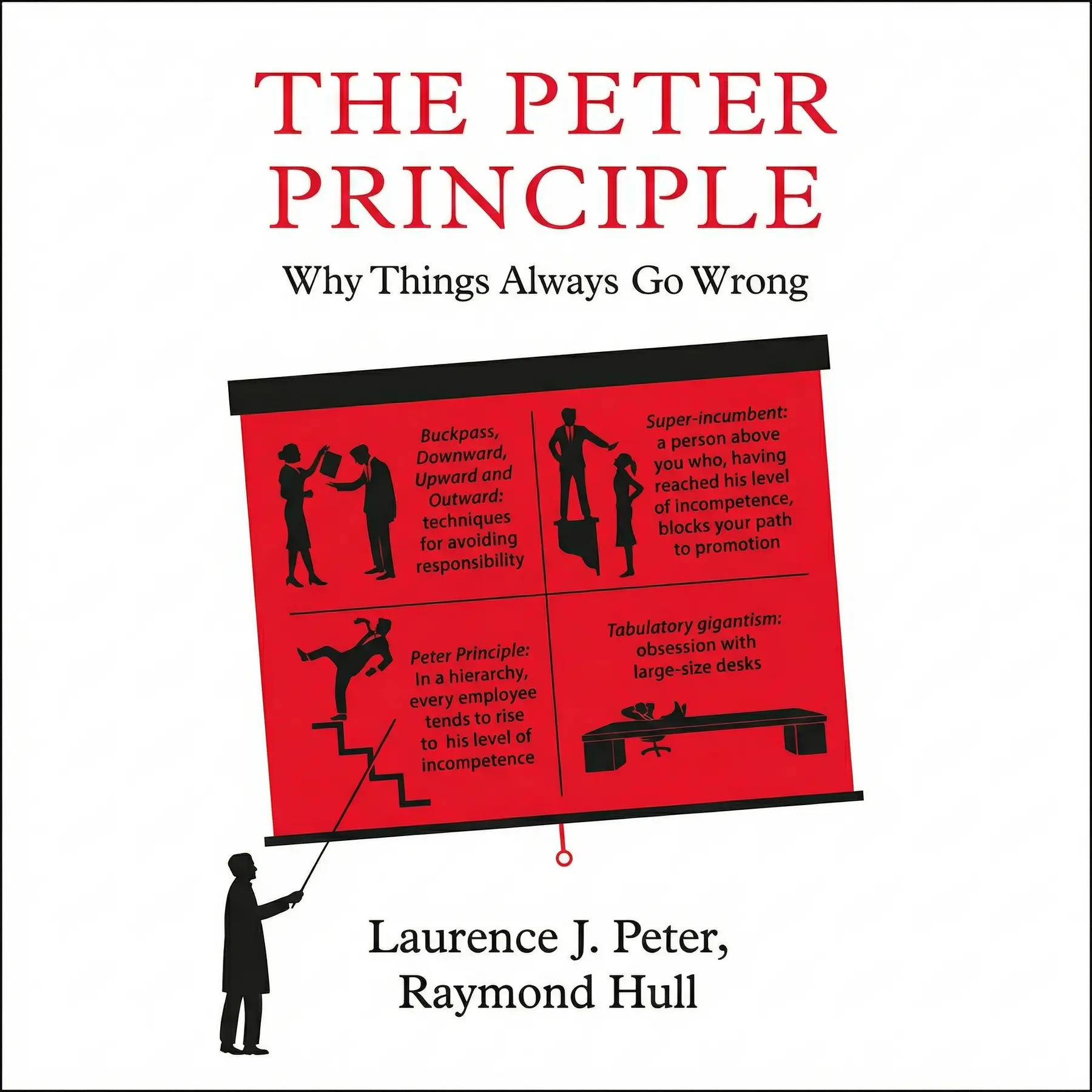
Listeners find this book highly insightful, with one listener noting it's packed with dozens of instructive examples, and many consider it a must-read for those in management. They enjoy the witty writing style and engaging content, with one review emphasizing its amusing outlook on professional and personal life. The work earns praise for its clarity and significance, as one listener points out how relevant it remains to the modern workplace hierarchy. Although some listeners feel it is dated, others describe it as timeless.
This book is a satirical masterpiece that cuts right to the bone of corporate absurdity with surgical precision. It remains a must-read for managers because it perfectly explains the 'Final Placement Syndrome' that plagues almost every large organization I have ever encountered. The central idea—that people are promoted until they are no longer good at their jobs—is both hilarious and deeply unsettling. Laurence J. Peter uses a humorous style to mask what is actually a very cynical, analytical look at human nature and our obsession with hierarchies. I found the dozens of instructive examples to be surprisingly applicable to my own career path in tech. While the 1969 publication date makes some references feel a bit like a time capsule, the core logic is absolutely timeless. If you have ever felt like your superiors were actively sabotaging the mission, this book will provide the vocabulary you need to understand why.
Show morePicked this up because my son asked me what the term meant, and I was surprised by how much wisdom is packed into these pages. It’s a charming read that manages to be both wickedly funny and incredibly instructive about the pitfalls of modern ambition. The distinction between Pseudo-Achievement Syndrome and reaching your final level of incompetence is something every HR department should study. I laughed out loud at the suggestion of parking in the president's spot as a form of strategic incompetence. It’s rare to find a business book that doesn't take itself too seriously while still making a profound point. The clarity of the writing is refreshing compared to the jargon-heavy 'gurus' of today. This is a classic for a reason, and it should be required reading for anyone entering a hierarchy. Truly a gem.
Show moreEver wonder why your boss seems completely incapable of doing their job effectively? This book provides the definitive answer through the lens of 'Hierarchiology,' and the results are as entertaining as they are depressing. I particularly enjoyed the section on 'creative incompetence' as a way to avoid being promoted into a role you’ll eventually hate. The authors suggest that by acting slightly incompetent in small, harmless ways, you can stay in a position where you actually provide value. It’s a brilliant, if somewhat wicked, piece of advice for anyone tired of the endless ladder-climbing of the corporate world. The writing style is droll and academic in a way that makes the satire even sharper. Some of the language is definitely stuck in the sixty's, but the workplace dynamics haven't changed nearly as much as we’d like to think.
Show moreAfter hearing about this principle for years in my office, I decided to finally see where the term originated. The book is much more than just a catchy phrase; it’s a detailed study of how excellence can actually be a threat to an organization’s hierarchy. Dr. Peter points out that being too good at your job can sometimes get you fired because you disrupt the status quo. That insight resonated with me deeply based on my own experience with middle management politics. The inclusion of those Victorian-style illustrations from Punch magazine adds a charming, ironic touch to the text. It’s a light read that manages to provoke far more thought than your typical airport business book. I’d recommend it to anyone who feels stuck in a 'lateral arabesque' or who is dealing with a supervisor who has reached their level of incompetence.
Show moreThe Victorian-style illustrations from Punch were a delightful surprise in what I expected to be a dry business text. This book is far more entertaining than it has any right to be, given the subject matter. Peter and Hull have a gift for naming the various pathologies of the workplace, like 'Rigor Cartis' and the 'Teeter-Totter Syndrome.' I’ve seen too many people in my own life who were promoted until they became miserable and ineffective, just as the book describes. It’s a sobering reminder that a promotion isn't always a reward; sometimes it’s a trap. The humor keeps you from getting too depressed about the state of the world, but the underlying message is quite serious. It’s a quick, insightful read that provides a great framework for understanding why bureaucracies behave the way they do. Definitely worth your time.
Show moreIn my experience, Dr. Peter hits the nail on the head regarding the 'Lateral Arabesque'—those meaningless promotions that just move an incompetent person sideways. I’ve worked in several flat organizations that tried to avoid these hierarchies, but the Peter Principle always seems to find a way to manifest. The book is filled with dozens of instructive examples that make the theory feel grounded in reality rather than just abstract philosophy. I particularly appreciated the advice on how to avoid the 'ultimate promotion' to maintain one’s own happiness. It’s a refreshing take in a culture that tells us we always have to be moving up. The book is definitely dated in its presentation, but the psychological insights into worker behavior are still very sharp. I would consider it a foundational text for anyone interested in organizational sociology.
Show moreA bit dated if you’re looking for modern management strategies, but it still offers some strangely accurate observations about why offices fail. To be fair, the entire book is based on a concept that could easily fit on the back of a postcard without using small handwriting. It tends to repeat the same core message over 150 pages, which can feel a bit like 'Puff the Magic Peter Principle' after a while. I struggled with the lack of a 'human soul' in the writing, as it often reduces complex people to mere cogs in a machine. However, the humor kept me engaged enough to finish it in a single afternoon. It is a good book to read if you want a chuckle about your incompetent boss, but don't expect a silver bullet for fixing your company culture. It’s mostly a look at the problem rather than a guide for the solution.
Show moreWow, talk about a cynical yet hilarious look at the way we organize our professional lives. The truth is that the book is very much a product of its era, and some of the examples feel a little limited by the scope of a 1969 office environment. I often felt like the authors were overstating their case just for the sake of a good joke. We are all doomed to mediocrity according to this theory, which is a pretty bleak outlook to hold for 150 pages. That being said, I can't deny that I recognized many of my former colleagues in the descriptions of 'Tabulatory Gigantism' and the 'Auld Lang Syne Complex.' It’s a fun perspective on life, even if it ignores the resiliency of human nature and our ability to learn new skills. Read it for the laughs, but take the 'science' with a grain of salt.
Show moreFrankly, the core thesis could probably fit on a single page, and the rest of the book feels like it's spinning its wheels. It’s a prime exemplar of a trend where one good idea is stretched thin to satisfy a publisher's page count requirement. I found the tone to be a bit 'cutsey' at times, which undermined the legitimate points about organizational inefficiency. While the concept of rising to one’s level of incompetence is brilliant, the book doesn't offer much in terms of fixes. It's great for identifying why everything feels broken, but it leaves you hanging when it comes to actually improving things. I suppose that’s the point—that incompetence is inevitable—but it makes for a frustrating reading experience. It’s a fascinating historical curiosity that remains relevant, though it definitely shows its age in the gendered language and old-school office tropes.
Show moreTo be fair, much of the book feels stuck in the sixty's mindset, and the scope is somewhat limited by the time it was written. I found myself disagreeing with the idea that we are all inevitably headed toward incompetence, as it ignores the capacity for self-improvement. However, the book is undeniably funny and offers a unique perspective on the frustrations of office life. The chapter on 'Creative Incompetence' alone is worth the price of admission for the sheer audacity of the suggestions. It’s a light, breezy read that will make you look at your coworkers in a completely different light. Even if you don't buy into the entire theory, the book is a great conversation starter for anyone dealing with bureaucratic red tape. Just don't expect a deep dive into the human soul or high-level leadership training.
Show moreJoseph A. Maciariello
Deborah Gruenfeld
Robin Ryan
Mike Michalowicz
AUDIO SUMMARY AVAILABLE
Get the key ideas from The Peter Principle by Laurence J. Peter, plus 5,000+ more titles in English and Thai.







