
17 min 53 sec
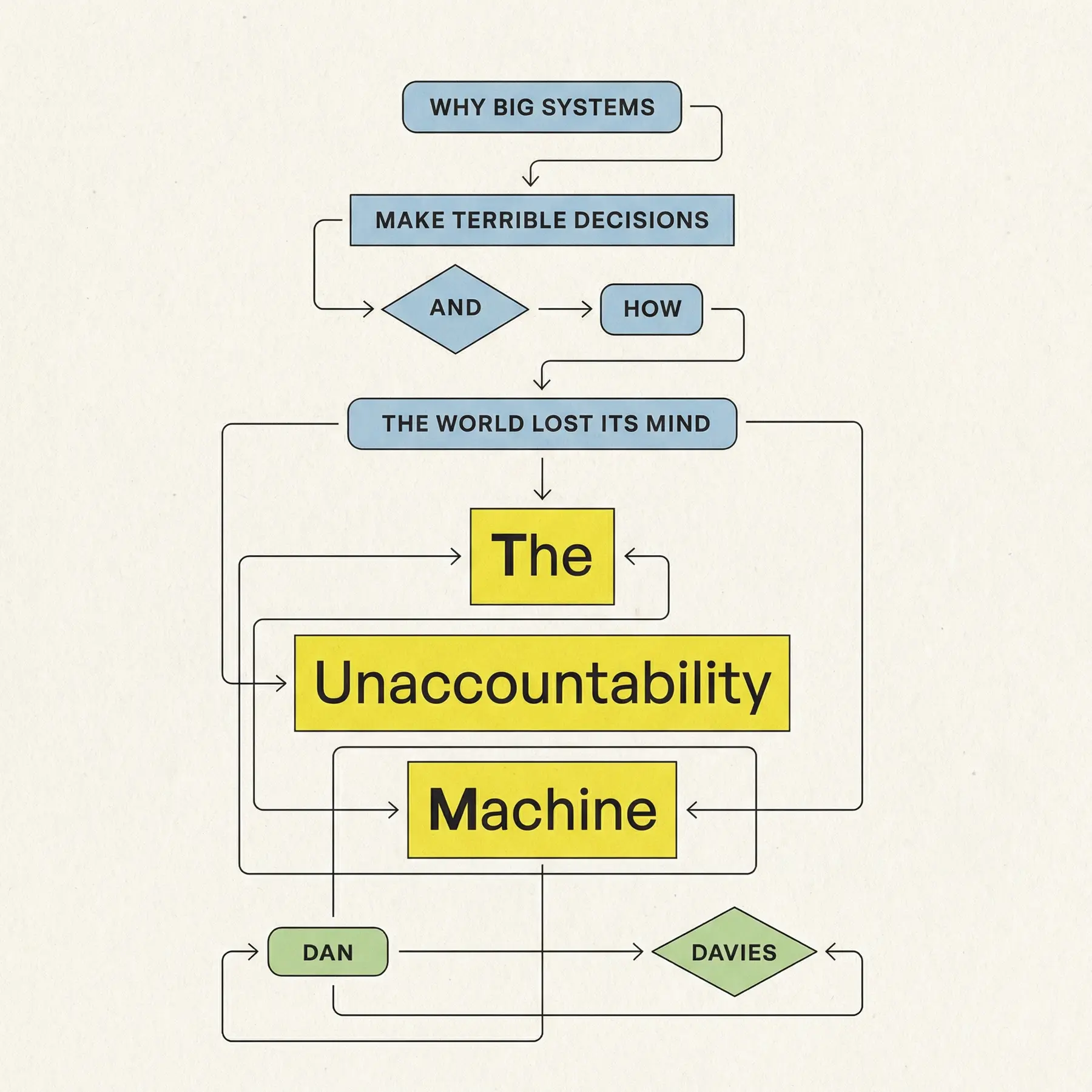
The Unaccountability Machine: Why Big Systems Make Terrible Decisions & And How the World Lost Its Mind
By Dan Davies
An exploration of how modern institutions use complex systems to dodge responsibility, analyzing why organizations make irrational decisions and how we can redesign them to prioritize human judgment and systemic resilience.
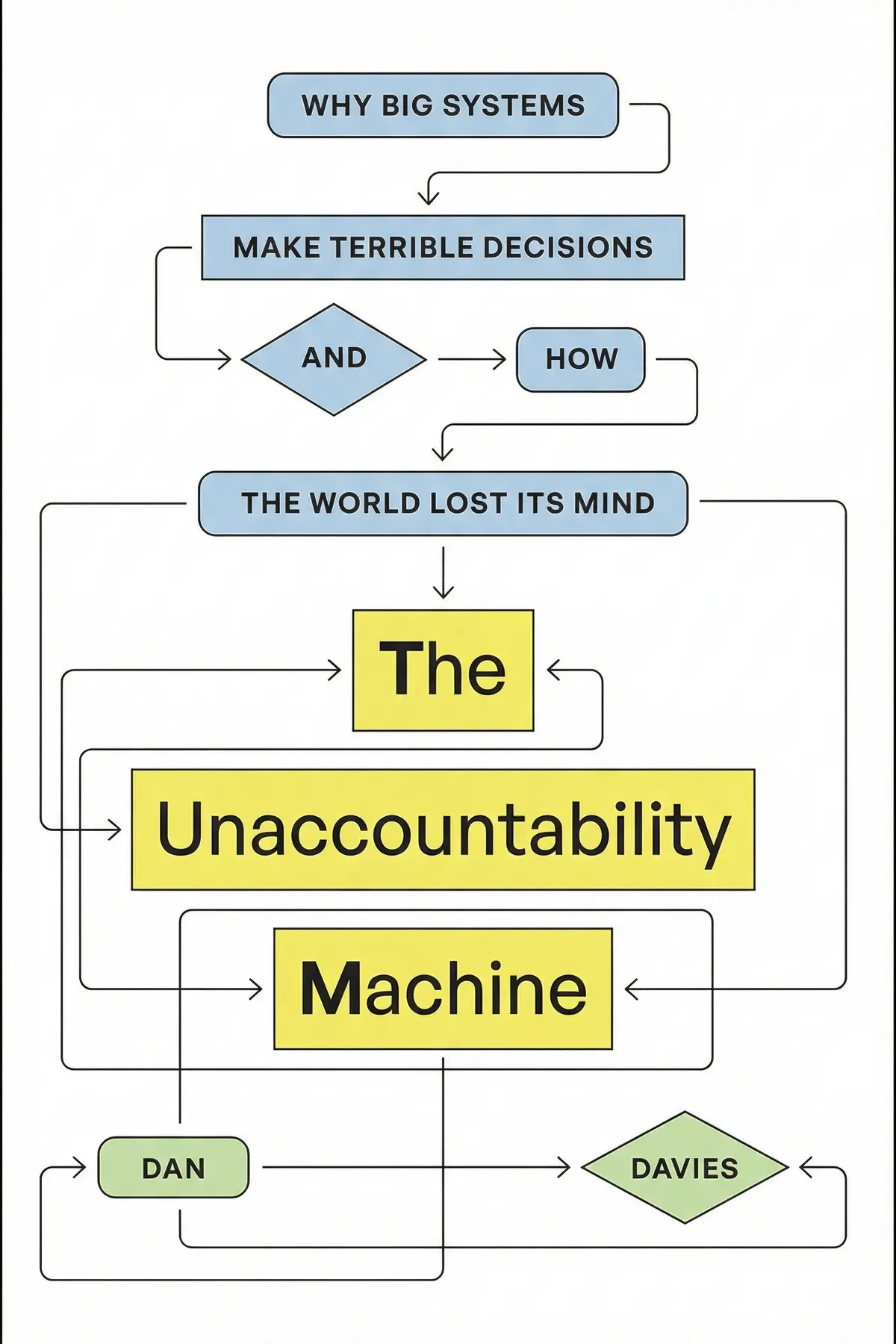
Table of Content
1. Introduction
1 min 37 sec
Have you ever found yourself trapped in a loop with a large corporation, where every person you speak to insists that their hands are tied by ‘the system’? It’s a frustratingly common experience in the modern world. We live in an era of massive, complex institutions that seem to operate with a mind of their own, often making choices that no individual human within them would ever actually defend. This isn’t just a matter of poor customer service; it’s a fundamental shift in how power and responsibility function in our society.
In our exploration of The Unaccountability Machine, we’re going to look at the hidden architecture behind these frustrations. We will see how organizations have essentially outsourced their moral and practical judgment to rigid frameworks, creating what is known as an accountability sink. This throughline explains why financial markets crash, why algorithms promote harmful content, and why even the most powerful CEOs often claim they are powerless to change course.
The core of our journey today involves understanding that when we build systems to be incredibly efficient at one specific task—like maximizing profit or following a strict legal code—we often accidentally strip away the system’s ability to be humane or even rational. We’ll uncover how the loss of personal ownership in decision-making has led to a world that feels increasingly ‘alien.’ More importantly, we’ll look at the strategies we can use to fix these broken loops, drawing on the forgotten science of cybernetics to imagine a future where institutions actually serve the people they were meant to support. By the end of this summary, you’ll have a new lens through which to view every bureaucratic hurdle and systemic failure you encounter.
2. The Accountability Sink and the Death of Responsibility
2 min 30 sec
Discover why modern organizations are designed to make responsibility disappear into a void of rules, leaving no one to blame when things go catastrophically wrong.
3. When Organizations Act Like Alien Intelligence
2 min 26 sec
Explore how big systems can develop their own logic, behaving more like a mindless computer program than a group of humans working together toward a goal.
4. Cybernetics and the Science of Control
2 min 23 sec
Learn how the principles of feedback and variety can help us understand why systems fail and how we might start to fix them.
5. The Dangerous Gap Between Wealth and Wisdom
2 min 20 sec
Discover how the way we measure success often masks deep incompetence and why the smartest-looking systems are frequently the most fragile.
6. How Short-Termism Destroys Systemic Resilience
2 min 26 sec
Uncover how the obsession with quarterly profits and ‘shareholder value’ has stripped the immune systems out of our most important institutions.
7. Redesigning for Human-Centered Accountability
2 min 24 sec
Explore the potential for a new kind of institution—one that balances multiple goals and listens to feedback from the bottom up.
8. Conclusion
1 min 47 sec
As we wrap up our journey through The Unaccountability Machine, the central lesson is clear: our modern world is increasingly governed by systems that have drifted away from human control. We’ve seen how these ‘accountability sinks’ allow people to ignore their own moral compass in favor of following a script, and how our obsession with narrow metrics like profit and efficiency has made our society more fragile and less humane. From the shredded squirrels of a Dutch airport to the systemic collapse of the global financial market, the evidence of this failure is all around us.
However, the path forward isn’t one of despair, but of redesign. By understanding the principles of cybernetics, we can see where our feedback loops have broken and how we can begin to mend them. The key is to stop treating organizations as simple, mindless machines and start treating them as complex entities that must be responsive to the real world. This means valuing human judgment over automated rules, prioritizing long-term resilience over short-term gains, and ensuring that those with power are truly responsible for the consequences of their actions.
The next time you find yourself stuck in a bureaucratic nightmare, remember that the system isn’t an unchangeable law of nature. It’s a design choice. By demanding more ‘red handles’ in our institutions and pushing for structures that account for more than just the bottom line, we can begin to dismantle the unaccountability machine. It starts with the simple act of refusing to accept ‘it’s just the way the system works’ as an answer. Real accountability requires us to look past the rules and reassert our own human agency. Thank you for listening to this BookBits summary of The Unaccountability Machine by Dan Davies. We hope it gives you a new perspective on the world around you and the systems we all share.
About this book
What is this book about?
The Unaccountability Machine examines the structural evolution of large organizations that have effectively automated decision-making to the point where no human feels responsible for the results. By looking at corporate failures, algorithmic biases, and economic history, the book identifies the 'accountability sink'—a mechanism that allows leaders to hide behind rules and procedures when things go wrong. The book promises a path toward understanding why our world feels increasingly out of control and how cybernetic principles can help us build more responsive systems. It explores the tension between short-term financial efficiency and long-term institutional health, arguing that by reclaiming human oversight and correcting feedback loops, we can prevent the systemic collapses that define the modern age.
Book Information
About the Author
Dan Davies
Dan Davies is a British economist, writer, and former investment analyst known for his expertise in banking, finance, and fraud. Davies is also the author of Lying for Money, a best-selling exploration of financial crime, and he frequently comments on systemic risks and institutional dynamics.
Ratings & Reviews
Ratings at a glance
What people think
Listeners find the book intellectually stimulating, with one listener highlighting the way it navigates sensitive subjects with deliberate self-reflection. Furthermore, the work is commended for being very easy to read. On the other hand, the material presented by the author has drawn a range of conflicting opinions.
Top reviews
Manop
Ever wonder why nobody is ever responsible when things go sideways? Davies explores the 'industrialization of decision-making' with a sharp, often funny perspective that makes complex cybernetics feel accessible. The concept of 'accountability sinks'—where systems are designed to absorb blame without changing anything—is a total lightbulb moment for anyone stuck in corporate purgatory. While the middle sections on economic theory get a bit dense, the writing remains engaging and surprisingly self-reflective. It really makes you question if we've traded human judgment for efficient but heartless algorithms. Ultimately, it’s a brilliant diagnosis of why modern life feels like talking to a brick wall. A must-read for systems thinkers.
Show moreAraya
The chapter on 'accountability sinks' should be mandatory reading for every corporate executive and politician. Dan Davies has written a masterful bridge between the history of cybernetics and the failures of modern finance. It is intellectually invigorating to see Stafford Beer’s 'Brain of the Firm' concepts applied to the 2008 financial crisis. The author shows how we’ve built structures that are literally incapable of processing the risks they create. This isn't just a book about business; it's a look at why our democracy feels so unresponsive to the people. Every page offers a new way to look at the world. Truly a brilliant, multi-layered piece of work.
Show moreSangduan
As someone who works in operations, this book provided the language I’ve been looking for to describe my daily frustrations. It’s an amazing and intellectually stimulating deep dive into why systems fail even when 'good' people are in charge. Davies’ analysis of the 2008 crash through the lens of information theory was a highlight for me. It’s rare to find a book that balances historical context with such relevant modern critiques of the corporate world. The writing is punchy, the examples are vivid, and the self-reflection on his own discipline of economics is refreshing. If you want to understand the invisible structures governing your life, read this book immediately.
Show morePenelope
After hearing Rory Sutherland rave about this in a Masterclass, I had to see if the hype was real. Davies does an excellent job reviving the forgotten world of Stafford Beer and management cybernetics to explain our current global malaise. He argues that we've optimized ourselves into a corner where no one actually makes decisions anymore; the system just 'happens.' The explanation of POSIWID—the purpose of a system is what it does—is a powerful mental model that I’ve already started applying to my own workplace. My only gripe is that the critique of neoliberalism feels a bit well-trodden toward the end. Still, the unique lens of information theory makes this a very worthwhile read for the intellectually curious.
Show moreJin
Picked this up to better understand why large organizations feel so inhuman lately. Davies provides a fascinating look at how we’ve outsourced our morality to systems and processes. The book isn’t just a dry academic text; it’s a thoughtful self-reflection on how we’ve let economic modeling flatten the complexity of the real world. I particularly enjoyed the sections on 'information-reducing filters' in corporations. It’s a dense subject, but the prose is lively enough to keep you turning the pages. You might not agree with every conclusion regarding neoliberalism, but the framework he provides for viewing organizations as information-processing entities is invaluable.
Show moreGrace
Finally got around to Davies’ latest, and it’s a remarkably readable take on a normally dry subject. He handles controversial economic issues with a level of nuance that you don't often see in popular science books. The central idea—that we are living in an era of 'industrialized decision-making'—really resonated with my experiences in the public sector. He explains complex ideas like 'sufficient variety' and the 'Viable System Model' without making your head spin. There are some minor pacing issues in the later chapters when the focus shifts heavily toward leveraged buyouts. However, the overall message about the loss of human agency in our systems is chilling and necessary.
Show moreChokdee
To be fair, the first half of this book is absolute lightning. The way Davies connects mid-century cybernetics to modern bureaucratic failures is genuinely thought-provoking and filled with black humor. But somewhere around the deep dive into Milton Friedman, it loses its momentum and veers into abstract tangents. I found myself wishing he spent more time on practical evidence rather than pretty diagrams and theoretical models of 'variety.' It’s a readable book, but the ending feels a bit like a shrug. It identifies the problem of the 'unaccountability machine' perfectly but leaves the machine running without telling us how to unplug it.
Show moreAurora
Look, I appreciate the deep dive into Stafford Beer, but the connection to modern AI felt a bit strained. The book starts with a strong premise about how systems avoid blame, but it gets bogged down in the history of operations research. It’s a bit of a 'black box' itself; you put in the effort to read it, but the output is a bit fuzzy. While the writing style is conversational and often witty, the middle sections on the Friedman Doctrine felt like they belonged in a different book. I think I’ll stick to 'Thinking in Systems' for a clearer introduction to these concepts. Interesting, but ultimately a bit disjointed.
Show moreArthit
Frankly, I found the core thesis about information flow fascinating, but the lack of concrete solutions left me hanging. I loved the early anecdotes and the introduction to the heroes of cybernetics like Norbert Wiener. But as the book progressed, it felt more like a history lesson on why everything is broken rather than a guide for the future. The author is clearly brilliant, and his critique of how economists ignore information theory is spot on. I just wish there was more 'how-to' and less 'here’s why.' It’s a great book for identifying the symptoms of our unaccountable world, even if the cure remains elusive.
Show moreGor
Not what I expected based on the catchy title. The book starts with a bang, using the 'squirrel shredding' at Schiphol Airport as a vivid example of how processes replace personal responsibility. However, the narrative quickly peters out into a long-winded grievance about accounting standards and private equity. I was hoping for a roadmap on how to fix these 'accountability sinks,' but the author eventually admits that cybernetics might not offer clear solutions. It felt like a bait-and-switch where a cool systems-thinking premise was used to smuggle in a standard critique of shareholder value. Disappointing, especially given how much I enjoyed the initial chapters.
Show moreReaders also enjoyed
A Year with Peter Drucker: 52 Weeks of Coaching for Leadership Effectiveness
Joseph A. Maciariello
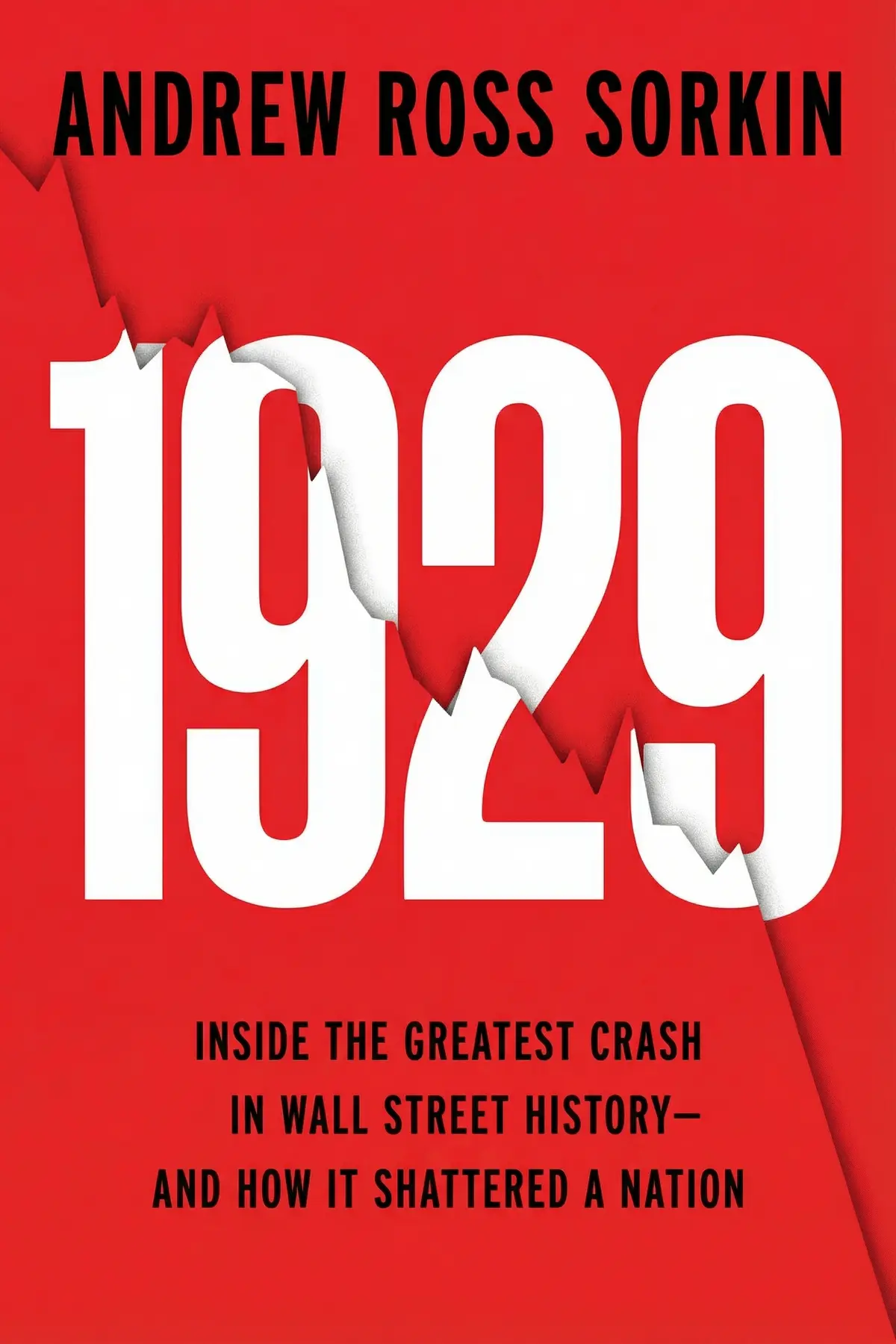
1929: Inside the Greatest Crash in Wall Street History--and How It
Andrew Ross Sorkin

Acting with Power: Why We Are More Powerful Than We Believe
Deborah Gruenfeld
All In: How Great Leaders Build Unstoppable Teams
Mike Michalowicz
23 Things They Don’t Tell You About Capitalism
Ha-Joon Chang

A Little History of Economics
Niall Kishtainy
AUDIO SUMMARY AVAILABLE
Listen to The Unaccountability Machine in 15 minutes
Get the key ideas from The Unaccountability Machine by Dan Davies, plus 5,000+ more titles in English and Thai.
- 5,000+ titles
- Listen as much as you want
- 7-day free trial
- Cancel anytime







