
A Little History of Economics
Niall Kishtainy
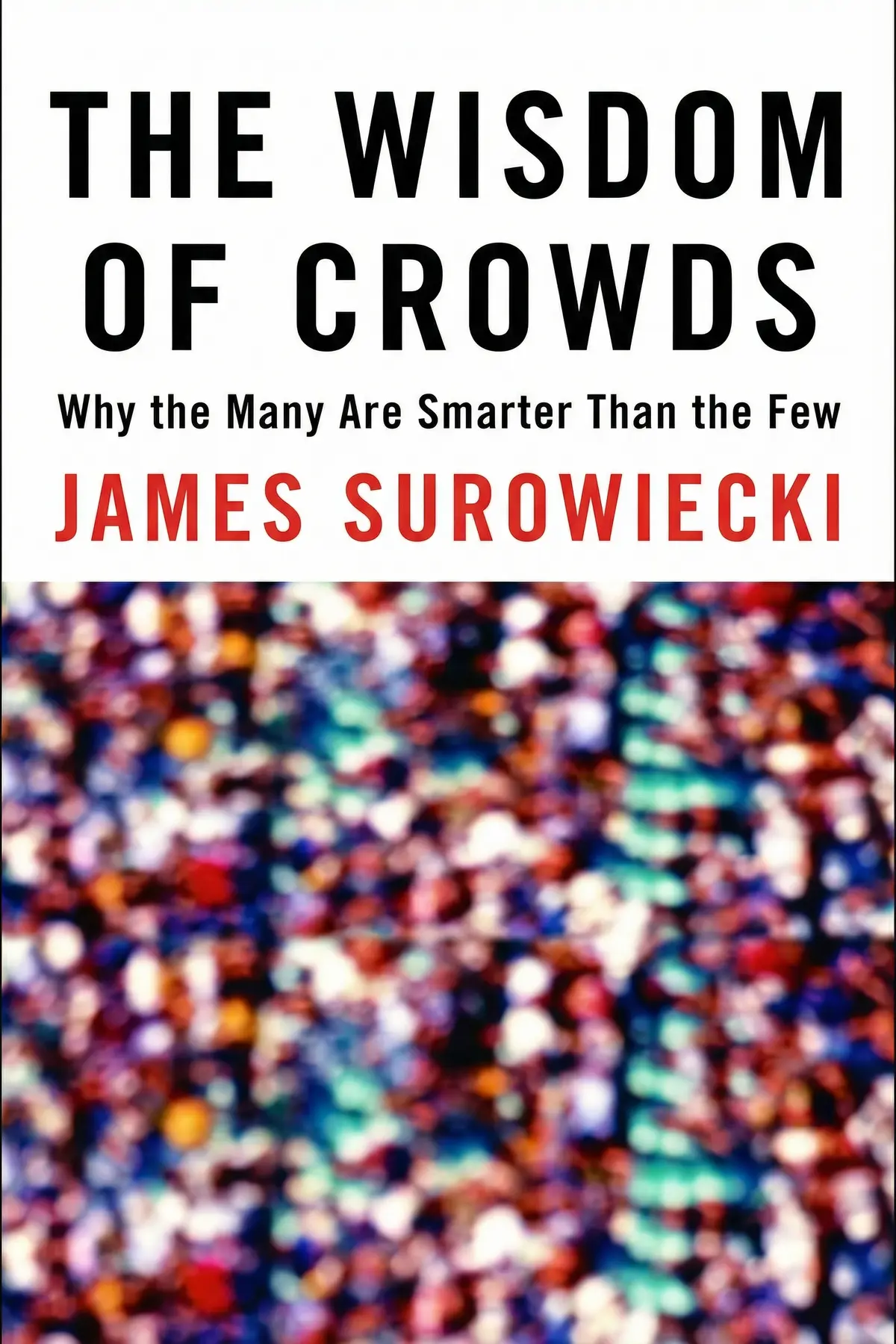
The Wisdom of Crowds challenges the idea that expertise is the ultimate authority, demonstrating how large, diverse groups consistently outperform individual experts in problem-solving, prediction, and decision-making when specific conditions are met.
1 min 52 sec
In a world that prizes the specialized expert, we are often taught to look toward the individual genius for answers. We seek out the most decorated scientist, the most seasoned politician, or the highest-ranking executive to solve our most pressing problems. But what if our reliance on the ‘lone expert’ is actually a disadvantage? What if the most accurate answers are already hidden within the collective mind of a large, seemingly unorganized group of people? This is the central premise we are exploring today: the idea that a crowd of diverse individuals is almost always smarter than even the most brilliant single person among them.
This concept isn’t just a feel-good theory about democracy; it is a mathematical and sociological reality. When we aggregate the guesses, opinions, and observations of a large group, the individual errors—the biases, the overestimations, and the lack of knowledge—tend to cancel each other out. What remains is a core of truth that is startlingly precise. However, this ‘wisdom’ isn’t a guarantee. We’ve all seen groups descend into madness, mobs behave with irrational violence, and organizations fail through ‘groupthink.’ The key is understanding the specific conditions that transform a random gathering of people into a collective engine of intelligence. In this summary, we will look at how diversity, independence, and decentralization act as the vital ingredients for group success. We will move through the evidence, from livestock fairs to space missions, to see how we can better harness the power of the many over the few. By the end, you’ll see why the average of a thousand voices is often the closest thing to the truth we have.
2 min 12 sec
Discover how a 1906 livestock fair and a modern game show reveal the hidden mathematical precision of the average person.
2 min 04 sec
Why a room full of experts often makes worse decisions than a group of people with different backgrounds and perspectives.
2 min 04 sec
Explore why bigger groups are less prone to radical errors and the influence of dominant, yet incorrect, personalities.
1 min 57 sec
How the human desire for social safety can lead to ‘social proof’ and the abandonment of common sense.
1 min 50 sec
Learn how the tragedy of the Columbia space shuttle could have been avoided by fostering a culture of independent thought.
2 min 00 sec
Why a ‘bottom-up’ approach to information often works better than a central command, provided there’s a way to bring it all together.
2 min 23 sec
See how humans naturally coordinate in crowds and why trust is the invisible glue that makes groups successful.
1 min 55 sec
As we wrap up our look at the collective mind, the throughline is clear: our greatest resource isn’t the individual expert, but the aggregate intelligence of the community. We have seen that when a group is diverse, when its members think independently, and when its structure allows for both local action and central aggregation, it can achieve levels of accuracy and problem-solving that no single person could match. The livestock fair, the game show audience, and the coordinated movements of pedestrians all point to a hidden order in the crowd—a ‘wisdom’ that emerges when we stop trying to control the group and start learning how to listen to it.
However, we must also take the warnings to heart. The failures of the Bay of Pigs, the Columbia shuttle, and the 9/11 intelligence gaps remind us that group intelligence is fragile. It can be easily crushed by the weight of hierarchy, the pressure of conformity, or the silence of fear. To harness the wisdom of crowds in our own lives—whether in our businesses, our local communities, or our families—we must actively cultivate diversity and protect the right of individuals to disagree. We must resist the lure of the herd and the false comfort of consensus.
In your next meeting or community project, instead of asking ‘Who is the expert here?’, try asking ‘How can we gather the most diverse set of opinions?’ Encourage the quietest person to speak, and value the dissenting voice as a vital piece of the puzzle. By shifting our focus from the ‘smartest person in the room’ to the ‘smartness of the room itself,’ we unlock a level of potential that can solve our most complex challenges. The wisdom is there, waiting in the crowd; we just need to provide the right conditions for it to shine.
Have you ever wondered why a random audience on a game show is more likely to give the correct answer than a hand-picked expert? This book explores that very paradox, revealing that collective intelligence is a powerful, often untapped resource. It posits that under the right circumstances—diversity of opinion, independence, and decentralization—the many are smarter than the few. Through historical anecdotes, psychological experiments, and real-world tragedies, the text illustrates how groups can accurately predict the weight of an ox, coordinate their movements on a crowded sidewalk, or fail catastrophically when they fall into the traps of hierarchy and conformity. This is a journey into the mechanics of social cooperation and the mathematical beauty of the average, offering a roadmap for better decision-making in business, government, and daily life.
James Surowiecki is a prominent American journalist who has built a distinguished career covering financial and cultural matters. He is widely recognized for his long-running column in The New Yorker. In addition to his work there, his insights and articles have been featured in major publications including the New York Times, the Washington Post, and the Wall Street Journal.
Listeners find the book captivating and skillfully authored, offering valuable perspectives on how groups make decisions and the importance of diverse thinking. Furthermore, the work addresses various intricate topics through a broad range of illustrations, and one listener points out how well it is backed by concrete examples. Listeners also value the high quality of the storytelling and feel the concept is intriguing, with one review highlighting its honest approach to performance.
Picked this up after hearing about the famous jelly bean experiment in a podcast. The book is way more comprehensive than just that one anecdote, diving deep into how groups often outperform individual experts. Surowiecki uses a wide spectrum of examples, ranging from the weight of an ox to the search for a lost submarine, to illustrate his points effectively. I found the four essential conditions for a wise crowd—diversity, independence, decentralization, and aggregation—to be incredibly practical. While some chapters drag slightly, the overall quality of the stories kept me engaged throughout the weekend. It’s a compelling look at why we should trust the many over the few in specific contexts. Personally, I liked the honest approach to why crowds sometimes fail, like in market bubbles.
Show moreWow, this was a mind-bending look at how we process information and make decisions as a society. I loved the variety of fields covered, from military history to the stock market and even game shows like 'Who Wants to Be a Millionaire.' Surowiecki’s core argument that a diverse group of amateurs can outperform a single expert is backed by so many concrete examples. The writing is incredibly engaging, making even the sections on financial news and short selling feel fast-paced and interesting. It really changed the way I think about team meetings and collective brainstorming sessions. If you meet the four conditions for a 'wise crowd,' the results are almost like magic. I couldn't put it down and finished it in two sittings.
Show moreThe chapter on the Challenger disaster was absolutely haunting and served as a powerful illustration of the book's core thesis. Surowiecki argues convincingly that for a group to be smart, it needs diversity of opinion and independence of thought above all else. I appreciate how he breaks down complex economic theories into digestible stories about everyday situations like pedestrian traffic or sports betting. To be fair, some of the American football metaphors were a bit lost on me, as someone not well-versed in the sport. However, the overarching message about the dangers of excessive faith in single decision-makers is more relevant today than ever. It's a well-written piece of non-fiction that balances academic insight with engaging prose. Definitely worth your time if you're interested in organizational behavior.
Show moreAs someone who manages teams, I found this book to be a refreshing validation of my decentralized management style. The author explores how local knowledge is often far more valuable than top-down managerial expertise when solving complex coordination problems. Truth is, we often default to trusting the most talkative person in the room rather than aggregating the private information held by the whole group. Surowiecki’s analysis of the Linux community and betting markets provides concrete evidence for his claims. While the middle sections feel a bit repetitive, the opening and closing chapters are punchy and thought-provoking. It’s not just a business book; it’s a study on democracy and collective intelligence. I’ll be recommending this to my colleagues during our next strategy meeting.
Show moreEver wonder why the stock market behaves so erratically despite being composed of thousands of rational actors? This book dives into that paradox by explaining the difference between information cascades and genuine collective wisdom. Surowiecki argues that when we stop thinking for ourselves and start following the herd, the 'wisdom' evaporates instantly. I found the section on decentralization particularly insightful, as it explains how local specialization helps the entire system function better. Frankly, the book is at its best when it uses specific historical events to ground its theoretical claims. It’s a well-written exploration of a complex topic that remains relevant in our interconnected, digital world. A solid four stars for the quality of the research and the clarity of the prose.
Show morePersonally, I find books that challenge my intuitions about leadership to be the most valuable, and this one delivered. We are so conditioned to look for a 'great leader' to solve every problem, but Surowiecki shows that the crowd is often a safer bet. The book is filled with wonderful examples of how diverse perspectives lead to better outcomes in everything from science to government. I especially appreciated the honest discussion on the requirements for a wise crowd—without independence, you just have a mob. The prose is clear and accessible, even when the author is tackling dense economic or psychological concepts. It’s a very practical guide for anyone who wants to improve their decision-making processes. I came away with a much deeper appreciation for diversity of thought.
Show moreTruth is, I wasn't sure if a book about 'mobs' would be useful for my daily life, but I was pleasantly surprised. The author makes a compelling case for how coordination problems, like people navigating a busy sidewalk, are solved without central control. I found the analysis of 'trust' as a foundational element of successful societies to be one of the most moving parts of the book. While there were a few minor math errors and some repetition, the overall message is powerful and well-supported. It’s not just about guessing jelly beans; it’s about how we can build better organizations and communities. The stories are top-notch and keep the pacing brisk throughout most of the text. I'd recommend it to anyone curious about human behavior.
Show moreFinally got around to this one after years of it sitting on my shelf, but I’m left with mixed feelings. The premise is fascinating, and the early chapters on the ox-weight competition are genuinely gripping. However, I suspect that Surowiecki occasionally cherry-picks his examples to fit the narrative while ignoring contradictory evidence. For instance, the discussion on Enron and market failures felt a bit thin compared to the more successful 'wise' examples. Also, the writing style leans heavily on the formula of 'anecdote followed by sweeping conclusion,' which can feel a bit repetitive after 200 pages. It’s a decent read with some gems of insight, but it probably could have been a long-form article rather than a full book. Not bad, just slightly bloated.
Show moreAfter hearing so many people quote the title in meetings, I decided to see what all the fuss was about. Look, the core idea is brilliant and certainly changes your perspective on hierarchy, but the execution is a bit uneven. The author spends a lot of time on American football examples that might be frustrating if you aren't a sports fan. Additionally, some of the scientific experiments mentioned have been debated quite a bit since the book was first published. It’s a good primer on collective intelligence, but it feels very much like a product of its time. I enjoyed the anecdotes about the search for the Scorpion submarine and the Challenger investigation. It’s an informative read, though you might find yourself skimming through the middle chapters.
Show moreNot what I expected given the high praise I’ve seen on various business blogs over the years. My biggest gripe is that Surowiecki seems to misinterpret or misrepresent some of the foundational theories he cites, particularly Keynes. If you look at the original context of the quotes used regarding worldly wisdom, they often mean the opposite of how they are presented here. Furthermore, the book lacks a balanced analysis of when groups truly devolve into mindless mobs versus when they remain 'wise.' It feels like a collection of interesting New Yorker articles that don't quite gel into a rigorous, cohesive whole. While the story quality is decent, the intellectual rigor just isn't there for a book of this length. Look, you're better off just reading a summary.
Show moreNiall Kishtainy
Steven C. Hayes
William J. Bernstein
Deborah Gruenfeld
Anthony Pratkanis
AUDIO SUMMARY AVAILABLE
Get the key ideas from The Wisdom of Crowds by James Surowiecki, plus 5,000+ more titles in English and Thai.







