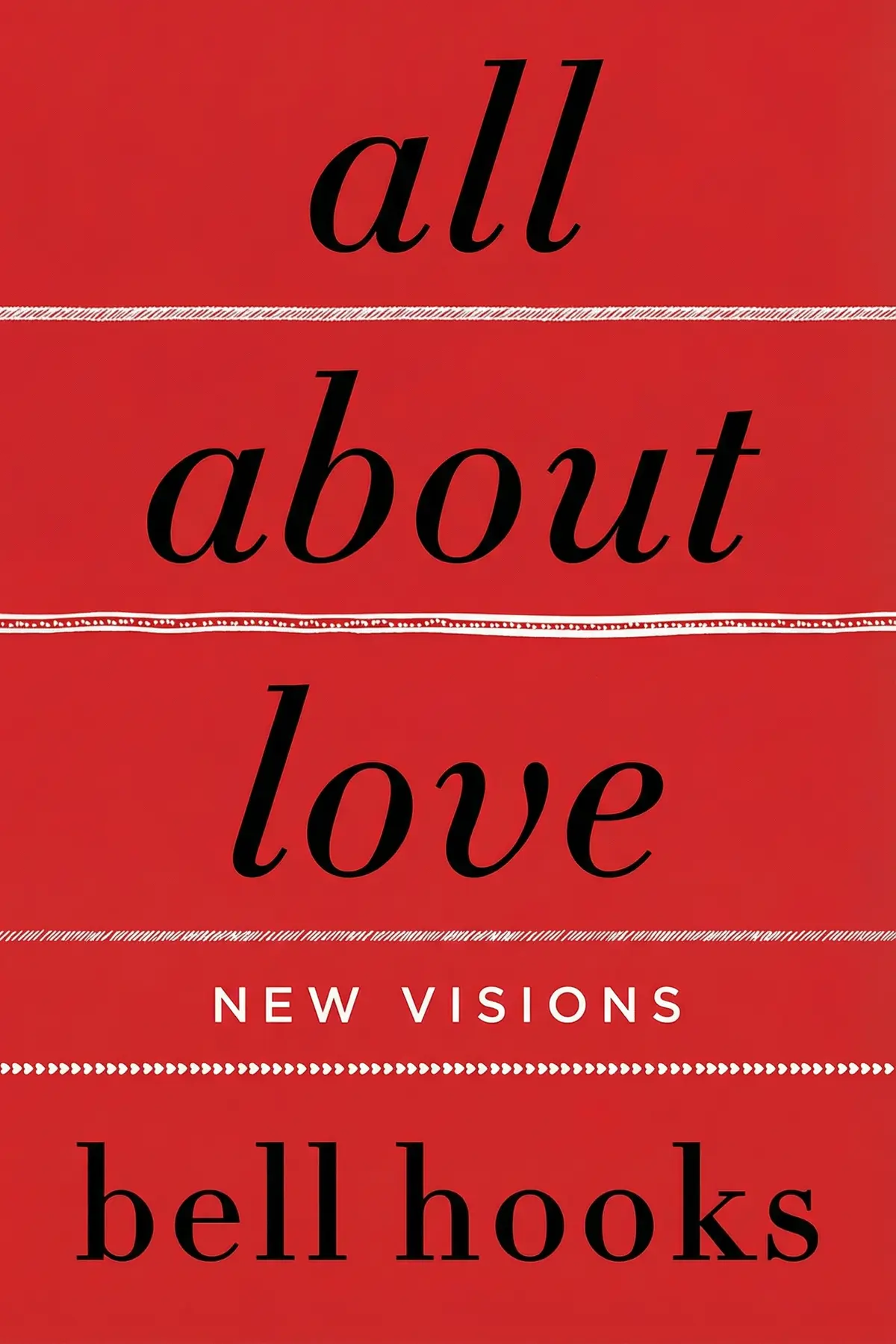
All About Love: New Visions
bell hooks
Us explores how to move from a self-centered individual mindset to a relational one. It offers tools like neuroplasticity and the feedback wheel to heal communication and build lasting intimacy.
1 min 52 sec
In our modern world, we are often told that the individual is the hero of the story. We celebrate the self-made entrepreneur, the independent thinker, and the person who stands alone against the odds. This cultural obsession with the ‘I’—the individual achievement and the lone journey—has many benefits, but it also carries a hidden cost. When we bring that same fierce individualism into our most intimate romantic relationships, it often acts as a slow-acting toxin. Instead of partners, we become two individuals competing for space, for control, and for the right to be ‘correct.’
This summary explores the profound shift required to move from this ‘you-and-me’ mindset toward an ‘us’ consciousness. It is a journey that asks us to reconsider how we view ourselves and our partners, moving away from a stance of competition and toward a stance of shared ecology. We will look at how our brains are literally wired to influence one another, why we often revert to the defensive versions of ourselves during an argument, and how we can parent those younger, reactive parts of our psyche to stay in our ‘wise adult’ selves.
Throughout this exploration, we will dive into the science of how our nervous systems interact and the practical steps needed to dismantle the mental images that turn our partners into villains. By the end, you’ll see how even the most significant fractures in trust can be used as a foundation for a stronger, more resilient bond. This is not just about staying together; it is about learning how to live in a relationship where the health of the connection is more important than any individual victory. Because, as we will see, in a relationship, when one person wins, the relationship itself always loses. The goal is to build a world where you both win together.
2 min 19 sec
Individual success is a cultural ideal, but it often creates walls within a marriage that prevent true intimacy and shared growth.
2 min 21 sec
Our bodies are biologically linked to our partners, meaning our stress and calm are constantly influencing one another.
2 min 30 sec
Conflict often causes us to revert from our rational ‘Wise Adult’ to a reactive, defensive ‘Adaptive Child’ formed in our past.
2 min 29 sec
By practicing relational mindfulness and the ‘respect test,’ we can actually rewire our brains to move beyond toxic patterns.
2 min 37 sec
We often fight with a cartoon villain version of our partner rather than the real person, creating a cycle of resentment and stalemate.
2 min 24 sec
Most conflicts can be resolved by shifting focus from personal demands to identifying the common goal that both partners actually want.
2 min 24 sec
Even after devastating fractures like infidelity, a relationship can be reconstructed using structured communication and new narratives.
1 min 51 sec
The journey from ‘you and me’ to ‘us’ is perhaps the most challenging and rewarding work any couple can undertake. It is a path that requires us to look unflinchingly at our own defensive habits, our childhood wounds, and the ways we try to exert control over the people we love. We have seen that individualism, while celebrated by our culture, is often a barrier to the very intimacy we crave. By understanding the biological link between our nervous systems and learning to parent the reactive Adaptive Child within us, we can begin to cultivate a Wise Adult presence in our relationships.
We have explored how to dismantle the cartoonish ‘core negative images’ that turn our partners into enemies and how to replace them with a focus on the shared ecology of the bond. We’ve learned that conflict, rather than being something to fear, can be a gateway to deeper understanding if we can find our shared objectives and use tools like the feedback wheel to communicate our needs with respect and vulnerability. Even the most significant breaks in trust do not have to be the end; they can be the beginning of a more honest and integrated connection.
As you move forward, remember that your relationship is a living thing that exists in the space between you. Every word you speak and every action you take either nurtures that space or poisons it. The most important thing you can do is to strive to be a safe harbor for your partner. When you notice them slipping into their defensive, younger self, resist the urge to meet them there with your own defenses. Instead, stay in your Wise Adult self and help them feel secure enough to return to theirs. By prioritizing the ‘us,’ you create an environment where both of you can finally stop fighting for survival and start thriving in the warmth of a truly shared life.
Modern culture often celebrates the individual, yet this same focus on the self can be the very thing that erodes a romantic partnership. In Us, Terrence Real addresses the common pitfalls that cause couples to drift apart, such as the need to be right, the tendency to view a partner as a villain, and the defensive habits learned in childhood. The book promises a way out of these cycles by introducing the concept of relational mindfulness and the wise adult self. By understanding how our nervous systems are linked and how our past shapes our present reactions, readers can learn to stop fighting for individual dominance and start nurturing the relationship as a shared ecosystem. The core promise is that through shifting from a you-versus-me stance to an us-consciousness, even deeply damaged trust can be repaired. It provides a practical framework for anyone looking to replace toxic emotional habits with vulnerability, respect, and a renewed sense of partnership.
Terrence Real is a highly regarded family therapist and a prominent speaker who has pioneered the Relational Life Therapy methodology. His work focuses on helping couples move toward deeper communication and intimacy. As an established author, his practical insights have reached a wide audience, earning him features on prominent platforms like The Today Show, Good Morning America, and Oprah. Additionally, his expertise and advice have been shared through the New York Times, solidifying his role as a leading voice in modern relationship therapy.
Listeners view this title as an essential resource for relationships, providing actionable tips and observations that are relevant across different types of partnerships. Additionally, they value its transformative nature; for instance, one listener shared that it completely altered their outlook on marriage. The narrative is praised for its accessible style and flow, with one listener specifically mentioning the inclusion of relatable stories. On the other hand, opinions on the political elements are divided, as several listeners felt the content became too political.
This book completely shifted how I view my marriage and myself. I found the distinction between the 'Adaptive Child' and the 'Wise Adult' to be incredibly illuminating for our daily interactions. Instead of reacting out of old childhood wounds, Real teaches you how to pause and stay in your rational brain. To be fair, some of the social commentary felt a bit shoehorned in at times, but the core message remains powerful. If you are tired of the constant power struggles and point-scoring, this offers a genuine path forward. It's not just about compromise; it’s about a total ecological shift in how you inhabit your relationship. I wish I had read this ten years ago before certain patterns became so deeply ingrained.
Show moreWow, I didn't expect a therapy book to feel this urgent and necessary. Most relationship advice focuses on communication techniques, but Real goes deeper into the neurobiology of why we snap at each other. He explains how our stress hormones spike in tandem, leading to those awful cycles where the 'us' gets lost. Truth is, I had to put the book down several times to sit with how much I saw myself in the 'grandiose' descriptions. It’s a bit of a reality check that asks you to take accountability rather than just blaming your spouse. While the prose can be a little clunky in the middle chapters, the ending sections on rebuilding trust are superb. This is definitely a must-read for anyone feeling stuck in a 'you versus me' mindset.
Show morePicked this up on a whim because of the Bruce Springsteen foreword and stayed for the actual psychology. Real’s approach to 'us-consciousness' is a radical departure from the 'what’s in it for me' attitude that dominates our culture. He argues that when one person in a relationship wins an argument, the relationship itself loses. That perspective shift alone has saved us from at least three major blowouts this month. I particularly valued the sections on redistribution of flaws and owning your part in the toxic ecology. Not gonna lie, some of the phrasing is a bit 'therapist-speak,' but the underlying heart of the book is genuine. It’s a brave look at how we can rebuild intimacy after the reality of a relationship has shattered.
Show moreFinally got around to finishing this and I'm genuinely impressed by the practical skills provided for navigating conflict. Unlike many self-help books that offer vague platitudes, Real gives you a literal script for how to speak to your partner. The 'respect test' and the focus on 'relational mindfulness' are tools you can use immediately. I actually used some of the concepts to help navigate a difficult dynamic with my brother, so it’s not just for spouses. Look, the prose can be a bit awkward and the pacing is definitely uneven in the second half. However, the insight into how we 'coregulate' our stress levels is worth the cover price alone. If you want to stop the point-scoring and start healing, get this book.
Show moreDirect and unapologetic, Terrence Real has written a guide that doesn't shy away from the hard truths of marriage. He understands that we are all works-in-progress who bring a lot of childhood baggage into our adult lives. By identifying our 'adaptive child' responses, we can finally stop the self-sabotage that destroys intimacy. The focus on 'ecology'—the idea that you live in the environment you create—is a powerful deterrent to acting like a jerk. I appreciated his acknowledgement of how systemic oppression affects our private lives, even if some of those sections felt a bit brief. It’s a refreshing change from therapists who pretend we live in a vacuum. Truly a transformative read for those ready to move past 'you and me' to build something better.
Show moreAfter hearing Terrence Real on several podcasts, I was eager to see if his written work held the same punch. While it does feel a bit like an infomercial for Relational Life Therapy at times, the case studies are undeniably fascinating. He doesn't hold back when calling out entitled behavior, which might rub some readers the wrong way. Frankly, his willingness to address how larger cultural trends like sexism impact our living rooms is what sets this apart from fluffier self-help titles. Some sections felt a bit repetitive, yet the 'respect test' is a tool I’ve already started using with my partner. It is a dense read but worth the effort for anyone serious about long-term repair.
Show moreThe chapter on the 'grandiose' partner felt like a personal attack, but maybe that's the point of good therapy. Real has a very specific, direct style that avoids the typical hand-holding you find in the psychology aisle. I appreciated the focus on 'relational mindfulness' and how to parent your inner child during a conflict. However, the author’s habit of positioning himself as the hero in every clinical anecdote started to grate on me after a while. To be fair, the tools are practical enough that I can overlook the occasional ego-tripping in the writing. Some of the political diversions felt a bit distracting from the actual therapeutic advice. Still, the core concept of moving past toxic individualism is something every modern couple needs to hear.
Show moreEver wonder why a single unwashed dish can lead to a weekend-long cold war? This book breaks down that exact cycle using interpersonal neurobiology in a way that actually makes sense. I loved the idea of the 'core negative image'—that cartoon villain version of our partner we create in our heads. It’s terrifyingly accurate. Real shows how we stop fighting the person we love and start fighting a ghost of our own making. My only real gripe is that the book leans heavily on heteronormative dynamics, even when it tries to be inclusive. Regardless, the advice on 'corrective emotional experiences' is life-changing for those willing to do the work. It’s a solid 4 stars for the sheer utility of the exercises provided.
Show moreAs someone who has struggled with low self-esteem, seeing it framed as the flip side of grandiosity was a huge 'aha' moment. Real explains that both states are forms of disconnection from our equal worth as human beings. The book is filled with these kinds of insights that make you stop and re-evaluate your entire personality. While I found the specific case studies about infidelity to be a bit intense, the lessons on repair were universal. My partner and I have started using the 'wise adult' check-in during dinner, and it's noticeably lowered the tension. I do wish there was less focus on the author’s personal life, but the clinical results speak for themselves. This is essential reading for anyone who wants a more functional relationship.
Show moreTo be fair, there are some decent kernels of wisdom here, but the delivery is exhausting. It often feels like a first draft that desperately needed a more aggressive editor to trim the fat. Real spends an inordinate amount of time talking about himself and his own 'maladaptive strategies' instead of the reader's needs. The constant name-dropping and self-congratulatory tone made it hard for me to connect with the actual psychology being presented. I also found the 'adaptive child' concept to be a bit reductive compared to other trauma-informed works I've explored. While I’m sure RLT works for many, this felt more like a long-form brochure than a cohesive guide. Not a total waste of time, but certainly not the masterpiece the blurb suggests.
Show moreAUDIO SUMMARY AVAILABLE
Get the key ideas from Us by Terrence Real, plus 5,000+ more titles in English and Thai.