
A Higher Loyalty: Truth, Lies and Leadership
James Comey
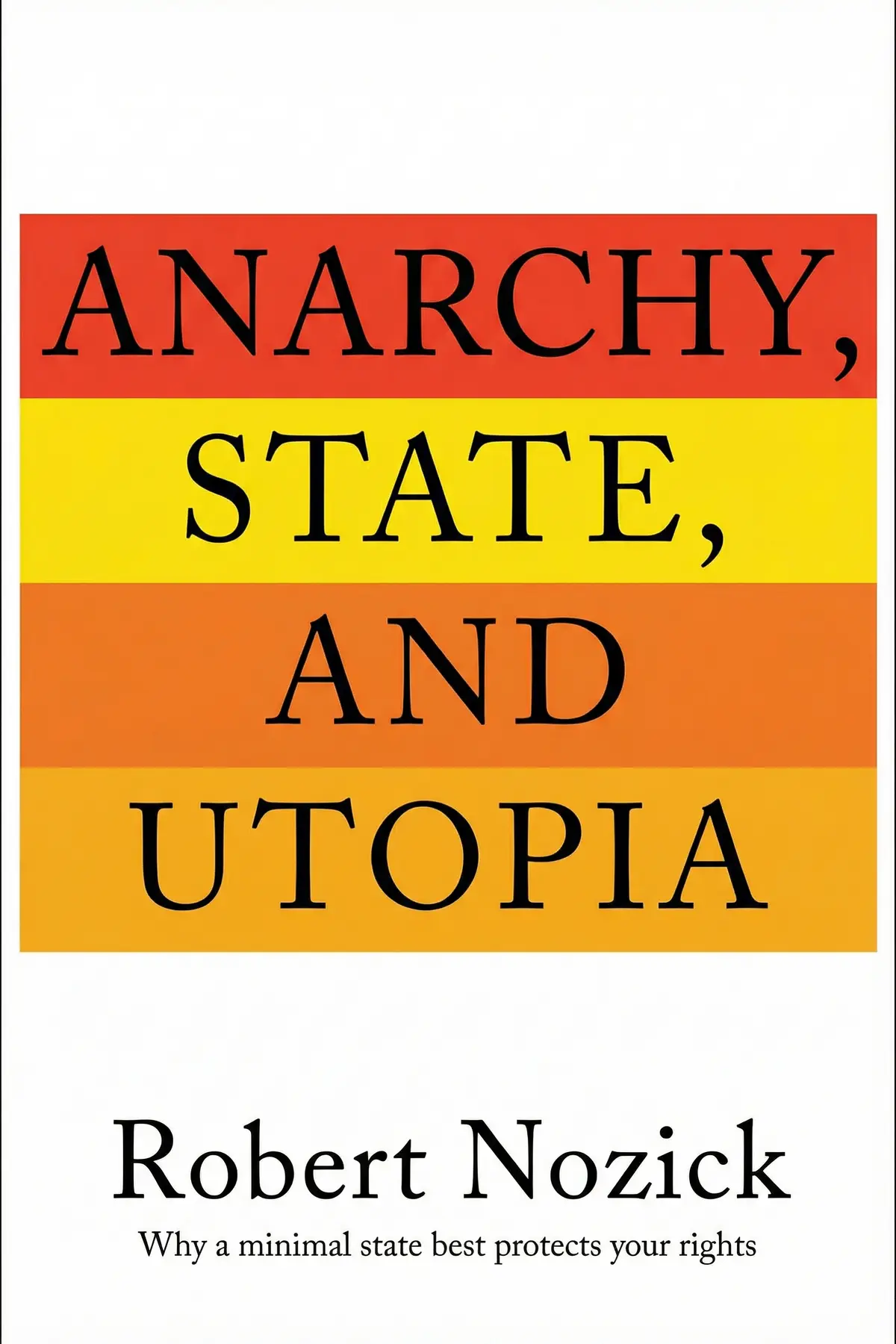
A profound philosophical defense of the minimal state. Robert Nozick argues that individual rights are absolute, making any government activity beyond protection against force, theft, and fraud morally indefensible and a violation of liberty.
1 min 28 sec
Why does the government have any authority over you at all? It is a question that most of us take for granted, assuming that some form of state is necessary for a functional society. But Robert Nozick’s classic work, Anarchy, State, and Utopia, pushes us to start from a much more radical starting point: the idea that individuals have rights that are so strong and far-reaching that they raise the question of what, if anything, the state and its officials may do.
In this summary, we are going to explore a vision of political life that puts the individual at the absolute center. We will trace the journey from a state of nature—where there is no government—to the emergence of a minimal state that exists only to protect people from harm and theft. We will see why many of our common ideas about fairness and wealth redistribution might actually be moral violations of human liberty.
Throughline here is simple yet profound: People are ends in themselves, not just means to some social goal. Because every person’s life is separate and unique, any system that tries to balance one person’s needs against another’s through force is inherently flawed. By the end of this exploration, you will see why Nozick believes that the only state that can be morally justified is a tiny one, and how that tiny state actually provides the best possible foundation for a world where everyone can live according to their own vision of the good life.
2 min 13 sec
How could a legitimate government ever form from total anarchy without violating the rights of those who never agreed to join it?
2 min 15 sec
Discover why treating society as a single organism often leads to the unethical sacrifice of individual human beings for the so-called greater good.
2 min 14 sec
Why the way you acquired your wealth matters far more than how much you have compared to your neighbor.
1 min 54 sec
What if the taxes you pay for social programs are actually a form of forced labor that claims ownership over your life?
2 min 01 sec
Instead of one perfect society, why not a system that allows for thousands of different versions of perfection to exist at once?
1 min 32 sec
As we wrap up this exploration of Robert Nozick’s *Anarchy, State, and Utopia*, we’re left with a powerful and challenging vision of what it means to be free. We’ve seen how a minimal state can emerge naturally as a tool for protection, and why that state must remain small to avoid violating our fundamental rights. We’ve looked at why justice is found in the history of our choices—not in some arbitrary social pattern—and why the redistribution of wealth is a violation of the principle of self-ownership.
Nozick’s work reminds us that every individual is a world unto themselves. When we try to fix society’s problems by moving people around like chess pieces, we lose sight of the dignity and the separate reality of each human life. The minimal state might seem limited, but in its very limitation, it offers something grand: a framework where every person and every group can seek their own version of utopia.
So, the next time you hear a proposal for a new government program or a new tax, ask yourself the question Nozick would ask: Does this respect the boundaries of the individual? Does it treat people as ends in themselves, or merely as means to an end? By holding our political institutions to the standard of individual rights, we protect the only foundation upon which a truly diverse and free society can be built. The throughline of Nozick’s philosophy is that liberty is not just a policy goal—it is the moral limit of all political power.
This exploration of political philosophy addresses the fundamental question of how much power a state should have over its citizens. Robert Nozick begins by establishing that individuals possess rights that are so extensive that any state must justify its existence against a backdrop of total anarchy. He demonstrates that a minimal state—one limited to the narrow functions of protection and contract enforcement—can emerge legitimately without violating anyone's rights. The book then moves into a critique of distributive justice, famously arguing that property rights are based on historical merit rather than social patterns. Nozick challenges the idea that wealth should be redistributed to achieve equality, suggesting that such actions treat individuals as mere tools for the collective good. Finally, the work proposes a visionary framework for utopia, where a minimal state acts as an umbrella under which diverse communities can experiment with different ways of life, provided participation remains entirely voluntary.
Robert Nozick was an American philosopher and longtime Harvard University professor whose work revitalized libertarian political philosophy and made major contributions to epistemology, metaphysics, and rational choice theory. His other widely read books include Philosophical Explanations and the bestseller The Examined Life, along with later works such as The Nature of Rationality and Invariances.
Listeners consider this work a fundamental pillar of political philosophy, with one listener describing it as THE academic text on libertarianism. Furthermore, the quality of the content is highly praised; one listener notes it is full of useful information for Libertarians. However, perceptions of the readability and logic are divided, with some finding it a great read while others remark it is not an easy read and the arguments are entirely unpersuasive. Additionally, the writing style is criticized for being hard to follow.
This book is the ultimate intellectual heavyweight for anyone leaning toward libertarianism. Nozick provides a rigorous, analytical framework that puts popular writers to shame with its sheer philosophical depth. The way he systematically builds from a Lockean state of nature to the emergence of a minimal state is nothing short of masterful. While the math-heavy passages on self-defense can be a bit much, his Wilt Chamberlain argument is a classic for a reason. It forces you to reconsider whether redistribution can ever truly be justified without violating individual liberty. If you want to understand the modern debate between liberalism and libertarianism, you simply cannot skip this. It is a dense, rewarding challenge that stays with you.
Show moreWidely considered the definitive response to John Rawls' A Theory of Justice, this text stands as a pillar of 20th-century political thought for good reason. Nozick manages to defend the minimal state with a level of sophistication that few others have ever reached in the libertarian tradition. His writing is sharp, and his ability to dismantle utilitarian arguments for redistribution is both impressive and highly influential. You can see why this won the National Book Award; the level of scholarship is simply on another level compared to the usual political tracts. It's a challenging read, but it provides a necessary counterbalance to modern liberal orthodoxy and should be on every philosopher's shelf. Truly a masterpiece of the genre.
Show moreAfter hearing about the Wilt Chamberlain thought experiment for years, I finally decided to read the source material and I was not disappointed. The book is a fascinating exploration of what it means to be truly free and how a state can exist without violating rights. Nozick’s argument that liberty upsets patterns is one of the most powerful insights in political philosophy I have ever encountered. Personally, I found his breakdown of why end-state goals are inherently coercive to be the strongest part of the book. It’s definitely not an easy read, but it is one that will stay with you and change how you view every tax bill you receive. A true classic of the individualist tradition.
Show morePicking this up was a turning point for my understanding of individual rights and the inherent dangers of state overreach. As a graduate student, I’ve read a lot of theory, but Nozick’s clarity of thought and commitment to the minimal state is uniquely refreshing. He doesn't shy away from the difficult questions, like how a state could emerge without everyone's consent, and his answers are always intellectually honest. Even the sections that were a bit impenetrable, like the self-defense formulas, felt like they were serving a larger, rigorous purpose. This is essential reading for anyone who wants to see the strongest possible case for a libertarian society presented with academic integrity. It is worth every bit of effort it requires.
Show moreAs a political science student, I knew I had to tackle this eventually, and I must say it lived up to its reputation for being difficult. The writing is incredibly dense, filled with symbolic logic and complex formulas that would make anyone's head spin. However, the intellectual payoff is there if you are willing to put in the work and read slowly. Nozick is a brilliant stylist who manages to be playful even when he is being impenetrable. Even though I don't agree with his entitlement theory of justice, his critique of Rawls is essential reading for any serious student. It is a work of professional academic brilliance that deserves its place on the shelf, even if it requires a few aspirins.
Show moreThe first fifty pages were a total slog, making me wonder if I had made a massive mistake by picking this up. I struggled with his phrasing and the way he jumps between abstract concepts without much grounding for the reader. But once the discussion moved into the Wilt Chamberlain example and the critique of end-state patterns, everything finally started to click. To be fair, this isn't a book you read for pleasure on a Sunday afternoon; it's a rigorous academic text that demands your full attention. The ideas about rectification of property are particularly interesting, even if Nozick doesn't fully solve the problem of historical theft. It’s a must-read for anyone serious about political theory.
Show moreGotta say, Nozick’s writing style is surprisingly playful for such a dense academic work, even if it does make my brain hurt. He loves to use rhetorical questions and hypothetical scenarios that force you to follow him down rabbit holes of pure logic. One moment he's talking about protective agencies, and the next he's discussing the ethics of self-defense with complex algebraic formulas. While I found some of the sections on the state of nature a bit dry, his defense of individual liberty is incredibly compelling. It is a dense, rewarding challenge that provides plenty of ammunition for anyone who believes that government should stay out of our lives. Just be prepared to re-read every page three times.
Show moreNozick is clearly a genius, but his "Invisible Hand" explanation for the state often feels like a clever sleight of hand. The book starts by asking why we need a state at all, then builds a hypothetical world of private protective agencies. It’s a fascinating thought experiment, but it feels disconnected from how real societies actually function or form. Truth is, while the arguments are cogently structured, they rely on assumptions about rational agents that rarely exist in the real world. I appreciated the intellectual exercise and the challenge to my own beliefs, but I left the book feeling entirely unpersuasive regarding the minimal state’s legitimacy. It’s brilliant as a puzzle, but less so as a practical roadmap for governance.
Show moreFrankly, I found the core analogies here deeply offensive and logically bankrupt despite the high-flying academic prose. Nozick tries to argue that taxation is essentially forced labor or slavery, yet he remains remarkably silent on the coercive nature of poverty. He seems perfectly fine with a person being "free" to starve or work in a sweatshop, yet views a marginal tax rate as a gross violation of human rights. The logic is circular and relies on a version of history where property rights were always acquired justly, which we know is never the case. It feels less like philosophy and more like an elaborate justification for corporate greed. Even if you appreciate the wit, the conclusions are truly impossible to swallow.
Show moreAbsolutely atrocious logic that ignores the reality of history and property theft while pretending to be a work of high-level moral philosophy. Nozick builds his entire theory of entitlement on the idea of just initial acquisition, but then fails to address that most land was stolen. If the foundation of his property rights is rotten, the entire "Utopia" he describes is nothing more than a gated community for the wealthy. I found his prose to be needlessly complicated, using symbolic logic to mask simple fallacies that even an undergraduate could spot. It’s a frustrating experience that prioritizes clever brain teasers over actual human suffering and the complexities of real governance. Don't waste your time unless you enjoy circular reasoning.
Show moreJames Comey
Anthony Pratkanis
Barack Obama
Masaji Ishikawa
John Rawls

Miles Taylor
AUDIO SUMMARY AVAILABLE
Get the key ideas from Anarchy, State, and Utopia by Robert Nozick, plus 5,000+ more titles in English and Thai.







